





 Login
 Blog
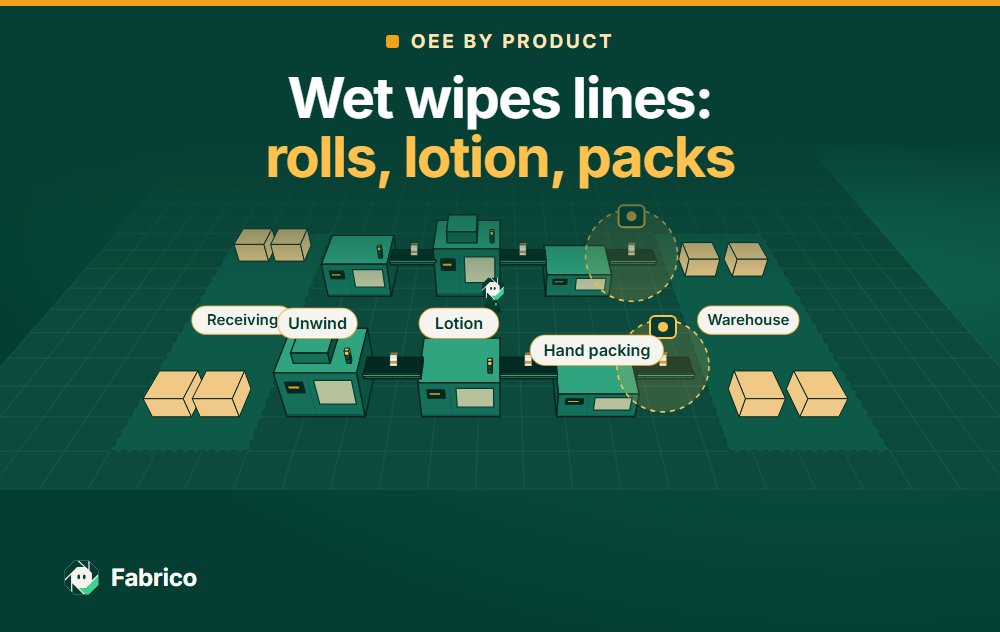
OEE on a wet wipes line: rolls, lotion, packs

In brief
- A wet wipes line turns a roll of nonwoven fabric into packs. It unwinds, wets with lotion, folds, cuts, stacks and packs. OEE is read at the folding machine.
- In the example, the SKU changeover is the costliest stop. A different lotion, a different film and a different lid.
- In the example below, the shift loses 882 EUR. The SKU changeover is over one third of that amount.
- Wipes that contain plastic carry a "plastic in product" marking. For them, changing the pack film is also changing a mandatory marking.
OEE on a wet wipes line is the share of planned time in which the folding machine makes good, wetted, counted and sealed packs. The losses covered here are the SKU changeover, splicing a new roll, lid applicator stops, short stops when stacks are fed to the packing machine, and rejects for dry wipes, open seals and wrong counts.
This article is for owners, technologists and production managers at plants that make wet wipes for babies, for the face and for the home. You will find how the folding machine is measured, how rolls and lids are counted against it, and a calculation for one shift in euros.
Wipes in Bulgarian industry
According to Eurostat structural business statistics, in 2024 the group "Manufacture of household and sanitary goods and of toilet requisites" in Bulgaria had 83 enterprises with 1,747 persons employed, and the group "Manufacture of non-wovens" had 18 enterprises with 174 persons employed (data for C13.95, accessed 27.11.2026). Wet wipes sit between the two groups: the raw material is nonwoven fabric, and the product is a hygiene item.
For the line this means one thing: the roll comes from a supplier, and the value is made in wetting, folding and packing. At a rate of 60 packs per minute, every minute of the folding machine is 60 packs, and one hour of downtime is 3,600 packs.
The machines on the line
| Machine | What it does | Losses that are recorded |
|---|---|---|
| Unwinder | Feeds the web from the roll | Splicing a new roll, torn web |
| Wetting | Doses the lotion onto the web | Lotion change, uneven wetting |
| Folding and cutting | Folds, cuts and stacks the wipes | Jam, wrong count |
| Packing machine | Seals the stack in a film pack | Film, open seal, short stops |
| Lid applicator | Sticks the lid onto the pack | Lid jam, crooked lid |
Availability, performance and quality are defined per ISO 22400-2 (accessed 27.11.2026). The folding machine is the core machine: it sets the pace of the whole line, because everything after it works with the stacks it makes. Stops of the unwinder, of packing and of the applicator are recorded as reasons for its downtime.
For machines that report their state by the PackML model (ISA-TR88.00.02, accessed 27.11.2026), the "Suspended" state of the folding machine shows that it is waiting for web or for open space after it, and "Held" shows that it has stopped because of a problem of its own.
The roll and splicing
One roll of nonwoven fabric is enough for a set number of packs. When it runs out, the operator splices the new roll. If the unwinder has automatic splicing, the line barely stops. If splicing is manual, the folding machine stands for minutes at every roll.
The number of rolls in the shift is known in advance from the roll length and the number of wipes per pack, so splicing is predictable too. Record it as a separate reason with a standard time. If the actual minutes rise, check whether the new roll is prepared next to the machine before the old one runs out.
A torn web is a different stop. It is unplanned and has other causes: a defect in the roll, tension or lotion. Keep the two reasons separate. When tears rise with one delivery of rolls, the conversation is with the fabric supplier, and the data per roll are the evidence.
Lotion: dry wipes and lotion given away
Wetting doses the lotion in grams per wipe. If the dose drops, the wipes at the top of the pack come out dry. That is a reject if it is caught on the line, and a complaint if it is caught by the customer.
If the dose is set with a large margin, every pack carries more lotion than the recipe. For OEE the pack is good, but the lotion has been paid for. That is why lotion use per shift, compared with the recipe, is a number outside OEE that the technologist watches alongside it.
When the wipes are for the skin, they are a cosmetic product. Regulation (EC) No 1223/2009 requires a list of ingredients and a batch number on the packaging (accessed 27.11.2026). A lotion change is also a label change, and the remains of the previous lotion in the dosing system have to be rinsed out.
Lotion change: rinsing the dosing system
When changing from one lotion to another, the dosing system is emptied and rinsed. The first packs after the change are checked for scent and for the dose before they go to the cartons. While this lasts, the folding machine makes no good packs.
A change between two lotions with a similar formula is shorter than a change from a perfumed lotion to one without perfume. Set a standard per pair of lotions and record the actual minutes. Ordering the week from the lotions without perfume to the perfumed ones shortens the long rinses.
Cutting and counting
The folding machine cuts the web into wipes and stacks them with a set count. A dull knife leaves wipes that are not separated, and the stack comes out with the wrong count. The operator stops, checks the knife and restarts.
Changing the knife on schedule is a planned stop. Changing it when stacks already come out with the wrong count is unplanned. Record them separately so you can check whether the schedule is right.
Line hygiene
Wet wipes are a moist product, and moisture is a medium for microbes. Cleaning the wetting unit and the tables on schedule is a planned activity with its own standard. It is not a loss to hide, but part of the shift plan.
Record cleaning as a separate planned reason. Then the report shows how much time goes to it and whether it is done on time, without mixing it with the unplanned stops.
The "plastic in product" marking
Directive (EU) 2019/904 includes wet wipes that contain plastic among the single-use plastic products that carry a marking on the packaging (accessed 27.11.2026). The type and placement of the marking are set in Implementing Regulation (EU) 2020/2151 (accessed 27.11.2026). The regulation applies from 3 July 2021.
For the line this means the pack film is not only a brand. At an SKU changeover the operator checks that the right film with the right marking is on the machine. This check is part of the changeover standard, not a loss to hide.
The packing machine after folding
The stacks go to a packing machine that seals them in film. If a stack arrives tilted or with a raised edge, the seal catches a wipe and the pack stays open. The machine stops for half a minute, the operator removes the pack and restarts it.
These short stops are below the downtime threshold and go into the speed loss of the folding machine. If speed loss rises, check the stack feeding and the stack height first, then the seal setting. A small buffer between the two machines absorbs some of them.
The ideal rate by SKU
A pack of 72 wipes is made more slowly than a pack of 20 wipes, because the stack is higher. The ideal rate is set per SKU: number of wipes and pack type. A good rule is that it is the best sustained rate achieved for this SKU in a normal shift.
The lid applicator
When the pack has a lid, the lid keeps the wipes from drying out. The applicator sticks the lid over the pack opening. When the lids stick to each other in the magazine or the glue does not hold, the applicator stops.
On the folding machine, an applicator stop is recorded as "blocked" with a sub-reason. If stops rise after a new delivery of lids, check the lid batch before adjusting the machine.
One folding machine shift in euros
The numbers are an example, not from a real customer. The folding machine makes packs of 72 wipes at an ideal rate of 60 packs per minute. The shift is 450 planned minutes, and a stop over 2 minutes is recorded as downtime. The ideal for the shift is 27,000 packs.
In the middle of the shift the line moves to another SKU: a different lotion, a different film and a different lid. The new SKU is also a 72-wipe pack with the same ideal rate. The contribution per pack is taken as 0.15 EUR. Use your own price.
| Reason | Stops | Minutes | Recorded as | Packs | EUR per shift |
|---|---|---|---|---|---|
| SKU changeover | 1 × 35 min | 35 | downtime | 2,100 | 315.00 |
| Short stops at stack feeding | 46 × 30 s | 23 | speed loss | 1,380 | 207.00 |
| Splicing a new roll | 6 × 3 min | 18 | downtime | 1,080 | 162.00 |
| Lid applicator | 4 × 3 min | 12 | downtime, sub-reason applicator | 720 | 108.00 |
| Rejects: dry wipes, open seal, count | 600 packs | quality | 600 | 90.00 | |
| Total | 88 | 5,880 | 882.00 |
How the numbers are reached:
- Downtime: 35 + 18 + 12 = 65 minutes, run time 385 minutes. Availability: 385 / 450 = 85.6 %.
- For 385 minutes the ideal is 23,100 packs. The short stops take away 1,380. 21,720 are made. Performance: 21,720 / 23,100 = 94.0 %.
- Rejects 600, good 21,120. Quality: 21,120 / 21,720 = 97.2 %.
- OEE: 85.6 % × 94.0 % × 97.2 % = 78.2 %. Check: 21,120 / 27,000 = 78.2 %.
- The loss: 5,880 packs × 0.15 EUR = 882.00 EUR per shift.
By value, the SKU changeover comes first: 315.00 EUR. It depends on how many SKUs pass through the line per week and in what order. Second place goes to the short stops at feeding: 207.00 EUR, a loss that shows only in speed loss.
If each of the 500 shifts in the year (two shifts a day, 250 working days) has one such SKU changeover, it costs 157,500 EUR, and the short stops 103,500 EUR. The amounts are real only if every lost pack could have been sold; confirm the estimate with the finance department.
Wipe count and batch
Wipes are sold by count, not by weight. That is why quantity control is the number of wipes in the pack: the folding machine counts them, and the line check catches packs with the wrong count. Record rejects for count separately from rejects for dry wipes and for open seals.
The pack carries a batch number. It helps if it points to the fabric roll and the lotion batch, because in a complaint about dry wipes or scent these are the first questions.
Who owns the rolls, the lotion and packing
| Loss | Owner | Data they need |
|---|---|---|
| SKU changeover | Planning | Minutes against the standard per SKU pair |
| Roll splicing | The shift supervisor | Splicing minutes against the standard |
| Lid applicator | The mechanic | Stops by reason and lid batch |
| Short stops | The packing mechanic | Speed loss per hour |
| Dry wipes and lotion | The technologist | Rejects per batch, lotion use against the recipe |
Mistakes in recording wipes
| Mistake | What you see later | How to avoid it |
|---|---|---|
| Splicing and a torn web are one reason | You cannot see which stop is planned | Two separate reasons |
| Lotion use is not measured | Lotion is given away with no price | Use against the recipe per shift |
| The film check is not in the standard | Packs with the wrong marking | The check is a step of the SKU changeover |
| Rejects with no type | Dry and open packs get mixed | Rejects by type: dry, seal, count |
What to look at every morning
Four numbers from yesterday are enough: folding machine OEE, minutes of SKU changeover, splicing minutes against the standard and lotion use against the recipe.
If the SKU changeover rises, the conversation is with planning. If splicing rises, check the roll preparation. If lotion rises, check the dosing. That way each number goes to the person who can change it, and the plan for the week starts from data, not from memory.
What to choose for a wipes line
| Method | Suitable when | What it misses |
|---|---|---|
| Paper log | One line, few SKUs | Short stops and sub-reasons |
| Counter from the PLC in a spreadsheet | First assessment | Reasons and splicing |
| OEE software with a signal and reasons from the operator | A wide range of SKUs and brands | Lotion use, if it is not entered |
Questions for the vendor:
- Can roll splicing have its own standard time?
- How is "blocked" recorded with a sub-reason for the applicator?
- Can the standard changeover time be different for each SKU pair?
- Can lotion use be entered for the shift?
- What happens to the pack count if the network goes down?
More on the packing machine is in the article OEE of a flow wrapper, and on changeover standards in the article changeover standards in FMCG.
How to start
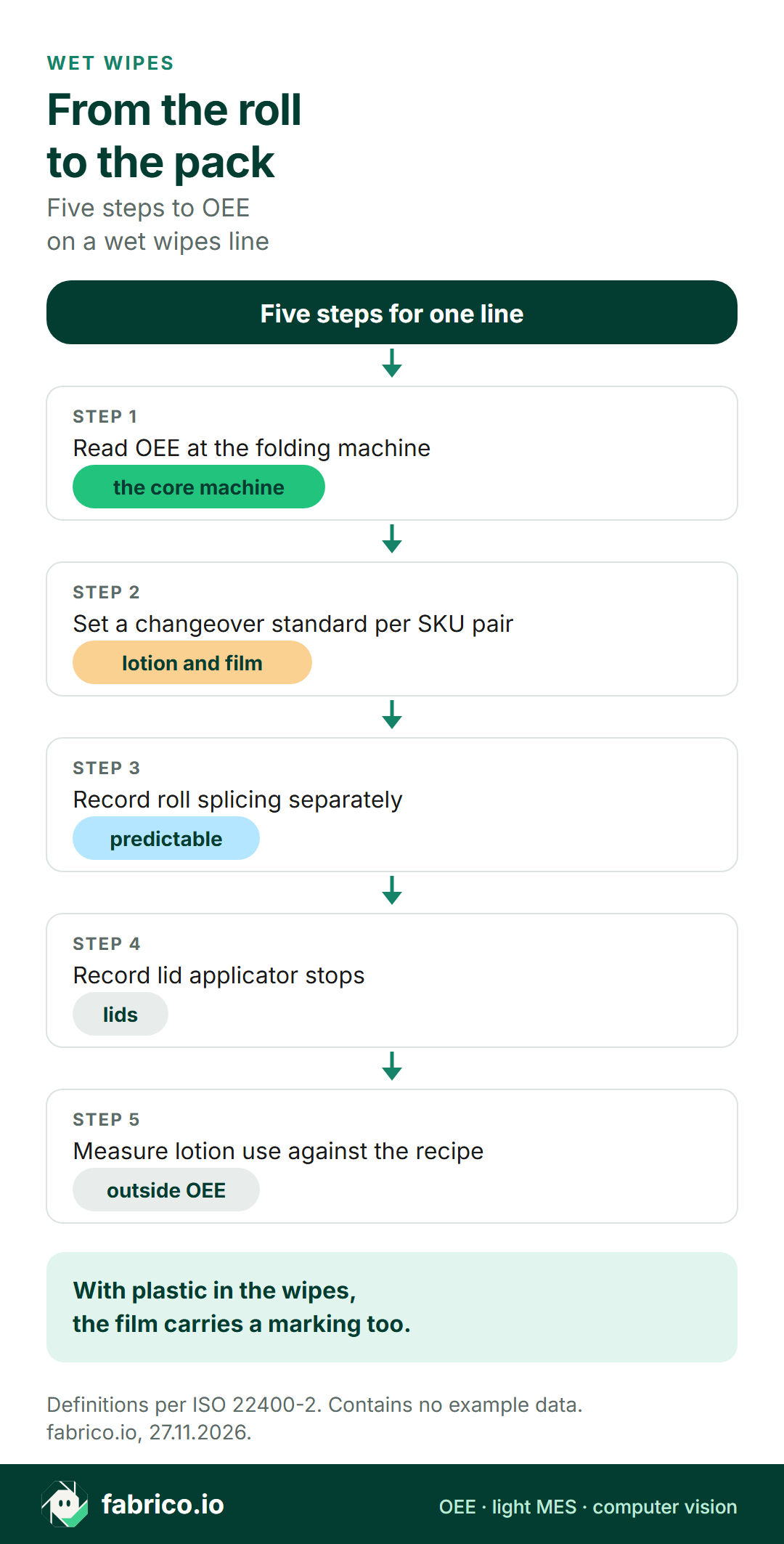
Text version of the diagram
- Read OEE at the folding machine.
- Set a changeover standard per SKU pair.
- Record roll splicing as a separate reason.
- Record applicator stops with a sub-reason.
- Measure lotion use against the recipe.
Fabrico provides the measured rates per line; the plan itself is made in the ERP, the APS or the planning spreadsheet.
This week: time one SKU changeover; write down the minutes of every splice for three shifts; measure lotion use against the recipe.
This quarter: a signal from the folding machine PLC and reasons from the operator; a standard per SKU pair with a film check; roll preparation before splicing.
Where Fabrico fits
Fabrico is made by the publisher of this article.
- What it is: an OEE platform and light MES with built-in maintenance management. It shows live OEE by line and shift.
- Connected line: OEE is read at the core machine, and waiting for product and blocked are recorded as stop reasons.
- Data: machines connect through the line PLC or through a Fabrico IoT device; where there is no signal, the camera counts output.
- Reasons: stops above the threshold get a reason in a few taps, and those below the set threshold (up to 10 minutes) go into speed loss. The camera does not determine the reason.
- Money: with the Financial Impact module, every loss has a price in EUR.
- Video: where the camera covers the line, the video for the minute of a stop opens from the shift timeline, is streamed on request and not stored in Fabrico.
- Hosting and security: EU customers are hosted on AWS in Frankfurt. Certifications ISO/IEC 27001, ISO/IEC 20000-1 and ISO 9001. The gateway keeps data for up to 30 days if the network goes down.
- Price: one quote per plant, based on the machines and modules (pricing).
For cosmetics and hygiene manufacturing, see also the article MES for cosmetics manufacturing.
Result from a Bulgarian plant
At Ficosota, a maker of home, hygiene and consumer products, time with no recorded stop reason fell from 3.20 % to 0.40 % between June and September 2026.
The result comes from 16 lines with OEE and the Financial Impact module, and OEE rose from 53.11 % to 59.62 %. The numbers are approved by the customer.
Ficosota is also an investor in Fabrico (since January 2025) and an industrial partner in developing the OEE module; keep this in mind when reading the results.
See one shift on a wipes line in Fabrico. In a demo you will see the stops by reason and what each one costs in euros.
Frequently asked questions
Which machine is OEE read from on a wet wipes line?
From the folding machine, because it sets the pace of the line. The unwinder, packing and the applicator are counted as reasons for its stops.
Is roll splicing part of OEE?
Yes, as downtime with its own reason and standard. It is predictable, so the standard shows whether the roll was prepared on time.
Why are the wipes at the top of the pack dry?
Because the lotion dose has dropped below the recipe or the pack is not sealed tightly. Record rejects for dry wipes by lotion batch.
Does the pack need a plastic marking?
Yes, if the wipes contain plastic. Directive (EU) 2019/904 requires a marking on the packaging of wet wipes with plastic, and its type is set in Implementing Regulation (EU) 2020/2151.
Is lotion given away part of OEE?
No. The pack is good. Lotion use is measured separately and compared with the recipe. If use rises with the same number of packs, check the dosing and the thickness of the fabric from the new roll.
Is a camera needed on a wipes line?
Not for a folding machine with a PLC. The camera helps with manual packing of packs into cartons, where it counts the finished cartons.
Latest from our blog




Real Fabrico tiles, sample data.