





 Login
 Blog

Recipe dosing errors in food production: cost and floor checklist

In short
- Dosing errors come in three kinds: wrong quantity, wrong ingredient, and a missed step or wrong order. What one costs depends on where you catch it: in the vessel it means a correction or scrap, after filling it costs the packaging too, and after dispatch it leads to a market withdrawal.
- In this example a sauce plant loses EUR 9,587.50 a quarter to 9 errors in 600 batches. One wrong ingredient that is an allergen costs EUR 3,216, or 33.5% of the total.
- The wrong ingredient costs most when it is an allergen from Annex II of Regulation (EU) No 1169/2011: the product no longer matches its label, and the vessel and filler must be cleaned and checked at least for visible debris.
- Match the scale to the quantity: under OIML R 76-1, a 30 kg scale with a 10 g interval may be out by ±10 g in service. On 600 g of preservative that is 1.7%; a 6 kg scale with a 2 g interval gives ±2 g.
- Bulgaria's Measurements Act puts legal metrological control on measurements in healthcare and on those tied to public safety, the environment, public revenue and commercial payments. Internal recipe weighing is not named there, so the daily scale check is your own rule.
How do you prevent recipe dosing errors in food production? With one batch card, an identity check on every ingredient, a scale chosen for the quantity, a second signature for allergens and small amounts, and a stock reconciliation at the end of each shift.
Each of these checks costs minutes. One wrong recipe costs scrap, a hold, and sometimes a market withdrawal.
The example comes from a sauce plant, but the method fits any site that mixes batches to a recipe: fillings, doughs and batters, drinks, dairy and meat products. It shows what is lost in a quarter, what each kind of error costs and which control pays for itself.
What a dosing error is, and where it happens
A dosing error is any gap between the recipe and what actually goes into the vessel. There are three kinds, and each takes a different route to scrap.
| Kind | Example | Where it is caught | Outcome |
|---|---|---|---|
| Wrong quantity | Double salt, short on starch | Check before filling: salt, viscosity, pH | Correction or scrap |
| Wrong ingredient | Milk powder instead of maltodextrin | Stock reconciliation, a complaint | Scrap, allergen clean, withdrawal |
| Missed step or wrong order | Starch before water, preservative left out | Check before filling, lumps | Scrap or correction |
There are three places it can happen: the weigh-up room for minor ingredients, metered or load-cell dosing of major ingredients, and the additions at the mixer. Minor ingredients are weighed by hand; in the example below, eight of the nine errors start there.
One rule holds for every kind: the later an error is found, the more product and work it drags along. A correction in the vessel costs minutes. Scrap after filling costs the packaging too. A market withdrawal costs the customer's trust as well.
What one error costs: from correction to scrap
The cost of each error is built from the same items. The table ties them to the moment of discovery.
| Found | What is lost | How to measure it |
|---|---|---|
| In the vessel, before filling | Hold time, an extra lab test | Downtime minutes, EUR per test |
| In the vessel, cannot be corrected | Ingredients, disposal, time for a new batch | kg × price, minutes |
| After filling, before dispatch | All of the above plus packaging and cleaning | Jars × price, cleaning minutes, tests |
| After dispatch | All of the above plus a market withdrawal | Not costed in the example |
The last row is left out on purpose: the cost of a withdrawal depends on the customers, the volumes and the press, and no sample number would be meaningful.
Worked example: sauces in jars, 600 batches a quarter
Plant, recipes and prices here are illustrative and contain no customer data.
The plant
- Ketchup, mustard and a mayonnaise-style sauce in 500 g jars. The mayonnaise-style sauce contains eggs, mustard and milk powder; the ketchup recipe has no allergens from Annex II of Regulation (EU) No 1169/2011.
- A batch is 1,200 kg in one agitated vessel, or 2,400 jars.
- The batch cycle is 80 min. Five batches a shift, two shifts a day, 60 working days a quarter: 600 batches.
- Minor ingredients (salt, sugar, starch, spices, potassium sorbate, mustard flour) are weighed by hand in a separate room. Tomato paste, oil, vinegar and water are dosed by flow meter.
- Ingredients cost EUR 1.05 per kg of sauce on average, scrap disposal EUR 0.09 per kg, and a jar with lid and label EUR 0.22.
- A person-hour costs EUR 12.00; Eurostat puts Bulgaria's average hourly labour cost at EUR 12.0 for 2025 (Eurostat, Hourly labour costs, accessed 27.11.2026).
- A minute of line downtime costs EUR 4.50 in labour and fixed costs. Margin is not included because the line is not sold out.
- An extra lab test costs EUR 35. A lateral-flow test for allergen residue costs EUR 25.
The quarter's nine errors
| Error | Count | Cost of one | Total, EUR |
|---|---|---|---|
| Short on starch or sugar, corrected in the vessel | 5 | 45 min × 4.50 + 35 = 237.50 | 1,187.50 |
| Double salt, batch scrapped | 2 | 1,200 kg × (1.05 + 0.09) + 80 min × 4.50 = 1,728.00 | 3,456.00 |
| Starch before water, lumps, scrapped | 1 | 1,368.00 + 360.00 = 1,728.00 | 1,728.00 |
| Milk powder instead of maltodextrin in ketchup, found after filling | 1 | See below | 3,216.00 |
| Total | 9 | 9,587.50 |
The wrong ingredient, step by step
Milk powder and maltodextrin are both white powders in identical sacks. The operator took the wrong sack, and the ketchup batch passed its salt and viscosity checks. The error came to light at the end-of-shift reconciliation: milk powder on hand was 18 kg lower than it should have been after the mayonnaise-style batches.
- Sauce and disposal: 1,200 kg × 1.14 = EUR 1,368.00.
- Jars: 2,400 × 0.22 = EUR 528.00.
- Cleaning the vessel, pipes and filler: 180 min × 4.50 = EUR 810.00.
- Six tests for milk residue: 6 × 25 = EUR 150.00.
- A new batch: 80 min × 4.50 = EUR 360.00.
In total 1,368 + 528 + 810 + 150 + 360 = EUR 3,216.00. That is 3,216 / 9,587.50 = 33.5%, about a third of the quarter's loss, from a single error.
Per shift, per month and per year
In this example the loss is 9,587.50 / 600 = EUR 15.98 per batch and 9,587.50 / 120 = EUR 79.90 per shift. That is EUR 3,195.83 a month and EUR 38,350 a year, if the number and kind of errors stay the same.
Nine errors in 600 batches is 1.5%. It looks small, but each one carries 9,587.50 / 9 = EUR 1,065.28 of loss on average. So a control is judged by the money it stops, not by the error rate.
Allergens: why the wrong ingredient costs most
Annex II of Regulation (EU) No 1169/2011 lists 14 groups of substances that cause allergies or intolerances. They include eggs, milk, celery and mustard; the recipes in the example contain eggs, milk and mustard.
Article 21 requires them to be named in the ingredients list and set apart by font, style or background colour (Regulation (EU) No 1169/2011, accessed 27.11.2026).
The ketchup in the example has no milk in its recipe or on its label. Milk powder in the vessel makes the label wrong, so the whole batch stops, however good it tastes.
Since 2021 the hygiene rules ask for one more thing.
Regulation (EU) 2021/382 adds point 9 to Chapter IX of Annex II to Regulation (EC) No 852/2004: equipment used to process an allergen is not used for food without it unless it has been cleaned and checked at least for the absence of visible debris (Regulation (EU) 2021/382, accessed 27.11.2026).
That is why the vessel, pipes and filler stop for 180 min in the example.
The same regulation adds Chapter XIa on food safety culture. It asks for open and clear communication between employees, including about deviations. In a weigh-up room that means an operator who reports a wrong sack without fear.
A wrong ingredient is not the only route to an undeclared allergen. An analysis of allergen recalls of FDA-regulated foods in the United States for fiscal years 2007 to 2012 found that use of the wrong package or label was the most frequent problem.
Bakery products were the most recalled food type and milk the most frequently undeclared allergen (Gendel and Zhu, Journal of Food Protection, 2013, accessed 27.11.2026). A weigh-up check does not replace a label check at the filler.
Traceability and holds: what Regulation (EC) No 178/2002 requires
Under Article 18, traceability must exist at every stage. A producer must be able to identify anyone who supplied it with a food or an ingredient, and every business it has supplied with its products. The information goes to the competent authorities on demand (Regulation (EC) No 178/2002, accessed 27.11.2026).
Article 19 covers what happens when a producer considers, or has reason to believe, that a food does not comply with food safety requirements. If the food has left its immediate control, it starts a withdrawal at once and informs the competent authorities.
If the product may have reached consumers, it informs them and, where needed, recalls the product from them.
For the weigh-up room this has a practical meaning. If the batch card records the lot number of every ingredient, the wrong sack of milk powder points to exactly the sauce batches it went into. Without that record, every batch of the shift is in doubt, and sometimes every batch of the week.
The regulations were read on 27.11.2026. Whether a given batch with an undeclared allergen must be withdrawn is a decision for your food safety team with the competent authority (in Bulgaria, BFSA), not for this calculation.
The scale: permissible error, minimum load and daily check
The international recommendation OIML R 76-1 sets the maximum permissible errors of non-automatic weighing instruments. For class III (medium accuracy), the error on initial verification is ±0.5e up to 500e, ±1e from 500e to 2,000e and ±1.5e from 2,000e to 10,000e, where e is the verification scale interval.
In service the permissible error is twice as large. The minimum capacity for class III is 20e (OIML R 76-1:2006, accessed 27.11.2026).
In the example, potassium sorbate is 0.05% of the batch, or 600 g, with a recipe tolerance of ±2%, which is ±12 g. Here is how it looks on two scales:
| Ingredient | Scale | Error in service | Share of the amount | Share of the tolerance |
|---|---|---|---|---|
| Sorbate, 600 g | 30 kg, e = 10 g | ±10 g | 1.7% | 83% |
| Sorbate, 600 g | 6 kg, e = 2 g | ±2 g | 0.33% | 17% |
| Salt, 18 kg | 30 kg, e = 10 g | ±20 g | 0.11% | Tolerance ±1%: 11% |
The working: 600 g on a scale with e = 10 g is 60e, below 500e, so the error is ±5 g on verification and ±10 g in service. On a scale with e = 2 g the same 600 g is 300e, so ±1 g on verification and ±2 g in service.
The 18 kg of salt is 1,800e, between 500e and 2,000e: ±10 g on verification, ±20 g in service. The salt tolerance is ±1% of 18 kg, or ±180 g.
The rule in the example: the scale's error in service must be no more than a third of the recipe tolerance. The large scale fails it for sorbate; the small one passes.
The minimum load (20e) is 200 g on the 30 kg scale and 40 g on the 6 kg scale, so nothing under 200 g is weighed on the large one.
The daily check is simple: a test weight close to the amount being weighed, before the first batch. The result goes in the log, and if the reading is off by more than the in-service error, the scale stops until it is checked.
What Bulgaria's Measurements Act and Directive 2014/31/EU say
Text of the Measurements Act as of 27.11.2026 (accessed 27.11.2026; last amended: State Gazette No. 55 of 16.06.2026).
- Art. 5: legal metrological control applies to the accuracy of measurements in healthcare and of measurements tied to public safety, environmental protection, state and municipal revenue and commercial payments.
- Art. 43: instruments in use undergo subsequent verification periodically or after repair. The interval is set by order of the head of the State Agency for Metrological and Technical Surveillance (DAMTN).
- Art. 44: whoever uses measuring instruments keeps them in working order and in correct use, presents them for subsequent verification, and does not use them without the verification marks.
Directive 2014/31/EU on non-automatic weighing instruments sorts uses into seven groups. Point (f) is determining price by mass for direct sales to the public and making up prepackages; point (g) is every other use. The essential requirements of Annex I apply, under Article 4, only to points (a) to (f) (Directive 2014/31/EU, accessed 27.11.2026).
What falls outside these texts: weighing ingredients for an internal recipe is named neither in Art. 5 of the act nor in points (a) to (f) of the directive. On this reading the weigh-up scale may sit outside legal metrological control, while the scale used to fill or check jars for net quantity falls under point (f).
That does not make checking the recipe scale optional: its error goes straight into the product. So the daily test-weight check and a yearly calibration are an internal rule in the example. Whether a given scale is under legal metrological control is a question for DAMTN.
Weigh-up check: 10 points for the room
The list is for the weigh-up room and the mixer. Each point closes one route to one of the three kinds of error.
- One card per batch: batch number, recipe version, amount and tolerance for every ingredient, in the order of addition.
- Ingredients on their own trolley: only those on the card; allergens in containers of a separate colour.
- Identity before weighing: the sack code matches the code on the card; the raw material lot number is recorded.
- The scale for the amount: per the table above; nothing below the scale's minimum load.
- Daily scale check: a test weight before the first batch, the result in the log.
- Each ingredient in its own container: labelled with the name, amount and product batch number.
- Second signature: a second person checks allergens and ingredients under 1 kg before the kit goes to the mixer.
- Order of addition: the mixer operator ticks each step and its time.
- Check before filling: pH, salt and viscosity per the card; on a deviation the batch is held in the vessel.
- End-of-shift reconciliation: what the recipes drew against what left the store for every ingredient; any gap above tolerance is traced to the batch.
Point 10 caught the milk error in the example, and points 3 and 7 could have stopped it before the vessel. Operators learn these checks on the job; the method is in the article on structured on-the-job training. Who may sign as the second person is shown by the operator skill matrix.
Second signature, recipe-guided scale or premix: how to choose
The three measures cost different amounts and stop different errors. The numbers come from the example and are per quarter.
| Measure | What it stops | Cost in the example | Pays back if it stops |
|---|---|---|---|
| Second signature | Wrong ingredient, wrong amount of allergens and minor ingredients | 4 min × 600 = 40 h; 40 h × 12.00 = EUR 480 | 5% of the loss |
| Recipe-guided scale with barcode | Wrong ingredient, wrong amount; records the lots by itself | EUR 9,000 for two stations and EUR 600 a year for service | 25% of the yearly loss in year one |
| Supplier premix | Errors on minor ingredients in the plant | 96 kg × EUR 0.15 × 600 = EUR 8,640 premium | Only if it frees the weigh-up post |
Second signature: 480 / 9,587.50 = 5.0%. One stopped double-salt batch (EUR 1,728) pays for the check for more than three quarters.
Recipe-guided scale with barcode: year one costs 9,000 + 600 = EUR 9,600, or 9,600 / 38,350 = 25% of the yearly loss. Spread over three years it costs (9,000 + 3 × 600) / 3 = EUR 3,600 a year, or 9.4%. The station price is an example; ask for a quote.
Premix: the dry minor ingredients are 8% of the batch, or 96 kg. At a EUR 0.15/kg premium that is EUR 14.40 a batch and EUR 8,640 a quarter, nearly the whole loss. The sums flip if the weigh-up post is freed entirely: 7.5 h × 120 shifts × EUR 12.00 = EUR 10,800 a quarter.
By plant: a site with one or two people on weigh-up starts with the second signature and the reconciliation. A site with dozens of recipes and several allergens has a case for a recipe-guided scale, because it also produces the traceability record.
Premix suits stable recipes in long runs, where the supplier takes over the weighing. Systems that keep the batch record and the losses together are reviewed in MES for food manufacturing.
Questions for a scale or premix supplier
- What accuracy class, maximum capacity and interval e do you offer for ingredients from 40 g to 20 kg?
- Does the system stop the weighing on a wrong barcode or an amount out of tolerance?
- Is each ingredient's lot number linked to the product batch, and how is the record exported?
- How is a new recipe version entered, and who approves it?
- What happens if the network drops during a weighing?
- For premix: what is the tolerance on each ingredient, and how is it shown in a certificate per lot?
Where Fabrico fits
Weighing and the batch record stay with the scale and the plant's batch documentation. Fabrico, an OEE platform with a light MES, records what the deviations cost the line and shows them in EUR.
Scrap is recorded by product and reason, so "double salt" and "wrong ingredient" are separate lines, not one scrap figure. Operators add the stop reason in a few taps; that is how the 45 minutes of hold and the 180 minutes of allergen cleaning get names.
Live OEE by line and shift is on screen, read at the core machine (the filler) on this linked line.
Analytics split by shift, day, week, month and hour show whether errors pile up on a particular shift. The Financial impact module prices the losses in EUR for each SKU, and downtime tracking ranks the stops by minutes.
The light MES page shows the modules, and pricing comes as one quote per plant, by machines and modules.
The weigh-up room card
Put the card on the wall between the scales and the trolleys. Its six steps are the short version of the 10-point list above.
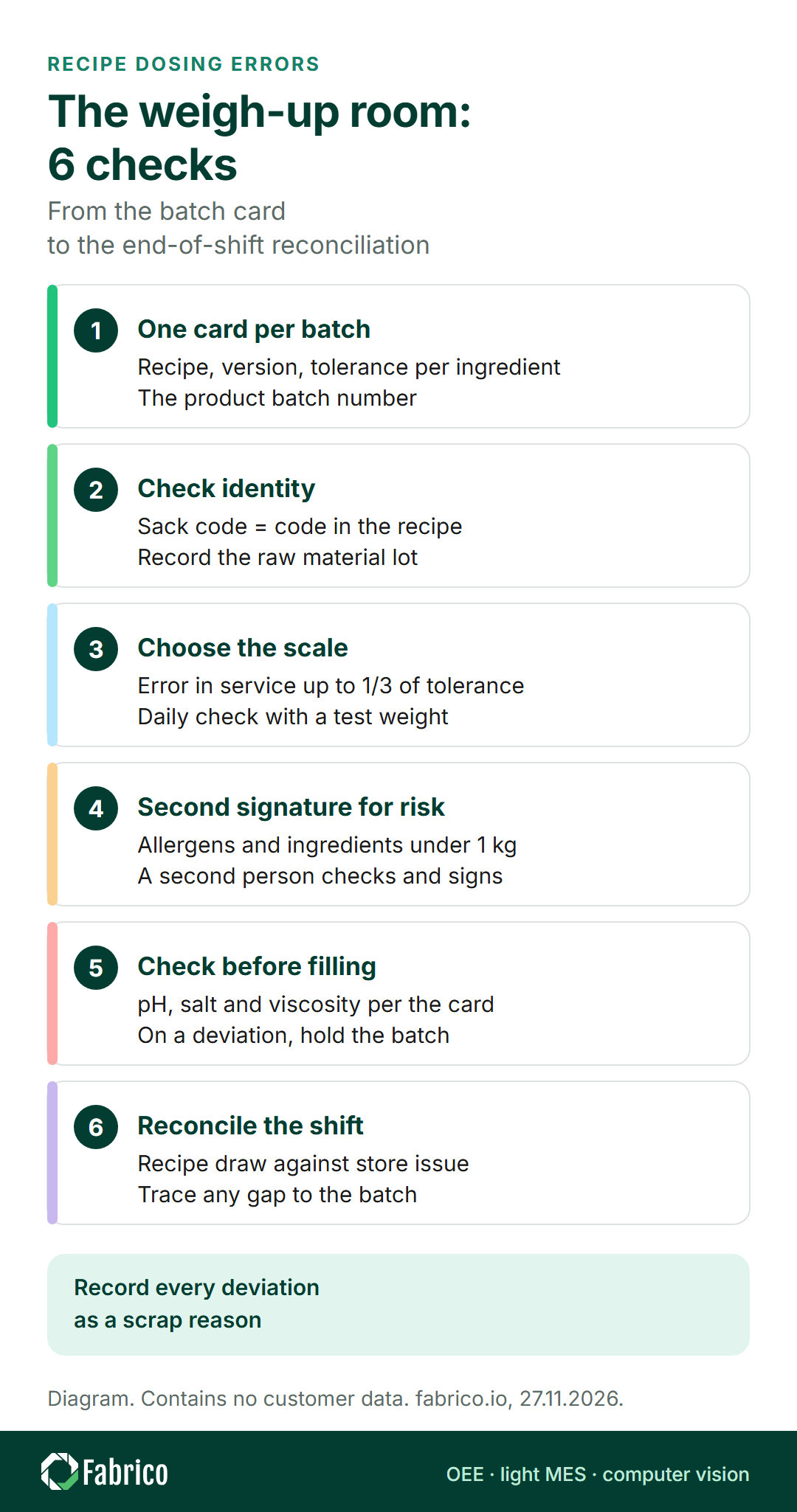
Text version of the diagram
- One card per batch: recipe, version and tolerance for every ingredient; the product batch number.
- Check identity: the sack code matches the code in the recipe; record the raw material lot.
- Choose the scale: error in service at most a third of the tolerance; a daily test-weight check.
- Second signature for risk: allergens and ingredients under 1 kg; a second person checks and signs.
- Check before filling: pH, salt and viscosity per the card; hold the batch on a deviation.
- Reconcile at the end of the shift: what the recipes drew against what left the store; trace any gap to the batch.
Frequently asked questions
What does a recipe dosing error cost?
It depends on when it is found. In this example a correction in the vessel costs EUR 237.50, scrapping a 1,200 kg batch costs EUR 1,728, and a wrong ingredient that is an allergen, found after filling, costs EUR 3,216.
What happens to a batch made with the wrong recipe?
It is held in the vessel, tested and corrected if the recipe allows an addition. If an amount is over tolerance or the ingredient is wrong, the batch is scrapped. If it contains an undeclared allergen, the equipment is cleaned and checked at least for visible debris.
How frequently should a production scale be checked?
For scales under legal metrological control in Bulgaria, the interval for subsequent verification is set by order of the DAMTN head. For the recipe scale, the example uses a daily test-weight check and a yearly calibration as an internal rule.
What scale is needed for small ingredient amounts?
One whose error in service is small against the tolerance. Under OIML R 76-1, a 6 kg scale with a 2 g interval may be out by up to ±2 g at 600 g, and a 30 kg scale with a 10 g interval by up to ±10 g.
Does food with an undeclared allergen have to be withdrawn?
Article 19 of Regulation (EC) No 178/2002 requires a withdrawal and notice to the competent authorities when a producer considers that a food outside its control does not comply with food safety requirements. The decision on a given batch is taken with the authority.
How do you trace which batches a wrong sack went into?
By recording the lot number of every ingredient on the product batch card. Then the wrong sack points to exactly the batches affected, and that link back and forward along the chain is what Article 18 of Regulation (EC) No 178/2002 asks for.
See what recipe errors cost on your own line. In the demo one line runs through scrap by reason, holds and cleaning in minutes, OEE by shift and the loss for each SKU in EUR.
Latest from our blog



Real Fabrico tiles, sample data.