





 Login
 Blog
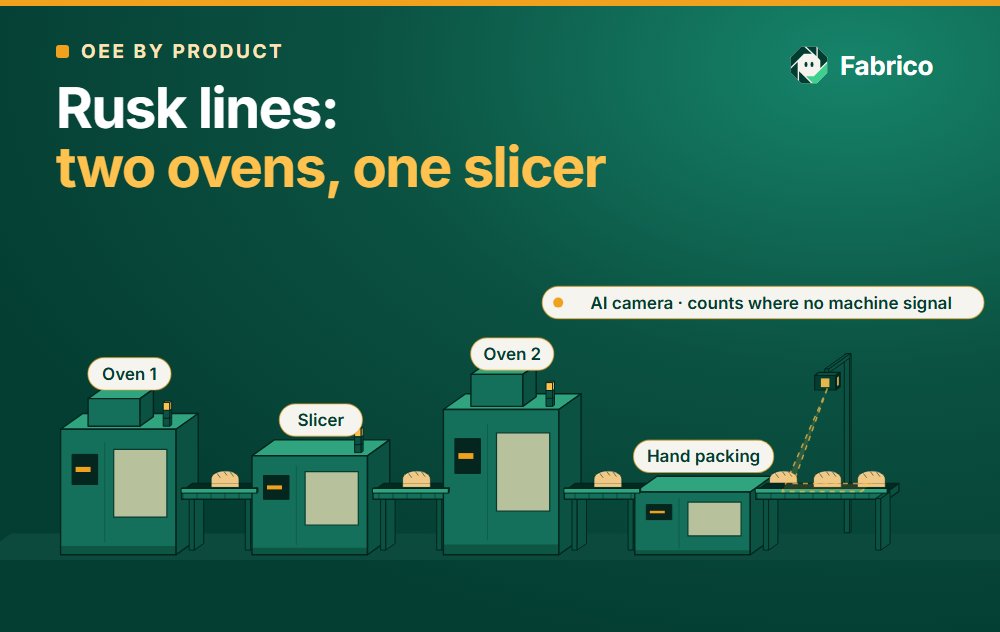
OEE in rusk production: two ovens and one slicer

In short
- Rusks go through two ovens. The first bakes the bread, the second toasts the cut slices. OEE is read from the second oven, because it decides how many rusks come out.
- The bread has to cool before it is sliced. If the slicer gets warm bread, the slices are crushed. If the bread is late, the second oven waits.
- In the example below, the shift loses 624.00 EUR. The largest item is the product changeover with a sesame clean-down.
- The heels of the bread are a separate account. The first and last slices do not become rusks, and OEE does not see them.
OEE in rusk and toast bread production is the share of planned time in which the core machine makes good packs; for rusks that is the second (toasting) oven. The losses covered here are waiting for cooled bread, product changeovers with a clean-down, slicer stops, short stops at packing, and rejects for burnt rusks, broken rusks and weight.
This article is for owners, process engineers and production managers in bakeries and plants that make rusks, twice-baked bread and toast bread. It shows how the two ovens are recorded against each other, how the bread is counted before the slicer, and a worked example of one shift in euros.
Rusk makers in Bulgaria
In the group "Manufacture of rusks and biscuits; preserved pastry goods and cakes", Bulgaria had 170 enterprises with 5,261 people employed in 2024, an average of 31 people per enterprise, according to Eurostat structural business statistics (accessed 27.11.2026). Rusk makers are part of this group.
Rusks have a long shelf life and are sold in retail chains under different brands. So the lines run in shifts, and the plan is set by the orders of the chains and by the capacity of the two ovens.
The line: bread, cooling, slicing, second bake
| Stage | What happens | Losses recorded |
|---|---|---|
| Dough and first oven | The bread is baked in tins | Late dough batch, oven not up to temperature |
| Cooling | The bread stands for hours to cool and firm up | Bread that has not cooled |
| Slicer | The bread is cut into slices | Blunt blade, crumbs, jam |
| Second oven | The slices are toasted into rusks | Burnt slices, temperature correction |
| Packing | The rusks go into packs and cases | Short stops, foil, weight |
Availability, performance and quality are defined per ISO 22400-2 (accessed 27.11.2026). The second oven is the core machine on this line: it is a tunnel oven and runs at a constant rate, and everything before and after it adjusts to it. Slicer and packing stops are recorded as reasons for its downtime, and output is counted at the packing outfeed.
Cooling: yesterday's bread
Bread for rusks is not sliced warm. It has to cool and firm up, or the blade crushes the slice and crumbs jam the slicer. So the bread for today's shift is baked the day before or early in the night.
When the first oven is late or the bread has not cooled enough, the slicer has nothing to cut and the second oven stands still. On the second oven this is recorded as "waiting for product" with the sub-reason "bread". Without a sub-reason the report shows the second oven as the problem, while the cause is in the first oven or in yesterday's plan.
It helps if every bread trolley carries its baking time. Then the slicer takes the oldest bread first, and the process engineer sees how many hours each batch actually cooled.
The slicer: blade, crumbs and thickness
The slicer cuts the bread into slices of a set thickness. A blunt blade crushes the slice, and crumbs build up and jam the belt. The operator stops, cleans and restarts.
Slicer stops above the threshold are downtime with the reason "cleaning" or "blade change". A scheduled blade change is a planned stop. A change when the blade is already crushing is unplanned. Record them separately, to see whether the schedule is right.
The slice thickness decides how long the slice has to stay in the second oven. A thicker slice needs a slower belt or a higher temperature. So thickness is part of the recipe, not a shift setting. When the operator changes the thickness to catch up on rate, the colour of the rusks changes with it, and rejects rise.
The second oven: rate and colour
The second oven toasts the slices into crisp rusks. Belt speed and temperature decide the colour. If the colour comes out too dark, the operator lowers the temperature or speeds up the belt, and part of the output is rejected.
Regulation (EU) 2017/2158 requires makers of bakery products to apply measures to reduce acrylamide, which forms during baking, and to check its levels (accessed 27.11.2026). For the second oven this means that temperature and colour are not only a matter of taste. A temperature correction is a stop with its own reason, and colour is a parameter checked per batch.
The first oven: bread as a batch
The first oven bakes the bread in tins, batch after batch. It has its own OEE, but for rusks it is a supplier to the second oven. If the first oven runs well but the bread reaches the slicer late, the problem is in the plan, not in the oven.
So between the two ovens, watch the stock: how many trolleys of cooled bread are waiting in front of the slicer at the start of the shift. If the stock is small, every delay at the first oven reaches the second within hours. The number of trolleys of cooled bread at 6 in the morning is the simplest number that shows this.
Toast bread: the same line without the second oven
Toast bread goes through the first oven, cooling, the slicer and packing, but not through the second oven. For toast bread the core machine is the slicer together with packing, because they decide how many packs come out.
If one line makes both rusks and toast bread, OEE is read from a different machine depending on the product. So the product is selected at every changeover, and the report shows the two products separately. Otherwise two different rates and two different lists of reasons get mixed.
The ideal rate per product
Rusks from wholegrain bread bake longer than plain ones, and a thicker slice needs a slower belt. The ideal rate of the second oven is set per product and thickness. A good rule is to make it the best sustained rate reached for that product in a normal shift.
Products and allergens
Rusks are made plain, with sesame, with spices or wholegrain. Sesame and gluten are listed in Annex II to Regulation (EU) No 1169/2011 among the substances that cause allergies or intolerances (accessed 27.11.2026). All the products contain gluten, so gluten is no reason to clean between them. Sesame is.
A changeover from rusks with sesame to rusks without sesame needs a full clean-down of the slicer, the belts and packing. The opposite direction is short. Sequence the week from the products without sesame to those with sesame, so there is only one full clean-down.
One shift on the rusk line in euros
The numbers are an example, not from a real customer. The line makes 200 g packs, with an ideal rate of 50 packs a minute at the second oven. The shift has 450 planned minutes, and a stop longer than 2 minutes is recorded as downtime. The ideal for the shift is 22,500 packs.
Halfway through the shift the line switches from rusks with sesame to plain rusks, the direction that needs a full clean-down. Both products are in 200 g packs with the same slice thickness, so the ideal rate and the contribution per pack are the same. The contribution per pack is taken as 0.12 EUR. For comparison, data from Aswath Damodaran (NYU Stern) shows a gross margin of 23.23 % for US listed food processing companies (data as of January 2026, accessed 27.11.2026). Use your own prices.
| Cause | Stops | Minutes | Recorded as | Packs | EUR per shift |
|---|---|---|---|---|---|
| Changeover from a product with sesame to one without | 1 × 30 min | 30 | downtime | 1,500 | 180.00 |
| Waiting for cooled bread | 3 × 9 min | 27 | downtime, sub-reason bread | 1,350 | 162.00 |
| Short stops at packing | 40 × 30 s | 20 | speed loss | 1,000 | 120.00 |
| Slicer: blade and crumbs | 5 × 3 min | 15 | downtime | 750 | 90.00 |
| Rejects: burnt, broken, weight | 600 packs | quality | 600 | 72.00 | |
| Total | 92 | 5,200 | 624.00 |
How the numbers are reached:
- Downtime: 30 + 27 + 15 = 72 minutes, run time 378 minutes. Availability: 378 / 450 = 84.0 %.
- For 378 minutes the ideal is 18,900 packs. Short stops take away 1,000. Packed: 17,900. Performance: 17,900 / 18,900 = 94.7 %.
- Rejects 600, good 17,300. Quality: 17,300 / 17,900 = 96.6 %.
- OEE: 84.0 % × 94.7 % × 96.6 % = 76.9 % (calculated with the unrounded values). Check: 17,300 / 22,500 = 76.9 %.
- The loss: 5,200 packs × 0.12 EUR = 624.00 EUR per shift.
Ranked by value, the product changeover comes first: 180.00 EUR, a loss that sequencing the week reduces to one full clean-down. Close behind is waiting for bread: 162.00 EUR, a loss that comes from the first oven plan.
If each of the 500 shifts in a year (two shifts a day, 250 working days) has one such changeover, it costs 90,000 EUR, and waiting for bread costs 81,000 EUR. The sums are real only if every lost pack could have been sold; confirm the estimate with the finance department.
Bread heels: an account outside OEE
From every loaf, the first and last slices are heels (end slices). They do not become rusks of the right shape. The good packs come out, and OEE does not see these kilograms.
The heels are weighed per shift. If they rise, the cause is in the shape of the bread or in the slicer setting. Some plants grind them into breadcrumbs, others throw them away. In both cases their weight is a number the process engineer watches next to OEE.
Pack weight and lot
Under Directive 76/211/EEC (consolidated text of 11.04.2009, accessed 27.11.2026), the tolerable negative error for a 200 g pack is 9 g. The average weight of the batch cannot be below the nominal weight.
Rusks are counted or weighed into the pack. When the slice thickness changes, the pack weight changes with it. The checkweigher after packing shows this first.
The pack carries a lot marking under Directive 2011/91/EU, with the exceptions in Article 2 (accessed 27.11.2026). For rusks it helps if the lot points to the day the bread was baked, not only the rusks.
Who owns the ovens, the slicer and packing
| Loss | Owner | Data they need |
|---|---|---|
| Waiting for bread | The first oven supervisor | Minutes with a sub-reason, baking time of each trolley |
| Product changeover | Planning | Minutes against the standard per direction |
| Slicer | The mechanic | Stops by reason, planned and unplanned blade changes |
| Short stops at packing | The shift supervisor | Speed loss per hour |
| Rejects for colour and weight | Quality | Rejects per batch, colour, average weight |
Mistakes in recording rusks
| Mistake | What shows up later | How to avoid it |
|---|---|---|
| OEE is read from the first oven | The second oven, which actually limits the line, is not seen | OEE from the second oven |
| Waiting for bread is booked as "oven downtime" | The second oven looks like the problem | "Waiting for product" with a sub-reason |
| Blade changes are only booked as unplanned | The schedule is never checked | Planned and unplanned separately |
| The heels are not weighed | Yield falls with no explanation | Heel weight per shift |
What to look at in the morning meeting
Four numbers from yesterday are enough: OEE of the second oven, minutes of waiting for bread, the number of product changeovers and in which direction, and the weight of the heels.
If waiting rises, the conversation is with the first oven. If colour rejects rise, check the temperature of the second oven. Each number goes to the person who can change it. The stock of cooled bread at the start of the shift shows whether today will start on time.
What to choose for a rusk line
| Method | Fits when | What it misses |
|---|---|---|
| Paper log | One line, one product | Short stops and sub-reasons |
| PLC counter into a spreadsheet | A first estimate | The reasons and the link to the first oven |
| OEE software with a machine signal and operator reasons | Several products and pack sizes | The heels, if they are not weighed |
Questions for the vendor:
- How is "waiting for product" recorded with a sub-reason for the bread?
- Can the standard product changeover time depend on the direction?
- Can the heel weight be entered against the shift?
- How is an ideal rate set per product and pack size?
- Are the counted packs kept if the plant network goes down?
More on packing bakery products in the article stops on a bread bagging line, and on the changeover table by allergen in the article allergen changeover matrix.
How to start
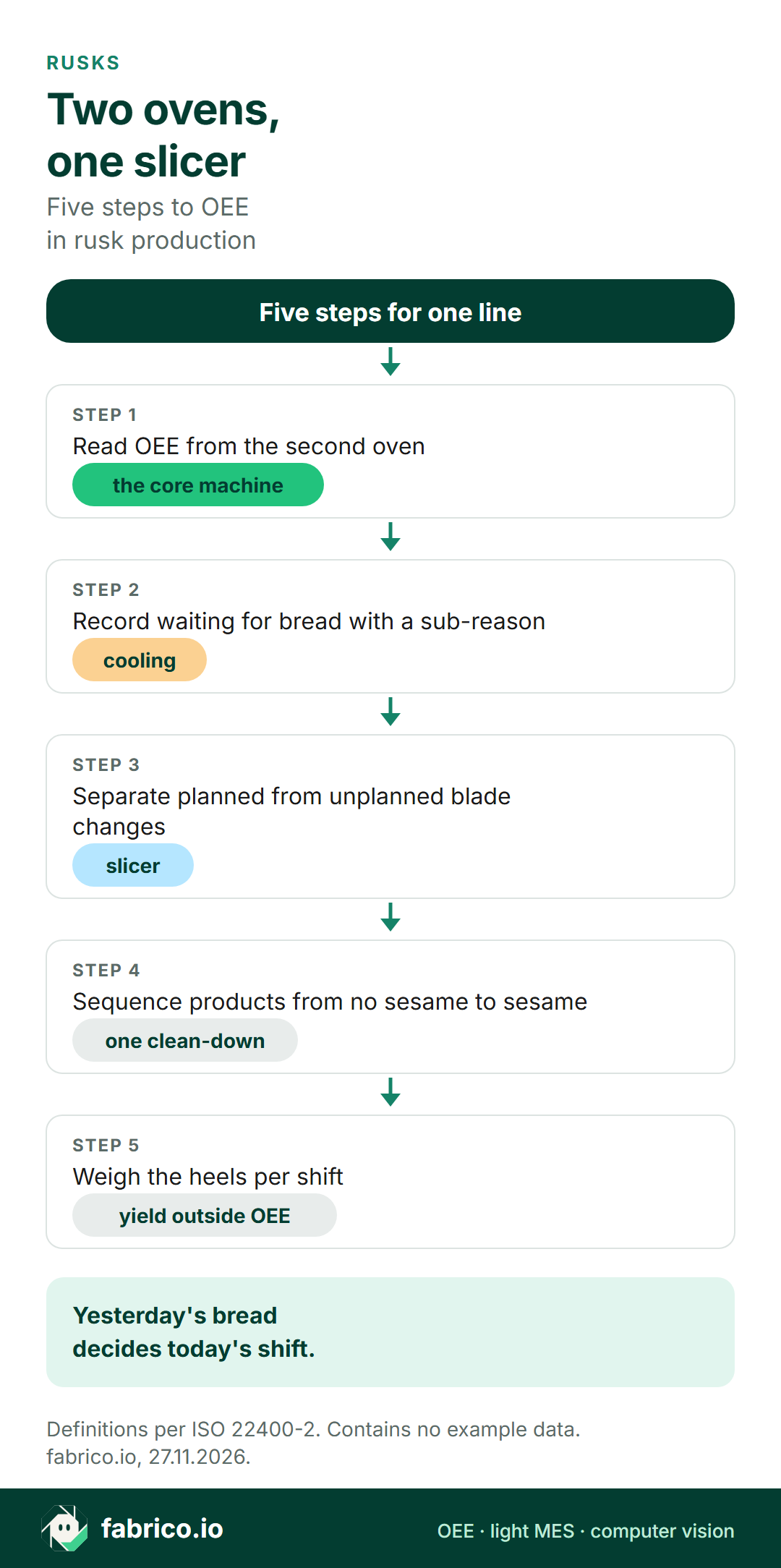
Text version of the diagram
- Read OEE from the second oven.
- Record waiting for bread with a sub-reason.
- Separate planned from unplanned blade changes.
- Sequence products from those without sesame to those with sesame.
- Weigh the heels per shift.
Fabrico provides the measured rates per line; the plan itself is made in the ERP, the APS or the planning spreadsheet.
This week: write the baking time on every bread trolley; time one product changeover in both directions; weigh the heels for three shifts.
This quarter: a PLC signal from the second oven and operator reasons; a changeover standard per direction; a first oven plan arranged around the second oven.
Where Fabrico fits
Fabrico is made by the publisher of this article.
- What it is: an OEE and light MES platform with built-in maintenance management. It shows live OEE per line and shift.
- Connected line: OEE is read at the core machine, and waiting for product and blocked are recorded as stop reasons.
- Data: machines connect through the line PLC or through a Fabrico IoT device; where there is no signal, a camera counts the output.
- Reasons: stops above the threshold get a reason in a few taps, and stops under the set threshold (up to 10 minutes) count as speed loss. The camera does not decide the reason.
- Money: with the Financial Impact module, every loss has a price in EUR.
- Video: where a camera covers the line, the video for the minute of a stop opens from the shift timeline, is streamed on request and not stored in Fabrico.
- Hosting and security: EU customers are hosted on AWS in Frankfurt. Certified to ISO/IEC 27001, ISO/IEC 20000-1 and ISO 9001. The gateway keeps data for up to 30 days if the network goes down.
- Price: one quote per plant, based on the machines and modules (pricing).
For food plants, see also the article MES for food manufacturing.
A result from a Bulgarian plant
At Ficosota, a maker of home care, hygiene and consumer goods, not food, time with no recorded stop reason fell from 3.20 % to 0.40 % between June and September 2026.
The result comes from 16 lines with OEE and the Financial Impact module, and OEE rose from 53.11 % to 59.62 %. The numbers are approved by the customer.
Ficosota is also an investor in Fabrico (since January 2025) and an industrial partner in developing the OEE module; keep this in mind when reading the results.
See both ovens in one shift in Fabrico. In a demo you will see the stops by reason and what each one costs in euros.
Frequently asked questions
Which machine is OEE read from on a rusk line?
From the second oven, because it decides how many rusks come out. The first oven, the slicer and packing are recorded as reasons for its stops.
Why is bread not sliced warm?
Because warm bread is crushed under the blade, and crumbs jam the slicer. The bread has to cool and firm up before it is sliced. How many hours this takes, the process engineer sets in the recipe for each type of bread.
Is bread cooling part of OEE?
No. Cooling is process time. Only the second oven's waiting, when cooled bread is missing, counts in OEE.
When is the line cleaned of sesame?
At a changeover from a product with sesame to a product without sesame. Sequenced from those without sesame to those with sesame, the products need one full clean-down.
How much lighter can a 200 g pack of rusks be?
Up to 9 g, so down to 191 g. Directive 76/211/EEC allows this error for 200 g, and the average weight of the batch must be at least 200 g.
Are the bread heels part of OEE?
No. They are a yield loss that is weighed separately and watched next to OEE. When their weight rises, check the shape of the bread and the slicer setting.
Latest from our blog




Real Fabrico tiles, sample data.