





 Login
 Blog
Raw material variability on a production line: speed and scrap

In short
- Raw material is not a constant. Fruit size, sugar content (°Brix) and ripeness change from harvest to harvest and from lot to lot. Line speed, settings and scrap change with them.
- In this example a lot of smaller peaches (96 g instead of 120 g) costs the line EUR 115.00 per tonne more than the reference lot, and an overripe lot costs EUR 83.54 per tonne more.
- Over a 640 t season the two kinds of lots cost EUR 26,419.84 in this example, if they keep their 25% and 15% share of deliveries.
- EU marketing standards do not cover fruit for processing. Regulation (EU) 2023/2429 excludes fruit intended for industrial processing. Size and °Brix have to be written into the supplier contract.
- Three levers: a specification with intake checks and price by size, settings per lot (syrup, pitting machine), and blending lots, which works for purée and paste but not for halves.
How does raw material variability change the speed of a production line? Directly. A pitting machine handles a set number of fruit per minute, so smaller fruit means fewer kilograms per hour. Softer fruit breaks and jams the machine, and fruit with less sugar needs a different syrup.
The fix starts with measuring. Log the size, °Brix and firmness of every lot and tie them to kilograms per hour, stops and scrap by shift. The gap between two lots then becomes a sum in EUR that can go into the supplier contract.
The reader here runs a cannery, a fruit and vegetable plant or a bakery. You will find a table of variations by raw material, a reading of the standards, and a worked example on a peach halves line, priced in EUR per tonne, per lot and per season.
What varies in the raw material and what it changes on the line
Raw material from fields and orchards is biological. A study of a large snack food manufacturer describes managing raw material variability as critical in food manufacturing, because input attributes vary with the material's biological nature (Bourquard et al., Production & Manufacturing Research, 2022, accessed 27.11.2026).
Which attributes to track depends on the raw material. The table shows four raw materials and what each changes on the line.
| Raw material | What varies | What it changes on the line |
|---|---|---|
| Peaches, apricots | Size, ripeness, °Brix | kg/h at the pitting machine, broken halves, jams, syrup |
| Tomatoes for paste | °Brix | kg of tomatoes per kg of paste, evaporation time |
| Peppers for roasting | Size, flesh thickness | Yield after roasting and peeling, manual peeling work |
| Wheat flour | Water absorption | Water in the dough, mixing, piece weight |
Sugar content decides how much raw material goes into the product
For tomato paste the maths is a solids balance. A 28 °Brix paste made from 5 °Brix tomatoes needs about 28 / 5 = 5.6 kg of tomatoes per kg of paste. With 4.5 °Brix tomatoes it needs 28 / 4.5 = 6.2 kg, before processing losses.
The extra 0.6 kg per kg of paste is 11% more tomatoes for the same product. The evaporator also has to remove more water, so at the same evaporation capacity the line makes less paste per hour.
Size decides how many kilograms pass through the machine
Machines that handle fruit one by one run at a set number of pieces per minute. On those machines, kilograms per hour follow the average fruit weight. If the average fruit gets 20% lighter, the line makes 20% fewer kilograms per hour at the same rhythm.
For roasting peppers, size and flesh thickness set the yield after roasting and peeling. Measure that yield for each size grade instead of using one number for the whole season.
Flour changes with the harvest too
For Canada Western Red Spring wheat, larger kernels give flour with higher water absorption. The link is statistically significant across harvest survey data for 17 years (Morgan, Dexter and Preston, Cereal Chemistry, 2000, accessed 27.11.2026). For a bakery, that means a new water setting in the recipe when the flour lot changes.
Harvests are not constant: data for Bulgaria
Variation starts with quantity. The table shows the harvest in Bulgaria for four canning crops, from Eurostat (Eurostat, apro_cpsh1, data updated 24.11.2026, accessed 27.11.2026).
| Crop | Highest harvest 2015-2025, thousand t | 2024, thousand t | 2025, thousand t |
|---|---|---|---|
| Tomatoes | 158.76 (2017) | 128.14 | 105.24 |
| Peppers | 72.03 (2016) | 57.17 | 49.80 |
| Peaches | 34.37 (2015) | 17.34 | 5.93 |
| Apricots | 22.54 (2017) | 18.65 | 1.04 |
The 2025 peach harvest was about a third of the 2024 one, and apricots fell from 18.65 to 1.04 thousand tonnes. When the harvest is small, a plant may buy from more orchards or import. Lots then come from different varieties and regions, and the gaps between them grow.
Fruit size is not constant either. Peach fruit weight depends on fruiting shoot length and on the number of fruit per shoot at a given crop density (Marini and Sowers, Journal of the American Society for Horticultural Science, 1994, accessed 27.11.2026). Two orchards with the same variety can deliver different sizes in the same week.
What the standards and the law say about raw material
Below is a reading of four texts in force on 27.11.2026. They cover different things, and none of them says anything about line speed.
EU marketing standards for fresh fruit and vegetables
Commission Delegated Regulation (EU) 2023/2429 of 17 August 2023 sets specific marketing standards for 11 products, including peaches and nectarines, sweet peppers and tomatoes (Article 4). The peach standard applies to fruit "to be supplied fresh to the consumer, peaches and nectarines for industrial processing being excluded" (Regulation (EU) 2023/2429, accessed 27.11.2026).
Article 5(1)(a) exempts products clearly marked "intended for processing" from the marketing standards when they are intended for industrial processing.
For fresh peaches, the standard requires at least 8 °Brix and a minimum size of 56 mm or 85 g in Extra Class and 51 mm or 65 g in Classes I and II. Its weight size codes are a handy base for a supplier contract:
| Code | Fruit weight, g | Diameter, mm |
|---|---|---|
| D | 65-85 | 51-56 |
| C | 85-105 | 56-61 |
| B | 105-135 | 61-67 |
| A | 135-180 | 67-73 |
| AA | 180-220 | 73-80 |
What the regulation does not say: it sets no size, °Brix or ripeness for fruit going to processing. Those requirements come only from the contract between the plant and the grower. If they are not in the contract, the marketing standards give no ground to send a lot back over size or °Brix.
The Codex standard for canned stone fruits
Codex standard CXS 242-2003 describes the finished product. For canned peaches in a liquid packing medium, broken units may not exceed 5% by count, and "the fruit should be reasonably uniform in size" (Codex CXS 242-2003, FAO, accessed 27.11.2026).
The minimum drained weight for clingstone peaches in light syrup is 59% of the container's water capacity. For glass jars the capacity is the brimful water volume less 20 ml.
The standard does not apply when the product is labelled as intended for further processing. Whether Codex binds you depends on your buyer's contract, so read it as a reference for the finished product specification.
Accepting raw material, and traceability
Regulation (EC) No 852/2004, Annex II, Chapter IX, point 1 covers intake. A food business operator is not to accept raw materials known, or reasonably expected, to be contaminated so badly that the final product would be unfit for human consumption even after sorting and processing (Regulation (EC) No 852/2004, accessed 27.11.2026).
That is the safety floor, not a size or °Brix requirement.
Article 18 of Regulation (EC) No 178/2002 requires operators to be able to identify any person who supplied them with a food or an ingredient (Regulation (EC) No 178/2002, accessed 27.11.2026).
Article 18 does not require a link between a raw material lot and the shift, stops or scrap. That link is your choice, and it is the base of a lot log.
A reading, not legal advice. The texts were read on 27.11.2026. Your supplier contract and your buyer's requirements can add their own terms. Check with your food technologist, a lawyer or the food safety authority before you change a specification.
The lot log: what to record
A lot log ties two sets of data together: what came into the plant and what happened on the line. Without that link, the difference between lots stays a feeling on the shift.
| Field | How to measure | What it is for |
|---|---|---|
| Lot, supplier, orchard | From the intake sheet | Link to the contract and price |
| Average fruit, g | 20 fruit on a scale | kg/h at the pitting machine |
| °Brix | Refractometer, 10 fruit | Syrup for the lot |
| Firmness | Penetrometer, 10 fruit | Broken halves and jams |
| Start and end time | From the shift | Link to the line data |
| kg/h and jars/h | From the line | Speed for the lot |
| Stops by reason, min | From the line | Jams, size changes |
| Broken halves, % | Sample from the belt | Scrap and sorting |
| EUR per tonne vs reference | Calculation from the rows above | Price of the lot for the contract |
Tie each lot to the line data by its start time. If the line shows output and stops by the hour, every lot gets its own slice of the shift. How stops get logged by reason is shown on the page about downtime tracking.
Compare lots with a reference: a lot on which the line ran the way it should. The reference is a real lot from your season, not the nameplate speed of the machine. Comparing by hour and shift is covered on the page about shift analytics.
Worked example: a peach halves in syrup line
The numbers are an example, not a customer's data. They show the method; your numbers will differ.
- The peaches are clingstone. They are peeled, halved and pitted on one machine.
- The pitting machine is the bottleneck: 200 fruit per minute when set for the size of the lot.
- Jar of 720 ml: 440 g of halves and 260 g of syrup. The product specification in this example is 16 °Brix after equilibrium in the jar.
- Line cost is EUR 216 per running hour: crew, steam and power.
- Contribution per jar before fruit and sugar is EUR 0.62.
- The season is 640 t of peaches, delivered in lots of 16 t. Delivered fruit has to be processed, so a slower lot means more running hours.
Three lots from one week
| Lot | Size code, average fruit | °Brix, firmness | kg/h | Jars/h |
|---|---|---|---|---|
| A (reference) | B, 120 g | 11, firm | 1,440 | 2,520 |
| B | C, 96 g | 11, firm | 1,152 | 1,872 |
| C | B, 120 g | 9, soft, overripe | 1,440 | up to 2,520, with more stops and scrap |
Lot A, the reference. The machine takes 200 × 60 × 0.120 = 1,440 kg/h. Halves yield is 77%, so 1,108.8 kg/h, or 1,108.8 / 0.44 = 2,520 jars per hour. One tonne of peaches runs in 1,000 / 1,440 = 0.6944 h and gives 1,000 × 0.77 / 0.44 = 1,750 jars. Jams take 3 min per running hour.
Lot B: smaller fruit
The machine takes 200 × 60 × 0.096 = 1,152 kg/h, 20% less than the reference. In this example the yield drops to 71.5%, because pit and peel are a larger share of a smaller fruit. The line makes 1,152 × 0.715 / 0.44 = 1,872 jars per hour.
- More hours: a tonne runs in 1,000 / 1,152 = 0.8681 h, 0.1736 h more than the reference. At EUR 216 per hour that is EUR 37.50 per tonne.
- Fewer jars: a tonne gives 1,000 × 0.715 / 0.44 = 1,625 jars, 125 fewer. At EUR 0.62 contribution that is EUR 77.50 per tonne.
- Total: 37.50 + 77.50 = EUR 115.00 per tonne, or EUR 0.115 per kg of peaches.
In a 7.5 h shift the line processes 8,640 kg instead of 10,800 kg and makes 14,040 jars instead of 18,900. In money, a shift on lot B costs 8.64 t × 115.00 = EUR 993.60 more than the reference.
Lot C: overripe fruit with less sugar
- Broken halves: 9% instead of 3% on the reference. Sorting on the belt removes the extra 6% so the jar stays under 5% broken by count. Per tonne that is 770 × 6% = 46.2 kg of halves, or 46.2 / 0.44 = 105 fewer jars. Their contribution is 105 × 0.62 = EUR 65.10. Broken halves go to purée at EUR 0.30/kg: 46.2 × 0.30 = EUR 13.86. Net: EUR 51.24 per tonne.
- Jams: soft fruit jams the machine for 11 min per running hour instead of 3 min, 8 min more. Per tonne: 0.6944 h × 8 / 60 = 0.0926 h. At EUR 216 per hour that is EUR 20.00 per tonne.
- Syrup: fruit at 9 °Brix needs more sugar in the syrup for the jar to reach 16 °Brix. The gap is 8.8 g per jar (the maths is in the next section). Per tonne: 1,645 jars × 8.8 g = 14.476 kg of sugar × EUR 0.85/kg = EUR 12.30.
- Total: 51.24 + 20.00 + 12.30 = EUR 83.54 per tonne.
The season
In this example 60% of deliveries are like lot A, 25% like lot B and 15% like lot C. The season total uses the rounded per-tonne values:
| Lots like | Tonnes in season | EUR per tonne above reference | EUR per season |
|---|---|---|---|
| A (reference) | 384 | 0 | 0 |
| B, smaller fruit | 160 | 115.00 | 18,400.00 |
| C, overripe fruit | 96 | 83.54 | 8,019.84 |
| Total | 640 | 26,419.84 |
In this example raw material variability costs EUR 26,419.84 per season, if the lot shares hold. More than two thirds of it comes from size, not ripeness. Without a lot log, this sum shows up only as a lower OEE for the season, with no cause attached.
Settings per lot: syrup and the pitting machine
Syrup by fruit °Brix
Sugar in the syrup depends on sugar in the fruit. In this example the jar holds 700 g of product and has to reach 16 °Brix, which is 0.16 × 700 = 112 g of soluble solids. The fruit brings 440 g × fruit °Brix, and the rest comes from sugar in the syrup:
Sugar in the syrup, g = 112 - 4.4 × fruit °Brix
| Fruit °Brix | Sugar per jar, g | 260 g syrup, °Brix |
|---|---|---|
| 9 | 72.4 | 27.8 |
| 10 | 68.0 | 26.2 |
| 11 | 63.6 | 24.5 |
| 12 | 59.2 | 22.8 |
If the syrup stays at 24.5 °Brix for lot C too, the jar reaches (39.6 + 63.6) / 700 = 14.7 °Brix instead of 16. The product falls out of specification. If the syrup is held at 27.8 °Brix for every lot instead, sugar is wasted on the sweeter lots.
So the syrup changes per lot, after °Brix is measured at intake. Record which recipe each lot used, so the food technologist can check the maths.
The pitting machine by size
The machine is set for the size of the lot. In this example a size change takes 20 min, or 20 / 60 × 216 = EUR 72. If size B and size C lots arrive mixed and the line resets every day, the season carries 30 size changes.
If the cold store can hold a lot for up to a day, group lots by size. In this example that cuts size changes from 30 to 8: 22 × 72 = EUR 1,584 per season, if the new pattern holds. How to order runs like this is covered in the article on SKU changeover sequence.
Why not set the line for the worst lot and leave it alone? A study of canneries describes the same trap in thermal processing. When items in a batch differ and the sterilisation strategy does not account for it, the plant is forced into conservative operation: longer processing and more quality loss (Alonso et al., Food and Bioproducts Processing, 2021, accessed 27.11.2026).
A measured lot lets you run the settings it actually needs.
Specification, settings per lot or blending: which to choose
The three levers solve different problems. Size and ripeness cannot be corrected on the line; sugar content can, through the syrup. The table compares the levers with the numbers from the example.
| Lever | What it fixes | Cost in this example | When to choose it |
|---|---|---|---|
| Specification, intake checks, price by size | Size and ripeness | 25 min per lot: 40 lots × EUR 5 = EUR 200 per season | Regular growers, a season contract |
| Settings per lot | °Brix (syrup), size (machine) | EUR 12.30/t sugar at 9 °Brix, EUR 72 per size change | Lots differ but stay within tolerance |
| Blending lots | °Brix in purée, paste, jam | No direct cost, needs a tank and time | Purée and paste lines, not halves |
Specification and price by size
The example gives the price of size. Lot B costs the line EUR 0.115 per kg more than the reference, and lot C EUR 0.084 per kg more. If the contract prices peaches by size and ripeness at intake, that gap is shared with the grower instead of staying in the plant.
Intake checks cost little. In this example a lab technician spends 25 min per lot at EUR 12 per hour, so EUR 5. For 40 lots a season that is EUR 200, against EUR 26,419.84 of variability cost.
Price is not always the right lead criterion. In the snack food study, the conclusion was that for that firm flour price should drive supplier selection, rather than higher quality. That conclusion holds for that firm: on your line the maths may come out the other way, so run it with your own numbers.
Settings per lot
Settings per lot work when the variation stays within the specification tolerance. Syrup and machine settings absorb the differences and the product stays the same. The cost is the time to measure and to reset, so group lots where you can.
Blending lots
Blending averages. Mix purée from a 9 °Brix lot and a 12 °Brix lot 1:1 and you get 10.5 °Brix. For purée, tomato paste and jam this is a strong lever: the tank smooths out the differences between lots.
For halves, blending does not help. Size and firmness do not average: each half passes through the machine on its own. There, blending works only for the by-product, the purée from broken halves.
6 questions for your fruit supplier
- What size and what °Brix can be written into the season contract?
- How will lots "intended for processing" be marked, and what is the size tolerance within one lot?
- Can the price be set by size and ripeness at intake?
- How many hours pass between picking and delivery to the plant?
- Which orchards and varieties will a lot come from if the harvest is small and fruit is bought elsewhere too?
- What happens to a lot that fails the specification at intake?
The same logic applies to packaging materials: the loss measured on the line is the base of the conversation with the supplier. How that works for film and cases is covered in the article on packaging supplier claims.
Where Fabrico fits
Fabrico is an OEE platform and light MES. Fabrico shows live OEE by line and shift; on a linked line, OEE is read at the core machine, here the pitting machine.
Operators add the stop reason in a few taps, for example "jam: soft fruit" or "size change". Scrap is recorded by product and reason, and analytics split by hour, shift and day.
The lot itself is recorded on the intake sheet or in the ERP. Fabrico supplies output, stops and scrap by the hour, so every lot gets its own slice of the shift. The Financial impact module prices losses in EUR per SKU and ranks stops by the size of the loss.
See how a light MES works and what OEE for food canning lines looks like.
Diagram: how to manage raw material variability in 6 steps
Print the diagram for the pre-season meeting. The steps are the same for peaches, tomatoes, peppers and flour; only the attributes you measure change. For choosing a system for the plant, see the article on MES for food manufacturing.
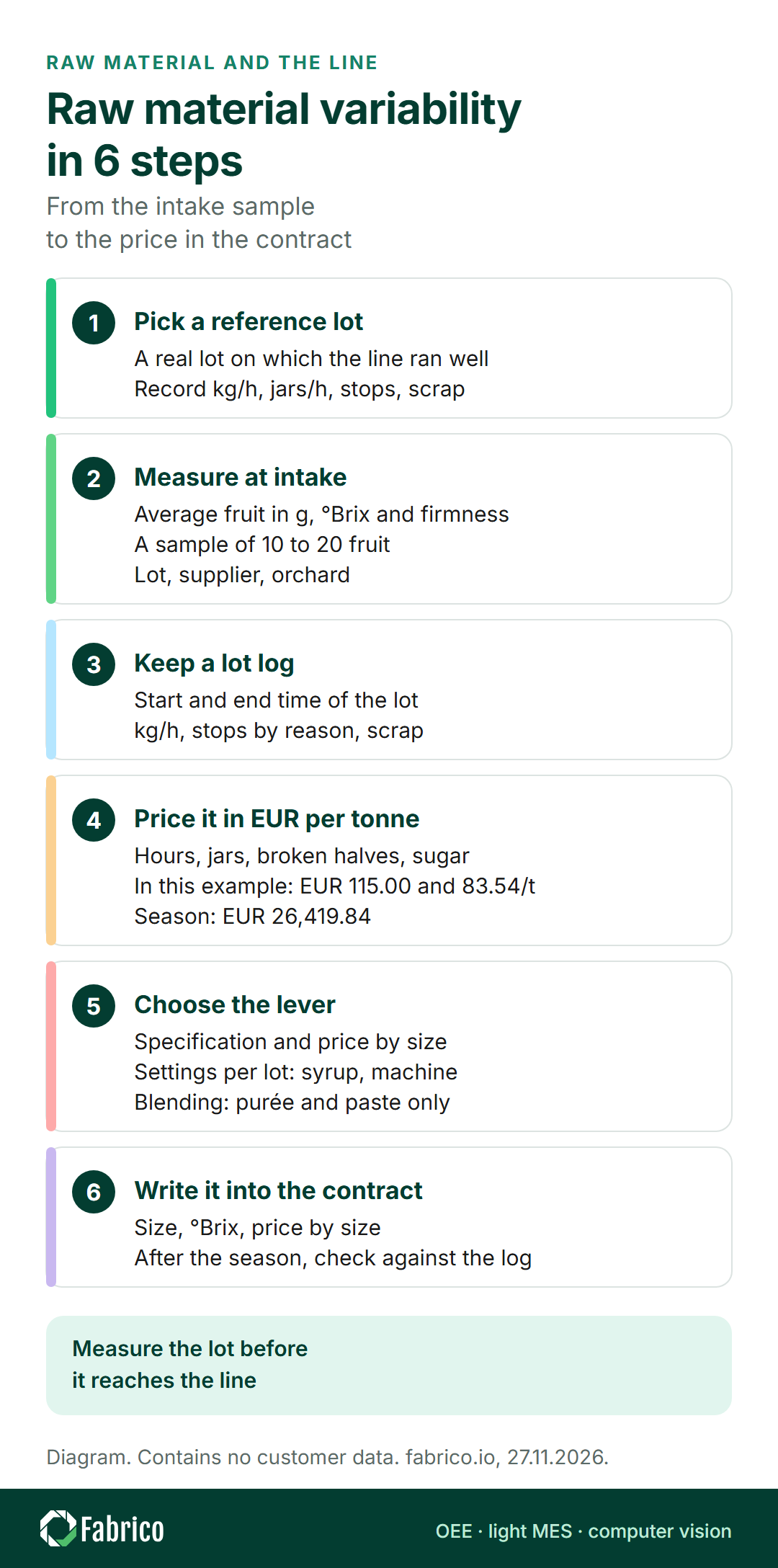
Text version of the diagram
- Pick a reference: a real lot from the season on which the line ran well; record kg/h, jars/h, stops and scrap.
- Measure at intake: average fruit in g, °Brix and firmness on a sample; record lot, supplier and orchard.
- Keep a lot log: start and end time; kg/h, stops by reason and scrap for the lot.
- Price it in EUR per tonne: extra hours, fewer jars, broken halves, sugar; in this example EUR 115.00 and 83.54 per tonne.
- Choose the lever: specification and price by size, settings per lot, or blending for purée and paste.
- Write it into the contract: size, °Brix and price by size; after the season, check the costing against the log.
Frequently asked questions
How does raw material quality affect line speed?
On machines that handle fruit one by one, kilograms per hour follow the average fruit weight. In this example, 96 g fruit instead of 120 g takes the pitting machine from 1,440 to 1,152 kg/h. Soft fruit adds jams, and lower °Brix needs a different syrup.
Do EU marketing standards apply to fruit for processing?
No. Regulation (EU) 2023/2429 excludes peaches for industrial processing from its standard, and Article 5 exempts products marked "intended for processing". Size and °Brix for processing are set in the contract with the grower.
How much does a lot of smaller peaches cost?
In this example a lot of 96 g fruit costs the line EUR 115.00 per tonne more than a lot of 120 g fruit: EUR 37.50 for extra hours and EUR 77.50 for fewer jars. Run it with your own kg/h, yield and contribution per jar.
How is syrup sugar calculated from fruit °Brix?
Multiply the target °Brix by the jar's product mass and subtract the sugar the fruit brings. In this example, sugar in the syrup is 112 - 4.4 × fruit °Brix, in grams: 63.6 g at 11 °Brix and 72.4 g at 9 °Brix.
When does blending lots solve raw material variability?
When the product is homogenised: purée, tomato paste, jam, juice. Blending averages °Brix, but not the size or firmness of individual fruit, so it does not help a halves line.
What should a raw material lot log record?
Lot and supplier, average fruit weight, °Brix and firmness at intake, start and end time, kg/h, stops by reason, broken halves and the cost in EUR per tonne against the reference lot.
See what each lot costs on your line. The demo shows OEE by line and shift, stops by reason, scrap by product and reason, and losses in EUR per SKU.
Latest from our blog






Real Fabrico tiles, sample data.