





 Login
 Blog

Line stops caused by packaging material: proving it to the supplier

In short
- The answer: link the material lot to the stops, the minutes and the euros, then confirm it with a standard lab test. Without a lot number, the argument with the supplier is your word against theirs.
- Log the lot at every change of reel, roll or pallet, with the time. The time is what joins the warehouse to the stop log.
- Compare per 1,000 packs against a lot that runs well on the same machine. A number with no reference point gets dismissed.
- Cheap film costs more: in the example, a 0.25 EUR/kg discount saves 160 EUR per lot while its stops cost 2,520 EUR.
- Notify first, prove second: in Bulgaria, Article 324 of the Commerce Act requires the buyer to notify the seller immediately.
How do you prove that the film, labels or cartons are stopping the machine? Log the lot number at every reel or pallet change. Code every material stop with a "material" reason and count the stops inside each lot's window, per 1,000 packs. Compare them with a lot that runs well on the same machine.
Turn the difference into minutes and euros, and confirm it with a standard lab test on retained samples. Then notify the supplier in writing, without waiting.
Written for production managers and buyers at food, beverage and FMCG plants. Below you get symptom tables by material and machine, a 4-part evidence pack template and a worked example carried through to euros per year. You also get the notice deadlines for a commercial sale under Bulgarian law.
Bad material symptoms by machine
Suspect the material when stops start and end with a lot change. If they follow the crew, the format or a settings change, look at the machine. The tables link what you see on the machine to the material property behind it and the test that confirms it.
Film: flow wrapper and shrink wrapper
| Symptom on the machine | Likely property | Test that confirms it |
|---|---|---|
| Film drags on the forming shoulder, pack length drifts, the knife cuts off the print mark | Coefficient of friction outside the spec | ISO 8295: static and dynamic coefficient |
| Wrinkles, the web wanders, weak seals in one lane across the width | Uneven thickness | ISO 4593: thickness by mechanical scanning |
| A stop at the same point in every reel | Factory splices: count, tape, marking | Splices per reel counted against the spec |
| The lot runs well at first, then drags after weeks in a warm store | Slip additive changes with time and temperature | ISO 8295 on samples of the same age and storage |
| Film tears on acceleration or at a splice | Weak spots, holes, poor winding | Reel inspection and a retained sample for the lab |
ISO 8295 measures the coefficient of friction of plastics film sliding over itself or another substance. ISO itself states that the method serves mainly for quality control and does not give a full assessment of how the film runs on a machine (ISO 8295:1995, accessed 26.11.2026).
So the lab result and the line data travel together. Either one alone is not proof.
Thickness is measured to ISO 4593:1993 (not suitable for embossed film), accessed 26.11.2026.
The age of the reel matters too. A study of polyethylene films with slip additives measured the coefficient of friction from day 0 to day 14 at 23 °C and 50 °C. Friction changed with the type of additive and with ageing time (Ningrum et al., 2023, accessed 26.11.2026).
Test both lots at the same age and after the same storage. Write the production date next to the lot number.
Splices your own crew makes at a reel change are a separate subject: see film splice stops. This page is about factory splices inside the reel, which are a property of the lot. For multipack film, see also how to measure shrink wrapper OEE.
Labels: labeller
| Symptom on the machine | Likely property | Test that confirms it |
|---|---|---|
| Labels will not dispense from the liner, the web breaks | Release force too high or uneven | FINAT FTM 3 (low speed) and FTM 4 (high speed) |
| Labels flag or fall off cold or wet bottles | Adhesive: adhesion and initial tack | FINAT FTM 1 (180° peel), FTM 9 (loop tack), FTM 13 (low temperature) |
| Labels land skewed, edges lift | Label curl, dimensional change | FINAT FTM 14 (dimensional stability) and a lay-flat check |
| A stop at every join in the roll, or the wrong unwind direction | Joins, winding direction | FINAT guidance on joins and the unwind roll chart |
FINAT, the self-adhesive label industry body in Europe, maintains a set of test methods (FTM) and guidance on joins in label rolls and on unwind direction (FINAT Test Methods, accessed 26.11.2026).
On cold-filled bottles, the label lands on a cold surface that can be wet. So for beverages, ask for FTM 13, low temperature adhesion. More on this machine's losses: labeller OEE.
Cases and folding cartons: case packer and cartoner
| Symptom on the machine | Likely property | Test that confirms it |
|---|---|---|
| Double feeds, magazine jams | Caliper outside tolerance | ISO 3034 (corrugated), ISO 534 (board) |
| The vacuum misses the blank or the carton will not open | Warped blanks | Flatness check after conditioning to ISO 187 |
| Cartons open stiffly or skewed | Crease too stiff or off position | Opening force by a method agreed with the supplier |
| The glue joint opens | Glue quantity or position | Joint test by an agreed method |
| Corrugated delaminates on folding | Weak bond between flute and liner | FEFCO No. 11: glue bond adhesion strength |
ISO 534 measures the thickness of paper and board, but it does not apply to corrugated fibreboard. For corrugated, the method is ISO 3034 (ISO 534:2011, ISO 3034:2011, accessed 26.11.2026).
The comparison only holds on conditioned samples. ISO 187 sets the standard atmosphere for conditioning and testing pulp, paper and board (ISO 187:2022, accessed 26.11.2026). A case straight off a cold truck and a case that has sat in the hall are not in the same state.
FEFCO, the European corrugated board industry body, publishes its own test methods as a common basis for communication between corrugated makers and their customers. They include No. 11 for glue bond adhesion strength and No. 50 for compression resistance (FEFCO Testing methods, accessed 26.11.2026).
The losses on these machines in detail: case packer OEE and cartoner OEE.
Tie every reel, roll and pallet to the run
The supplier will ask one thing: how do you know this exact lot was on the machine when it stopped? The answer is a number and a time. Without this step, the rest is opinion.
The delivery label
For food contact materials, Regulation (EC) No 1935/2004 requires traceability at all stages. Materials on the market must be identifiable through labelling or documents. Operators must be able to identify who supplied them and to whom (Regulation (EC) No 1935/2004, Article 17, accessed 26.11.2026).
A supplier of food packaging film should already know its lots. Put it in the purchase order that every reel and pallet carries:
- the lot number;
- the reel or pallet number;
- the production date;
- for film: the number of factory splices in the reel;
- a barcode with the same data, so it can be scanned at issue.
Logging at each material change
- The operator logs the lot and reel number at every material change, with the time.
- Where there is an ERP, scan the label when the material is issued to the line. The time logs itself.
- Code every material stop by type: "material: film", "material: label", "material: case". The lot number goes in the comment.
- Keep a sample of every lot: 2-3 m of film, 20 labels or 10 blanks, with the lot label.
A paper log at the machine is enough to start, but it misses short stops: a 40-second stop may never get written down.
If you are choosing equipment downtime tracking software, check that it takes stops from the machine signal and leaves the operator only the reason and the comment. For how to structure the reasons themselves, see downtime reason code design.
How long to collect data
- The full lot, or at least 5 shifts for each of the two lots you compare.
- Every crew runs both lots. Otherwise you are comparing people, not material.
- One machine, one format, one speed. Note the settings at the start and do not touch them without a note.
- A-B-A order: reference lot, suspect lot, reference lot again. If stops jump with B and drop with A, the machine is cleared.
- Small numbers prove nothing. 3 stops against 5 is noise. Keep collecting until the gap is clear.
The 4-part evidence pack
The pack answers the four questions the supplier will ask: which material, how often, how long and how much money. The numbers in the last column come from the worked example in the next section.
| Part | What it proves | Where the data comes from | Example |
|---|---|---|---|
| 1. Lot | Which material was on the machine | Reel label, goods receipt, ERP | Lot B: 640 kg, 40 reels |
| 2. Stops | That the lot stops the machine more often than the reference | Stop log with reason and comment, matched by time to the reel changes | 60 stops in 400,000 packs: 0.15 per 1,000 against 0.03 |
| 3. Minutes | How much time was lost | Stop log | 240 min against 42 min |
| 4. EUR | What it cost | Minutes times the value of a minute, plus scrap | 2,520 EUR per lot |
Attach to the four parts:
- a lab report for both lots, to the same standard;
- photos of the reel label and of the defect itself;
- video of the minute of the stop, if a camera covers the line;
- the machine settings during both lots;
- the specification and purchase order the material was delivered against.
A number with no reference proves nothing. The supplier will call "60 stops" a machine problem. "0.15 against 0.03 stops per 1,000 packs, on the same machine, across every crew" is a fact they have to explain.
Worked example: one flow wrapper, two films
These numbers are an example, not a customer's data. A biscuit line with a flow wrapper. Supplier B offers film at 0.25 EUR/kg less than supplier A, and purchasing releases one lot of B.
- Speed: 100 packs a minute, about 40,000 packs a shift.
- Pattern: 2 shifts for 21 days, so 42 shifts a month and 504 a year.
- Film use: 1.6 kg per 1,000 packs, so 64 kg a shift.
- One lot: 640 kg of film, enough for 400,000 packs, about 10 shifts.
| Measure for one lot | Film A | Film B |
|---|---|---|
| "Material: film" stops | 12 | 60 |
| Stops per 1,000 packs | 0.03 | 0.15 |
| Average minutes per stop | 3.5 | 4.0 |
| Total stop minutes | 42 | 240 |
| Stop minutes per shift | 4.2 | 24 |
| Stops per shift | 1.2 | 6 |
What one minute is worth
There are two ways to price the minute, and the supplier should see both. The first applies when the line is the bottleneck and everything it makes is sold. Then every lost minute is lost margin: 100 packs at 0.12 EUR margin = 12 EUR a minute.
The second applies when you catch up with overtime. Then the minute costs what the crew costs: 3 people at 15 EUR an hour = 45 EUR an hour, or 0.75 EUR a minute.
In both cases, add scrap: each stop sends 20 packs to scrap at 0.15 EUR, so 3 EUR a stop.
The maths, line by line
- Extra stop minutes per shift with B: 24 - 4.2 = 19.8 min.
- Extra stops per shift: 6 - 1.2 = 4.8.
- Loss per shift at lost margin: 19.8 × 12 = 237.60 EUR plus scrap 4.8 × 3 = 14.40 EUR, total 252 EUR.
- Loss per lot (10 shifts): 2,520 EUR. Price saving: 640 kg × 0.25 = 160 EUR. Net loss: 2,360 EUR per lot.
- Per month (42 shifts): 42 × 252 = 10,584 EUR lost. Saving: 42 × 64 kg × 0.25 = 672 EUR. Net loss: 9,912 EUR.
- Per year (504 shifts): 127,008 EUR lost against 8,064 EUR saved. Net loss: 118,944 EUR.
- The same maths at overtime cost: 19.8 × 0.75 = 14.85 EUR plus 14.40 EUR scrap, total 29.25 EUR a shift. Per lot, 292.50 EUR against a 160 EUR saving. Per year, 14,742 EUR against 8,064 EUR, a net loss of 6,678 EUR.
Film B loses either way. To break even, B would have to be cheaper by 29.25 / 64 = 0.46 EUR/kg at overtime cost, and by 252 / 64 = 3.94 EUR/kg at lost margin. A 0.25 EUR/kg discount does not reach even the lower figure.
Run the same sums with your own speeds and margins in the loss calculator. If the line is not the bottleneck, use the overtime cost: it is lower, but it is not zero.
Incoming checks that catch it before the line
A check in the warehouse costs minutes; a stop on the line costs euros every minute. You do not need to test everything yourself. Ask the supplier for a certificate for every lot with measured values against the spec, and keep your own testing for doubts and new suppliers.
| Material | Check at goods-in | Method | When |
|---|---|---|---|
| Film | Label: lot, reel, date, splices; winding direction | Visual | Every delivery |
| Film | Coefficient of friction | ISO 8295 | Certificate per lot, own test when in doubt |
| Film | Thickness | ISO 4593 | Certificate per lot |
| Labels | Unwind direction, joins | FINAT guidance | Every delivery |
| Labels | Adhesion and initial tack | FINAT FTM 1, FTM 9 | New material or in doubt |
| Cases, cartons | Caliper after conditioning | ISO 3034 or ISO 534, ISO 187 | Every lot |
| Food packaging | Declaration of compliance | Regulation (EU) No 10/2011, Article 15 | New material or a change |
For plastics in contact with food, Regulation (EU) No 10/2011 requires a written declaration of compliance at every marketing stage other than retail. The declaration must allow easy identification of the material. It is renewed when substantial changes in composition or production change the migration (Regulation (EU) No 10/2011, Article 15, accessed 26.11.2026).
So with a new supplier, the declaration is the first document. When a film suddenly behaves differently, ask whether its composition has changed.
Incoming checks test the lot, not the supplier. For a structured review of the supplier itself, use a separate supplier audit checklist.
The claim: what to send and when
What the law says in Bulgaria
A transaction concluded by a merchant and connected with its business is commercial (Commerce Act, Article 286). A sale that is a commercial transaction is a commercial sale (Article 318). A plant buying film for its line falls here.
This is what the texts say (Commerce Act and Obligations and Contracts Act on lex.bg, accessed 26.11.2026):
- Commerce Act, Art. 324: the buyer must inspect the goods and, if they do not meet the requirements, notify the seller immediately. If the buyer does not, the goods are deemed approved, except for hidden defects.
- Commerce Act, Art. 288: for matters the Act does not settle, civil legislation applies to commercial transactions.
- Obligations and Contracts Act, Art. 194: if defects are found later that could not be noticed in an ordinary inspection, the buyer keeps its rights by notifying the seller immediately after finding them.
- Obligations and Contracts Act, Arts. 193 and 195: the seller is liable for defects that significantly reduce the value of the goods or their fitness for ordinary use or for the use set in the contract. The buyer may return the goods, ask for a price reduction or remove the defect at the seller's cost, and may also claim damages under the general rules.
- Obligations and Contracts Act, Art. 197: claims under Article 195 for movable goods lapse 6 months after delivery, or 3 years if the seller knowingly concealed the defect. The parties may extend or shorten the term.
- Commerce Act, Art. 325: if you refuse goods sent from another place, you must keep them with the care of a good merchant for the time the seller normally needs to give instructions.
The practical point: you cannot see a coefficient of friction at goods-in. That kind of defect shows on the machine. Notify on the day the stops reveal it, not after a month of collecting data.
This is a summary of the legal texts, not legal advice. Your supply contract may set its own deadlines, thresholds and claims procedure. Read it, and talk to a lawyer before a large claim.
The letter in 6 steps
- Day 0, first notice: in writing, with the lot, the reel numbers, the symptom, the time and the action taken (the lot is on hold).
- Lot on hold: separate the remaining reels or pallets, mark them and store them in normal conditions.
- Within 1-2 weeks, the pack: the four parts, the lab report, the photos and, if you have it, the video.
- The request: replacement, a price reduction or cover of the costs. Show the sums in euros.
- An offer of a joint test: a retained reel from both lots, on the line or at an independent lab.
- The deadline: track the 6 months from delivery under Article 197, unless the contract says otherwise.
If you are on the other side, a packaging maker receiving claims like this, see MES for packaging manufacturers: the same lot data helps the supplier find the cause too.
Claim, tighter spec, second supplier or machine settings?
A claim is only one of four ways out. The choice depends on what the lab and the line data show. The costs in the table come from the example above.
| Option | Pick it when | Who leads | Cost in the example |
|---|---|---|---|
| Claim | The lab shows the lot outside the spec | Purchasing and quality | Time for the pack and a test; damage up to 2,520 EUR per lot |
| Tighter spec | The lot is inside the spec, but the spec does not cover friction, thickness or splices | Quality and process engineer | A premium of up to 0.46-3.94 EUR/kg pays back |
| Second supplier or back to A | The supplier misses the spec two lots in a row | Purchasing | An A-B-A trial of 5+ shifts and a declaration of compliance |
| Machine settings | Both lots are inside the spec and the stops follow the crew or the format | Maintenance and process engineer | Technician hours, no change of material |
An expensive mistake is to file a claim for material that is inside the spec. The supplier is then right, and the problem is the spec. If it has no coefficient of friction or splice count, add them first, then argue.
7 questions for the supplier
- What coefficient of friction range do you commit to for every lot: static and dynamic, film to film and film to metal? Do you measure to ISO 8295, and at what reel age?
- Can every reel label carry the lot, reel number, production date and splice count?
- Do you send a certificate with measured values for every lot, not just typical values?
- How many factory splices per reel do you allow, and how are they marked?
- Did the resin, additive or production line change for this lot? Has the declaration of compliance been renewed?
- Will you send a technician for a line trial with reels from both lots?
- What is your claims procedure, and does the contract change the legal deadline?
The diagram: the evidence pack on one page
Print the diagram and put it next to the machine and in purchasing. The six steps are the same for film, labels and cartons. Only the tests in step 5 change.
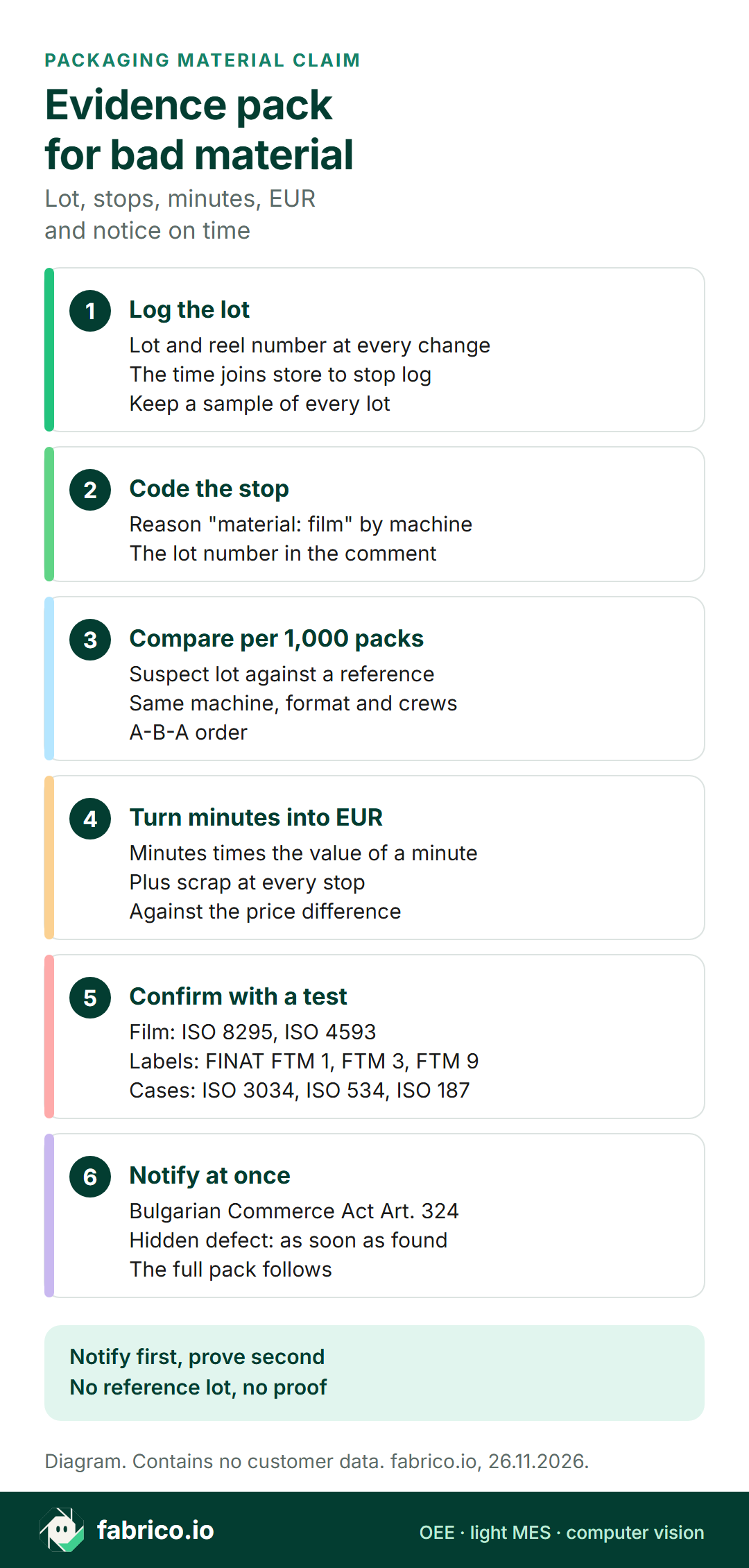
Text version of the diagram
- Log the lot: lot and reel number at every change, with the time; keep a sample.
- Code the stop: "material: film" reason by machine, the lot number in the comment.
- Compare per 1,000 packs: suspect lot against a reference, same machine, format and crews, A-B-A order.
- Turn minutes into EUR: minutes times the value of a minute plus scrap, against the price difference.
- Confirm with a test: film to ISO 8295 and ISO 4593, labels to FINAT FTM 1, 3 and 9, cases to ISO 3034, ISO 534 and ISO 187.
- Notify at once: Commerce Act Art. 324 at inspection; a hidden defect as soon as you find it; the full pack follows.
Where Fabrico fits
Fabrico is an OEE platform and light MES. In the pack it covers parts 2, 3 and 4. Fabrico does not hold the lot number: it comes from the operator's comment or the ERP and is matched by time.
- Stops by reason: the operator picks "material: film" for the specific machine in a few taps and types the lot in the comment.
- Pack count: output is counted from the line PLC or a Fabrico IoT device. Where a machine has no usable signal, a camera counts output.
- Hour, shift, EUR: analytics split by hour and shift, and stops are ranked by financial impact in euros.
- Video: where a camera covers the line, the minute of a stop is opened from the shift timeline and streamed on request, not stored. The team can watch the film tear while building the case. The camera does not detect the defect or the cause.
More on OEE with computer vision and on pricing.
Frequently asked questions
How long do I have to notify the supplier about bad material?
In Bulgaria, Commerce Act Article 324 requires immediate notice after inspection. For defects an ordinary inspection cannot reveal, Obligations and Contracts Act Article 194 keeps your rights if you notify immediately after finding them. Check the contract too: it may set its own term.
Can the supplier be made to pay for downtime, not just the material?
Article 195 of the Obligations and Contracts Act allows a claim for damages under the general rules, beyond replacement or a price reduction. That is why the pack carries the minutes and the euros. The contract may limit liability, so read the claims clause.
How many shifts of data do I need?
The full lot, or at least 5 shifts for each of the two lots, across every crew. The A-B-A order is the safest: reference, suspect lot, reference again, on the same machine.
What if the lab says the film is inside the spec?
Then it is not a claim. Either the spec does not cover the property that stops the machine, or the problem is in the settings. Add the missing parameter to the spec and check the machine.
Do I need my own coefficient of friction tester?
Not necessarily. Ask for a certificate with measured values for every lot to ISO 8295 and keep samples. In a dispute, send samples from both lots to an independent lab.
How should I code stops caused by the material?
With a reason by material type: "material: film", "material: label", "material: case", by machine. The lot number goes in the comment, and the time of the reel change in the log or the ERP.
Does the same apply to labels and cases?
Yes. The four parts of the pack stay the same. Only the tests change: FINAT FTM for labels, ISO 3034 or ISO 534 and ISO 187 for cases and cartons.
See which reasons stop your machines and what they cost. The demo shows stops by machine and reason, analytics by hour and shift, and stops ranked by loss in euros.
Latest from our blog







Real Fabrico tiles, sample data.