





 Login
 Blog
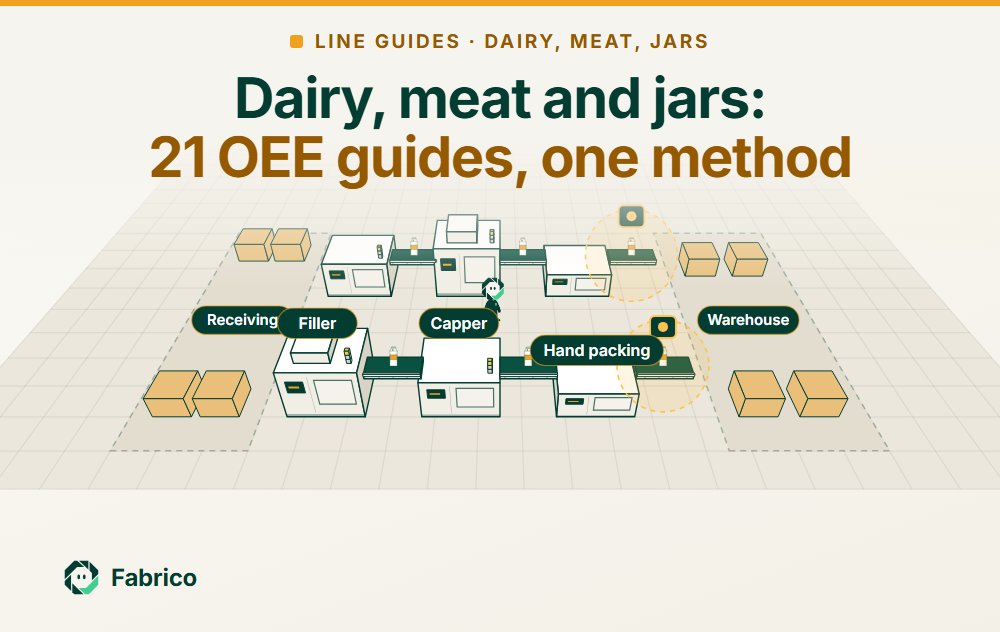
OEE for dairy, meat, chilled and packed goods lines: 21 guides

In short
- 21 guides for dairy, meat, chilled, jar, dry goods and household lines, each with its own worked example in money.
- One shared method: rate the process side and the packing side in their own units, name the side that paces the line, and book waiting for product as its own reason.
- Yield and giveaway are weighed in kilograms, apart from OEE.
Dairy, meat, jar and chilled lines have two halves that run at different speeds. The process half works in batches: a cheese vat, a churn, a kettle, a kitchen. The packing half runs in units or kilograms per minute: a filler, a stuffer, a slicer, a bagger. OEE goes wrong when the two are mixed into one number.
The shared method
The method that holds on all of them: rate each half in its own unit, then name the half that paces the line. When the filler waits for product, book it as waiting for product, with the batch as a sub-reason, owned by the process lead. Count good units after the last weight, seal and label check.
Ripening and brining are process time, not downtime. Only the minutes a machine waits because the step before it is not ready go into OEE.
Yield and giveaway are separate losses. A jar or pack filled above its declared weight still counts as good in OEE, so weigh it apart and price it at material cost. The rice and pulses guide shows why dry goods are better counted in kilograms than in bags.
| Situation | Book it as |
|---|---|
| The filler waits for the next batch | Waiting for product, sub-reason: batch; owned by the process lead |
| Ripening, brining or cooling in the recipe | Process time, not in OEE |
| A pack fails the weight, seal or label check | Quality, at the station that rejected it |
| A pack is over its declared weight | Outside OEE: weigh and price apart |
The 21 line guides
Each guide works through its own case: its own stations or decisions, its own worked example and its own sources.
Dairy
| Line guide | The question it answers |
|---|---|
| Ayran and drinking yogurt | From tank to filler: where does the line wait? |
| Brined white cheese | From vats to brine: where does a cheese line lose time? |
| Kashkaval lines | Steam, moulds and wheels: which step holds the line back? |
| Butter lines | The churn or the packer: which one sets the pace? |
Meat, chilled and plant-based
| Line guide | The question it answers |
|---|---|
| Sausage lines | From the stuffer to the pack: where are the losses? |
| Slicing lines | Slicer or packer: which station loses more, and what does it cost? |
| Plant-based meat lines | Extruder pace and start-up scrap: what do they cost? |
| Tofu lines | Press cycles, giveaway and downtime: how are they measured? |
| Hummus and dips | Kitchen, tub filler or HPP: which one paces the line? |
| Dumpling lines | Piece counts, open seams and filling drift: what do they cost? |
| Sandwich lines | Crew cards, changeovers and giveaway: how are they counted? |
Jars, oil and honey
| Line guide | The question it answers |
|---|---|
| Glass jar food lines | Lyutenitsa, pickles and jam: where does a jar line lose time? |
| Lyutenitsa and relish | Kettles, yield and jars: what does each loss cost? |
| Honey packing | Varieties, heating and rate: what slows a honey line? |
| Sunflower oil bottling | Stops and overfill: how are they measured and priced? |
Dry goods packing
| Line guide | The question it answers |
|---|---|
| Flour and sugar packing | In what order should the changeovers run? |
| Rice and pulses packing | Why count in kilograms, not bags? |
| Nut and dried fruit packing | Where does a nut packing line lose time? |
| Spice packing | Short runs, many changeovers: where does the time go? |
Household products
| Line guide | The question it answers |
|---|---|
| Bar soap lines | Extruder and stamping press: how are their losses split? |
| Wet wipes lines | Rolls, lotion and packs: where does a wipes line stop? |
How to pick where to start
Start with your product. If it is not listed, pick by the shape of the line:
- Batch process, then filler: ayran, butter, lyutenitsa, hummus.
- Continuous stuffing, forming or slicing: sausages, dumplings, plant-based meat, sliced meat and cheese.
- Filler or bagger only: sunflower oil, honey, flour, rice, spices, nuts.
- Converting and pressing: wet wipes, bar soap.
Many SKUs and short runs, as with spices or flour and sugar: start with the changeover order and the changeover time per product pair. Products packed to a declared weight, such as cheese, nuts, honey and oil: start with giveaway and yield.
From one line to the whole plant
One line can be measured with a clipboard. A dairy or meat plant with several lines, CIP between runs and three shifts needs the stops and counts logged as they happen. That is where OEE software pays. For the wider systems picture in a food plant, see MES for food manufacturing.
Where Fabrico fits
- OEE by line and shift, read at the core machine.
- Operators pick the stop reason on a tablet.
- Losses ranked by financial impact.
- Where a machine has no usable signal, a camera counts output.
Fabrico is made by the publisher of this article.
Frequently asked questions
Which machine do I read OEE from on a linked line?
From the machine that paces the line, for example the filler. Stops in the steps before it are booked as reasons for its stops, so the loss still lands with the step that caused it.
Does overfill count as a quality loss?
No. A pack above its declared weight is good output. Track overfill by weight and price it at material cost.
See where your filler waits, and what it costs. A Fabrico consultant walks you through OEE by line and shift, stop reasons chosen by operators and losses ranked by financial impact.
Questions first? Contact us.
Latest from our blog


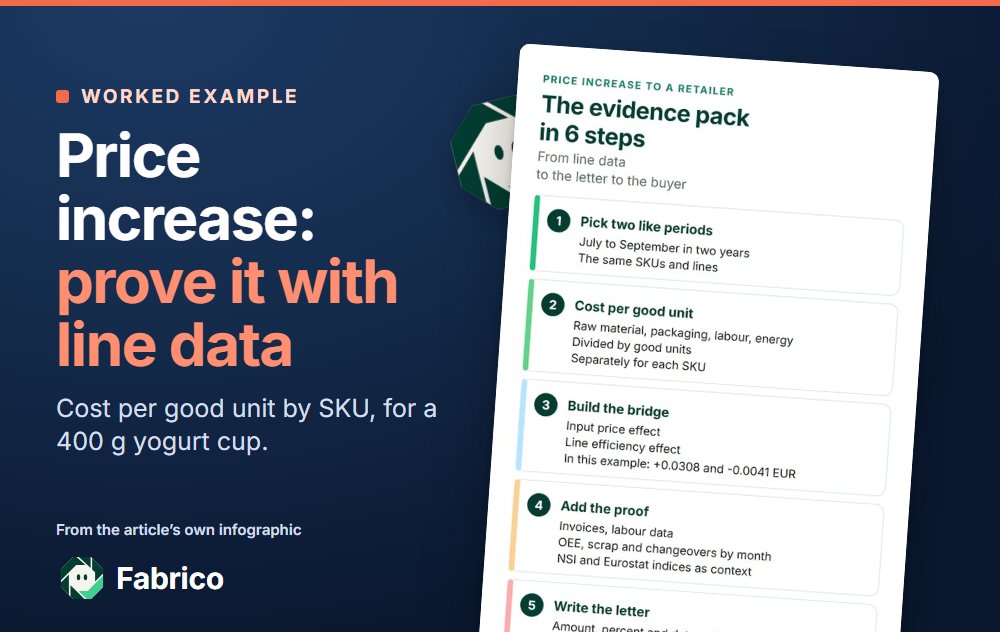
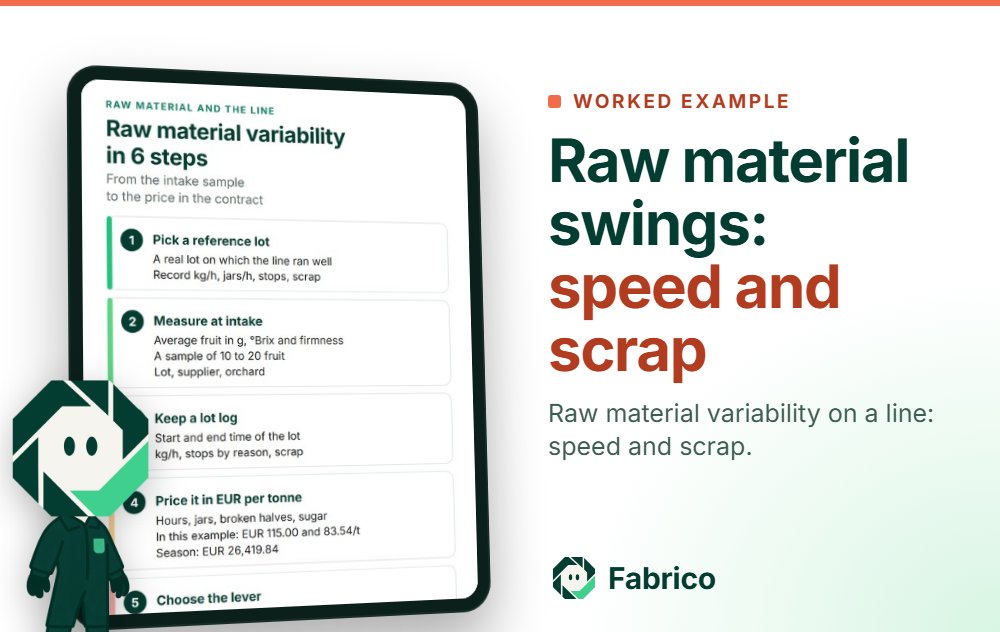


Real Fabrico tiles, sample data.