





 Login
 Blog
OEE in bar soap production: extruder and stamping press

In short
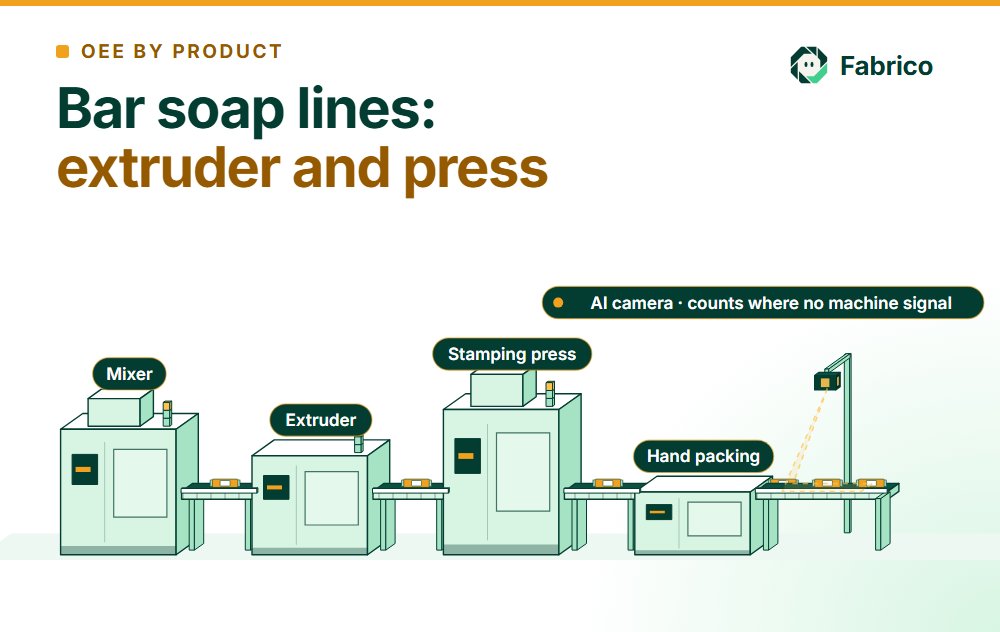
- A bar soap line is a chain of machines: dryer, mixer, rollers, extruder, cutter, stamping press and packing machine. OEE is read at the stamping press, because it makes the good bars.
- A change of scent and colour requires purging the extruder. The first kilograms after the change go back into the process and the machine makes no good bars.
- In the example below, the shift loses 824.40 EUR. The largest item is the scent changeover.
- Scent is also a label matter. Above a set concentration, fragrance allergens are declared in the ingredient list, so residue from the previous scent is not just a cosmetic problem.
OEE in bar soap production shows what share of the planned time the stamping press turns into good, shaped and packed bars. The losses covered here are scent and colour changeovers with purging, waiting for soap base from the dryer, stops to clean the stamping press, short stops at packing, and rejects for cracked bars, poor imprint and weight.
The article is for owners, technologists and production managers at soap and cosmetics companies that make bars on their own line or for private labels. You will find how each machine is measured against the stamping press, how purging is accounted for, and a calculation for one shift in euros.
Soap production in Bulgaria in numbers
According to Eurostat structural business statistics, in 2024 the group "Manufacture of soap and detergents, cleaning and polishing preparations" in Bulgaria had 115 enterprises with 3,237 persons employed (read on 27.11.2026). Bar soap makers are in this group, together with makers of liquid products.
Bar soap is a product with high volume and a low price per piece. In the example below the stamping press makes 120 bars per minute, so every minute of downtime is 120 bars. When one line makes scents for several brands, the number of changeovers per week is an important figure.
The machines along the line
| Machine | What it does | Losses that are recorded |
|---|---|---|
| Dryer | Dries the soap base to the required moisture | Base out of spec, late batch |
| Mixer | Adds scent, colour and additives | Recipe change |
| Rollers and extruder | Homogenise the mass and push it out as a log | Purging on change, overheating |
| Cutter and stamping press | Cut the log and shape the bar | Sticking in the press, cracked bars |
| Packing machine | Wraps the bars and places them in cases | Short stops, film, print |
Availability, performance and quality are defined per ISO 22400-2 (read on 27.11.2026). The stamping press is the core machine of this line: it decides how many bars come out. The dryer and the mixer come before it, the packing machine after it. Their stops are recorded as reasons for its downtime.
If the machines report their state by the PackML model (ISA-TR88.00.02, read on 27.11.2026), the stamping press shows "Suspended" when it waits for mass or for space at packing, and "Held" when it has stopped because of a problem of its own. That shows whether it was waiting or had a problem of its own.
The dryer and the soap base
The soap base passes through a dryer that brings it to the required moisture. If the base is too moist, the bars stick in the stamping press. If it is too dry, the bars crack.
When the dryer runs late or the batch is out of spec, the extruder and the stamping press stand still. On the stamping press this is recorded as "waiting for product" with the sub-reason "dryer" or "base out of spec". Without a sub-reason the stamping press looks like the weak spot, while the cause is two stages earlier.
Record the moisture of each base batch together with the time it left the dryer. These two values show which stops after it come from the base. When sticking or cracking grows, moisture is the first place to check.
The scent changeover: purging the extruder
Soap is made in a wide range of scents and colours. A change from one scent to another requires the mixer to be emptied and the extruder to be purged: the first kilograms of the new recipe push out the residue of the old one. Those kilograms are not good output. They go back into the process as rework.
Purging takes time in which the stamping press makes no good bars. Record it as a changeover with a separate standard for each recipe pair. A change from a light to a dark colour is shorter than the reverse, because the dark colour hides the residue of the light one.
Scent has a second side too. Under Regulation (EC) No 1223/2009 on cosmetic products, certain fragrance substances are declared in the ingredient list when they are above a set concentration (read on 27.11.2026). Residue from a previous scent can bring in a substance that the new label does not declare. That is why purging has a minimum it never goes below, and a check before packing starts.
Ingredient names, including those from the fragrance, are checked in the European Commission's CosIng database (read on 27.11.2026). It is useful to the technologist when writing the purging standard per recipe pair.
The stamping press: sticking and cracking
The stamping press shapes the bar under pressure. If the mass sticks to the die, the edge of the bar tears or the lettering does not print clearly. The operator stops and cleans the die.
Each cleaning lasts a few minutes and is recorded as downtime with the reason "stamping press cleaning". If cleanings grow, check the die temperature and the base moisture. Die cooling is a setting the technologist sets per recipe.
A cracked bar is a reject. It goes back into the process, but the line time is lost. Record rejects by recipe and by hour, to see whether cracking is linked to a certain base batch.
The rollers and the extruder: temperature and rate
The rollers mill the mass, and the extruder compacts it and pushes it out as a continuous log. The temperature of the mass in the extruder affects everything after it: cutting, stamping and weight.
When the extruder overheats, the log softens and the bars stick. When it is cold, the mass does not compact and the bar cracks. The operator lowers the rate to compensate. That reduction is a speed loss that shows in the OEE of the stamping press, while its cause lies in the extruder.
That is why the mass temperature at the extruder outlet is a useful number for every shift. Compared with speed loss by hour, it shows when the line runs slowly because of the mass, not because of the stamping press.
Packing after the stamping press
The bars go to a packing machine: film, paper or a carton box. When it stops for a reel change or a jam, the bars pile up and the stamping press has to stop. On the stamping press this is recorded as "blocked" with a sub-reason for packing.
A small buffer between the stamping press and packing absorbs the short stops at packing. Without a buffer, every half-minute jam on the packing machine also shows on the stamping press.
Bar size and the ideal rate
The stamping press makes bars of 75, 100 or 125 g. A bigger bar needs a longer cut of the log, and the machine makes fewer bars per minute. The ideal rate is set per size and recipe, not for the whole line. If the rate is taken from the fastest product, bigger bars show a speed loss that cannot be reduced.
Returned kilograms: a count outside OEE
Purged soap, cracked bars and cut-offs from cutting go back into the process. They are not lost raw material, but they are lost time for the mixer, the rollers and the extruder, which process them a second time.
That is why the weight of returned mass per shift is a separate number next to OEE. If it grows, the line does more work for the same number of good bars. Record it by recipe, to see which scents and colours return the largest amounts.
One shift of the stamping press in euros
The numbers are an example, not from a real customer. The stamping press makes 100 g bars at an ideal rate of 120 bars per minute. The shift is 450 planned minutes, and a stop over 2 minutes counts as downtime. The ideal for the shift is 54,000 bars.
In the middle of the shift the line moves from a dark to a light recipe, that is, in the direction with the longer purge. The contribution per bar is taken as 0.06 EUR. Replace it with your own.
| Reason | Stops | Minutes | Recorded as | Bars | EUR per shift |
|---|---|---|---|---|---|
| Scent changeover with purging | 1 × 35 min | 35 | downtime | 4,200 | 252.00 |
| Short stops at packing | 50 × 30 s | 25 | speed loss | 3,000 | 180.00 |
| Waiting for base from the dryer | 3 × 8 min | 24 | downtime, sub-reason dryer | 2,880 | 172.80 |
| Stamping press cleaning | 6 × 3 min | 18 | downtime | 2,160 | 129.60 |
| Rejects: cracked, poor imprint, weight | 1,500 bars | quality | 1,500 | 90.00 | |
| Total | 102 | 13,740 | 824.40 |
How these numbers are reached:
- Downtime: 35 + 24 + 18 = 77 minutes, run time 373 minutes. Availability: 373 / 450 = 82.9 %.
- In 373 minutes the ideal is 44,760 bars. Short stops take 3,000. 41,760 are shaped. Performance: 41,760 / 44,760 = 93.3 %.
- Rejects 1,500, good 40,260. Quality: 40,260 / 41,760 = 96.4 %.
- OEE: 82.9 % × 93.3 % × 96.4 % = 74.6 %. Check: 40,260 / 54,000 = 74.6 %.
- The loss: 13,740 bars × 0.06 EUR = 824.40 EUR per shift.
Ranked by value, the scent changeover comes first: 252.00 EUR. The direction of the change and the order of recipes through the week decide how many of them are long. Second are the short stops at packing: 180.00 EUR, a loss that shows only in speed loss.
If each of the 500 shifts in the year (two shifts a day, 250 working days) has one such scent changeover, it costs 126,000 EUR, and waiting for base costs 86,400 EUR. The sums are real only if every lost bar could have been sold; refine the estimate with the finance department.
Weight, batch and label
A bar is sold at a nominal weight. Under Directive 76/211/EEC on prepackaged products (consolidated text of 11.04.2009, read on 27.11.2026), the tolerable negative error for a package of 50 to 100 g is 4.5 g. The average weight of the batch may not be below the nominal weight.
The weight of a bar depends on the length of the cut log and on the density of the mass. When the moisture of the base changes, the weight changes too. The checkweigher after the stamping press shows this first.
The cosmetics regulation requires a batch number on the pack, along with the ingredient list. For soap it helps if the batch code points to the base batch and the day, because in a complaint about scent or colour that is the first question.
Who owns the dryer, the extruder and the stamping press
| Loss | Owner | Data they need |
|---|---|---|
| Scent changeover | Planning and the technologist | Minutes against the standard per recipe pair and direction |
| Waiting for base | The dryer supervisor | Minutes with sub-reason, batch moisture |
| Stamping press cleaning | The mechanic | Cleanings by hour, die temperature |
| Short stops at packing | The shift supervisor | Speed loss by hour |
| Rejects | Quality | Rejects by recipe and by base batch |
Mistakes in recording soap
| Mistake | What you see later | How to avoid it |
|---|---|---|
| Purging is counted as run time | The changeover looks short | Purging is part of the changeover |
| Waiting for base is "stamping press downtime" | The stamping press looks like the problem | "Waiting for product" with sub-reason dryer |
| One standard for every scent changeover | The costly direction gets lost | Standard per recipe pair and direction |
| Rejects without a base batch | You cannot see which base cracks | Rejects by base batch |
The numbers that start the day
Four numbers from yesterday are enough: the OEE of the stamping press, the number of scent changeovers and in which direction, the minutes of waiting for base, and the stamping press cleanings.
If waiting grows, the conversation is with the dryer. If cleanings grow, check moisture and cooling. If the changeovers go in the costly direction, the conversation is with the plan. Kilograms returned to the process are reviewed in the same meeting, because they show work that OEE does not count. The mass temperature at the extruder outlet completes the picture when speed loss grows.
What to choose for a soap line
| Method | Suitable when | What it misses |
|---|---|---|
| Paper log | One line, few recipes | Short stops and the direction of the changeover |
| PLC counter into a spreadsheet | First estimate | Reasons and the link to the dryer |
| OEE software with a signal and reasons from the operator | A wide range of scents and brands | Base moisture, if it is not entered |
Questions for the vendor:
- How is "waiting for product" recorded with a sub-reason for the dryer?
- Can the standard scent changeover time depend on the direction?
- Can base moisture be entered for the batch?
- How is an ideal rate set per bar size?
- What happens to the bar count if the plant network drops?
More on changeover standards is in the article changeover standards in FMCG, and on the packing machine after the stamping press in the article OEE for a flow wrapper.
How to start
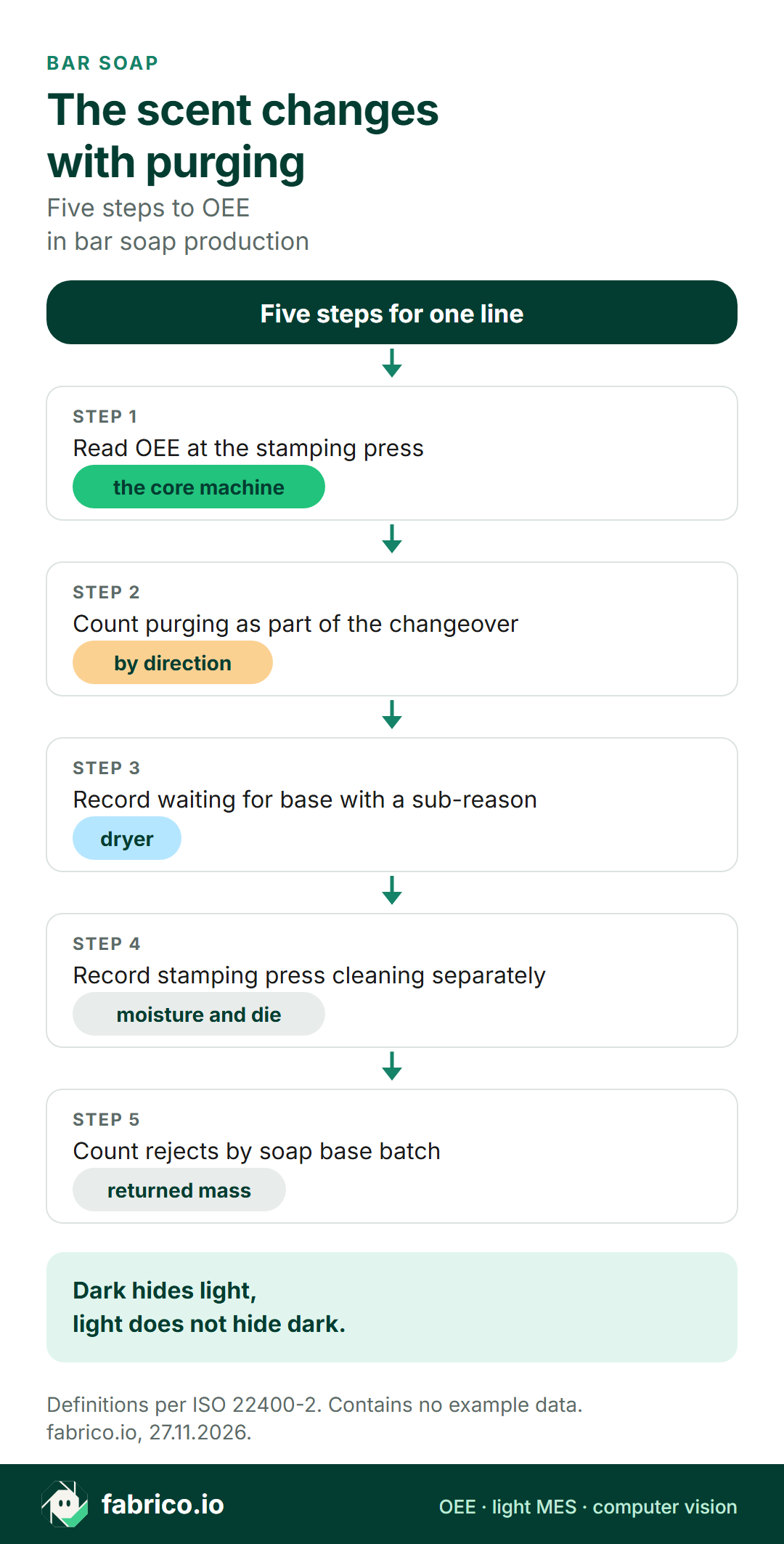
Text version of the diagram
- Read OEE at the stamping press.
- Count purging as part of the changeover.
- Record waiting for base with the sub-reason dryer.
- Record stamping press cleaning as a separate reason.
- Count rejects by recipe and base batch.
Fabrico provides the measured rates per line; the plan itself is made in the ERP, the APS or the planning spreadsheet.
This week: time one scent changeover in each direction; record the moisture of each base batch; count stamping press cleanings by hour.
This quarter: a signal from the PLC of the stamping press and reasons from the operator; a purging standard per recipe pair; a scent plan ordered by direction.
Where Fabrico fits
Fabrico is made by the publisher of this article.
- What it is: an OEE platform and light MES with built-in maintenance management. It shows live OEE by line and shift.
- Connected line: OEE is read at the core machine, and waiting for product and blocked time are recorded as stop reasons.
- Data: machines connect through the line PLC or through a Fabrico IoT device; where there is no signal, a camera counts output.
- Reasons: stops above the threshold get a reason in a few taps, and stops under the set threshold (up to 10 minutes) go into speed loss. The camera does not identify the reason.
- Money: with the Financial Impact module every loss has a price in EUR.
- Video: where a camera covers the line, the video for the minute of a stop opens from the shift timeline, is streamed on request and not stored in Fabrico.
- Hosting and security: EU customers are hosted on AWS in Frankfurt. Certified to ISO/IEC 27001, ISO/IEC 20000-1 and ISO 9001. The gateway keeps data for up to 30 days if the network drops.
- Price: one quote per plant, based on machines and modules (pricing).
For cosmetics production, see also the article MES for cosmetics manufacturing.
A result from a Bulgarian plant
At Ficosota, a maker of home care, hygiene and consumer goods, the time without a recorded stop reason fell from 3.20 % to 0.40 % between June and September 2026.
The result is from 16 lines with OEE and the Financial Impact module, and OEE rose from 53.11 % to 59.62 %. The figures are approved by the customer.
Ficosota is also an investor in Fabrico (since January 2025) and an industrial partner in developing the OEE module; keep that in mind when reading the results.
See one shift of a soap line in Fabrico. In a demo you will see the stops by reason and what each one costs in euros.
Frequently asked questions
Which machine is OEE read at on a bar soap line?
At the stamping press, because it decides how many good bars come out. The dryer, the mixer and packing are recorded as reasons for its stops.
Is purging the extruder part of the changeover?
Yes. While the new recipe pushes out the old one, the stamping press makes no good bars. Purging is part of the scent changeover standard, and the kilograms from it are recorded as returned mass.
Why do bars stick in the stamping press?
Because the base is moister than spec or the die is warm. Compare stamping press cleanings with the batch moisture.
Why does the direction of the scent changeover matter?
A dark colour hides residue of a light one, but a light colour does not hide a dark one. That is why a change from dark to light needs a longer purge.
How much lighter can a 100 g bar of soap be?
By up to 4.5 g. Directive 76/211/EEC allows this error for packages from 50 to 100 g, and the average weight of the batch must be at least 100 g.
Is a camera needed on a soap line?
Not for a stamping press with a PLC. A camera helps where bars are placed in cases by hand, where it counts the finished cases.
Latest from our blog





Real Fabrico tiles, sample data.