





 Login
 Blog
OEE in kozunak production: proofing, braiding, oven

In brief
- Kozunak (Bulgarian sweet Easter bread) is made in hours and sold for weeks. When the oven runs three shifts around Easter and Christmas, every lost minute is a lost sale.
- Proofing sets the pace. If the proofing chamber is not ready, the oven waits. OEE is read at the oven, and the wait is recorded as a reason against it.
- In the example below, the shift loses 1,035 EUR. The largest item is waiting for proofed dough.
- Hand braiding is a station with no signal. There a camera counts the finished braids, and the operator records the reasons.
OEE in kozunak production is the share of planned time in which the oven makes good, baked and packed kozunaks. The losses covered here are waiting for proofed dough, product changeover with cleaning, empty spaces on the belt when braiding falls behind, oven temperature corrections, and rejects for burnt or collapsed kozunaks and for weight.
This article is for owners, technologists and production managers in bakeries and plants that make kozunak and sweet breads, especially in the season. You will find how the oven is measured, how proofing and hand braiding are counted against it, and a calculation for one shift and for the whole season in euros.
Bread making in Bulgaria in numbers
In the group "Manufacture of bread; manufacture of fresh pastry goods and cakes" in Bulgaria, 2,531 enterprises with 19,131 persons employed were active in 2024, according to Eurostat structural business statistics (accessed 27.11.2026). Kozunak producers belong to this group.
Kozunak is a seasonal product. The weeks before Easter are the period when the oven runs at full capacity, so this article looks at the season as well, not only at one shift.
The stages of kozunak
| Stage | What happens | Losses that are recorded |
|---|---|---|
| Mixing | Dough with eggs, butter, sugar and yeast | Late batch, dough out of temperature |
| First proofing | The dough proofs for hours | The chamber is full or not ready |
| Dividing and braiding | The dough is divided and braided by hand or by machine | Braiding falls behind, empty spaces |
| Second proofing and baking | The braids proof in tins and are baked | Temperature correction, burnt kozunaks |
| Cooling and packing | The kozunaks cool and go into bags | Short stops, weight |
The definitions of availability, performance and quality follow ISO 22400-2 (accessed 27.11.2026). The oven is the core machine: it sets how many kozunaks come out in the shift. The proofing chambers and braiding come before it, packing after it. Their delays and stops are recorded as reasons for its downtime.
Mixing: a batch with eggs and butter
Kozunak dough is mixed in batches. It contains flour, eggs, butter, sugar, milk and yeast, and the dough temperature after mixing decides how fast it will proof. If the dough comes out colder, proofing takes hours longer. If it comes out warmer, the dough proofs fast, but the kozunak then collapses in the oven and comes out lower than the standard.
That is why the dough temperature after each mix is a useful number. Recorded together with the mixing time, it shows whether tomorrow's wait at the oven will come from mixing or from the chamber.
Proofing: the clock of the line
Kozunak dough is rich in butter and sugar and proofs slowly. The first proofing lasts hours, and so does the second, in the tins. The technologist sets the time and temperature in the recipe, and the shift supervisor checks them per batch.
When the proofing chamber is full or the dough has not proofed, the oven stands. On the oven this is recorded as "waiting for product" with the sub-reason "proofing". Without a sub-reason the report shows the oven as the weak spot, while the cause lies in mixing or in chamber capacity.
It helps if every dough batch carries its mixing time. Then you can see how many hours it actually proofed, and whether the delay comes from mixing, from the chamber or from the temperature in the hall.
Braiding: a station with no signal
When kozunak is braided by hand, the braiders' pace changes during the shift. When braiding falls behind, empty spaces remain on the belt to the oven, and the oven bakes less than it can.
Empty spaces are not downtime: the oven is running. They are speed loss. If speed loss rises at certain hours, check how many braiders are on the shift and when their breaks are.
The hand braiding station has no PLC and no signal. There a camera pointed at the table counts the finished braids. The operator records the reasons for falling behind, because the camera counts output and does not determine the reason.
Machine braiding
Some bakeries braid by machine. The machine has its own signal and its own pace, and its stops get a reason like any machine. When the machine and the hand table work side by side, the counts from both are added together, and the reasons are recorded separately for each.
The oven: temperature and colour
Kozunak is baked at a lower temperature than bread, because sugar and butter darken quickly. If the oven is too hot, the top crust burns before the middle is baked. The operator corrects the temperature and stops the belt.
Every correction above the threshold is downtime with the reason "temperature". Regulation (EU) 2017/2158 requires bakery producers to apply measures to reduce acrylamide and to check its levels (accessed 27.11.2026). For the oven, this means colour is a parameter with its own control, not only a matter of taste.
Fillings and allergens
Kozunak is made plain, with raisins, with walnuts, with Turkish delight or with chocolate. Eggs, milk, gluten and nuts are listed in Annex II to Regulation (EU) No 1169/2011 among the substances that cause allergies (accessed 27.11.2026). The dough contains eggs, milk and gluten in all variants. Nuts are not in all of them.
Changing from walnut kozunak to kozunak without nuts requires cleaning the tables, the belts and packing. The opposite direction is short. Order the day from the variants without nuts to those with nuts, so there is only one full cleaning.
One oven shift in euros
The numbers are an example, not from a real customer. The oven bakes 500 g kozunaks at an ideal rate of 20 pieces per minute. The shift is 450 planned minutes, and a stop longer than 2 minutes is recorded as downtime. The ideal for the shift is 9,000 kozunaks.
In the middle of the shift the line changes from walnut kozunak to plain kozunak, that is, in the direction that needs cleaning. Both variants are 500 g with the same ideal rate. The contribution per piece is taken as 0.50 EUR. As a reference, data from Aswath Damodaran (NYU Stern) show a gross margin of 23.23 % for American listed food processing companies (data as of January 2026, accessed 27.11.2026). Use your own price.
| Reason | Stops | Minutes | Recorded as | Kozunaks | EUR per shift |
|---|---|---|---|---|---|
| Waiting for proofed dough | 2 × 14 min | 28 | downtime, sub-reason proofing | 560 | 280.00 |
| Changeover from a walnut variant to a variant without nuts | 1 × 25 min | 25 | downtime | 500 | 250.00 |
| Empty spaces when braiding falls behind | 42 × 30 s | 21 | speed loss | 420 | 210.00 |
| Temperature correction | 4 × 4 min | 16 | downtime | 320 | 160.00 |
| Rejects: burnt, collapsed, weight | 270 pieces | quality | 270 | 135.00 | |
| Total | 90 | 2,070 | 1,035.00 |
How the numbers are reached:
- Downtime: 28 + 25 + 16 = 69 minutes, run time 381 minutes. Availability: 381 / 450 = 84.7 %.
- For 381 minutes the ideal is 7,620 kozunaks. The empty spaces take away 420. 7,200 are baked. Performance: 7,200 / 7,620 = 94.5 %.
- Rejects 270, good 6,930. Quality: 6,930 / 7,200 = 96.3 %.
- OEE: 84.7 % × 94.5 % × 96.3 % = 77.0 %. Check: 6,930 / 9,000 = 77.0 %. (calculated with unrounded values).
- The loss: 2,070 kozunaks × 0.50 EUR = 1,035.00 EUR per shift.
Ranked by value, waiting for proofing comes first: 280.00 EUR, a loss that comes from mixing and from chamber capacity. Second is the variant changeover: 250.00 EUR, a loss that the order of the day reduces to one cleaning.
The season: what 108 shifts cost
If the season before Easter is 6 weeks, at 6 days a week and 3 shifts a day, that is 108 shifts. If each looks like the example, waiting for proofing costs 30,240 EUR and the variant changeover 27,000 EUR, with one such changeover per shift. The amounts are real only if every lost kozunak could have been sold; confirm the estimate with the finance department.
In the season the loss has another side: a kozunak not baked by Easter is not sold after it. That is why the season plan is made backwards from the last delivery day, and the capacity of the proofing chambers is the number it starts from.
After the season, the OEE data show which losses were the costliest. If waiting for proofing came first, the answer is in the chambers or in the mixing schedule. If it was braiding, the answer is in the people or in a braiding machine. This conversation happens in summer, not in March.
Cooling and packing
Kozunak is packed once it has cooled. A warm kozunak steams up the bag and gets crushed. If cooling is short, packing waits; if the cooling area is full, the oven has to stop. On the oven the second case is recorded as "blocked" with a sub-reason for cooling.
The cooling area is capacity, like the proofing chambers. In the season it fills up fastest, so the number of trolleys in it is a useful number for every shift.
The ideal rate by size
Kozunak is made in 400 g, 500 g and larger sizes. A larger one bakes longer, and the oven bakes fewer pieces per minute. The ideal rate is set by size and variant. A good rule is that it is the best sustained rate achieved for this product in a normal shift.
Weight, batch and label
Under Directive 76/211/EEC (consolidated text of 11.04.2009, accessed 27.11.2026), the tolerable negative error for a 500 g kozunak is 15 g. The average weight of the batch cannot be below the nominal weight.
Weight depends on dividing the dough and on moisture loss during baking. If the oven is hotter, the kozunak loses more moisture and gets lighter. The checkweigher after packing shows this first.
The bag carries a lot marking under Directive 2011/91/EU, with the exceptions in Articles 2 and 5 (accessed 27.11.2026). Under Article 5 the lot is not needed if the date of minimum durability shows at least the day and the month. For kozunak it helps if the lot points to the day and the dough batch, because in a complaint about the filling or the taste this is the first question.
Who owns the dough, the braiding and the oven
| Loss | Owner | Data they need |
|---|---|---|
| Waiting for proofing | The technologist | Minutes with sub-reason, mixing time of each batch |
| Variant changeover | Planning | Minutes against the standard by direction |
| Empty spaces from braiding | The shift supervisor | Speed loss per hour, number of braiders |
| Oven temperature | The baker | Corrections per hour and colour per batch |
| Rejects | Quality | Rejects by variant and by batch, average weight |
Mistakes in recording kozunak
| Mistake | What you see later | How to avoid it |
|---|---|---|
| Waiting for proofing is "oven downtime" | The oven looks like the problem | "Waiting for product" with a sub-reason |
| Empty spaces are not counted | OEE looks higher than it really is | Count from the oven signal or a camera on braiding |
| All variant changeovers are treated the same | The costly direction gets lost | Standard by direction |
| OEE is viewed only per shift | The season is not seen as a whole | OEE and loss for the whole season |
The numbers for a day in the season
Four numbers from yesterday are enough: oven OEE, minutes of waiting for proofing, speed loss from braiding and the number of variant changeovers.
If waiting rises, the conversation is with mixing and with the chambers. If speed loss rises, the conversation is about the braiding staff. Each number goes to the person who can change it.
What to choose for a kozunak bakery
| Method | Suitable when | What it misses |
|---|---|---|
| Paper log | Small bakery, one variant | Empty spaces and sub-reasons |
| Counter from the oven PLC in a spreadsheet | First assessment | Reasons and braiding |
| OEE software with an oven signal, a camera on braiding and reasons from the operator | Several variants and seasonal shifts | Mixing time, if it is not entered |
Questions for the vendor:
- How is "waiting for product" recorded with a sub-reason for proofing?
- Can a camera count the braids at a manual station without a PLC?
- Can the standard changeover time depend on the direction?
- Can the report show the whole season, not only the shifts?
- Are the counted pieces kept if the plant network goes down?
More on packing bakery products is in the article stops on a bread bagging line, and on manual stations in the article OEE of a manual station with a camera.
How to start
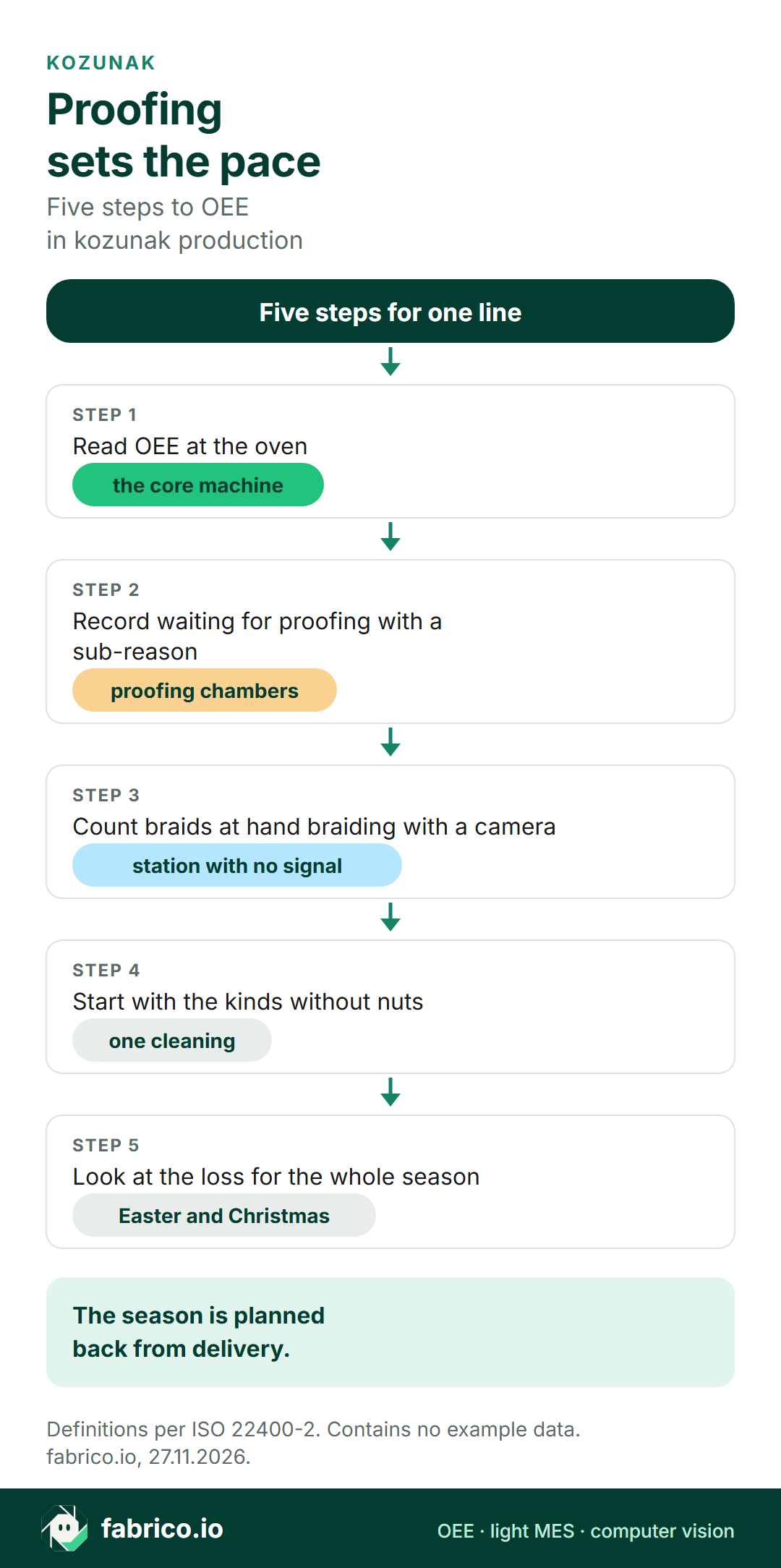
Text version of the diagram
- Read OEE at the oven.
- Record waiting for proofing with a sub-reason.
- Count the braids at hand braiding with a camera.
- Order the variants from those without nuts to those with nuts.
- Look at the loss for the whole season.
Fabrico provides the measured rates per line; the plan itself is made in the ERP, the APS or the planning spreadsheet.
This week: write down the mixing time of every batch; time one variant changeover in both directions; count the braids per hour at braiding.
Before the season: a signal from the oven PLC, a camera on hand braiding and reasons from the operator; a changeover standard by direction; a proofing chamber plan made backwards from the last delivery day.
Where Fabrico fits
Fabrico is made by the publisher of this article.
- What it is: an OEE platform and light MES with built-in maintenance management. It shows live OEE by line and shift.
- Connected line: OEE is read at the core machine, and waiting for product and blocked are recorded as stop reasons.
- Data: machines connect through the line PLC or through a Fabrico IoT device; where there is no signal, the camera counts output.
- Reasons: stops above the threshold get a reason in a few taps, and those below the set threshold (up to 10 minutes) go into speed loss. The camera does not determine the reason.
- Money: with the Financial Impact module, every loss has a price in EUR.
- Video: where the camera covers the line, the video for the minute of a stop opens from the shift timeline, is streamed on request and not stored in Fabrico.
- Hosting and security: EU customers are hosted on AWS in Frankfurt. Certifications ISO/IEC 27001, ISO/IEC 20000-1 and ISO 9001. The gateway keeps data for up to 30 days if the network goes down.
- Price: one quote per plant, based on the machines and modules (pricing).
For food plants, see also the article MES for food manufacturing.
Result from a Bulgarian plant
At Ficosota, a maker of home, hygiene and consumer products, not food, time with no recorded stop reason fell from 3.20 % to 0.40 % between June and September 2026.
The result comes from 16 lines with OEE and the Financial Impact module, and OEE rose from 53.11 % to 59.62 %. The numbers are approved by the customer.
Ficosota is also an investor in Fabrico (since January 2025) and an industrial partner in developing the OEE module; keep this in mind when reading the results.
See the oven and braiding in one shift in Fabrico. In a demo you will see the stops by reason and what each one costs in euros.
Frequently asked questions
Which machine is OEE read from in kozunak production?
From the oven, because it sets how many kozunaks come out. Proofing, braiding and packing are counted as reasons for its stops.
Is proofing part of OEE?
No. Proofing is process time. Only the oven's wait when proofed dough is missing goes into OEE. Chamber capacity is viewed separately, in trolleys per shift.
How is hand braiding counted?
With a camera pointed at the table that counts the finished braids. The operator records the reasons for falling behind.
Why does the top crust burn?
Because the oven is hotter than the recipe, and the sugar and butter in the dough darken quickly. Record temperature corrections as a separate reason.
How much lighter can a 500 g kozunak be?
Up to 15 g lighter, that is, down to 485 g: this is the tolerable negative error for 500 g under Directive 76/211/EEC. Only a small share of the batch may fall below that, a pack with an error over 30 g (below 470 g) may not carry the ℮ mark, and the average weight of the batch must be at least 500 g.
Does OEE make sense if kozunak is made only in the season?
Yes. In the season capacity is at its highest value, and data from one season show what to fix before the next. Outside the season the same data show what share of capacity remains for other sweet breads.
Latest from our blog






Real Fabrico tiles, sample data.