





 Login
 Blog
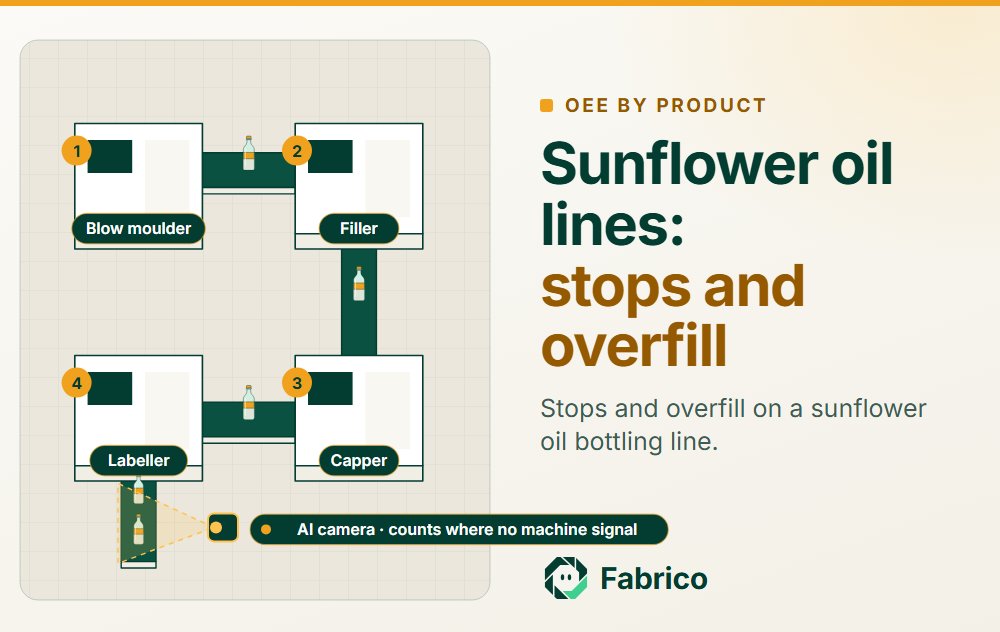
OEE on a sunflower oil bottling line: stops and overfill

In short
- An oil line loses in five places: drips and cleaning around the filler, changeovers between sizes, the blow moulder, the caps, and labels on oily bottles.
- One loss OEE does not show: overfill. A bottle with 1,004 ml is a good unit, but 4 ml of oil is given away.
- In the example below the shift loses 1,260 EUR in OEE and another 207 EUR in overfill. The overfill costs as much as 17 minutes of downtime.
- The checkweigher gives both numbers: the underfill rejects and the average overfill.
OEE on a sunflower oil bottling line measures how much of the planned time the line turns into good bottles, capped and labelled. On this line the losses are stops to clean drips around the filler, changeovers from one bottle size to another, stops at the blow moulder, jams at the capper, and rejects from labels that do not stick to an oily bottle.
There is also a loss OEE does not see at all: overfill. The bottle is good, but it holds more oil than the label says.
This article is for production managers, process technologists and quality managers in plants that bottle sunflower oil and other vegetable oils. It covers how to measure each OEE factor on this line, where the time goes, how to count overfill, and a worked example for one shift in euros.
Why oil lines matter in Bulgaria
Bulgaria is one of the largest sunflower producers in the EU. According to Eurostat crop production data, in 2025 the country harvested 1,600.78 thousand tonnes of sunflower seed out of 8,494.53 thousand tonnes in the EU, close to one fifth (accessed 26.11.2026).
Processing is concentrated in a few plants. According to Eurostat structural business statistics, in 2024 the manufacture of vegetable and animal oils and fats in Bulgaria counted 67 enterprises with 2,617 persons employed (accessed 26.11.2026). There are few plants and large volumes, so every minute on the bottling line means a lot of bottles.
What the line looks like and where it loses time
The oil line in this article fills PET bottles and has six machines. Each one stops in its own way.
| Machine | Stops | How they are recorded |
|---|---|---|
| Blow moulder | Preform infeed jam, heating out of range | Downtime, then "starved (waiting for product)" at the filler |
| Filler | Drips and oil on the conveyor, nozzle cleaning | Downtime with the reason "cleaning" |
| Capper | Empty cap chute, cap on crooked | Mostly short stops |
| Labeller | Label does not grip an oily bottle, label applied crooked | Rejects and short stops |
| Checkweigher | Rejects underfilled bottles | Rejects |
| Packing and palletising | Full conveyor, film change | "Blocked" at the filler |
On a linked line, OEE is read at the core machine, here the filler. Stops at the other machines are recorded as reasons against it. Availability, performance and quality are calculated using the definitions in ISO 22400-2 (accessed 26.11.2026). How the buffer between machines decides which stop reaches the filler is described in the article cameras for OEE on a bottled water line: a PET oil line follows the same logic.
Drips: the loss that comes from the product
Oil is not water. It runs down the neck, drips onto the conveyor and makes the bottles oily. This creates three kinds of loss.
- Cleaning: when oil builds up on the conveyor, bottles slip and fall. The line stops for cleaning.
- Labels: an oily bottle does not hold the label. The label goes crooked or falls off and the bottle is a reject.
- Caps: an oily neck sometimes does not hold the cap during capping.
If these three losses are recorded separately, the common cause becomes visible: the filler nozzles drip. If they are recorded as "labelling", "conveyor" and "caps", each one looks small and nobody gets to the nozzles.
So give cleaning its own reason and record how many times per shift it happens. If the count rises with the time since the nozzle seals were last changed, you also have a maintenance schedule based on real data.
The blow moulder and the preforms
Where a line blows its own bottles from preforms, the blow moulder sits before the filler and feeds it through an air conveyor with a small buffer.
When it stops for longer than the buffer can cover, the filler records "starved (waiting for product)". This is not the filler's loss but the blow moulder's, and it should be assigned to it as a sub-reason.
The causes to log are jams at the preform infeed and bottles with heating defects. Both depend on the preforms. Record the preform batch at every reload, the same way the carton batch is recorded at packing. Then the conversation with the supplier happens with numbers in hand.
Changeover between sizes
Where a line fills several sizes (1 l, 2 l, sometimes 3 or 5 l), every size change needs new conveyor parts, new starwheels on the capper, a labeller reset and new preforms in the blow moulder.
Split the changeover into three parts:
- Stop and parts change: from the last bottle of the old size until the machine restarts.
- Start-up to the first good bottle: setting the fill volume, checking the checkweigher and the label.
- Slow running: the first minutes below the ideal rate, while the line settles.
Set a standard for each pair of sizes and record the difference against it. The cheapest improvement is still in the plan: two fewer sizes a week, grouped by customer, bring more than any new fixture.
Overfill: the loss OEE does not see
OEE counts good bottles. A bottle with 1,004 ml of oil is good. It is also a 4 ml gift to the customer.
Plants overfill so they do not fall below the tolerance. Under Directive 76/211/EEC on prepackaged products (consolidated text of 11.04.2009, accessed 26.11.2026), the average content of the batch may not be below the nominal. For packs from 500 to 1,000 ml, the tolerable negative error for a single pack is 15 ml.
The rule on the average is the reason for overfill. If the filler is not stable, the technologist raises the target to be sure the average stays above 1,000 ml. The less stable the filler, the more it overfills.
The checkweigher already weighs every bottle. It can give not only the underfill rejects but also the average overfill per shift. Put that number next to OEE at the morning meeting. Any improvement in filler stability shows there first.
Example: one shift on an oil line
The numbers are illustrative, not from a customer. 1 l PET bottles, ideal filler rate 100 bottles a minute, planned time 450 minutes, so the ideal for the shift is 45,000 bottles. The downtime threshold is 2 minutes. In the middle of the shift the line switches from 1 l to 2 l; in the example everything is counted in 1 l bottles.
Prices in the example: 0.12 EUR contribution per bottle and 1.50 EUR per litre of oil for the overfill. The contribution is deliberately modest: data from Aswath Damodaran (NYU Stern) give a gross margin of 23.23 % for US listed food processing companies (data as of January 2026, accessed 26.11.2026). Replace both prices with your own.
| Reason | Stops | Minutes | Recorded as | Bottles | EUR per shift |
|---|---|---|---|---|---|
| Changeover from 1 l to 2 l | 1 × 40 min | 40 | downtime | 4,000 | 480.00 |
| Cleaning drips around the filler | 6 × 4 min | 24 | downtime | 2,400 | 288.00 |
| Blow moulder, preforms | 3 × 5 min | 15 | downtime | 1,500 | 180.00 |
| Jams at the capper | 20 × 45 s | 15 | speed loss | 1,500 | 180.00 |
| Label does not grip, oily bottle | 900 bottles | quality | 900 | 108.00 | |
| Underfill, rejected by the checkweigher | 200 bottles | quality | 200 | 24.00 | |
| Total in OEE | 94 | 10,500 | 1,260.00 | ||
| Overfill, 4 ml on average | 34,500 bottles | outside OEE | 138 l | 207.00 |
How the numbers are reached:
- Downtime: 40 + 24 + 15 = 79 minutes, run time 371 minutes. Availability: 371 / 450 = 82.4 %.
- For 371 minutes the ideal is 37,100 bottles. Short stops cost 1,500 bottles. Output is 35,600. Performance: 35,600 / 37,100 = 96.0 %.
- Rejects: 900 + 200 = 1,100, good 34,500. Quality: 34,500 / 35,600 = 96.9 %.
- OEE: 82.4 % × 96.0 % × 96.9 % = 76.7 %. Check: 34,500 / 45,000 = 76.7 %.
- Loss in OEE: 10,500 bottles × 0.12 EUR = 1,260.00 EUR per shift.
- Overfill: 34,500 good bottles × 4 ml = 138 l × 1.50 EUR = 207.00 EUR per shift. One minute on the line is worth 12 EUR, so the overfill equals 17 minutes of downtime.
Ranked by money, the changeover comes first. Second is drip cleaning, which also causes part of the label rejects. Third is overfill, which no downtime report shows.
Over 500 shifts a year (two shifts, 250 days), a 4 ml overfill comes to 103,500 EUR. If a more stable filler allows a target of 1,002 ml instead of 1,004 ml, half of that amount comes back without a single extra minute of work.
The money in OEE is real only if the line's whole output can be sold. The money in overfill is always real: it is oil the plant bought and did not sell. Agree with finance how to value both before showing them at the morning meeting.
Batch, weight and label: the rules
Every bottle needs a readable code. Directive 2011/91/EU requires a lot marking on food, with the exemptions in Article 2; under Article 5 it is not needed when the label shows a best-before or use-by date with at least the day and month (accessed 26.11.2026). A bottle without a readable lot or date code is a reject, even if the oil inside is perfect.
The bottle itself is changing too. Regulation (EU) 2025/40 on packaging and packaging waste applies from 12 August 2026, and many of its obligations have their own later dates (accessed 26.11.2026). Any change to the preform, for example with more recycled plastic, shows first in the blow moulder stops. Measure them for a week before and a week after the switch.
Who owns each loss
| Loss | Owner | Data they need |
|---|---|---|
| Changeover | Planning and the line crew | Minutes against the standard for each pair of sizes |
| Drips and cleaning | The filler technician | Cleanings per shift and time since the seal change |
| Labels | The technologist | Label rejects per hour, compared with the number of cleanings |
| Overfill | The technologist and quality | Average content and spread from the checkweigher per shift |
| Blow moulder | The technician and purchasing | Stops by preform batch |
The morning meeting with these numbers
The table in the example only matters if someone looks at it every day. The morning meeting needs OEE at the filler, minutes spent cleaning, label rejects and the average overfill from the checkweigher.
The first three show whether the line runs. The fourth shows how much oil was given away. If cleanings rise while overfill stays high, check the filler's stability first.
One loss gets one owner and a deadline. If the same reason is first by money for three shifts in a row, it goes into the week's tasks instead of staying in the conversation.
Mistakes when introducing OEE on an oil line
| Mistake | What you see later | How to avoid it |
|---|---|---|
| Cleaning is part of "other" | Labels and caps look like separate problems | Its own reason for drip cleaning |
| One ideal rate for all sizes | Performance on 2 l looks poor, but it is not | An ideal rate per bottle size |
| Rejects counted at the end of the shift | Nobody knows which hour they came from | Live rejects from the checkweigher and the labeller |
| Overfill is not measured | Oil is given away and nobody sees it | Average content from the checkweigher next to OEE |
| Reports by operator | People stop recording reasons | Reports by line and shift |
How to choose a way to measure
| Method | Suits you when | What it misses |
|---|---|---|
| Paper log | One size, rare stops | Short stops and the link between drips and labels |
| PLC counter into a spreadsheet | A first OEE assessment | Reasons and overfill |
| OEE software with a PLC signal and reasons from the operator | Several sizes, frequent changeovers | Overfill, if the checkweigher is not connected |
| The same plus checkweigher data | High volume, expensive product | Almost nothing |
Questions for the vendor:
- Which machine is OEE read from on a linked line?
- How is an ideal rate set for each bottle size?
- Can cleaning be a separate reason with a count per shift?
- How is a changeover recorded against a standard for each pair of sizes?
- Can checkweigher rejects enter quality automatically?
- What happens to the data if the plant network drops?
More about the case packer after the filler is in the article OEE on a case packer, and about short stops in micro-stop detection software.
How to start
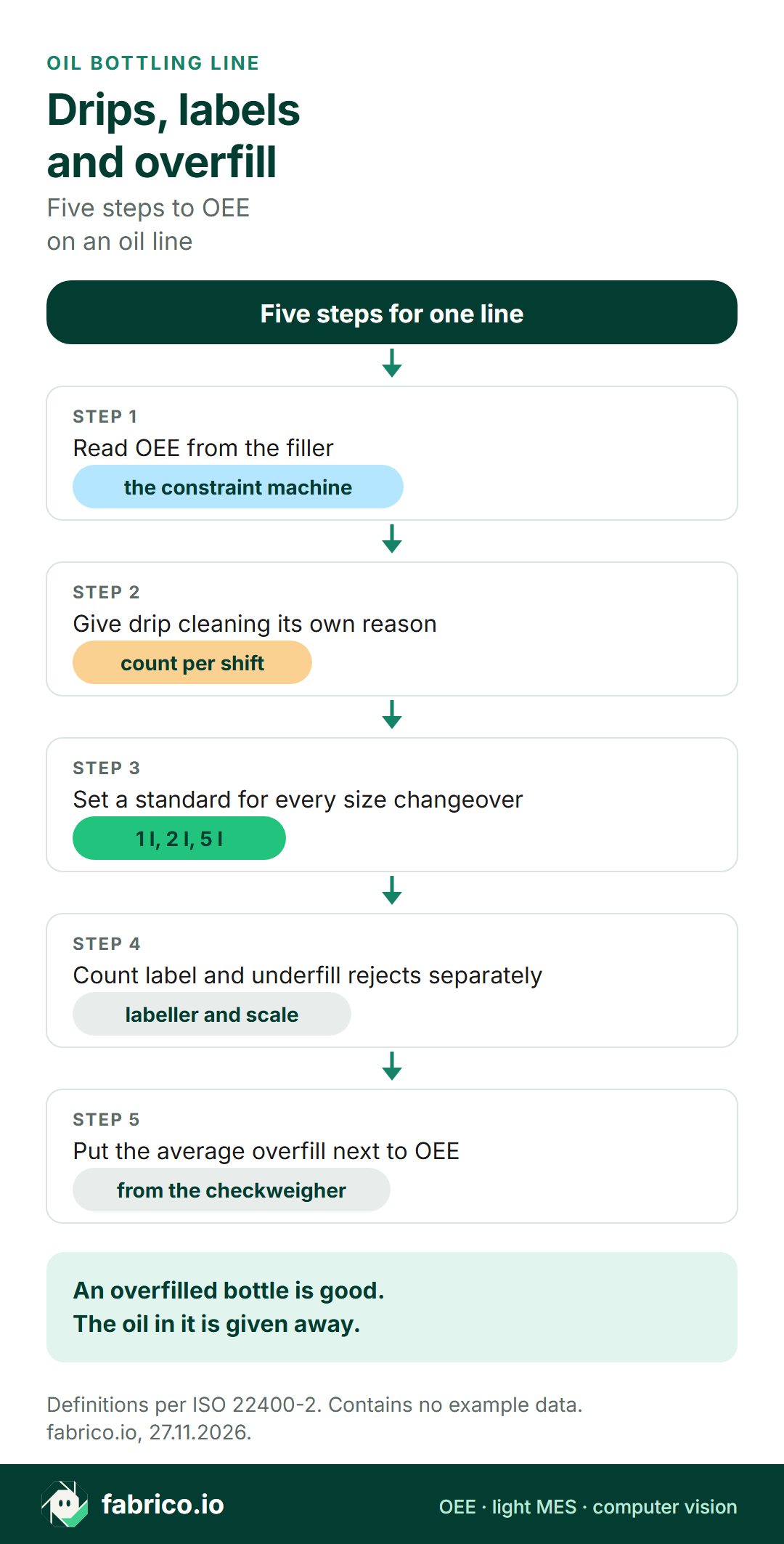
Text version of the diagram
- Read OEE from the filler.
- Give drip cleaning its own reason.
- Set a standard for every changeover between sizes.
- Count label rejects and underfill rejects separately.
- Put the average overfill next to OEE.
Fabrico provides the measured rates per line; the plan itself is made in the ERP, the APS or the planning spreadsheet.
This week: count the filler cleanings over three shifts; ask the checkweigher for the average content; work out what 1 ml of overfill costs per shift.
This quarter: a signal from the filler PLC and reasons from the operator; a standard for the two most frequent changeovers; an overfill target next to OEE at the morning meeting.
Where Fabrico fits
Fabrico is made by the publisher of this article.
- What it is: an OEE and light MES platform with built-in maintenance management. It shows live OEE by line and shift.
- Linked line: OEE is read at the core machine, and starved (waiting for product) and blocked states are recorded as stop reasons.
- Data: machines connect through the line PLC or through a Fabrico IoT device; where there is no signal, the camera counts output.
- Reasons: stops above the threshold get a reason in a few taps, and stops under the set threshold (up to 10 minutes) go into speed loss. The camera does not decide the reason.
- Money: with the Financial Impact module, every loss has a price in EUR.
- Video: where the camera covers the line, the video for the minute of a stop opens from the shift timeline. It is streamed on request and not stored in Fabrico.
- Hosting and security: EU customers are hosted on AWS in Frankfurt. Certified to ISO/IEC 27001, ISO/IEC 20000-1 and ISO 9001. The gateway keeps the data for up to 30 days if the network drops.
- Price: one quote per plant, based on machines and modules (pricing).
For food plants, see also the article MES for food manufacturing.
A result from a Bulgarian plant
At Ficosota, a maker of home care, hygiene and consumer goods rather than food, time without a recorded stop reason fell from 3.20 % to 0.40 % between June and September 2026. This is on 16 lines with OEE and the Financial Impact module, and OEE rose from 53.11 % to 59.62 %. The numbers are approved by the customer.
Ficosota is also an investor in Fabrico (since January 2025) and an industrial partner in developing the OEE module; keep that in mind when reading the results.
See a bottling line in Fabrico. In a demo you will see the line's stops by reason and what each one costs in euros.
Frequently asked questions
Which machine is OEE read from on an oil line?
From the filler, which sets the pace. Stops at the blow moulder, the labeller and packing are recorded as reasons against it.
Is overfill part of OEE?
No. An overfilled bottle is a good unit. That is why overfill is measured separately, from checkweigher data, and shown next to OEE.
How underfilled can a 1 l bottle be?
Under Directive 76/211/EEC, the tolerable negative error for packs from 500 to 1,000 ml is 15 ml, and the batch average may not be below the nominal.
Why do labels fall off on an oil line?
Oil on the bottle from dripping nozzles is the first cause to check. Record label rejects next to the number of filler cleanings and the link becomes visible.
Is a changeover a loss if it is planned?
Yes, it lowers availability. Set a standard for each pair of sizes and record the difference against the standard separately.
How do you reduce overfill?
First measure it: the average content and the spread from the checkweigher for every shift. Then stabilise the filler, and only then lower the fill target. The reverse order leads to underfill rejects.
Does an oil line need a camera?
Not where the machines have a PLC. A camera makes sense only at a station without a usable signal, for example manual packing of the large sizes.
Latest from our blog




Real Fabrico tiles, sample data.