





 Login
 Blog
OEE in nut and dried fruit packing

In short
- Nut packing loses time in five places: the changeover with allergen cleaning, waiting for the sorter, film and seals, product sticking in the multihead weigher, and seal and weight rejects.
- The most expensive loss is the changeover. Switching from peanuts to almonds needs a wet clean, not just a product change.
- In the example below the shift loses 2,548 EUR in OEE. The changeover is 41 % of that sum.
- The optical sorter also rejects good nuts. That loss is outside packing OEE, but in the example it is 180 EUR per shift.
OEE in nut and dried fruit packing measures how much of the planned time the line turns into good bags: filled, sealed and on weight. The losses come from the changeover from one product to another with allergen cleaning, waiting for product from the sorter or the roaster, film changes, product sticking in the multihead weigher, and bags with a poor seal or under the allowed weight.
This article is for owners, production managers and food technologists in plants that pack nuts, seeds, dried fruit and mixes. It shows how to measure OEE on the packing line, who owns each loss, how to measure the yield of the optical sorter, and a worked example of one shift in euros.
Why this line is different
Nuts are an expensive product with few packs per minute but a high price on every gram. They are also among the main allergens: Annex II to Regulation (EU) No 1169/2011 lists peanuts and nuts among the substances that cause allergies (accessed 26.11.2026). That is why a change from one product to another can need a full clean.
The raw material carries risk too. Regulation (EU) 2023/915 sets maximum levels for certain contaminants in food, including aflatoxins in nuts (accessed 26.11.2026). The optical sorter before packing is part of the defence: it removes nuts with defects, but it also removes some good ones.
In Bulgaria, nut packing is part of the wider fruit and vegetable processing sector. According to Eurostat structural business statistics, in 2024 this group had 331 enterprises with 6,692 people employed (accessed 26.11.2026), about 20 people per enterprise on average.
From the sorter to the case
| Section | What it does | Losses |
|---|---|---|
| Optical sorter | Removes nuts with defects and foreign bodies | Good nuts in the reject stream, re-sorting |
| Roasting and cooling | Batch or continuous roasting, then cooling | Waiting for a batch, uneven roasting |
| Seasoning | Drum with salt or spices | Dust that later gets into the seal |
| Multihead weigher | Builds a portion of the exact weight | Product sticking in the buckets, giveaway |
| Vertical form fill seal machine | Forms, fills and seals the bag | Film, seal, bags without product |
| Checkweigher and metal detector | Reject light bags and bags with metal | Rejects |
| Case packing | By hand or by machine | Short stops, wrong count |
OEE is measured on the packing line, from the vertical form fill seal machine that sets the pace. The definitions follow ISO 22400-2 (accessed 26.11.2026). The sorter and the roaster before it are recorded as reasons when the line is starved (waiting for product).
Newer packing machines can report their state using the PackML state model (ISA-TR88.00.02, accessed 26.11.2026). "Suspended" means the machine is in order and waiting for product; "Held" means it has a problem of its own. That difference shows whether the loss belongs to packing or to the sorter.
The changeover with allergen cleaning
Changing from almonds to a mix of almonds and peanuts is simple: the new product contains the old allergen. The reverse change, from peanuts to almonds, means everything that touched peanuts has to be cleaned and checked.
So changeovers are not all the same. There are at least three kinds:
- No clean: the new product contains all the allergens of the old one. Only the film and label change.
- Dry clean: same allergens, different flavour or size. The weigher and chutes are cleared.
- Wet clean with a check: the new product lacks an allergen the old one had. Full cleaning, drying and a check before start-up.
Set a standard for each kind and record each changeover with its kind. Then planning can see which sequences are expensive and avoid them. Sequence from the product with no allergens to the product with more allergens, and do the wet clean once, at the end of the week.
More on product sequence is in the article OEE on a high-mix food line.
The multihead weigher and the vertical form fill seal machine
Sticking. Salted and oily nuts stick to the weigher buckets. The portion does not drop in time and the machine runs a cycle without product or stops. These are short stops that a paper log misses.
The seal. Salt and seasoning dust get into the seal. The bag looks closed, but it lets air in and the nuts go rancid before their date. Seal rejects come in runs, after a change of product or seasoning.
The film. Changing the reel is a routine stop. Set a standard for it and record anything above it as a loss.
Weight. The checkweigher rejects light bags. Under Directive 76/211/EEC on prepackaged products (consolidated text of 11.04.2009, accessed 26.11.2026), for packs of 100 to 200 g the tolerable negative error is 4.5 %. For a 150 g bag that is 6.8 g after rounding up. The batch average may not be below the nominal quantity, so the multihead weigher is set slightly above it.
Dried fruit: a sticky product
Dried apricots, prunes, dates and raisins behave differently from nuts. They are sticky, heavy and uneven in size. They stick to the buckets in the multihead weigher, and large pieces make an exact weight harder.
So on the same line the ideal rate for nuts and for dried fruit is different. If the system has one ideal rate for all products, dried fruit performance will look low even though the machine is running normally for that product.
Set an ideal rate per product and record sticking in the weigher as its own reason. If sticking rises with a certain batch of dried fruit, check the moisture of that batch before the machine.
Mixes of nuts and dried fruit combine both problems: dust and salt from the nuts, stickiness from the fruit. There the changeover and weigher cleaning take longest, and they need their own standard.
The optical sorter: yield outside OEE
The sorter sits before packing. It is not part of the packing line's OEE, but it decides how much of the purchased raw material reaches the line at all.
Every sorter makes two errors: it lets through nuts with defects, and it rejects good nuts. The first is a safety matter with no compromise. The second is pure yield loss.
How many good nuts are in the reject stream can only be found by checking. Take a sample from the reject stream once a shift, sort it by hand and record the share of good nuts. Then the sorter setting becomes a decision based on numbers, not on feel. Show that share next to OEE at every meeting.
Example: one shift on a nut line
The numbers are an example, not a customer's. 150 g bags, a vertical form fill seal machine with an ideal rate of 60 bags per minute, 450 minutes of planned time, so the ideal for the shift is 27,000 bags. The stop threshold is 2 minutes. Midway through the shift the line changes from peanuts to almonds, with a wet clean.
Prices in the example: 0.35 EUR contribution per bag and 6.00 EUR per kilogram of raw material for the sorter. The contribution is deliberately modest: Aswath Damodaran's data (NYU Stern) gives a gross margin of 23.23 % for US-listed food processing companies (data as of January 2026, accessed 26.11.2026). Replace both prices with your own.
| Cause | Stops | Minutes | Recorded as | Bags | EUR per shift |
|---|---|---|---|---|---|
| Changeover with wet clean | 1 × 50 min | 50 | downtime | 3,000 | 1,050.00 |
| Starved, waiting for the sorter | 2 × 10 min | 20 | downtime, sub-reason sorter | 1,200 | 420.00 |
| Film change and seal | 5 × 4 min | 20 | downtime | 1,200 | 420.00 |
| Sticking in the multihead weigher | 40 × 30 s | 20 | speed loss | 1,200 | 420.00 |
| Poor seal, rejected bags | 500 bags | quality | 500 | 175.00 | |
| Light bags, rejected by the checkweigher | 150 bags | quality | 150 | 52.50 | |
| Rejected by the metal detector | 30 bags | quality | 30 | 10.50 | |
| Total in OEE | 110 | 7,280 | 2,548.00 | ||
| Good nuts in the sorter rejects | 30 kg | outside OEE | 180.00 |
How the numbers are reached:
- Downtime: 50 + 20 + 20 = 90 minutes, run time 360 minutes. Availability: 360 / 450 = 80.0 %.
- In 360 minutes the ideal is 21,600 bags. Sticking takes 1,200 bags. Output was 20,400. Performance: 20,400 / 21,600 = 94.4 %.
- Rejects: 500 + 150 + 30 = 680, good bags 19,720. Quality: 19,720 / 20,400 = 96.7 %.
- OEE: 80.0 % × 94.4 % × 96.7 % = 73.0 %. Check: 19,720 / 27,000 = 73.0 %.
- One minute of the line is worth 60 × 0.35 = 21.00 EUR. The loss: 7,280 bags × 0.35 EUR = 2,548.00 EUR per shift.
- The sorter: of 3,000 kg input it rejects 4 %, that is 120 kg. The sample shows 25 % good nuts in them: 30 kg × 6.00 EUR = 180.00 EUR per shift.
Sorted by money, the changeover comes first: 1,050 EUR, or 41 % of the OEE loss. One change from peanuts to almonds costs two and a half times as much as sticking, film or waiting for the sorter, each on its own.
The first task is about the plan: fewer changeovers with a wet clean, grouped at the end of the week. The second is about the sorter: how many good nuts it rejects, and whether the waiting at packing comes from re-sorting.
If each of the 500 shifts a year (two shifts, 250 days) has one wet changeover, it costs 525,000 EUR, and the good nuts in the rejects 90,000 EUR. The money in OEE is real only if the whole output is sold. Agree the rule with finance.
Owners: sorter, weigher, seal
| Loss | Owner | Data they need |
|---|---|---|
| Changeover | Planning and quality | Minutes by changeover kind and by product pair |
| Waiting for the sorter | The sorting supervisor | Starved minutes with a sub-reason, and re-sorts |
| Good nuts in the rejects | The technologist | Share of good nuts in the sample per shift |
| Sticking in the weigher | The technician | Short stops by hour and by product |
| Seal | The technologist and the technician | Seal rejects by hour, compared with product and seasoning |
Mistakes with the changeover and the sorter
| Mistake | What you see later | How to avoid it |
|---|---|---|
| All changeovers are the same | Nobody can see which sequence is expensive | Changeover with a kind: no clean, dry, wet |
| Waiting is logged as "packing downtime" | Packing looks like the problem | "Starved (waiting for product)" with a sub-reason |
| Sorter rejects are never checked | Yield is lost without anyone noticing | A sample per shift, share of good nuts |
| Rejects counted at the end of the shift | Nobody knows which product change they followed | Live rejects from the checkweigher and the detector |
The meeting: changeover and sorter
The meeting looks at yesterday's OEE of the packing line, changeover minutes by kind, starved minutes, and the share of good nuts in the sorter rejects.
If the changeover is the most expensive item, the talk is about the plan. If waiting is rising, about the sorter. If the share of good nuts in the rejects is rising, about the sorter setting. The owner of that figure brings the answer the next day.
A camera on manual packing
Where bags are packed into cases or boxes by hand, there is no signal. A camera above the table counts the cases that leave, and a pause in the count is a stop.
The camera does not identify the reason and does not monitor people: point it at the cases, not at the walkways, and report by line and shift. More is in the article camera or sensor for OEE by machine.
Which system for a nut line
| Method | Fits when | What it misses |
|---|---|---|
| Paper log | One product, rare changeovers | Short stops and the changeover kind |
| PLC counter into a spreadsheet | A first estimate of OEE | Reasons and waiting for the sorter |
| OEE software with a signal and operator reasons | Many products and allergens | Manual packing, if there is no camera |
| The same plus a camera on manual packing | Hand packing into cases | Almost nothing |
For the machine that also packs other products in film, see the article OEE for snack food lines.
Questions for the supplier:
- Can a changeover be recorded with the kind of cleaning?
- How is "starved (waiting for product)" recorded with a sub-reason for the sorter?
- How do checkweigher and metal detector rejects enter quality?
- How are short stops on the multihead weigher counted?
- How are cases counted at a manual station without a signal?
- What happens to the data if the plant network drops?
How to start
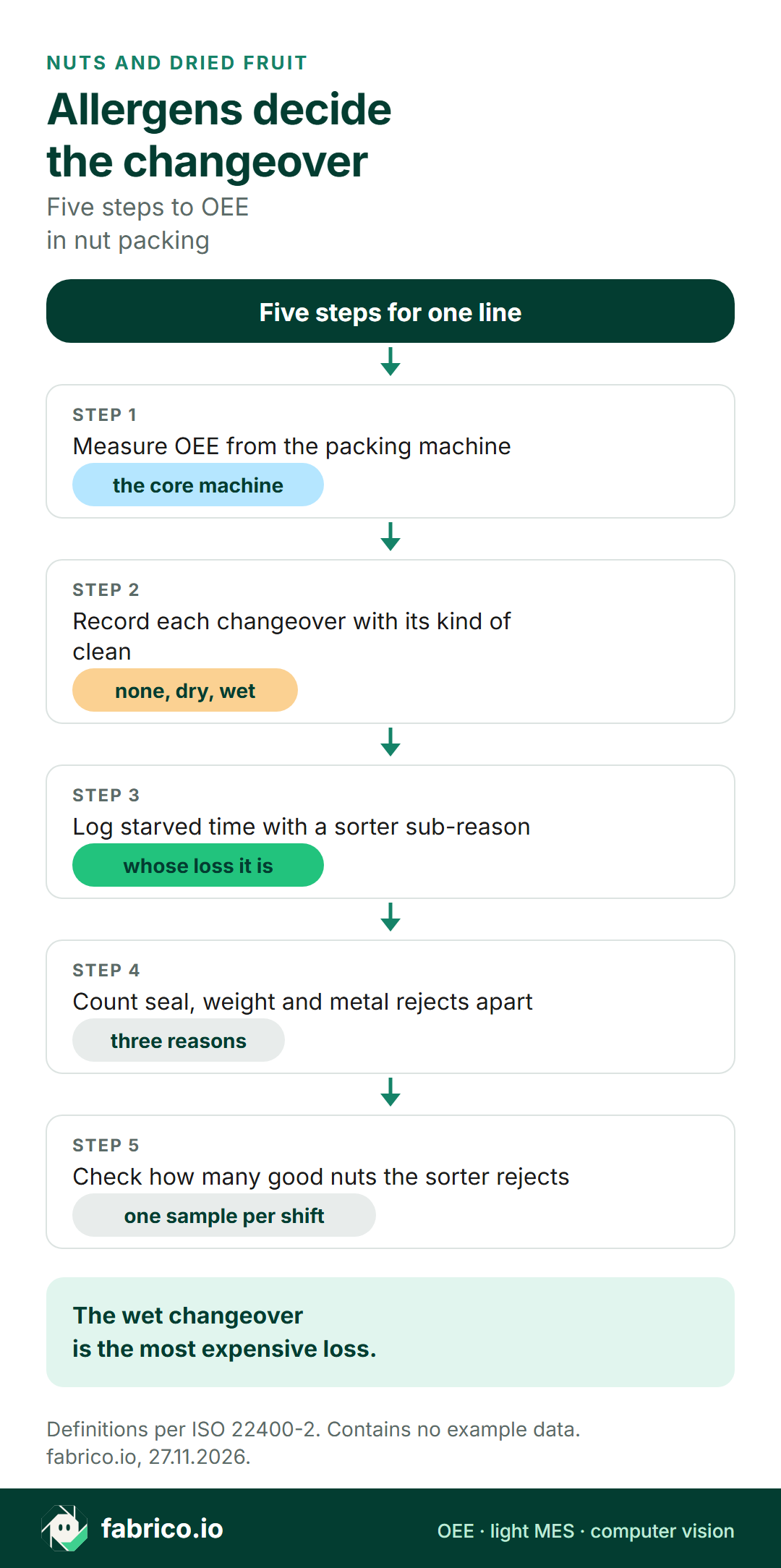
Text version of the diagram
- Measure OEE from the packing machine.
- Record each changeover with the kind of cleaning.
- Record "starved (waiting for product)" with a sub-reason for the sorter.
- Count seal, weight and metal rejects separately.
- Check every shift how many good nuts the sorter rejects.
Fabrico provides the measured rates per line; the plan itself is made in the ERP, the APS or the planning spreadsheet.
This week: time one changeover of each kind; take a sample from the sorter rejects and sort it by hand; work out what one minute of the packing line is worth.
This quarter: a PLC signal from the packing machine and reasons from the operator; a standard for each kind of changeover; a plan that groups the wet cleans.
Where Fabrico fits
Fabrico is made by the publisher of this article.
- What it is: an OEE platform and light MES with built-in maintenance management. It shows live OEE by line and shift.
- Linked line: OEE is read at the core machine, and starved (waiting for product) and blocked time are recorded as stop reasons.
- Data: machines connect through the line PLC or through a Fabrico IoT device; where there is no signal, a camera counts output.
- Reasons: stops above the threshold get a reason in a few taps, and stops under the set threshold (up to 10 minutes) go into speed loss. The camera does not identify the reason.
- Money: with the Financial Impact module every loss has a price in EUR.
- Video: where a camera covers the line, the video for the minute of a stop opens from the shift timeline, is streamed on request and not stored in Fabrico.
- Hosting and security: EU customers are hosted on AWS in Frankfurt. Certified to ISO/IEC 27001, ISO/IEC 20000-1 and ISO 9001. The gateway keeps data for up to 30 days if the network drops.
- Price: one quote per plant, based on machines and modules (pricing).
For food plants, see also the article MES for food manufacturing.
A result from a Bulgarian plant
At Ficosota, a maker of home care, hygiene and consumer goods, not food, the time without a recorded stop reason fell from 3.20 % to 0.40 % between June and September 2026. That is across 16 lines with OEE and the Financial Impact module, and OEE rose from 53.11 % to 59.62 %. The figures are approved by the customer.
Ficosota is also an investor in Fabrico (since January 2025) and an industrial partner in developing the OEE module; keep that in mind when reading the results.
See a packing line in Fabrico. In a demo you will see the line's stops by reason and what each one costs in euros.
Frequently asked questions
Which machine is OEE read from in nut packing?
From the vertical form fill seal machine, which sets the pace. Waiting for the sorter or the roaster is recorded as "starved (waiting for product)" with a sub-reason.
Why are changeovers so different?
Because they depend on allergens. When the new product lacks an allergen the old one had, the line gets a wet clean and a check, and that takes much longer than a film change.
Is the sorter part of OEE?
Not part of packing OEE. The sorter is measured separately: how much it rejects, and how much of the rejects are good nuts.
How light can a 150 g bag be?
Under Directive 76/211/EEC the tolerable negative error for packs of 100 to 200 g is 4.5 %, that is 6.8 g for 150 g, and the batch average may not be below the nominal quantity.
Why does the bag seal let air in?
Salt or seasoning dust in the seal is the first thing to check. Count seal rejects by hour, compared with product and seasoning, and you will see when they appear.
Why does dried fruit look slower in the report?
Because it is sticky and heavy, and the weigher builds portions more slowly. Set a separate ideal rate for it, or its performance will look poor even though the machine is running normally.
Does a nut line need a camera?
Not for machines with a PLC. A camera makes sense at manual case packing, where it counts the cases.
Latest from our blog





Real Fabrico tiles, sample data.