





 Login
 Blog
Operator job rotation on a production line: the interval that pays

In short
- Rotation pays under two conditions: the stations in the loop load different parts of the body, and a swap takes about a minute. In this example, rotating every 2 hours saves EUR 44.40 per shift compared with fixed stations.
- A shorter interval is not better: in this example, rotating every hour loses EUR 6.30 per shift, because 7 swaps eat the gain from fresher hands late in the shift.
- The swap minute decides the maths: if a swap takes 3 minutes instead of 1, the 2-hour rotation in this example turns into a loss of EUR 32.40 per shift.
- The health benefit is not proven: two systematic reviews (2015 and 2017) and one randomised trial (2017) find no clear effect of rotation on musculoskeletal complaints. Fix the station first, then rotate.
- Before the first rotation, everyone can run every station in the loop: in this example, training 8 operators costs EUR 1,958.40 and pays back in 1.05 months if the gain holds.
What is the right interval for operators to swap stations on a production line? In the example in this guide, a 2-hour rotation comes out best: it saves EUR 44.40 per shift compared with fixed stations. Rotating every hour loses money, because each swap stops the machine for a minute.
The answer for your line depends on three numbers: how far the pace drops late in the shift, how long a swap takes, and which station loads which part of the body. This guide gives the load map, the maths in euros, what the research says about ergonomics, and what Bulgarian labour law says about moving people to other work.
Fixed stations or rotation: what changes on the line
With fixed stations, each operator stays in one place for the whole shift. With rotation, the crew swaps stations on a schedule, every N hours and in a set order. The machines and the people stay the same. The load on the body, attention and the crew's flexibility change.
| What | Fixed stations | Rotation every N hours |
|---|---|---|
| Load on the body | The same body part all shift | Different parts take turns, if the stations differ |
| Pace late in the shift | Can drop at the hardest station | A fresher person works the hardest station |
| Swap | None | A short stop at every swap |
| Skills | One person knows one station | Everyone knows every station in the loop |
| Absence | The hard station is difficult to cover | Anyone in the loop can take it |
The table also shows the trap. Rotation only adds something if the stations really differ. If two people swap two stations with the same movement, the load stays the same and the swaps cost minutes.
What the research says about rotation and musculoskeletal complaints
Leider and colleagues pooled 16 studies in a systematic review in the journal Ergonomics. Their conclusion: the evidence for positive or negative effects of job rotation on musculoskeletal complaints and related exposures is inconsistent (Leider et al., Ergonomics, 2015, accessed 27.11.2026).
Their advice to practitioners is specific. First identify and assess the exposures of all the tasks and body regions involved. Only then can you see whether rotation changes the exposure at all.
Padula and colleagues reviewed 14 studies in manufacturing. They found weak evidence supporting rotation as a way to prevent and control musculoskeletal disorders. Rotation did not appear to reduce exposure to physical risk factors, but it correlated with higher job satisfaction (Padula et al., Applied Ergonomics, 2017, accessed 27.11.2026).
The same review describes worker training as a crucial part of a successful rotation programme.
Comper and colleagues tested rotation in a one-year cluster randomised trial in textile production sectors. Both groups received ergonomic training, and one group added a rotation programme.
After 12 months, the difference between the groups in working hours lost to sick leave for musculoskeletal disease was not significant. There were no significant differences in symptoms, risk factors or productivity either (Comper et al., Occupational and Environmental Medicine, 2017, accessed 27.11.2026).
EU-OSHA, the EU agency for workplace safety and health, puts eliminating risks first, together with adapting work to workers. Among its work management measures it lists rest breaks, rotating jobs and reallocating work (EU-OSHA, musculoskeletal disorders, accessed 27.11.2026).
The lesson for the line: rotation does not replace fixing the station. If a station needs lifting at an awkward height, the answer is a table, a lift aid or a vacuum gripper. Rotation only spreads the load over more people.
The load map: which stations should take turns
Before you pick an interval, rate each station on four things: wrists and hands, shoulders, lower back and attention. The example below uses three levels. On your line, the rating comes from the risk assessment made by your occupational health service.
| Station | Wrists, hands | Shoulders | Lower back | Attention |
|---|---|---|---|---|
| Loading portions | High | High | Low | Medium |
| Pack check | Low | Low | Low | High |
| Case packing | Medium | Medium | Medium | Low |
| Palletising | Low | Medium | High | Low |
The ordering rule is simple: after a station with a high load on one body part comes a station with a low or medium load on that same part. In this example the order is loading, palletising, pack check, case packing and back to loading.
- Loading to palletising: wrists go from high to low, shoulders from high to medium.
- Palletising to pack check: the lower back goes from high to low.
- Pack check to case packing: attention goes from high to low.
- Case packing to loading: the weakest link, medium to high for hands and shoulders, but no high after high.
Two stations with a high load on the same body part do not sit next to each other in the loop. If every station loads the hands equally, rotation does nothing for the hands and the fix is in the equipment.
Worked example: packing cheese portions, 4 stations, 2 shifts
The dairy, its line and its prices are made up for the maths; there is no customer data here. The maths is for one shift. Breaks are the same in every option, so they are left out.
The line
- A thermoforming packer vacuum-packs 200 g portions of yellow cheese. The ideal rate is 40 packs a minute, or 19,200 packs in 480 working minutes.
- Four operators per shift, 2 shifts a day, 21 working days a month: 42 shifts.
- The line is sold out, so every pack not made is a lost margin of EUR 0.32.
- Re-packing a pack rejected at the check station costs EUR 0.25 for film, label and labour.
- At every rotation the machine stops for 1 minute while the four swap stations: 40 packs fewer.
Four options for one shift
With fixed stations, the loader cannot hold the pace in the last 2 hours. The shift leader cuts the speed from 40 to 37 packs a minute so that no pockets run empty. With rotation, a fresher person works the hard station in the final block and the drop is smaller.
| Option | Swaps | Packs lost | Re-packed | EUR per shift |
|---|---|---|---|---|
| Fixed stations | 0 | 0 + 360 = 360 | 96 | 139.20 |
| Rotation every 4 h | 1 | 40 + 240 = 280 | 84 | 110.60 |
| Rotation every 2 h | 3 | 120 + 120 = 240 | 72 | 94.80 |
| Rotation every hour | 7 | 280 + 120 = 400 | 70 | 145.50 |
Packs lost are the sum of the swaps and the drop in the last 2 hours. The drop is (40 - speed) × 120 minutes: 3 × 120 = 360 with fixed stations, 2 × 120 = 240 with a 4-hour rotation, and 1 × 120 = 120 with the 2-hour and 1-hour rotations.
The maths for the 2-hour rotation: 240 × 0.32 = EUR 76.80 lost margin and 72 × 0.25 = EUR 18.00 re-packing, EUR 94.80 in total. For fixed stations: 360 × 0.32 + 96 × 0.25 = 115.20 + 24.00 = EUR 139.20.
Per shift, month and year
The 2-hour rotation saves 139.20 - 94.80 = EUR 44.40 per shift. Over 42 shifts that is EUR 1,864.80 a month and EUR 22,377.60 per year, provided the gain holds.
The 4-hour rotation saves EUR 28.60 per shift, or EUR 14,414.40 a year. Rotating every hour loses EUR 6.30 per shift, or EUR 3,175.20 a year, compared with fixed stations.
OEE in this example
Out of the ideal 19,200 packs, fixed stations lose 360 + 96 = 456, or 2.375 OEE points. The 2-hour rotation loses 240 + 72 = 312, or 1.625 points. The difference is 0.75 OEE points, if the rotation stops count in OEE, as they do in this example.
The number is small on purpose. Rotation is not an OEE lever; it is a measure against fatigue and a way to cover absences. The OEE gain is a side effect that another line may not see.
Training before the first rotation
For a loop of 4 stations, each of the 8 operators learns 3 new stations. In this example each new station takes one 8-hour shift next to an experienced colleague: 8 × 3 × 8 = 192 hours of extra labour.
Eurostat puts the labour cost in Bulgarian manufacturing at EUR 10.2 per hour for 2025 (Eurostat, Labour cost levels by NACE Rev. 2 activity, accessed 27.11.2026). So 192 × 10.20 = EUR 1,958.40.
With EUR 1,864.80 saved a month, the training pays back in 1,958.40 / 1,864.80 = 1.05 months, if the gain holds.
Choosing the rotation interval
Every swap costs the same: in this example 40 packs, or EUR 12.80. The gain from a fresher person on the hard station grows up to a certain interval and then stops. So the maths has an optimum, and "the shorter the interval, the better" does not work.
Going from 2 hours to 1 hour in this example adds 4 swaps, or 160 packs and EUR 51.20. Against that stand only 2 fewer re-packs, or EUR 0.50, because the late-shift drop is already down to 1 pack a minute.
The rule for your line: rotating every N hours pays if the packs saved late in the shift plus the re-packing saved are worth more than the number of swaps × the packs lost per swap.
The swap minute decides. If a swap takes 3 minutes instead of 1, the 2-hour rotation loses 3 × 3 × 40 = 360 packs, or EUR 115.20, against a gain of EUR 82.80: minus EUR 32.40 per shift. The 4-hour rotation stays at a small plus of EUR 3.00.
The EUR 82.80 gain comes from 240 packs saved (EUR 76.80) and 24 fewer re-packs (EUR 6.00). For the 4-hour rotation the gain is 120 packs and 12 re-packs, or EUR 41.40.
With a 2-minute swap the maths favours the 4-hour rotation: it gains 41.40 - 2 × 40 × 0.32 = EUR 15.80 per shift, while the 2-hour rotation gains 82.80 - 6 × 40 × 0.32 = EUR 6.00.
Four rules keep a swap under a minute:
- The swap time is on the schedule on the board by the line, not whenever someone remembers.
- The loop moves at once: everyone goes to the next station in order and nobody waits for someone else to step out.
- The person handing over says one sentence: what is wrong and what is set differently.
- The stop is logged with the reason "rotation", so you see how long it really takes.
What an operator must know before joining the loop
Rotating someone who has not mastered a station is worse than fixed stations: the pace drops exactly where it was supposed to rise. So before the first rotation, everyone in the loop is qualified on every station in it.
- Loading: how a portion sits in the pocket, the machine's pace, and what to do with an empty pocket.
- Pack check: which packs are rejected (product in the seal, torn film, weight out of tolerance) and how the reason is logged.
- Case packing: the packing pattern and the case label.
- Palletising: the pallet pattern, changing the film reel, and lifting by the manual handling rules.
Who can do what is tracked in a skill matrix; the guide to the operator skill matrix shows how to build one. Learning a new station next to an experienced colleague follows the method of structured on-the-job training.
Directive 89/391/EEC, Article 12, requires every worker to receive safety and health training specific to the workstation or job, including in the event of a transfer or a change of job.
The training takes place during working hours and not at the worker's expense. For rotation this means every station in the loop has its instruction before a person stands at it.
Rotation and the law: the Bulgarian Labour Code and two EU directives
These readings date from 27.11.2026 and are not legal advice. The latest change to the Bulgarian Labour Code appeared in State Gazette issue 99 of 30 October 2026 (accessed 27.11.2026).
- Art. 120(1) and (2): in case of production necessity, and during idle time, the employer may assign a worker temporarily to other work without the worker's consent, in the same town or locality. The limit is 45 calendar days in a calendar year, and during idle time for as long as it lasts. The change must match the worker's qualification and state of health.
- Art. 127(1), item 4: the employer provides a job description, a copy of which is handed to the worker against signature when the employment contract is signed.
What this means for rotation. If all four stations are in the job description of a "line operator", rotation is the work under the contract. If the description covers only one station, the 45 days a year of Art. 120 do not stretch to a daily rotation.
Art. 120 does not mention rotation at all. Ask a lawyer or the General Labour Inspectorate how to word the stations in the job description.
Directive 89/391/EEC, Article 6(2)(d), lists among the general principles of prevention adapting the work to the individual. The aim is alleviating monotonous work and work at a predetermined work-rate and reducing their effect on health (Directive 89/391/EEC, accessed 27.11.2026). The directive does not name rotation. It names the aim.
Directive 90/269/EEC on the manual handling of loads asks first for organisational measures or mechanical equipment to avoid manual handling. Where it cannot be avoided, the employer reduces the risk (Article 3).
Among the requirements of the activity that put the back at risk, Annex I lists an insufficient bodily rest or recovery period and a rate of work imposed by a process which cannot be altered by the worker (Directive 90/269/EEC, accessed 27.11.2026).
For palletising in this example, that means the lift table or vacuum gripper comes before rotation. Rotation gives the lower back time to recover between blocks.
A better station, rotation or automation: how to choose
The four paths solve different problems. The figures are from the example; equipment prices depend on the quote.
| Option | What it solves | Cost in this example | When |
|---|---|---|---|
| Rotation every 2 h | Fatigue at the hard station, absence cover | EUR 1,958.40 training; EUR 44.40 less loss per shift | Stations differ in load, a swap takes up to 1 min |
| Rotation every 4 h | The same, less strongly | The same training; EUR 28.60 per shift | A swap takes 2-3 min |
| A better station | The load at source | A quote for a table, a gripper or a new working height | One station loads one body part far above the rest |
| Automating the station | The manual work disappears | A quote and a payback calculation | The station is the bottleneck on both shifts |
The order of decisions follows the directives: the station first, then the organisation. Rotation is an organisational measure. It makes sense once the station is fixed and the work is still monotonous.
Fixed stations make sense when the line has one station with long training, such as machine setting, and the other stations are light. Then the hard station gets fixed, and rotation runs only among the light ones.
A 4-hour rotation is a sensible first step: one swap, the same training, and the crew gets used to the loop. If after a month the data show that a swap takes under a minute, the next step is 2 hours.
7 questions for the occupational health service and the machine supplier
- Which body parts does each station load according to the risk assessment, and at what level?
- Which two stations should not follow each other in the loop?
- What do a full case and a film reel weigh, and at what height are they lifted?
- Can the loading height or the pallet height be adjusted, and what does that cost?
- Does the machine have to stop when the loader is swapped, or is there a safe way without stopping?
- Which stations need a separate safety instruction before someone's first shift on them?
- What complaints were recorded at health checks in the past year, and at which stations?
How to check rotation with data from the line
Four weeks the old way and four weeks with rotation give a clean comparison only with the same products and shifts. Measure four things:
- Output for each hour of the shift: whether the drop in the last 2 hours shrinks.
- Swap minutes: the average and the longest stop with the reason "rotation".
- Packs rejected at the check station: by hour and by reason.
- Complaints by station: a short survey at the start and the end of the period, with the occupational physician.
If late-shift output does not rise and the swap takes longer than planned, rotation does not make money on that line. What remains is the absence-cover argument, which is calculated separately.
When the line runs a person short, the losses are booked as shown in staffing losses in OEE. Covering people during breaks is a separate topic: break relief operators.
Where Fabrico fits
The rotation schedule stays in the shift leader's spreadsheet. Fabrico, an OEE platform with a light MES, shows whether the schedule works: live OEE by line and shift, output by hour of the shift, and every stop with its reason.
On a linked line, OEE is read at the core machine, which on this line is the thermoformer. Operators add the stop reason in a few taps, so "rotation" becomes its own line with minutes rather than part of general downtime. Analytics by shift and by hour show the late-shift drop before and after rotation.
Each pack scrapped at the check station gets a product and a reason. The Financial impact module turns the losses into EUR for each SKU. Downtime tracking ranks the stops by minutes, the OEE software page describes the modules, and pricing is one quote per plant by machines and modules.
The rotation schedule in 6 steps
The diagram is for the board by the line. The six steps pull together the load map, the maths and the rules from this guide.
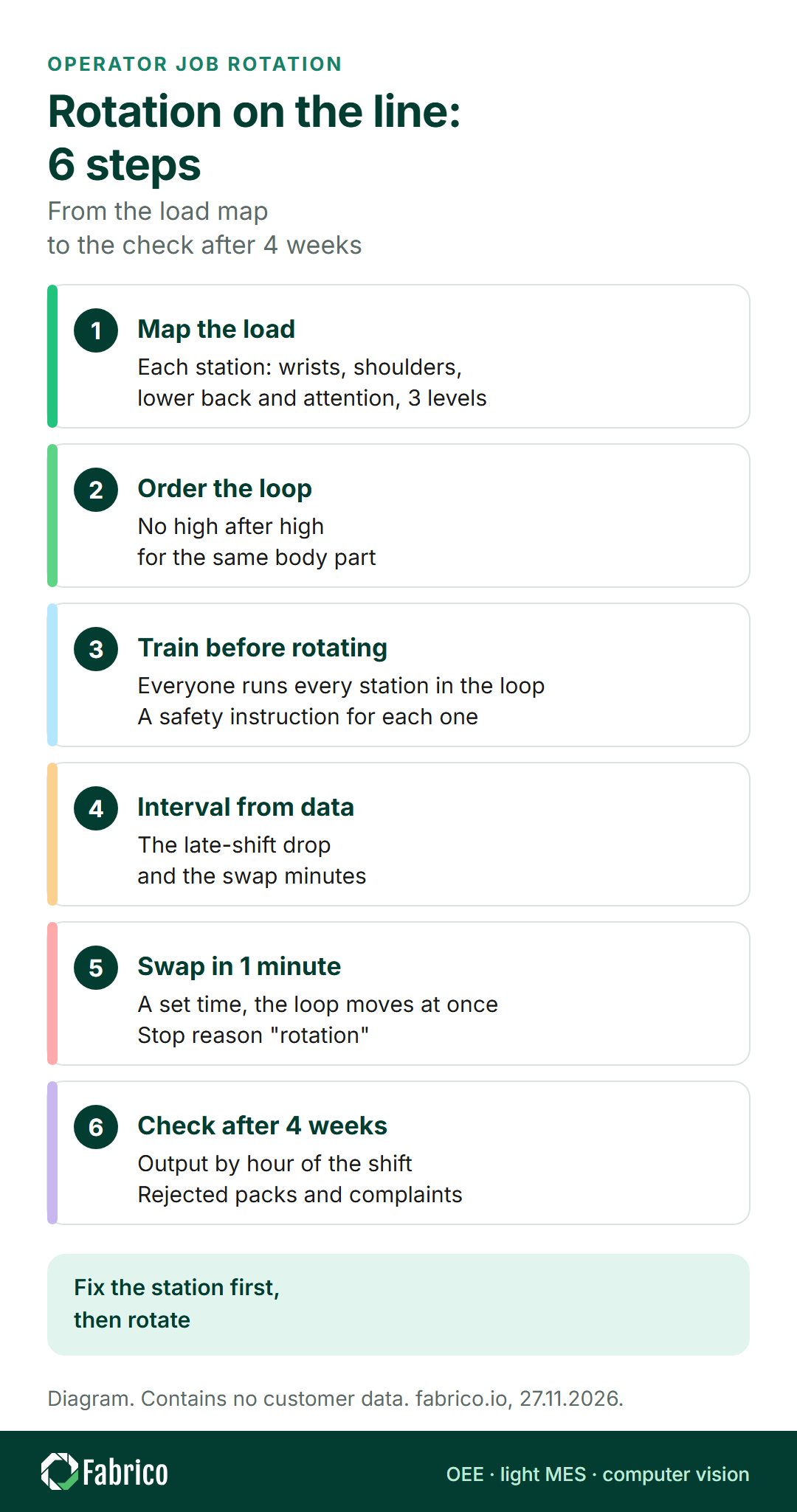
Text version of the diagram
- Map the load: rate each station for wrists, shoulders, lower back and attention.
- Order the loop: no high after high for the same body part.
- Train before rotating: everyone can run every station in the loop and has its safety instruction.
- Pick the interval from data: the late-shift drop and the swap minutes.
- Swap in 1 minute: a set time, the loop moves at once, stop reason "rotation".
- Check after 4 weeks: output by hour, rejected packs, complaints.
Frequently asked questions
What is job rotation on a production line?
The crew swaps stations on a schedule, every N hours and in a set order. The aim is to alternate the load on different body parts and to make sure everyone can cover every station.
What is the right rotation interval on a production line?
There is no single standard. In this example a 2-hour rotation gives the smallest loss, and rotating every hour loses money, because each swap stops the machine for 1 minute. Work out the late-shift drop and the swap minutes on your own line.
Does job rotation reduce back and arm pain?
Two systematic reviews (Leider et al., 2015; Padula et al., 2017) find inconsistent or weak evidence. A randomised trial in textile production (Comper et al., 2017) found no significant difference in sick leave over one year. Fix the station first.
Can an employer move an operator to another station without consent?
In Bulgaria, Art. 120 of the Labour Code allows temporary other work without consent in case of production necessity, up to 45 calendar days a year, matched to qualification and health. If the stations are in the job description, rotation is work under the contract. A lawyer or the General Labour Inspectorate can confirm the wording.
How does job rotation affect OEE?
In this example the 2-hour rotation lifts OEE by 0.75 points, if swap stops count in OEE. Rotating every hour loses more packs to swaps than it saves late in the shift.
What training is needed before rotation?
Every operator is qualified on every station in the loop and has its safety instruction. Directive 89/391/EEC requires training in the event of a transfer or a change of job, during working hours.
See how your shift runs, one hour at a time. The demo shows one line hour by hour: output, every stop with its reason, OEE for the line by shift, and what the losses cost for each SKU.
Latest from our blog







Real Fabrico tiles, sample data.