





 Login
 Blog
Break relief operators: stop the line or keep it running?

In short
- The break is never optional: the EU Working Time Directive gives a rest break for any working day over 6 hours. Bulgarian law adds at least 30 minutes for a meal. The only choice is who keeps the line running during the break.
- Three models: the line stops for breaks, a relief operator takes over the post, or breaks are staggered inside the crew.
- A stop costs more than the break: in this example every stop adds 5-8 minutes of restart and 20-40 bags of scrap. With the 50 minutes of breaks, that is 68 lost minutes per line per shift.
- The money in this example: two frozen vegetable lines, 3 shifts. If every bag sells, stopping costs EUR 459,648 a year and the relief model EUR 76,140, of which EUR 45,900 is gross wages.
- The season decides: if the lines are full only 4 months a year, a mix is the cheapest option in this example. Relief operators cover the peak, and staggered breaks cover the rest of the year.
A production line does not have to stop for operator breaks. Break rules protect the person, not the machine.
There are three models: the whole line stops, a relief operator takes over the post during the break, or the crew staggers its breaks. In the last case the line runs one person short.
Three numbers decide which model is right. What is one minute of line time worth? What time and scrap does every restart cost? What does a relief operator cost?
Below are the break rules in the EU and in Bulgaria, plus a comparison of the three models. Then comes a worked example with two frozen vegetable packing lines, priced in EUR per shift, month and year.
What the law says about breaks in production
Here is what the texts say as they read on 27.11.2026. This is a reading of the texts, not legal advice. The table also lists what each text does not say, because there the decision stays with the plant.
| Text | What it says | What it does not say |
|---|---|---|
| Directive 2003/88/EC, Art. 4 | A rest break when the working day is over 6 h. Details come from collective agreements or national law. | How long the break is. |
| Bulgarian Labour Code, Art. 151 | A meal break of at least 30 min. Breaks are not working time. In continuous processes, meal time is given within working time. | That the line must stop, or that everyone eats at once. |
| Bulgarian Labour Code, Art. 141(6) | In continuous processes, a worker does not stop work until the relief arrives, unless the supervisor allows it. | Anything about breaks: the text is about shift handover. |
| Bulgarian Ordinance No. 15 of 1999 | Short rest breaks where Article 9 applies: a constant, even process, a shift over 6 h and a developed regime. They count as working time and are taken away from the workstation. | The exact minutes for your line: the regime is built for the specific job. |
The EU Working Time Directive
As Article 4 of Directive 2003/88/EC reads (accessed 27.11.2026), every worker whose working day is longer than six hours is entitled to a rest break.
Its duration and terms are set by collective agreements or, failing that, by national legislation. The Directive applies to all sectors, public and private, without prejudice to Articles 14, 17, 18 and 19 (Article 1(3)).
Article 17(3)(c)(v) allows exceptions, set by law or collective agreement, for industries where work cannot be interrupted for technical reasons. The condition is equivalent periods of compensatory rest or, in exceptional cases where that is not possible, appropriate protection (Article 17(2)). As a rule, an exception does not cancel the break. It moves it.
The Bulgarian Labour Code
In Bulgaria, as Article 151(1) of the Labour Code reads (accessed 27.11.2026), working time is interrupted by one or more breaks. The meal break is at least 30 minutes. Under paragraph 2, breaks are not included in working time.
Paragraph 3 matters for lines. In continuous processes and in businesses that work non-stop, the employer provides meal time within working time. The text does not define which lines count as a "continuous process". Each plant has to settle that for itself.
Article 141(6) covers shift handover in continuous processes. A worker may not stop work until the relief arrives, unless the direct supervisor allows it. The supervisor must arrange the relief.
The text says nothing about breaks, but the principle carries over well: the post is never left empty.
Three more rules shape the roster. With a 5-day week, normal working time at night is up to 7 hours (Article 140(1)), so an 8-hour night shift like the one in the example is checked with the plant's lawyer, for example under summed working-time calculation (Article 142(2)).
There must be at least 12 hours of unbroken rest between two shifts (Article 152). Night work brings free food, refreshing drinks and other relief (Article 140(3)).
Bulgarian Ordinance No. 15 on rest regimes
Ordinance No. 15 of 31.05.1999 (accessed 27.11.2026) covers short rest breaks during work. Under Article 9, they apply when the process is constant and even and the shift is longer than 6 hours. A regime must also have been developed for that type of work.
- Who sets them: an occupational health service develops the regime (Article 4), and it goes into the plant's internal work rules (Article 7).
- Working time: these breaks fall within the working day and count as working time (Article 6(2) and § 1(2)).
- Where: they are taken away from the workstation, in rest areas (Article 11(2)). The operator really leaves the line.
- When: an 8-hour day gets at least 2 breaks, the first 2-2.5 hours after the start, the second 1.5-2 hours after the meal (Annex, point 8). Each lasts at least 5-10 minutes and at most 30 (point 9).
- How: frequent short breaks rather than rare long ones (point 7). Evening and night shifts get additional breaks (point 15(b)).
The Ordinance does not say whether the line stops. It says when, and for how long, the person rests.
Check with a lawyer or the labour inspectorate. Is your line a "continuous process", and how is meal time counted? The plant's lawyer makes that call; in Bulgaria, guidance can be asked from the General Labour Inspectorate (ИА ГИТ) (accessed 27.11.2026). The inspectorate enforces Ordinance No. 15 (§ 4).
Three break models compared
The break itself is not up for negotiation. It protects people, and with them product quality.
At a large engineering company, accident risk rose over 2 hours of continuous work. In the last 30 minutes it was 2.08 times the risk in the first 30 minutes (Tucker, Folkard and Macdonald, The Lancet, 2003, accessed 27.11.2026).
The authors found regular rest breaks an effective way to keep that risk from building up.
In a meat-processing plant, NIOSH researchers added 36 minutes of breaks per workday on top of the plant's 30-minute lunch and two 15-minute breaks.
Production did not fall, and the schedule with four 9-minute breaks reduced leg discomfort (Dababneh, Swanson and Shell, Ergonomics, 2001, accessed 27.11.2026).
EU-OSHA reaches the same point: short breaks during a shift reduce fatigue and sleepiness significantly (OSHwiki, Approaches to work design, accessed 27.11.2026). Night work is more exhausting than day work (OSHwiki, Working time, accessed 27.11.2026).
That leaves the question of who keeps the line going. The three models at a glance:
| Model | Cost | OEE effect | Fits when |
|---|---|---|---|
| Line stops | No extra people. Loses the break time and the restart after it. | The break is a planned stop. The restart pulls OEE down. | Spare capacity, short restart with no scrap |
| Relief operator | One extra wage per shift (4 posts in the example) | Almost no loss. The break becomes line run time. | The bottleneck, hot processes, one-operator machines |
| Staggered breaks | No new hires, but cross-training. The line runs slower. | Speed drops while someone is out. OEE can come out lower than on the stopped line. | Crews of 2 or more, a line that can run slower |
1. The line stops
Everyone leaves at once, the line stops and starts again after the break. It is simple to schedule and simple to supervise. The price is the restart: checks, a slow start and scrap after every break.
2. Relief operator
A trained person takes over the post of everyone who goes on break, to a fixed schedule. On two lines with two people each, one relief operator per shift covers all four. That is the job for the whole shift, not a side task.
3. Staggered breaks
People go out one at a time, and a crewmate covers both posts. Lunch is taken in turns, one person per line at a time. The line never stops, but it runs slower while one person is away.
What a stop for a break really costs
On a line that stops, a 10-minute break costs more than 10 minutes. After it, the line has to start again, and the restart has its own price. On the frozen vegetable line in the example below, it comes from five places:
- Start-up checks: a metal detector test with the test pieces, a checkweigher check, and a check of the date and lot code on the bag.
- Sealing: if the jaws on the vertical bagger cool down, the first bags come out with poor seals.
- The product: frozen vegetables left in the weigher and the hopper clump together and frost over. They are cleared before the restart.
- Slow start: for the first 15 minutes the line runs slower while people and machine get back into rhythm.
- Hygiene: the whole crew washes hands at the same time, and there are two basins. The last person back is a few minutes late.
Hot processes make it worse. An oven, a fryer, a shrink tunnel or a hot-melt glue unit on the case erector needs time to reach working temperature. There, a short break can easily cost far more than its own minutes.
These losses are measured, not guessed. Set a standard for the restart and measure the gap against it, as for any start-up. How to write that standard is covered in the guide to line start-up standard work.
Worked example: two frozen vegetable lines, 3 shifts
The numbers are an example, not a customer's data. A frozen vegetable plant packs mixes into 450 g bags on two identical lines.
- Line: multihead weigher, vertical form-fill-seal bagger, checkweigher, metal detector and manual case packing. Ideal rate: 40 bags a minute.
- Crew: two people per line, the machine operator and the packer. Four per shift, three crews.
- Shifts: 06:00-14:00, 14:00-22:00 and 22:00-06:00, 5 days a week. That is 63 shifts a month and 756 a year.
- Breaks: a 30-minute meal and two 10-minute breaks per person, at 08:15, 10:30 and 12:30 on the morning shift. The regime is an example: in your plant, the occupational health service sets it.
- Money: contribution margin of EUR 0.10 a bag (price minus variable costs). A scrapped bag costs another EUR 0.30 in materials.
- Wage: EUR 1,275 gross a month, the average wage in Bulgarian manufacturing for September 2026 (NSI, preliminary data, accessed 27.11.2026). Employer social contributions are not included.
One line's maximum in 480 minutes is 480 × 40 = 19,200 bags. Every bag below that maximum costs EUR 0.10 of margin, if it would have sold. One minute of line time is worth 40 × 0.10 = EUR 4.00.
Model 1: the line stops
- Breaks: 30 + 10 + 10 = 50 minutes stopped.
- Restart: 5 minutes after each short break and 8 after the meal, 18 minutes in total.
- Start-up scrap: 20 bags after each short break and 40 after the meal, 80 in total.
Good bags: (480 - 50 - 18) × 40 - 80 = 16,400. That is 2,800 bags short of the maximum, or 2,800 × 0.10 = EUR 280 of margin. Scrap costs another 80 × 0.30 = EUR 24.
Total: EUR 304 per line per shift, EUR 608 for both lines.
Model 2: relief operator
One relief operator per shift covers all four people. The morning shift schedule:
| Break | L1, machine | L1, cases | L2, machine | L2, cases |
|---|---|---|---|---|
| First, 10 min | 08:00 | 08:10 | 08:20 | 08:30 |
| Meal, 30 min | 10:00 | 10:30 | 11:00 | 11:30 |
| Second, 10 min | 12:00 | 12:30 | 13:00 | 13:30 |
Everyone gets the first break 2-2.5 hours after the start and the second 1.5 hours after the meal. The relief operator takes his own breaks when nobody else is out. His break regime is also agreed with the occupational health service.
The line never stops. The relief operator is a little slower on someone else's post. In this example the line runs at 95% of its rate during the 100 minutes per shift he is on it.
That is 5 minutes lost, 19,000 good bags and EUR 20 per line per shift.
Three relief operators, one per shift, cost 3 × 1,275 = EUR 3,825 a month and EUR 45,900 a year, or EUR 60.71 per shift. Total: 2 × 20 + 60.71 = EUR 100.71 per shift.
Model 3: staggered breaks
People go out one at a time on the same schedule, and the crewmate covers both posts. In this example the line runs at 75% of its rate during the 100 minutes per shift when someone is missing.
That is 25 minutes lost, 18,200 good bags and EUR 100 per line per shift, EUR 200 for both lines.
It needs cross-training. In this example that is 12 people for 16 hours each at 1,275 ÷ 168 = EUR 7.59 an hour, about EUR 1,457 one-off.
Shift, month and year
| Model, two lines | Per shift | Per month | Per year |
|---|---|---|---|
| Line stops | EUR 608 | EUR 38,304 | EUR 459,648 |
| Relief operator | EUR 100.71 | EUR 6,345 | EUR 76,140 |
| Staggered breaks | EUR 200 | EUR 12,600 | EUR 151,200 plus EUR 1,457 one-off |
In this example, relief operators save EUR 383,508 a year compared with stopping, if the lines are the bottleneck and every bag sells. Per day that is 15,600 more bags, or 7,020 kg of frozen vegetables.
All three shifts have the same regime here, to keep it simple. Under Ordinance No. 15, evening and night shifts get additional breaks (point 15(b)). With one extra 10-minute break, the stopped line loses another 10 minutes and one more restart on those shifts, so the stopping cost above is a floor.
If the lines are full only 4 months a year
Frozen vegetables are seasonal. Say the lines are sold out 4 months a year and have spare capacity in the other 8. Off-peak, a stopped minute is then worth close to nothing, but the start-up scrap remains.
| Model | Per year in this example | Calculation |
|---|---|---|
| Line stops | EUR 177,408 | 423,360 ÷ 3 margin + 36,288 scrap |
| Relief all year | EUR 55,980 | 30,240 ÷ 3 + 45,900 wages |
| Staggered all year | EUR 51,857 | 151,200 ÷ 3 + 1,457 training |
| Relief in the peak, staggered off-peak | EUR 26,837 | 10,080 + 3,825 × 4 + 1,457 |
In this example the mixed model is the cheapest, if the relief operators work the lines only in the peak. They could be people from another department who cover breaks during the season. If the peak grows longer, the sums tip back towards relief operators all year.
When the extra bag would not sell: in this example, relief operators cost EUR 9,612 a year more than stopping (EUR 45,900 in wages minus EUR 36,288 of scrap saved). Staggered breaks are then the cheapest, because they cost only the training.
Which lines should run through breaks
Start with the plant's bottleneck. The line that limits output is the first candidate to keep running. If you are not sure which one it is, start with a bottleneck analysis.
| Line trait | Model | Why |
|---|---|---|
| Bottleneck, output sells | Relief operator | Every stopped minute is a lost sale |
| Restart over 5 min or scrap at every start | Relief or staggered | The restart costs more than the break |
| Hot process: oven, fryer, tunnel | Relief operator | Product inside cannot wait, warm-up is long |
| One-operator machine | Relief operator | Nobody in the crew can take the post |
| Product that changes when the line stands | Keep running, or empty the line before the break | Frozen product clumps, dough keeps proving |
| Spare capacity, restart under 2 min, no scrap | Line stops | The simplest and cheapest model |
| Manual work, crew of 3 or more | Staggered breaks | Two can cover the third for a short while |
The thresholds in this example
A relief operator beats stopping if one minute of line time is worth more than EUR 0.10. Per shift he costs EUR 60.71. He saves EUR 48 of scrap material and 130 line-minutes of output: 63 minutes per line plus the 80 scrapped bags (2 minutes of output), on both lines. (60.71 - 48) ÷ 130 = EUR 0.10.
Against staggered breaks, relief wins if the minute is worth more than EUR 1.52: EUR 60.71 ÷ 40 minutes saved per shift. In the peak the minute is worth EUR 4.00, off-peak close to nothing. That is why the choice changes with the season.
- The minute is worth close to nothing, the restart is under 2 minutes with no scrap: the line can stop.
- The minute is worth up to EUR 1.52: staggered breaks, above all if every start produces scrap.
- The minute is worth more than EUR 1.52: relief operator.
What one relief operator costs
In Bulgaria, one relief operator costs at least EUR 7,442.40 a year at the 2026 minimum wage of EUR 620.20 (Council of Ministers Decree No. 243 of 13.11.2025, accessed 27.11.2026). At the manufacturing average of EUR 1,275 (NSI), the cost is EUR 15,300 a year.
From 1 January 2027 the minimum wage is EUR 660 (Decree No. 235 of 29.10.2026, accessed 27.11.2026), or EUR 7,920 a year. All figures are gross, before employer social contributions.
Count leave too. Paid annual leave in Bulgaria is at least 20 working days (Labour Code, Article 155(4)). If the team leader does not cover breaks while the relief operator is on leave, add a fourth person: another EUR 15,300 in this example.
If stopping forces Saturday shifts to make up the output, the minute has another price. Overtime in Bulgaria is paid with a premium of at least 50% on working days and 75% on rest days (Labour Code, Article 262).
7 questions for the machine supplier and the OEE system supplier
- How long do the sealing jaws take to heat up after a 10-minute and after a 30-minute stop?
- Can the machine hold working temperature in standby during the break?
- How many bags are rejected at every restart, and for what reason?
- How long does the metal detector test take after a stop, and can it run without the line waiting?
- Can a break be set up as a planned stop with a standard time, with any overrun logged separately?
- Does the system show good units by hour, so the dip after every break is visible?
- How long does it take to train a relief operator to run the machine safely?
Logging breaks in OEE for each model
This is only the logging rule. The formulas and TEEP are in the guide do breaks count in OEE.
- The line stops: the break is a planned stop with a standard time, 30 or 10 minutes. It comes out of planned production time.
- The overrun is unplanned: if the line restarts after 41 minutes instead of 30, 11 minutes are downtime with a reason.
- The restart is logged separately: checks and waiting are downtime with the reason "restart after break". The slow start is a speed loss, and start-up scrap is scrap with a reason.
- The line runs through the break: the time is planned production time. A person's break is not a line stop.
- The relief does not show up: the line stops unplanned, with the reason "no staff". More in the guide to staffing losses in OEE.
Be careful when comparing. If you count only the break-related losses in this example, the stopped line shows an OEE of 95.3% (16,400 ÷ 17,200). The line with staggered breaks shows 94.8% (18,200 ÷ 19,200).
The line with the lower OEE makes 1,800 more bags per shift. That is why the models are compared on good bags per shift or per calendar hour, not on OEE.
If OEE comes from OEE software, check that breaks are set up as planned stops and that the restart has its own reason.
Handing over a running line in 60 seconds
The relief model works only if the handover is short and complete. Here is a 60-second sequence to drill until it becomes a habit.
- 0-10 seconds: the relief operator arrives dressed and with washed hands before the operator leaves. The post is never empty, not even for a minute.
- 10-25 seconds: what is running now: product, lot, date code, speed.
- 25-40 seconds: what is coming up: a film reel change, the time and result of the last metal detector test, checkweigher rejects over the last hour.
- 40-50 seconds: what not to touch: any setting the operator changed, and why.
- 50-60 seconds: safety: where the emergency stop is, guards in place, who is the senior person on the shift. The relief operator says "I have it", and only then does the operator leave.
A relief operator takes over only machines he is trained on. His training and safety briefing are documented like those of any operator on that machine.
Hygiene at handover in a food plant
Annex II of Regulation (EC) No 852/2004 on the hygiene of foodstuffs (accessed 27.11.2026) requires:
- every person working in a food-handling area to maintain a high degree of personal cleanliness and wear suitable, clean and, where necessary, protective clothing (Chapter VIII, point 1);
- an adequate number of washbasins for cleaning hands, suitably located (Chapter I, point 4);
- food handlers to be supervised and instructed or trained in food hygiene in line with their work (Chapter XII, point 1).
The Regulation does not cover breaks. It sets the state in which a person comes back to the food.
That is why the washbasins become a bottleneck when the whole line goes out at once. With relief operators, people leave and return one at a time, and there is no queue.
In a food plant, the handover is also about traceability: the lot and the date code must be clear to whoever takes over the line. More on that in the guide to MES for food manufacturing.
Where Fabrico fits
- Fabrico shows live OEE by line and shift. On a linked line like the ones in the example, OEE is read at the core machine, here the vertical bagger.
- Planned and unplanned stops are kept apart. Operators add the stop reason in a few taps, for example "restart after break" or "no staff".
- Analytics by hour and shift show output per hour against the ideal rate, so the slow start after every break is visible.
- Scrap is logged by product and reason, start-up scrap included. The Financial impact module prices losses in EUR and ranks stops by financial impact.
- The break roster is made by the shift manager or HR. Fabrico shows what each break model does to output, scrap and cost on the line.
Choosing a break model in 6 steps
The card is for the meeting between the production manager and the shift leaders. Six steps, in the order they are done.
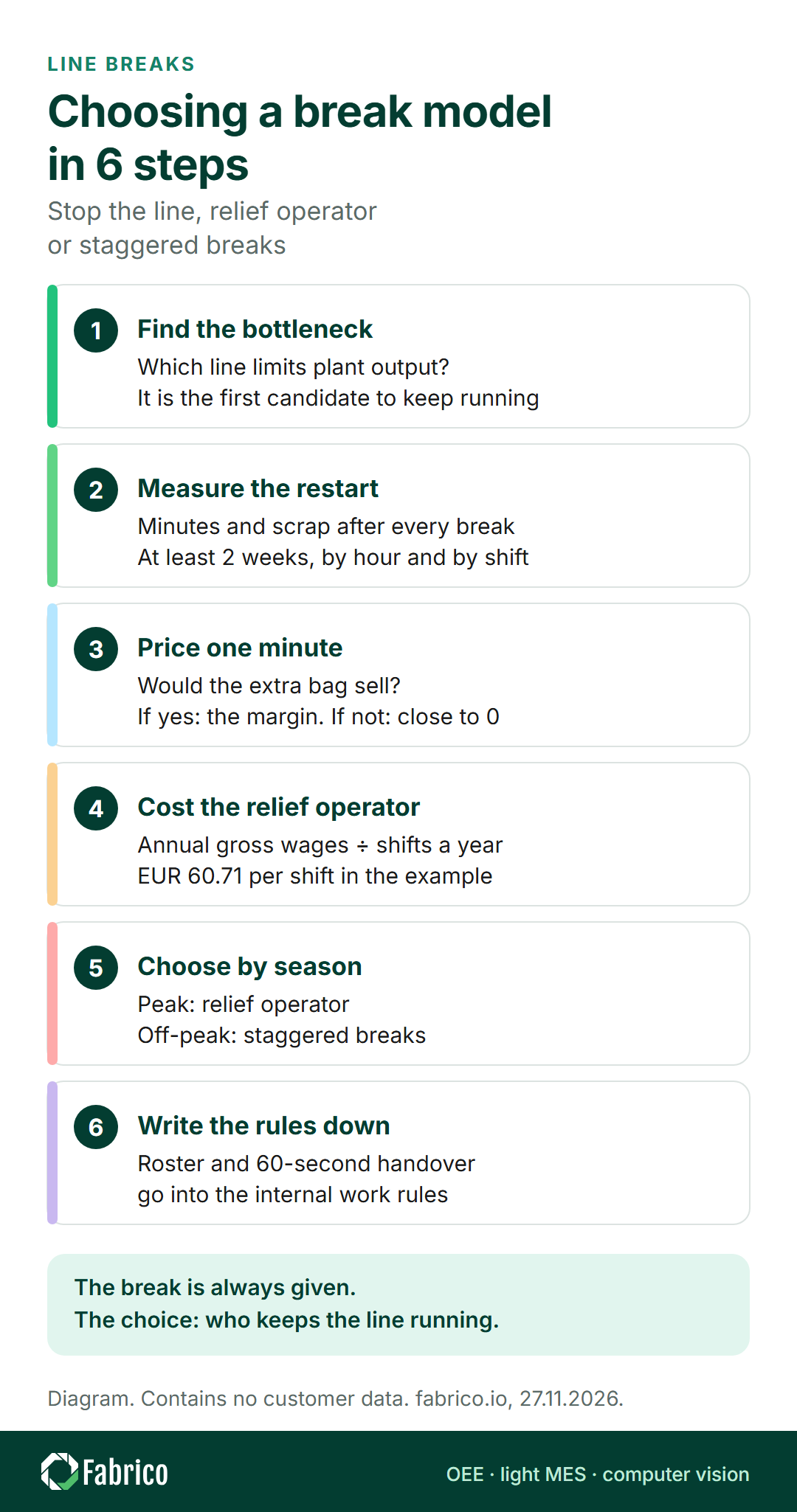
Text version of the diagram
- Find the bottleneck: which line limits plant output; it is the first candidate to keep running.
- Measure the restart: minutes and scrap after every break, for at least 2 weeks, by hour and by shift.
- Price one minute: if the extra bag sells, the minute is worth the margin; if not, close to nothing.
- Cost the relief operator: the annual gross wages divided by the shifts in a year: EUR 45,900 ÷ 756 = EUR 60.71 per shift in the example.
- Choose by season: relief operator in the peak, staggered breaks off-peak.
- Write the rules down: the roster and the 60-second handover go into the internal work rules. The break is always given; the choice is who keeps the line running.
Frequently asked questions
Does the line have to stop for the lunch break?
No. Break rules give the break to the person, not to the line. The line can keep running with a relief operator or with staggered breaks, as long as no post is left without a trained person.
How long is the lunch break in the EU?
The Working Time Directive sets no length. It requires a rest break when the working day is longer than six hours and leaves the details to collective agreements or national law. In Bulgaria, the Labour Code sets the meal break at no less than 30 minutes (Article 151).
Are short breaks counted as working time?
In Bulgaria, breaks under Ordinance No. 15 fall within the working day and count as working time. The meal break under Article 151 of the Labour Code does not, except in continuous processes, where meal time is given within working time.
How many breaks does an 8-hour shift get?
In Bulgaria, the annex to Ordinance No. 15 provides at least 2 breaks in an 8-hour day. The first comes 2-2.5 hours after the start, the second 1.5-2 hours after the meal. An occupational health service develops the exact regime for the job.
What does a relief operator do?
He takes over the post of everyone who goes on break, to a fixed schedule, so the line never stops. On two lines with two people each, one relief operator per shift covers all four.
How is a break logged for each break model?
If the line stops, the break is a planned stop and comes out of planned production time. If the line runs through the break, that time stays in planned production time. The restart after the break is logged separately, with a reason.
How much does a relief operator cost?
In Bulgaria, at least EUR 7,442.40 a year at the 2026 minimum wage of EUR 620.20. At the manufacturing average of EUR 1,275 (NSI, September 2026), it is EUR 15,300 a year. Both figures are gross, before employer social contributions.
Want to see what every break costs on your lines? The demo shows planned and unplanned stops by line and shift, output by hour after each break, and scrap by product and reason.
Latest from our blog





Real Fabrico tiles, sample data.