





 Login
 Blog
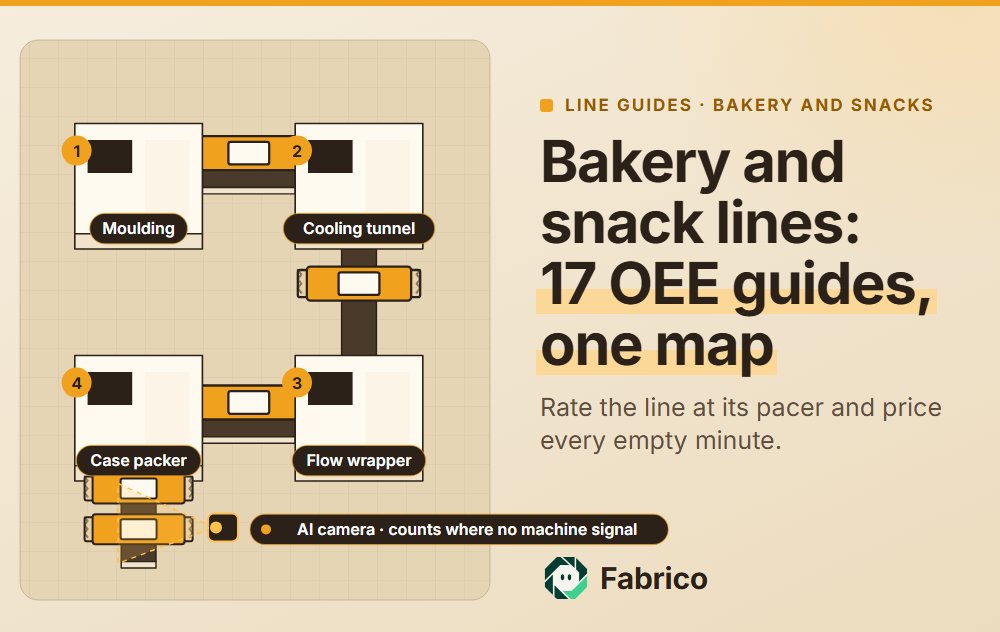
OEE for bakery, confectionery and snack lines: 17 line guides

In short
- 17 guides, one per line type, from frozen pastry to instant noodles. Each prices its own line losses in a worked example.
- One shared method: rate the line at its pacer, book every empty pacer minute under the station that caused it, and weigh giveaway apart from OEE.
- Start with the guide for your product, or the one with the same pacer.
On the continuous lines in this group, one station sets the pace and cannot win back lost time: a tunnel oven, a fryer, a mogul or a cooling tunnel. When the station in front of it is late, it runs empty, and those minutes are gone for the shift.
The shared method
So OEE is measured the same way on all of them. Rate the line at the pacer, in pieces or kilograms per minute. Book every minute the pacer runs empty as an availability loss, under the station that caused it: mixing, the depositor, a full cooler. Count good product after the last check at packing.
Batch lines such as halva and lokum count time per batch instead, but the rule holds: the loss belongs to the step that caused it. The full formula is in the OEE calculation guide.
Giveaway sits outside OEE. An overweight cake or bar still counts as good, so weigh it apart and price the extra grams at material cost.
| Loss | Where it shows | Book it as |
|---|---|---|
| Pacer runs empty | Oven band, fryer or mogul with no product | Availability, under the station that caused it |
| Pacer runs slow | Band or mould speed below the rated pace | Performance |
| Broken or rejected product | The last check at packing | Quality |
| Giveaway | Pieces over target weight | Outside OEE: weigh and price apart |
The 17 line guides
Each guide works through its own case: its own stations or decisions, its own worked example and its own sources.
Bread, pastry and baked goods
| Line guide | The question it answers |
|---|---|
| Frozen pastry lines | Banitsa, filo, puff pastry and croissants: where does the line lose time? |
| Kozunak and sweet bread | Proofing, braiding or the oven: which step holds the line back? |
| Rusk and toast bread lines | Two ovens feed one slicer: how do you rate the line? |
| Pretzel lines | What do the lye bath, oven pace and broken knots cost? |
| Cracker lines | Oven pace, the trim loop and breakage: where do the losses sit? |
| Cake lines | Why does the oven band run empty, and what does giveaway cost? |
| Donut lines | Proofer pace, fryer oil and glaze: where does the money go? |
| Waffle lines | What do plate losses, sticking and sugar giveaway cost? |
| Wafer lines | Oven, cream and cutting: where does the yield go? |
| Pizza lines | How do the pacer, topping giveaway and changeovers add up? |
Confectionery and sweets
| Line guide | The question it answers |
|---|---|
| Enrobing lines | Tunnel speed and coating giveaway: how are they priced? |
| Gummy candy lines | What does one day on a mogul line lose, in euros? |
| Lokum production | Trays, cutting and powder: where does the time go? |
| Halva and tahini | How long does each batch really take, and where does it wait? |
| Cereal bar lines | Cooling, cutting and bar weight: what does each loss cost? |
Snacks and fried products
| Line guide | The question it answers |
|---|---|
| Popcorn lines | Dosing, seals and the overwrapper: where does the line stop? |
| Instant noodle lines | Fryer pace, packer stops and oil uptake: what does each cost? |
How to pick where to start
If your product is in the table, start there. If not, pick the guide with the same pacer:
- Tunnel oven: cakes, crackers, pretzels, wafers, rusks.
- Fryer: instant noodles.
- Proofer or fryer, whichever is slower: donuts.
- Starch mogul: gummy candy.
- Cooling and cutting: cereal bars, lokum.
Then measure one line for two weeks before you change anything: every stop with a reason the operator chooses, good output at the end of the line, and giveaway by weight. Price the three biggest losses. That short list tells you which station to fix first, and it is the number to bring to the budget meeting.
From one line to the whole bakery
On one line a clipboard and a spreadsheet will do. Across several lines and three shifts the logging gets slow and the numbers arrive late. That is the point where OEE software pays: stops and counts are logged as they happen. For the wider systems picture in a food plant, see MES for food manufacturing.
Where Fabrico fits
- OEE by line and shift, read at the core machine.
- Operators pick the stop reason on a tablet.
- Losses ranked by financial impact.
- Where a machine has no usable signal, a camera counts output.
Fabrico is made by the publisher of this article.
Frequently asked questions
Does giveaway count in OEE?
No. An overweight product counts as good output. Weigh it apart and price the extra grams at material cost.
How do I book time when the oven keeps running but the line has stopped?
Count the empty band minutes. Each one is an availability loss, booked under the station that left the band empty.
See what your bakery line loses, in euros. A Fabrico consultant walks you through OEE by line and shift, stop reasons chosen by operators and losses ranked by financial impact.
Questions first? Contact us.
Latest from our blog




Real Fabrico tiles, sample data.