





 Login
 Blog
Waffle Production Line OEE: Plate Losses, Sticking and Sugar Giveaway

In short
- Read OEE at the waffle oven: rate it in plates per minute times waffles per plate, and count waffles at the demoulding exit.
- Count plates, not turns: in the example, 2 empty plates out of 48 cost 380 waffles a shift while the oven counter showed a normal run.
- Split plate cleaning in two: the scheduled brush and release-agent pass is planned; a clean forced by a stuck plate is unplanned.
- Weigh the pearl sugar: 1.5 g over target per waffle, on average, came to 13.11 kg a shift in the example.
- Example result: a Belgian Liège-style line at 78.4% OEE, with priced losses of €548.03 a shift and €274,015 a year.
OEE on a waffle production line is availability times performance times quality, read at the waffle oven. Rate the oven in plates per minute times the waffles each plate bakes. Count every waffle that leaves the plates, then every good waffle at the case.
The gap between the two counts, and the gap to the rated pace, is your loss.
The trap on a waffle line is the plate. A carousel or chain oven turns at full speed even when one plate is empty, sticky or sealed off. The oven counter sees a normal turn. The bakery loses that plate's waffles every lap, all shift long.
This page covers soft and Liège-style waffles and frozen toaster waffles. Biscuit lines on a tunnel oven are a different flow, covered in OEE for biscuit production lines. Flat wafer sheets baked in plate ovens are a different product again, with their own rules, and are not covered here.
Plates per minute: the pace of the whole line
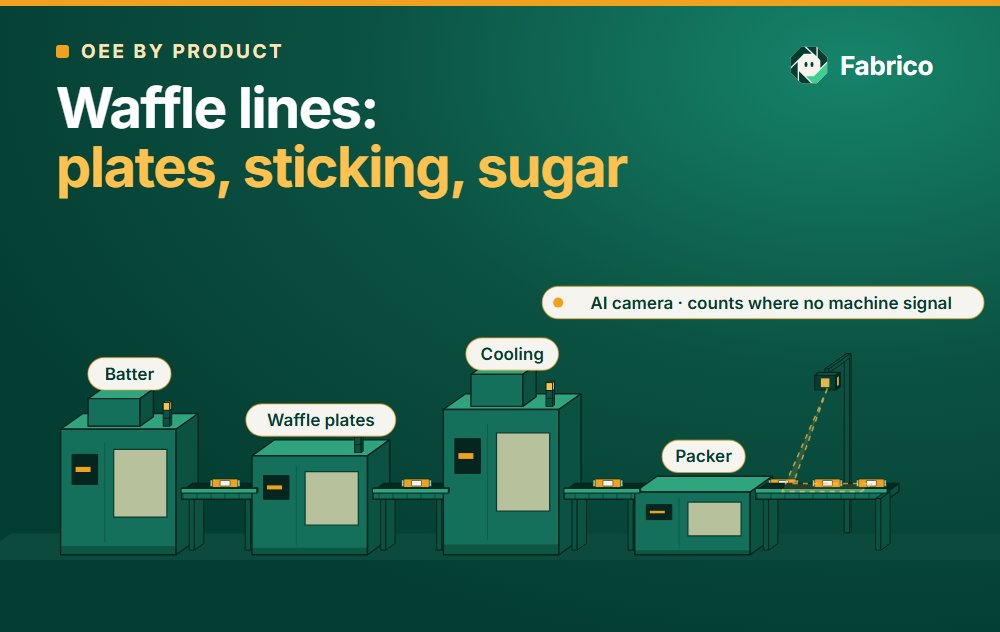
On the line in this article, the oven is the constraint. Mixing runs in batches ahead of it. Cooling, freezing, stacking and packing are sized to take what it bakes. When the oven slows, every station after it slows too.
So the rated speed is the oven's: plates per minute at the chain speed set for that product, times the cavities on each plate. A plate pair with four cavities at 6 plates a minute is 24 waffles a minute. Write it on the product card, one line per product.
| Item | What to write down | Example value |
|---|---|---|
| Plates in the oven | Count of plate pairs on the chain | 48 |
| Chain speed | Plates a minute, per product | 6 |
| Cavities per plate | Waffles baked per plate pass | 4 |
| Rated speed | Plates a minute x cavities | 24 waffles a minute |
| Lap time | Plates / plates a minute | 8 minutes |
Bake time changes by product, so the chain speed does too. A thicker Liège-style waffle needs a slower chain than a thin toaster waffle on the same oven. Rate each product at its own chain speed, or the slow product looks like a performance loss it is not.
Industrial ovens run at real volume. Huber and Schoenlechner, writing in Food Science & Nutrition, cite an earlier handbook: an industrial waffle oven produces up to 40,000 waffles an hour. At that pace, a few minutes of lost plates is thousands of waffles.
The plate ledger: one empty plate, every lap
A turn counter does not show this loss, and it decides whether your performance figure means anything. A waffle oven has a fixed number of plates. If one is out of use, you lose its waffles on every lap, without a single stop.
Plates drop out of use for three reasons:
- A stuck plate: residue from a waffle that stuck, so the crew leave it empty rather than risk another stick.
- A missed dose: the batter nozzle or dough-ball placer skips a cavity or a whole plate.
- A plate held back: a hinge, latch or heating fault, so the plate runs open and empty until a planned stop.
None of these shows on a turn counter or the line PLC's run signal. The chain moves at rated speed. Only a count of waffles at the oven exit, set against plate passes, shows the gap.
How to keep the ledger
- Number every plate pair, if the oven does not have numbers already.
- Work out plate passes per shift: chain speed times run minutes.
- Multiply by cavities: that is the waffles the oven should have baked.
- Count waffles at the demoulding exit and take the difference.
- Every time a waffle sticks or a plate runs empty, write the plate number on the shift sheet.
If the same plate numbers repeat over a week, those plates go to re-coating or repair first. That is a targeted fix instead of a full plate change, and the shift sheet gives you the proof.
Book an empty plate as a performance loss, not a stop. The oven runs; it just bakes fewer waffles per lap than it is rated for. If you book it as nothing, availability and quality look fine while OEE quietly drops.
Six stations and the losses that belong to each
A waffle line has six stations from flour to case. Each one can cost oven time, but not every loss should land on the oven's crew. Give each loss a home station and an owner.
| Station | Loss on the floor | OEE bucket | Owner |
|---|---|---|---|
| Mixing | Batter or dough late to the oven | Availability | Mixing lead |
| Dosing | Skipped cavity, heavy dose, sugar off target | Performance, giveaway | Oven operator |
| Oven | Stuck waffle, empty plate, slow chain | All three | Oven operator, maintenance |
| Demoulding | Torn or folded waffle | Quality | Oven operator |
| Cooling and freezing | Broken or frosted waffles | Quality | Line lead |
| Stacking and packing | Stacker jam backs up to the oven | Availability | Packing lead |
The mixing lead owns a late batch, even though the oven is where it shows. The packing lead owns a stacker jam that blocks the oven. Reason codes that name the station keep the morning meeting short.
Stacking jams
A stacker can jam on warm, soft or misshapen waffles. A short jam is absorbed by the conveyor. A long one fills the buffer, and the dough or batter feed must stop, so the oven turns empty. Book that time as a stop caused by packing, not by baking.
Clearing jams is also where people get hurt. The UK Health and Safety Executive's food machinery guidance states that conveyors are involved in 30% of all machinery accidents in the food and drink industries. Count jams so you can remove their cause, not so crews clear them faster.
Short jams under a minute or two are micro-stops. They need a machine signal to count: a paper shift sheet misses them, as the first option below shows. See micro-stops for how to set the threshold between a micro-stop and a logged stop.
Why waffles stick, and what each cause looks like
Sticking is the waffle oven's own stop. Huber and Schoenlechner state that waffles which partly or fully stick to the plates "cause significant product loss and increased costs".
They also cite an earlier handbook: 1% of sticking waffles can make up to 72 kg of waste per day.
In their Part I study on batter ingredients, they write that sticking "interrupts continuous waffle baking in the industry". In their trials, a stuck plate needed a clean-up by brushing and fresh release agent before baking could carry on.
Their study on plate material in the Journal of Food Science found that ductile and grey iron plates released waffles less well than the two steel plates tested. They add that baking had to be hot enough for rapid crust formation but not so hot that it burned.
The failure-mode table below turns that into floor checks. It lists what an operator sees, the likely cause, and the first check to make before changing the recipe.
| Symptom | Likely cause | First check | Bucket |
|---|---|---|---|
| Same plate sticks again and again | Worn coating or surface damage | Plate number on the shift sheet | Availability |
| Sticking after start-up | Plates below temperature | Plate temperature before first dose | Availability |
| Sticking on all plates | Release agent too thin or missed | Spray nozzle and dose | Availability |
| Dark, sticky edges | Burnt sugar on the plate | Sugar dose and plate temperature | Quality |
| Torn waffles at demoulding | Crust not set at opening | Bake time for that product | Quality |
| Empty cavities, no stop | Nozzle or placer skip | Exit count against plate passes | Performance |
Release agent matters too. In the plate material study, release agents based on short-chain fatty acids with a higher degree of saturation gave better release than long-chain or emulsifier-acid types. Ask your release-agent supplier which family you use before changing anything else.
Sugar is part of the picture. The Part I study found crystal sugar performed better than powdered sugar for sticking in their batter. That is a lab result on one recipe, so treat it as something to trial on your line, not a rule.
Brushing and release agent: planned or unplanned?
A waffle oven needs plate care: brushing, a release-agent pass, and from time to time a deep clean. The question is how to book it. The answer decides whether your availability figure is fair to the crew.
- Planned: the brush and release-agent pass on a fixed schedule, every shift, at a set time. It gets its own reason, such as "Plate care, scheduled", and comes out of planned production time.
- Unplanned: any clean forced by a stuck plate, burnt sugar or a run of torn waffles. It is an availability loss with the reason "Plate stuck, cleared".
If both go under one "cleaning" code, two things go wrong. The planned clean inflates the loss, and the forced cleans hide inside it. Keep them apart and you see whether sticking is rising week to week.
Changeovers are a third thing. A swap from a hazelnut variant back to plain waffles can need an allergen clean.
Hazelnuts are among the nuts named in Annex II of Regulation (EU) No 1169/2011, the list of substances or products causing allergies or intolerances. Track changeovers against a standard time, as in changeover time.
Pearl sugar and batter weight: the grams OEE misses
OEE does not measure weight accuracy. A waffle with 1.5 g too much pearl sugar counts as good. So giveaway needs its own number beside OEE, priced in euros per shift.
On a Liège-style line, pearl sugar is folded into the dough before it is divided into pieces. Uneven mixing or a heavy hand at the hopper puts more sugar in every piece. On a toaster waffle line, the same thing happens with batter weight at the dosing nozzle.
Weigh it once an hour: ten dough pieces or ten waffles, against the target on the product card. Write the average. That is enough to price the gap. For the method, see giveaway and overfill.
Excess sugar also melts onto the plates. Sugar that caramelises on a plate can feed the next stick, so a sugar check is also a sticking check. Track both on the same sheet and look for plates that stick on high-sugar hours.
Colour as a quality reject
A dark waffle is a colour reject. Colour is also a food safety topic. The European Food Safety Authority states that acrylamide forms in starchy foods during high-temperature cooking, at +120°C and low moisture.
Commission Regulation (EU) 2017/2158 lists wafers, not waffles, among fine bakery wares. Check with your food safety lead whether the product falls in scope. Its rule for those products is to bake "to a lighter colour endpoint". Either way, book dark waffles under their own scrap reason.
Worked example: a Liège-style waffle line in Belgium
Plate counts, rates and prices are made up for this page, not taken from a bakery. They follow one shift on a chain oven making Liège-style waffles. Redo the arithmetic with your own figures.
The split into availability, performance and quality is the same one Tsarouhas used in a peer-reviewed OEE case study of a croissant line, to find maintenance improvement points on a bakery line.
The line
- Chain oven with 48 plate pairs, four cavities each.
- Rated: 6 plates a minute, so 24 waffles a minute.
- Shift: 480 minutes. Planned stops: 20 minutes of scheduled plate care and a 10-minute crew briefing.
- Planned production time: 480 - 30 = 450 minutes.
- Crew of six on the line.
Availability
Unplanned stops in the shift:
- Stuck waffles cleared: 4 stops of 6 minutes = 24 minutes.
- Stacker jams that stopped the dough feed: 2 of 8 minutes = 16 minutes.
- Dough divider fault: 10 minutes.
Total stops: 24 + 16 + 10 = 50 minutes. Run time: 450 - 50 = 400 minutes. Availability: 400 / 450 = 88.9%.
Performance
Ideal output in run time: 400 x 24 = 9,600 waffles. Two losses cut into it.
- Slow chain: after the second stick, the crew ran at 5 plates a minute for 120 minutes. Lost: 120 x 1 x 4 = 480 waffles.
- Dead plates: 2 of 48 plates ran empty all shift. Plate passes: 280 x 6 + 120 x 5 = 2,280. Empty: 2,280 x 2 / 48 = 95 passes, so 95 x 4 = 380 waffles.
Waffles out of the oven: 9,600 - 480 - 380 = 8,740. Performance: 8,740 / 9,600 = 91.0%.
Quality
Rejects: 110 stuck or torn, 70 too dark, 90 broken at the stacker. Total 270. Good waffles: 8,740 - 270 = 8,470. Quality: 8,470 / 8,740 = 96.9%.
OEE
OEE: 0.889 x 0.910 x 0.969 = 78.4%. Check it the short way: good waffles over the planned maximum. 8,470 / (450 x 24) = 8,470 / 10,800 = 78.4%.
The Belgian shift priced: €548.03
Labour cost comes from Eurostat's labour cost levels dataset (lc_lci_lev). For Belgium, manufacturing (NACE C), the latest published year is 2024, at €51.5 an hour. Eurostat notes that Belgian 2025 data are not released.
That is a sector average, not a waffle operator's pay. A crew of six costs 6 x 51.5 = €309 an hour, or €5.15 a minute. Each lost minute below is a minute the crew was paid without making good waffles.
| Loss | Minutes | € a shift |
|---|---|---|
| Stops (stick, stacker, divider) | 50 | 257.50 |
| Slow chain (480 / 24) | 20 | 103.00 |
| Empty plates (380 / 24) | 15.833 | 81.54 |
| Reject time (270 / 24) | 11.25 | 57.94 |
| Crew time lost | 97.083 | 499.98 |
Two more items have a material cost:
- Reject material: 270 waffles at €0.11 of dough each (sample figure), sent to animal feed with nothing recovered: €29.70.
- Pearl sugar giveaway: 1.5 g over target on 8,740 waffles = 13.11 kg. At €1.40 a kg (sample figure): €18.35.
For context on sugar, the European Commission's sugar price monitoring puts the EU average white sugar price at €503 a tonne in September 2026. Pearl sugar is a processed grade, so the sample figure sits above that.
Shift, month and year
- Per shift: 499.98 + 29.70 + 18.35 = €548.03.
- Per month, 21 days at 2 shifts = 42 shifts: €23,017.26.
- Per year, 250 days at 2 shifts = 500 shifts: €274,015.
The two empty plates alone cost €81.54 a shift, €40,770 over 500 shifts. That is the loss a turn counter never shows.
This bill leaves things out. Oven energy, release agent and plate re-coating are not priced. Neither is lost margin: if the line is sold out, the 2,330 good waffles short of the planned maximum (10,800 - 8,470) would also carry their contribution margin.
Toaster waffles: the freezer moves the count
A frozen toaster waffle line adds a cooling run and a freezer between oven and packing. The oven still sets the pace. What changes is where you count good waffles, and which losses happen after the oven.
In the EU, waffles sold as quick-frozen fall under Council Directive 89/108/EEC. Article 5 states that their temperature must be maintained "at all points in the product, at -18 °C or lower."
- Count total at the oven exit, as for soft waffles.
- Count good after the freezer, at the case packer infeed.
- Book freezer breakage as a quality loss with its own reason.
- Book a freezer stop that backs up to the oven as a downstream stop.
If good waffles are counted before the freezer, breakage and frosted packs disappear from OEE. If the freezer slows the oven, the oven's crew carry a loss they cannot fix. Agree both rules before the first shift is counted.
Oven counter, plate tally or line software
There are three ways to measure a waffle line. Each one fits a different stage, and in the example the price is crew time or a software subscription.
1. Oven counter and shift sheet
Read the oven's turn counter, count cases at the end, and log stops on paper. It costs a team leader about 10 minutes a shift: 10 x €0.85833 = €8.58 at the Belgian average cost per minute (51.5 / 60). It shows stops, but not empty plates or micro-stops.
2. Plate tally plus exit count
Add a waffle count at the demoulding exit, a plate-number column on the sheet and an hourly sugar weight. It costs about 20 minutes a shift, €17.17 at the same rate. It shows the plate ledger, but only as fast as someone types it up.
3. OEE or light MES software fed by the oven
Connect the oven's run signal and an exit count, and let operators pick stop reasons on a screen at the line. Get a written monthly quote for this oven line. Compare OEE software options on what they count, not on dashboards.
What you see: a shift timeline, unclassified time waiting for a reason, and the operator's line-down screen, on sample lines. Book a demo.
Plays from YouTube. Google may set cookies when you press play. Privacy policy.
For a plant with several lines, see OEE software for food and beverage. If you also need work instructions and order tracking on the floor, read MES for food manufacturing.
| Option | Best for | Shows empty plates? | Cost |
|---|---|---|---|
| Oven counter and sheet | A first baseline on one oven | No | €8.58 a shift in crew time |
| Plate tally and exit count | Proving the plate loss | Yes, by hand | €17.17 a shift in crew time |
| Line software | Several lines, daily reviews | Yes, from the exit count | Monthly vendor price, in writing |
Seven checks for a waffle line software vendor
- Can each product carry its own oven rate, in plates a minute times cavities?
- Where can the good count be taken: oven exit, after the freezer, at the case packer?
- How does a stacker jam that blocks the oven get booked?
- Can scheduled plate care and a forced clean have separate reasons?
- Which signal is needed from the oven, and what if it has none?
- How are giveaway grams entered next to OEE, and priced?
- What does the shift report cost per line per month, all modules in?
A plate-by-plate start on one waffle oven
Pick one oven and one product. Run the counts for two weeks before changing anything. The first week builds trust in the numbers; the second shows the pattern.
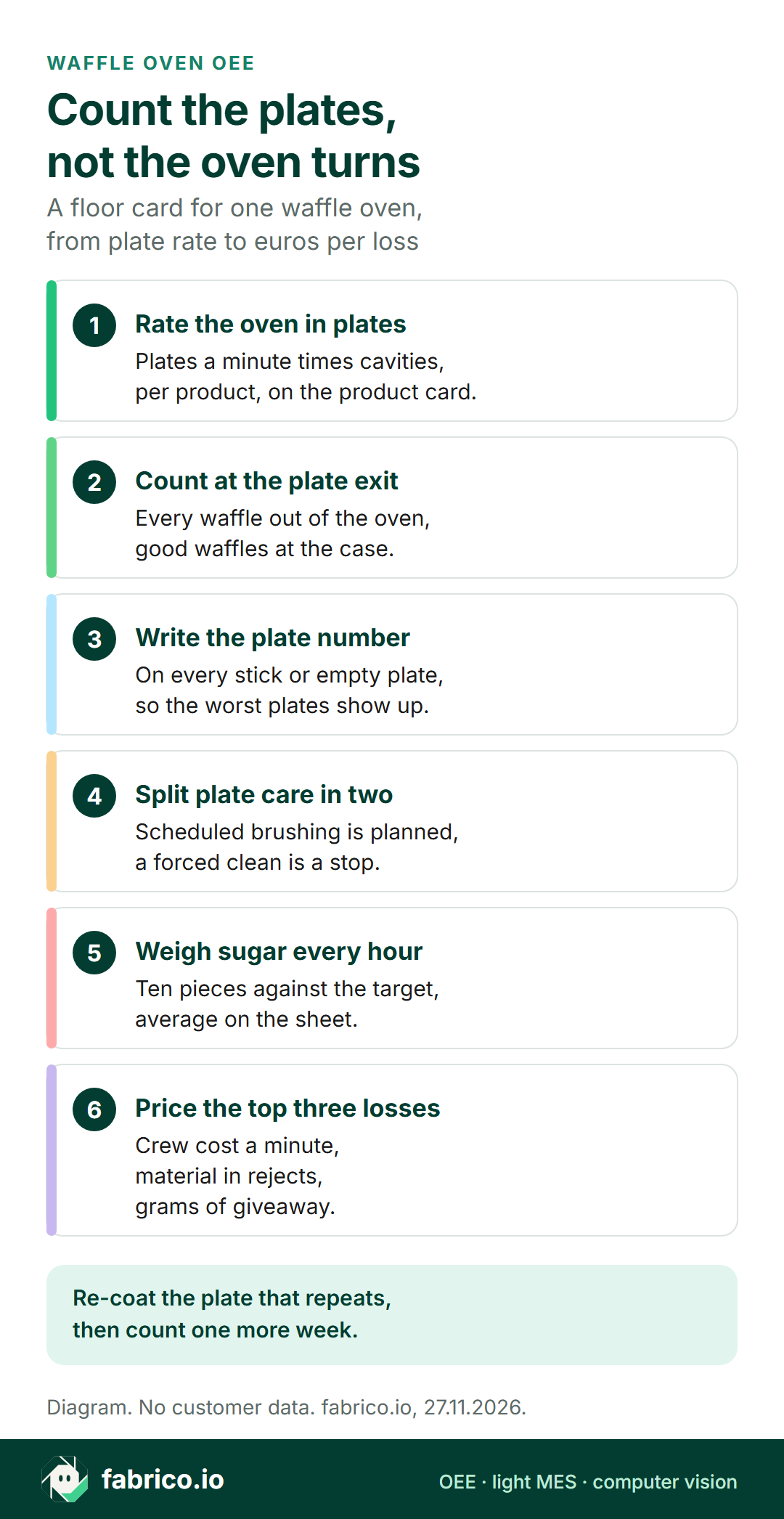
Text version of the diagram
- Rate the oven in plates: plates a minute times cavities, per product, on the product card.
- Count at the plate exit: every waffle out of the oven, and good waffles at the case.
- Write the plate number: on every stick or empty plate, so the worst plates show up.
- Split plate care in two: scheduled brushing is planned, a forced clean is a stop.
- Weigh sugar every hour: ten pieces against the target, average on the sheet.
- Price the top three losses: crew cost a minute, material in rejects, grams of giveaway.
At the end of the two weeks, sort the losses by euros, not by minutes. On the example line, the stops lead at €257.50 a shift. The slow chain and the empty plates add €184.54, and the slow chain followed the second stick.
Fix one thing, then count again for a week. A plate re-coat, a release-agent change or a start-up temperature check each show up in the exit count within days.
Where Fabrico fits
- OEE by line and shift from the core machine, here the waffle oven, connected through the line PLC or a Fabrico IoT device.
- Stops from the machine signal, with micro-stops under the line's threshold counted as delay; for longer stops the operator logs the reason at the oven in a few taps, for example "Plate stuck, cleared", set up in the reason list.
- Scheduled plate care and forced cleans kept apart as planned and unplanned stops; changeovers tracked against a standard time.
- Scrap recorded by product and reason, such as torn, dark or broken at the stacker.
- With the selling price and margin of each product entered, losses are priced in money and stops ranked by financial impact.
- Where a station has no usable signal, the camera add-on counts output there.
See OEE, light MES and computer vision for the modules, and pricing for how a plant quote is built. Fabrico is made by the publisher of this article.
Sources, accessed 27.11.2026: Eurostat, labour cost levels by NACE Rev. 2 activity (lc_lci_lev); Eurostat, Hourly labour costs; European Commission, sugar price monitoring; Huber and Schoenlechner, Waffle production Part II, Food Science & Nutrition; Huber and Schoenlechner, Waffle production Part I, Food Science & Nutrition; Huber, Kalss and Schoenlechner, baking plate material, Journal of Food Science; HSE, food processing machinery; EUR-Lex, Regulation (EU) No 1169/2011; EUR-Lex, Regulation (EU) 2017/2158; EUR-Lex, Council Directive 89/108/EEC; EFSA, acrylamide; Tsarouhas, croissant line OEE case study, International Journal of Productivity and Performance Management.
Frequently asked questions
What OEE target suits a waffle oven?
Take it from your own oven: two weeks of plate and exit counts give the baseline, and the first target follows from the biggest loss in it. The example line on this page ran at 78.4%.
Where should I count waffles for OEE?
Count the total at the oven exit after demoulding, and good waffles at the case packer infeed. On a frozen line, count good waffles after the freezer.
Is plate cleaning downtime?
Scheduled brushing and release-agent passes are planned stops with their own reason. A clean forced by a stuck waffle is unplanned downtime and counts against availability.
How do I find which plates cause sticking?
Number every plate pair and write the plate number on each stick event. After a week, the plates that repeat are the first candidates for re-coating or repair.
Does OEE include pearl sugar giveaway?
No. A waffle with extra sugar still counts as good. Weigh pieces every hour and price the extra grams as a separate line next to OEE.
How is OEE different on a toaster waffle line?
The oven still sets the pace, but a freezer sits before packing. Count good waffles after the freezer, so breakage and frozen-product rejects stay inside the quality figure.
See what your waffle oven loses, priced in euros. The demo shows OEE by line and shift from the core machine, stop reasons logged by operators, and losses ranked by financial impact from the margin of each product.
Latest from our blog




Real Fabrico tiles, sample data.