





 Login
 Blog
Popcorn Production Line OEE: Dosing, Seals and the Overwrapper

In short
- 120 bags a minute at the overwrapper: in the worked example it is the slowest station, so each minute it stands costs 120 bags.
- Two dosers, one bill: 1.5 g of kernel overfill and 0.8 g of slurry overfill cost USD 88,468 a year, and OEE shows none of it.
- Seal rejects are the largest single material loss: 1,800 bags a day, USD 55,793 a year, because a dosed bag is not reworked in the example.
- Count bags against cartons: in the example, 300 bags a day pass the checkweigher and never reach a carton.
- Lost minutes lead the bill either way: USD 1,419.70 of the USD 2,205.01 a day at crew cost, and USD 6,570 a day on a sold-out line.
On a popcorn production line, OEE compares the good bags that reach cartons with the bags the pacer could have made in the planned time. On the microwave popcorn line in this page's example, the pacer is the overwrapper.
The figure covers stops, slow running and rejects. It does not cover the grams that the kernel and slurry dosers give away, so this page prices those beside it.
Fried snacks such as chips and extruded shapes run on a different logic, covered on the page about OEE for snack food lines. This page stays with popcorn: mainly microwave bags, with one section on ready-to-eat popcorn as a contrast.
Six stations, one pacer: the overwrapper
A microwave popcorn line in this example runs in this order:
- Slurry kitchen: fat is melted and mixed with salt, flavour and colour, then kept warm in a day tank.
- Bag forming: printed paper with a susceptor patch is folded and bottom sealed into an open bag.
- Dosing: a volumetric cup drops the kernels and a piston pump adds the slurry.
- Top seal and fold: the bag is sealed, folded into its flat trifold and checked at a reject gate.
- Overwrapper: each bag gets a film wrap, then passes a checkweigher.
- Cartoner and case packer: three bags go into a carton, cartons into a shipping case.
The susceptor is the metallised patch that heats the kernels and slurry in the oven. It is also why the bag is a costly part of the pack: it is a printed laminate, not plain paper.
| Station | Rated, bags a minute | Role on the day |
|---|---|---|
| Bag maker, dosing and sealer | 130 | Feeds the wrapper, 10 spare |
| Overwrapper | 120 | Pacer |
| Cartoner, 45 cartons of 3 | 135 | Clears the wrapper, 15 spare |
In this example the overwrapper is the slowest station, so the line is rated at 120 bags a minute. On another layout the bag maker or the cartoner may be slower. Take the lowest rated speed on the real line, from the nameplate and a timed run.
A short accumulation conveyor sits between the sealer and the wrapper. When the bag maker stops for a few seconds, the wrapper runs on from the buffer, and the bag maker's 10 spare bags a minute refill it.
Why spare speed hides seal rejects
The same 10 spare bags a minute can replace bags rejected at the seal gate. The wrapper stays fed, so a count taken only at the wrapper shows a full minute while the bag maker threw away kernels, slurry and a susceptor bag.
That is why the total count on this line is taken at the sealer exit, before the reject gate. Rejects then land in the quality rate instead of vanishing upstream of the pacer.
Six counts and the bags-against-cartons check
If each shift counts at a different place, the quality rate depends on who was on. Fix six counts and keep them:
| Count | Where | Used for |
|---|---|---|
| Bags sealed | Sealer exit, before the gate | Total count |
| Seal rejects | Reject gate after the sealer | Quality loss, coded by cause |
| Bags wrapped | Overwrapper exit | Pacer running and speed |
| Wrap rejects | Overwrapper reject | Quality loss, coded by cause |
| Weight rejects | Checkweigher | Quality loss, by doser |
| Cartons | Cartoner exit | Good bags = cartons x 3 |
Good bags come from the last count: cartons times three. Any other good count trusts bags that might still be lost before the carton closes.
Closing the count every shift
Take the example day. The sealer counted 146,520 bags. Seal, wrap and weight rejects took out 1,800 + 450 + 900 = 3,150, which leaves 143,370 bags accepted by the checkweigher.
The cartoner counted 47,690 cartons, which hold 47,690 x 3 = 143,070 bags. The gap is 143,370 - 143,070 = 300 bags, 0.21% of the accepted bags.
Those 300 bags went somewhere: torn at the cartoner infeed, pulled off by hand at a jam, or left in a carton the cartoner rejected for a missing bag. None of them shows up in a reject count.
- Book the gap as its own scrap reason, so it stays visible in the quality rate.
- Close the count per shift, not per week, so a jump points to one crew and one run.
- Check part cartons: a carton with two bags is a reject that also holds two good bags.
Where the cartoner has no reliable counter, a camera over the cartoner exit can count cartons. The aim is one count of finished cartons that nobody types in.
Two dosing stations, two giveaway bills
A microwave popcorn bag is filled twice. Kernels come first, by volume. Slurry comes second, by piston stroke. Each station has its own spread around its target, and the plant sets each target above that station's share of the declared weight.
Kernels: a volume dose for a weight label
A volumetric cup holds a fixed volume, but the label states weight. When a new kernel lot is denser or has a different size mix, the same cup gives a different weight. The cup setting has to follow the lot.
Kernel moisture also matters for the eater. A Journal of Food Engineering study of five popcorn genotypes found the highest popping quality and the fewest unpopped kernels at 14% moisture, tested from 8% to 20%.
Unpopped kernels never touch OEE. A bag full of them is still a good bag on the line. Track kernel lot moisture and dose weight beside the OEE figure, not inside it.
Slurry: a warm liquid with a cold start
The slurry fat is kept warm so it pumps as a liquid. Its flow can change with temperature, so the first strokes after a long stop or a flush can dose a different weight than the steady run.
Weigh slurry doses after every restart longer than a set limit, and after every flush. A short sample on a lab scale tells the crew whether the pump needs a trim before the checkweigher starts rejecting.
Why the targets sit above the label
NIST Handbook 133, the US procedure guide for checking net contents, states: "In general, the average net quantity of contents of packages in a lot must at least equal the net quantity of contents declared on the label."
It also defines a maximum allowable variation (MAV): a single package short by more than the MAV counts as an unreasonable minus error. A plant that wants no short lots sets its doser targets above the declared weight. The margin it picks is giveaway, paid on every bag.
OEE is blind here: an overfilled bag is a good bag. The OEE figure stays the same whether the bag holds 85 g or 87.3 g, so giveaway needs its own weekly number per doser.
In the example, the bag is declared at 85 g: 60 g of kernels and 25 g of slurry. The kernel cups run 1.5 g over and the slurry pump 0.8 g over, so the average bag holds 87.3 g.
| Doser | Overfill now | USD a year now | USD a year per gram |
|---|---|---|---|
| Kernel cups | 1.5 g | 55,385 | 36,923 |
| Slurry pump | 0.8 g | 33,083 | 41,354 |
| Both | 2.3 g | 88,468 |
A gram of slurry costs more than a gram of kernels in this example, so the smaller overfill carries the higher price per gram. Halving the kernel overfill to 0.75 g would save USD 27,692 a year.
The page on giveaway and overfill as a quality loss covers how to set a target from the measured spread instead of a habit.
Susceptor bag seal failures and their causes
A microwave bag has to hold the slurry in the carton, in the warehouse and in the oven. A weak top seal is a reject at the gate, or worse, a leaking bag in a shop. Five failure modes to check on the floor:
| Symptom | Likely cause | Floor check | Loss |
|---|---|---|---|
| Open top seam | Jaw too cool or dwell too short | Jaw temperature at rated speed | Seal reject |
| Slurry on the seal | Nozzle drip after a stop | First bags after each restart | Seal reject |
| Seal pleated or creased | Paper tension, fold off line | Fold at the forming box | Seal reject |
| Bag opens at the wrapper | Weak fold or trifold spring-back | Bags in the buffer | Wrapper jam |
| Leak found in a carton | Weak seal passed the gate | Hourly squeeze sample | Count gap, complaint |
The second row links seal rejects to the slurry pump. A drip that lands on the seal area after a stop shows up as a burst of rejects in the first bags. Logged by time, the rejects point at the restart, not the jaws.
Bag paper is a variable too
The FDA page on PFAS in food contact uses lists grease-proofers for microwave popcorn bags among the uses it once authorized, and states that in February 2024 FDA announced that PFAS grease-proofing agents on paper and paperboard for food contact use are no longer being sold by manufacturers into the US market.
A change of bag paper or coating is a change to the seal. When a new paper arrives, rerun the jaw settings at rated speed and watch seal rejects by reel for the first shifts.
Pricing a seal reject
In the example, a rejected bag is not reworked: kernels coated in slurry cannot go back to the hopper. Each one is priced at its full material cost before wrap, USD 0.123. That makes 1,800 seal rejects USD 221.40 a day, the largest single material loss in the example.
Flavour changes, slurry flushes and the flavour kitchen
Flavours, flushes and bag sizes each touch different stations, and each is booked its own way:
| Change | What changes | Booked as | On the day |
|---|---|---|---|
| Flavour change | Bag reel, cartons, code, slurry tank | Changeover, standard 20 min | 2 x 25 min |
| Slurry flush | Pump, lines and nozzles | Planned stop, own reason | 2 x 20 min |
| Bag size swap | Cup volume, forming parts, wrap | Changeover, own standard | Not run that day |
The flavour change is measured against its standard: 2 x 25 = 50 minutes against 2 x 20 = 40, so 10 minutes over. The flush is a planned clean. It gets its own reason and its own trend, not a standard time.
In this example the flushes stay inside planned time, so they show in availability. Some plants take cleans out of planned time. Either rule works if it never changes between shifts.
One stop, two tasks: book the clock minutes
If the bag reel is changed while the slurry lines flush, the line stands once. Two tasks of 20 minutes done together hold the line for 20 clock minutes, not 40. Book those minutes once, under the action that held the line longest, and note the other.
The page on changeover time covers moving the bag reel, cartons and code setting outside the stop, so the flush becomes the only thing that holds the line.
Sequence and safety in the flavour kitchen
Run flavours from light to strong where the plan allows: plain salted, then butter, then extra butter. A sweet or kettle style slurry is a different fat and sugar system, so it earns its own flush and its own slot.
The slurry kitchen is also a health question. OSHA's page on flavorings-related lung disease notes that NIOSH investigated exposures at a Missouri microwave popcorn plant in 2000, and that flavorings commonly contain diacetyl or 2,3-pentanedione.
In the NEJM study of workers at a microwave popcorn plant, airway obstruction rose with estimated cumulative exposure to diacetyl. Flushes and flavour changes open tanks and lines, so exposure controls belong in the standard work for both.
One US microwave popcorn line, one day
The example is one microwave popcorn line in the US: 85 g bags, cartons of three, three shifts of 480 minutes with breaks covered by relief. Every figure here is invented for illustration; none comes from a real plant.
- Planned time: 3 x 480 = 1,440 minutes.
- Rated speed: 120 bags a minute at the overwrapper.
- Rated output: 1,440 x 120 = 172,800 bags.
- Day plan: three flavours, two flavour changes, two flushes.
| Time lost at the pacer | Minutes | Station |
|---|---|---|
| Flavour changeovers, 2 x 25 | 50 | Whole line |
| Slurry flushes, 2 x 20 | 40 | Dosing |
| Wrap film reel changes, 12 x 2 | 24 | Overwrapper |
| Bag maker stops past the buffer | 20 | Bag maker |
| Overwrapper jams | 15 | Overwrapper |
| Cartoner stops past the buffer | 10 | Cartoner |
| Total | 159 |
Five steps take the day from minutes to an OEE figure:
- Run time = 1,440 - 159 = 1,281 minutes. Availability = 1,281 / 1,440 = 89.0%.
- At 120 a minute, 1,281 minutes could make 153,720 bags. The sealer counted 146,520. Performance = 95.3%.
- Lost to quality: 1,800 seal + 450 wrap + 900 weight + 300 count gap = 3,450. Good bags = 143,070. Quality = 97.6%.
- OEE = 143,070 / 172,800 = 82.8%.
- Check: 0.890 x 0.953 x 0.976 = 0.828.
Performance lost 7,200 bags, which is one hour of output at 120 a minute. In this example, 50 of those minutes are 150 overwrapper micro-stops of 20 seconds, too short for anyone to write down. The other 10 are slow running after restarts.
That makes the overwrapper the owner of 24 + 15 + 60 = 99 minutes of the day. The micro-stops only appear when they are taken from the wrapper's running signal rather than from memory.
The example day in US dollars
What each input costs in this example:
- Labour: BLS Employer Costs for Employee Compensation gives USD 48.62 per hour worked for private industry manufacturing in June 2026.
- Crew: 8 people a shift (sample figure). 8 x 48.62 / 60 = USD 6.4827 a minute.
- Slurry: priced at palm oil, USD 1,120 a tonne in October 2026 in the World Bank Pink Sheet: USD 1.12 a kg.
- Kernels: USD 1.00 a kg (sample figure).
- Bag: susceptor bag USD 0.035, wrap film USD 0.006 (sample figures).
- Calendar: 252 production days a year, 21 in each month; each shift is one third of the day.
The Pink Sheet quote is for Malaysian palm oil, not a price delivered to a US plant, and real slurry also carries salt, flavour and colour. Treat the slurry figure as a proxy and use the plant's own blend cost.
Material per bag: 0.060 kernels + 0.028 slurry + 0.035 bag = USD 0.123 before wrap, USD 0.129 after. Lost minutes carry only the crew's compensation cost here, wages plus benefits; overheads and lost sales are left out.
| Loss, USD | Shift | Day | Month | Year |
|---|---|---|---|---|
| Stops, 159 min | 343.58 | 1,030.74 | 21,646 | 259,747 |
| Slow running, 60 min | 129.65 | 388.96 | 8,168 | 98,018 |
| Seal rejects, 1,800 | 73.80 | 221.40 | 4,649 | 55,793 |
| Kernel giveaway, 1.5 g | 73.26 | 219.78 | 4,615 | 55,385 |
| Slurry giveaway, 0.8 g | 43.76 | 131.28 | 2,757 | 33,083 |
| Weight rejects, 900 | 38.70 | 116.10 | 2,438 | 29,257 |
| Count gap, 300 | 12.90 | 38.70 | 813 | 9,752 |
| Wrap rejects, 450 | 19.35 | 58.05 | 1,219 | 14,629 |
| Total | 735.00 | 2,205.01 | 46,305 | 555,664 |
Totals are the sums of the rounded rows. In the example no rejected bag is reworked, so wrap rejects, weight rejects and the count gap are priced at the full USD 0.129 after wrap. A plant that rewraps bags would price only the film it loses.
The same day, by station
| Station | Time loss | Material loss | USD a day |
|---|---|---|---|
| Overwrapper | 99 min | Wrap rejects | 699.83 |
| Flavour changes and flushes | 90 min | None counted | 583.44 |
| Kernel and slurry dosing | None counted | Giveaway, weight rejects | 467.16 |
| Bag maker and sealer | 20 min | Seal rejects | 351.05 |
| Cartoner | 10 min | Count gap | 103.53 |
| Total | 219 min | 2,205.01 |
Read the map in two ways. The overwrapper leads on time: 99 minutes of stops, micro-stops and slow running. The dosing stations lead on material: USD 467.16 of the USD 785.31 a day of material losses, 59%.
Giveaway alone is USD 351.06 a day, 15.9% of the priced losses, and it would stay hidden in an OEE report.
The same minutes at USD 30 each
At crew cost, the stop and speed minutes are worth USD 1,419.70 a day. On a sold-out line, a pacer minute is worth its lost contribution instead: 120 bags x USD 0.25 (sample figure) = USD 30.
The 219 lost minutes then cost 219 x 30 = USD 6,570 a day, with material losses still at cost. The overwrapper and the flavour changes lead in both views; on a sold-out line the bag maker and sealer, at USD 821.40 a day, also move ahead of the dosers at USD 467.16.
Costs outside this bill
- Cartons and cases scrapped with rejects, and the labour to rewrap bags.
- Customer complaints from leaking bags or unpopped kernels.
- Overtime or extra shifts run to make up lost bags.
- The plant's own slurry blend cost above the palm oil proxy.
Ready-to-eat popcorn: popper, coater and VFFS
Ready-to-eat popcorn is popped at the plant, then coated or salted, cooled and bagged on a vertical form fill seal machine with a multihead weigher. The losses move to different stations:
| Question | Microwave bags | Ready-to-eat |
|---|---|---|
| Pacer candidates | Bag maker, wrapper, cartoner | Popper, coater, VFFS |
| Giveaway point | Kernel cups, slurry pump | Multihead weigher |
| Main quality loss | Seal rejects, short weight | Breakage, clumps, seal leaks |
| Change that holds the line | Slurry flush | Coating clean |
| Count unit | Bags, cartons x 3 | Kilos popped, bags |
Where popping and coating run in batches and the bagger runs continuously, the line has two rhythms. Rate the line at whichever is slower, in kilos a minute, then convert to bags at the declared weight.
Popped corn is light and bulky. A bag can be full by volume before it reaches weight, so the multihead weigher settings and the bag size work together. Breakage between coater and weigher also adds fines that are sold as nothing.
At the bagger, the losses look different again: film splices, jaw cleans and popcorn caught in the seal. The page on VFFS machine OEE covers that machine on its own.
Rules first: a three-week trial on one line
Test the six counts and the doser weighing on one line before any software quote. After three weeks, compare shifts, then lines.
Text version of the diagram
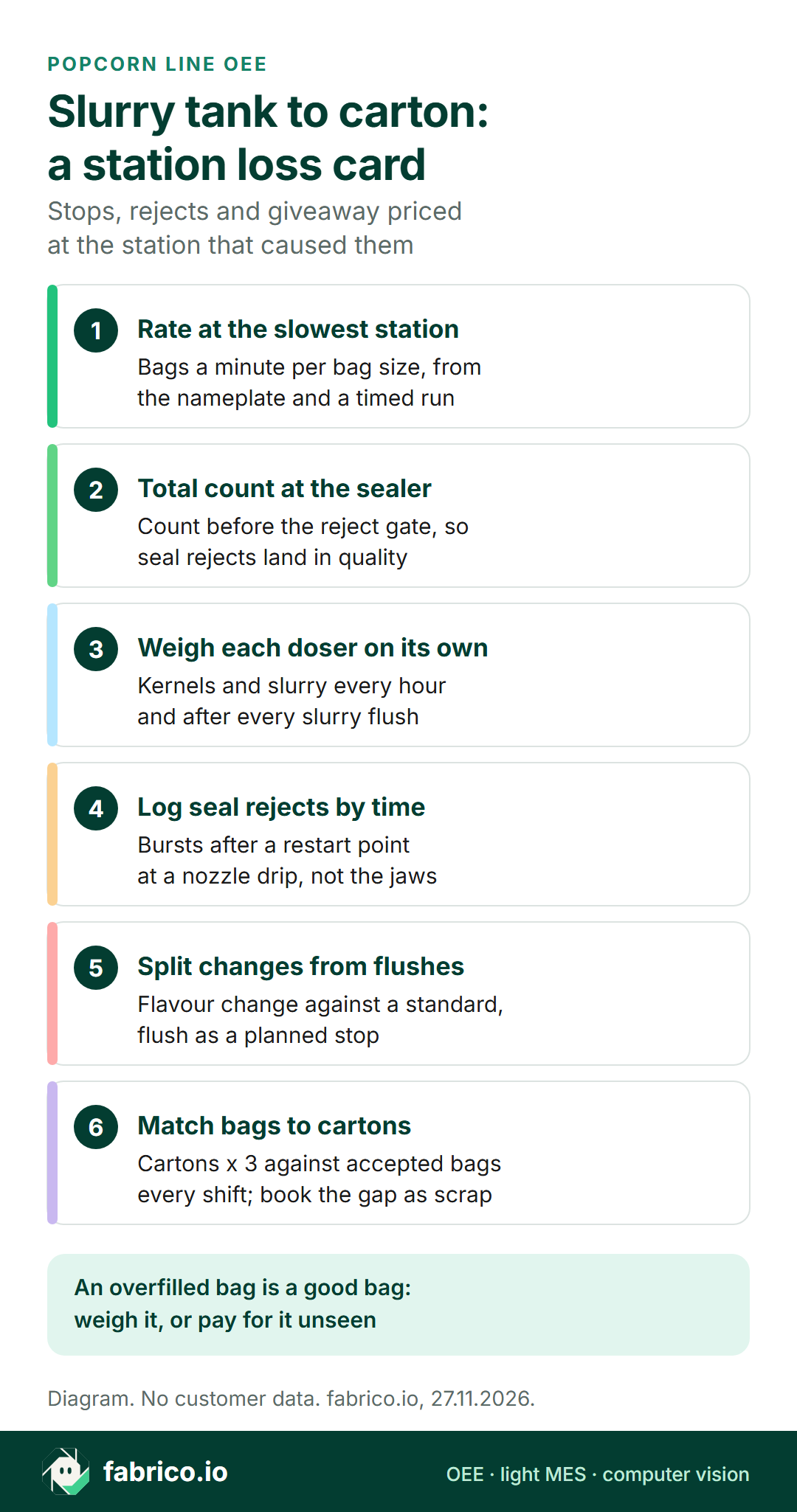
- Rate at the slowest station: bags a minute per bag size, from the nameplate and a timed run.
- Take the total count at the sealer exit, before the reject gate.
- Weigh kernel and slurry doses separately each hour and after every flush.
- Log seal rejects by reason and by time, so restart bursts show.
- Book flavour changes against a standard and flushes as a planned stop.
- Close bags against cartons every shift and book the gap as scrap.
- Week 1: fix one rated speed for each bag size, name the six count points, set the flavour change standard and a stop list of under fifteen reasons. Start weighing doses every hour.
- Week 2: log every stop at the pacer with a reason. Count overwrapper micro-stops from its running signal. Log seal rejects by time.
- Week 3: close bags against cartons every shift. If the gap moves with one crew or one flavour, walk the cartoner infeed on that run.
- Day 21: put the plant's real wage, material and margin numbers into the station map, then choose a single station as the first project.
Wire the wrapper and cartoner signals in from the first shift if their PLCs offer them. A hand tally cannot keep pace with 120 bags a minute, and a 20-second wrapper stop is over before anyone can note it.
Shift sheet to full MES: four routes for a popcorn plant
The routes below differ in which of this page's counts they can hold: the sealer total, the 20-second wrapper stops and the carton gap. The second column names what drives each price, not a figure.
| Route | What drives the cost | Right for | Drawback |
|---|---|---|---|
| Clipboard and shift sheet | About 15 min of one operator a shift: USD 12.16 at the BLS rate | First month, agreeing reasons | Micro-stops and the count gap stay hidden |
| Spreadsheet fed by PLC counters | Integrator time, billed by the day | One line with open PLCs | Depends on one person |
| OEE software or light MES from machine signals | Ask the vendor for a price per line per month | Multi-line plants wanting losses in dollars | Stop reasons stay vague until the list is agreed |
| Full MES, recipes and electronic records | Site-wide project, quoted per plant | Sites bound to keep batch records electronically | The popcorn line gains only when the site project reaches it |
Line software pays off where several popcorn lines run around the clock. OEE software takes the sealer, wrapper and cartoner counts straight from the machines and puts the operator's stop reasons beside them in one shift report.
What you see: a shift timeline, unclassified time waiting for a reason, and the operator's line-down screen, on sample lines. Book a demo.
Plays from YouTube. Google may set cookies when you press play. Privacy policy.
For tools compared across plant types, see OEE software for consumer goods, and for wrappers and cartoners, packaging line OEE software.
Where slurry recipes, release checks and shop floor records also need a home, compare MES for food manufacturing with a light MES rolled out one popcorn line at a time.
Matching the route to the plant
Stay on the clipboard only while the reasons are still being agreed. Switch to software when a second line or a third shift arrives, or when a month of priced losses dwarfs a line subscription.
A full MES earns its rollout when a retailer, an auditor or head office demands electronic batch records. In every option, dose weights come from a scale, so plan where those readings sit next to the line data.
Seven questions for a supplier
- Will the system rate the line at the overwrapper yet take its total count from the sealer?
- Do seal, wrap and weight rejects land in the quality rate under separate codes?
- Can overwrapper micro-stops of a few seconds be taken from the machine signal?
- Can flavour changes be timed against a standard while flushes stay a planned stop?
- Can the cartoner count, times three, be the good count, with the gap shown as scrap?
- Can each flavour's selling price and margin be entered, so the station map comes out in dollars?
- If a second popcorn line or a camera over the cartoner is added later, how does the price change?
Where Fabrico fits
Fabrico is made by the publisher of this article. It is OEE software and a light MES with computer vision. For a microwave popcorn line, these facts matter:
- OEE by line and shift from the core machine, here the overwrapper, connected through the line PLC or a Fabrico IoT device.
- Stops shorter than the line's micro-stop threshold, such as the 20-second wrapper jams, count as delay in performance from the machine signal; longer stops wait on screen for the operator to pick a reason at the machine.
- Seal, wrap and weight rejects booked as waste by product and reason, counted from a waste sensor on the line or entered as a quantity on the line screen.
- A flavour change started as a changeover from one product to the next, with the time left against its standard on screen; slurry flushes booked under a planned stop reason of their own.
- Where a camera covers the line it counts output, for example cartons leaving the cartoner.
- With the selling price and margin of each product entered, losses are priced in money and stops are ranked by financial impact.
The OEE, MES and computer vision features page lists the modules, and the pricing page explains the quote per plant.
Sources, accessed 27.11.2026: US Bureau of Labor Statistics, Employer Costs for Employee Compensation, June 2026, Table 4; World Bank, Commodity Price Data (Pink Sheet), November 2026; NIST, Handbook 133, Checking the Net Contents of Packaged Goods, 2026 edition; US FDA, Authorized Uses of PFAS in Food Contact Applications; OSHA, Flavorings-Related Lung Disease; Kreiss et al., Clinical bronchiolitis obliterans in workers at a microwave-popcorn plant, New England Journal of Medicine 347(5), 2002; Gokmen, Effects of moisture content and popping method on popping characteristics of popcorn, Journal of Food Engineering 65(3), 2004.
Frequently asked questions
How high should OEE be on a microwave popcorn line?
None of the seven sources behind this page gives an OEE figure for popcorn lines. Track the same line week on week under rules that never move: rated at the pacer, total count at the sealer, good count from cartons. The worked example runs at 82.8%.
Is the overwrapper always the pacer on a popcorn line?
No. The pacer is the slowest station at its rated speed. In this page's example it is the overwrapper at 120 bags a minute. On another layout it can be the bag maker or the cartoner.
Is kernel and slurry overfill part of the OEE figure?
No. OEE counts a bag as good once it passes the checkweigher, whatever its grams above the label. Weigh kernel and slurry doses separately and price the overfill beside the OEE figure.
How should seal rejects on popcorn bags be priced?
At the material value that is not recovered. A dosed bag with slurry cannot go back to the hopper, so the example prices each seal reject at its full USD 0.123 of kernels, slurry and bag.
Where do bags go missing between the wrapper and the carton?
In the example, at jams cleared by hand, torn bags at the cartoner infeed and cartons rejected for a missing bag. Close bags against cartons every shift and book the gap as its own scrap reason.
Should slurry flushes count as changeover time?
Book them as a planned stop with their own reason, separate from the flavour changeover. Time the flavour change against its standard, and trend the flushes on their own.
See which popcorn line station costs the most. In the demo: OEE by line and shift from the core machine, operator-chosen stop reasons, changeovers timed against a standard, and stops ranked by what they cost.
Latest from our blog




Real Fabrico tiles, sample data.