





 Login
 Blog
Instant Noodle Line OEE: Fryer Pacer, Packer Stops and Oil Uptake

In short
- Rate the line at the fryer: the steamer and fryer run at a fixed belt speed, so the fryer's blocks a minute is the line's rated speed.
- Packer stops cost blocks, not minutes: the front end keeps frying, so a stopped packer sends product to the diversion bin. Count it as a quality loss.
- Spare packer capacity decides the bill: in the worked example, one stopped packer diverts 60 of its 100 blocks a minute; the other two absorb the rest.
- Sachet feeders are the micro-stop leader: 120 short stops a day divert 4,800 blocks, EUR 59,028 a year of material that feed sales do not repay.
- Oil uptake sits outside OEE: one point more oil in every block costs EUR 109,670 a year at the world palm oil price.
OEE on an instant noodle line is the share of the fryer's rated output that leaves the line as good, sealed packs. The fryer is the pacer because the steamer and fryer belts run at a fixed speed set by cook and fry time.
The hard part is the boundary. The front end, from compound sheeter to cooler, behaves like a continuous process. The packing end, with its sachet feeders and wrappers, stops and starts like any discrete machine.
This page shows where to draw the line between them and how to price what falls through the gap.
Fried snack lines such as chips and extruded snacks have their own logic, covered on the page about OEE for snack food lines. This page stays on the noodle block: sheeted, waved, steamed, fried or dried, then packed with seasoning.
Where the OEE boundary sits on a noodle line
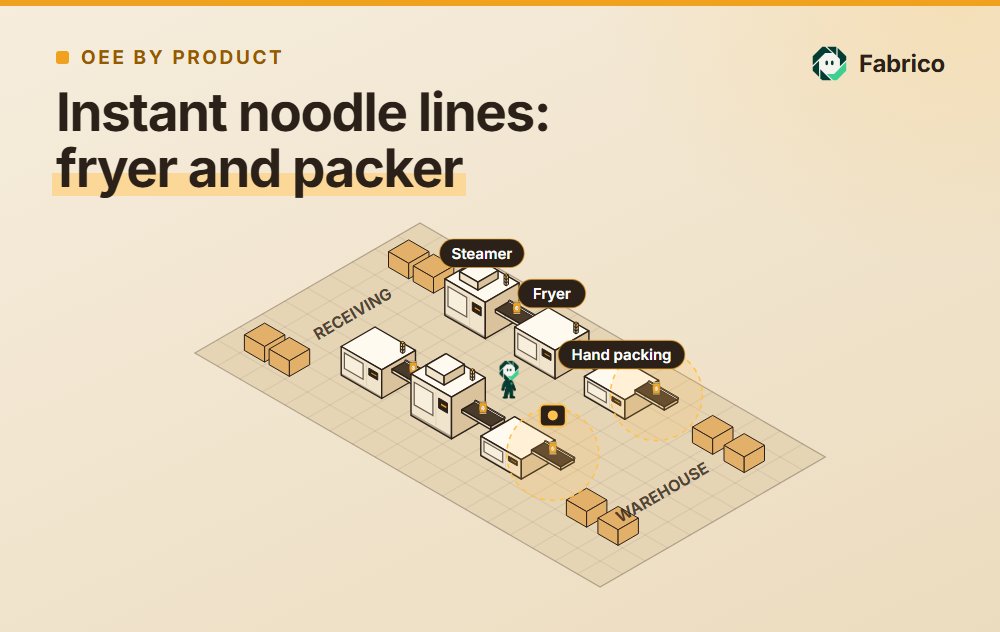
An instant noodle line runs in this order: mixing, compound sheeting and rolling, slitting and waving, steaming, cutting and folding into blocks or cups, frying or hot-air drying, cooling, then bag or cup packing with seasoning sachets.
Everything up to the cooler is one coupled strand. A dough sheet threads from the sheeter rolls through the steamer and into the fryer moulds. Stop one part and the strand breaks, so in practice the front end is not stopped for a packer fault.
The packers are different. Each wrapper or cup sealer has its own film reel, sachet feeders and jams. It can stop for 30 seconds while the fryer keeps delivering blocks.
That gives three ways to draw the boundary:
| Boundary | What it shows | What it hides |
|---|---|---|
| Fryer only | Front end stops and fry speed | Every block lost at the packers |
| Packers only | Wrapper and sachet stops | Sheet breaks and slow frying |
| Fryer rate, packed count | The whole line, in one number | Nothing, if diverted blocks are counted |
The third option is the one to use. Rate the line at the fryer, take the good count after the last packing reject, and count every block that is fried but never packed as a quality loss with its own reason.
The packing crew still needs a machine view of each packer. Keep that as packer OEE beside the line figure, never in place of it.
The fryer sets the rated speed
A fryer has a fixed number of moulds or baskets across the belt and a fixed fry time. Its output follows from geometry, not effort:
- Blocks a minute = moulds across the belt x mould rows passing the exit each minute.
- Mould rows a minute = belt speed / pitch between rows.
Take the example fryer: 10 moulds across, rows at a 0.25 m pitch and a belt speed of 7.5 m a minute. That is 7.5 / 0.25 = 30 rows a minute, and 10 x 30 = 300 blocks a minute.
The belt speed is tied to the fry time. A peer-reviewed study of frying temperature and time in ramyon fried blocks at 140-160 °C for 30-70 seconds and found moisture fell as temperature and time rose.
So a recipe that needs a longer fry slows the belt and the rated speed with it. Write one rated speed per noodle type, never one for the whole line.
Non-fried lines
On a hot-air drying line the dryer takes the fryer's place as pacer. Drying takes far longer than frying, so the dryer is long and holds a lot of product. The rules on this page still apply: rate at the dryer, count at the packers.
Check the packers against the fryer
The example line has three bag packers rated at 120 packs a minute each. Together they can take 360 a minute against 300 from the fryer, a 20% margin.
That margin is not waste. It is what lets two packers absorb part of the flow when the third stops, as the next sections show. For the general method, see the page on starvation and blocking.
Count points from sheet to sealed pack
Without fixed count points, shifts will report different quality rates for the same day. Five counts cover a noodle line:
| Count | Where | Goes into |
|---|---|---|
| Total blocks | Fryer exit, the pacer | Performance and quality |
| Good packs | After the last packing reject | Quality and OEE |
| Diverted blocks | Bin or chute before the packers | Quality loss, by packer |
| Fryer rejects | Visual check after the cooler | Quality loss, by reason |
| Sheet trim and breaks | Sheeter and slitter, before steaming | Rework rate, not OEE |
In the example, sheet trim before the steamer is mixed back into the dough. It never took fryer time, so counting it in OEE would double count. Track it as a rework rate and set a ceiling per batch.
Fried blocks cannot go back into dough. Once a block has been steamed and fried, a reject is final, which is why every count after the fryer matters more than the counts before it.
Rule: weigh the diversion bin every shift and convert to blocks at the standard block weight. A bin that is emptied without being weighed hides the largest loss in this example.
Packer stops that the fryer pays for
When one packer stops, its share of the fryer flow has to go somewhere. The distribution conveyor sends what it can to the other packers and the rest falls to the diversion bin.
The example line works like this:
- Flow per packer: 300 / 3 = 100 blocks a minute.
- Spare capacity per packer: 120 - 100 = 20 blocks a minute.
- One packer stopped: the other two take 2 x 20 = 40 extra. The rest, 100 - 40 = 60 blocks a minute, is diverted.
- Two packers stopped: the last one takes 20 extra, so 200 - 20 = 180 blocks a minute are diverted.
This is the core of the boundary problem. A packer stop of one minute costs 60 fried blocks, yet the fryer kept running. A fryer-only OEE shows a perfect minute.
Three ways to shrink the diversion
- Raise spare capacity: each extra 10 packs a minute on the two running packers saves 20 blocks for every minute a packer is stopped.
- Add a short buffer: an accumulation table before the packers holds blocks through short stops, then feeds them back as the spare capacity frees up.
- Never stop two at once: planned work on packers, such as reel changes and flavour swaps, should be staggered so that only one is down.
A buffer of 150 blocks would hold 150 / 60 = 2.5 minutes of a single packer stop. In the example, that covers every sachet feeder stop and every reel change.
Sachet feeders: the micro-stop leader
A bag of instant noodles can carry one or more sachets: seasoning powder, flavour oil, dried vegetables. Each sachet needs its own feeder, and each feeder places one sachet on every block before the film closes.
The feeder stops for small reasons: a sachet strip that tears, a double feed, a missed cut, a sensor that sees no sachet. The operator clears it in under a minute and the packer runs on.
These stops are too short to log by hand, which is what makes them expensive. The page on micro-stops covers how to capture them from the machine signal rather than from memory.
| Packer loss on the day | Packer minutes | Blocks diverted |
|---|---|---|
| Sachet feeder stops, 120 x 40 s | 80 | 4,800 |
| Flavour swaps, 3 x 15 min | 45 | 2,700 |
| Film reel changes, 18 x 2 min | 36 | 2,160 |
| Seal jaw jams | 20 | 1,200 |
| Total | 181 | 10,860 |
Each row is packer minutes x 60 blocks, because only one packer was down at a time. The sachet feeders alone cause 44% of the diverted blocks.
Missing sachets also matter for the label. Regulation (EU) 1169/2011 lists "Soybeans and products thereof", "Celery and products thereof" and sesame among the allergens in Annex II, and seasoning blends can carry them. A sachet from the wrong flavour is a label fault, not just a taste fault.
A worked day on a 300 block a minute line in Poland
The example is one fried bag noodle line in Poland: blocks of 85 g, three packers, three shifts, and weekly sanitation outside the planned days. The numbers are an example built for this page, not a customer's data.
- Planned time: 3 x 480 = 1,440 minutes. Breaks are covered by relief.
- Rated speed: 300 blocks a minute at the fryer.
- Rated output: 1,440 x 300 = 432,000 blocks.
- Day plan: two noodle types and three flavours.
| Front end loss | Minutes | Type |
|---|---|---|
| Noodle type change (standard 30) | 45 | Availability |
| Sheet breaks at the sheeter, 5 x 6 min | 30 | Availability |
| Cutter and folder jams | 12 | Availability |
| Dough batch late from the mixer | 10 | Availability |
| Fryer conveyor stops | 8 | Availability |
| Total | 105 |
The OEE follows in five lines:
- Run time = 1,440 - 105 = 1,335 minutes. Availability = 1,335 / 1,440 = 92.7%.
- At 300 a minute, 1,335 minutes could make 400,500 blocks. The fryer exit counted 384,000. Performance = 95.9%.
- Lost after the fryer: 10,860 diverted + 2,400 fryer rejects + 1,840 packing rejects = 15,100. Good packs = 368,900. Quality = 96.1%.
- OEE = 368,900 / 432,000 = 85.4%.
- Check: 0.927 x 0.959 x 0.961 = 0.854.
The 16,500 blocks missing from performance equal 55 minutes at rated speed: a slower belt after the noodle type change and after each sheet break, while the sheet was rethreaded and the fry settled.
Read the quality line closely. Of the 15,100 blocks lost after the fryer, 10,860 were diverted at packer stops. That is 72% of the quality loss, and none of it came from frying.
Oil uptake: the cost OEE does not show
A fried block leaves the fryer carrying oil. The Journal of Oleo Science study of steam-and-fried instant noodles measured oil uptake from 12.63% with a blended oil to 18.36% with added soybean lecithin, and advised against adding emulsifier to frying oil.
The example uses 16% oil in an 85 g block, inside that measured range: 0.85 x 16 = 13.6 g of oil per block. Uptake does not stop the line or create a reject, so OEE stays the same whether the block holds 13.6 g or 14.5 g.
Pricing a point of uptake
- Palm oil price: the World Bank Pink Sheet gives USD 1,120 a tonne for October 2026.
- In euros: at the ECB reference rate for October 2026, USD 1.1202 per EUR, that is EUR 1,000 a tonne, EUR 1.00 a kg.
- One point more uptake: 0.01 x 85 g = 0.85 g a block.
- Per day: 384,000 blocks x 0.85 g = 326.4 kg, EUR 326.40.
- Per year: 336 days x EUR 326.40 = EUR 109,670.
The Pink Sheet price is a world market quote before freight and duty. A delivered price in Poland will be higher, so EUR 1.00 a kg is a floor.
What moves uptake on the floor
- Oil choice: the same study found the oil type changed uptake by almost three points.
- Block moisture before frying: steaming and blowing off surface water change how much oil the block takes.
- Fry time: a belt slowed after a restart leaves blocks in the oil longer.
- Oil condition: track the oil change and top-up dates per fryer beside the line data, so a drift in block weight can be traced to the oil.
Check uptake by weighing 10 cooled blocks per lane each hour and comparing with the dry dough weight. Block weight is a production check, and the block also has to meet the pack's declared weight.
Under Directive 76/211/EEC on prepackaged products, "the actual contents shall not be less, on average, than the nominal quantity". Lower uptake can make a light pack, so moisture and dough weight must move with it.
Flavour, noodle type and format changes
A noodle line sees three kinds of change, and they sit at different ends of the line. One average changeover figure mixes them and helps nobody.
| Change | Where | Standard | Actual |
|---|---|---|---|
| Flavour swap | One packer: sachets, film, date code | 12 min | 15 min |
| Noodle type | Front end: dough, waving, cutter | 30 min | 45 min |
| Format, bag to cup | Folder, moulds, packing end | Set from best result | not on the day |
Flavour swaps belong to the packers
A flavour swap does not touch the fryer. It is a packer changeover: new sachet strips, new film, new date code, first-pack check. While one packer changes, the line diverts 60 blocks a minute.
In the example, three swaps of 15 minutes divert 2,700 blocks. Doing them one packer at a time is what keeps it at 60 a minute. All three at once would divert the full 300 a minute: the same 45 packer minutes, done together in 15 minutes, divert 4,500 blocks instead of 2,700.
Seasoning with a different allergen profile needs the sachet path checked, and the first packs verified against the label before release. That check belongs inside the standard time, not after it.
Noodle type changes stop the strand
A change of noodle width, colour or dough recipe means a new sheet threaded through the steamer and fryer. That is front end availability loss at the pacer, plus speed loss while the fry settles.
The 15 minutes over standard come from the usual places: the next dough not ready, cutter and waving settings found by trial, the first block check waiting for QA. The changeover time page covers how to move that work outside the stop.
Bag and cup formats
Where one fryer can feed both bag blocks and cup blocks, the format change is the longest change on the line. Moulds, folding and the whole packing end change together.
Plan it as a separate changeover type with its own standard, and put it at the start of a planned week where possible. Mixing it into flavour swaps makes both standards useless.
The line's losses in euros
The prices behind the example:
- Labour: Eurostat labour cost levels (lc_lci_lev) give EUR 17.1 an hour for Polish manufacturing (NACE C) in 2025.
- Crew: 10 people a shift from mixer to case packer (sample figure). 10 x 17.1 / 60 = EUR 2.85 a minute.
- Block material: 13.6 g oil at EUR 1.00 a kg (EUR 0.0136) + 70 g dough at EUR 0.45 a kg (EUR 0.0315, sample figure) = EUR 0.0451.
- Pack material: block + sachets and film (EUR 0.06, sample figure) = EUR 0.1051.
- Salvage: lost blocks sold as feed at EUR 0.10 a kg (sample figure): 0.085 x 0.10 = EUR 0.0085 a block.
- Calendar: 28 production days a month, 336 a year. A shift is a third of a day.
Price at what salvage does not recover: a diverted block costs EUR 0.0451 - 0.0085 = EUR 0.0366. A rejected pack costs EUR 0.1051 - 0.0085 = EUR 0.0966, because the sachets and film are lost with it.
The table prices minutes at the crew rate, the floor value. Euros are rounded; totals come from unrounded figures.
| Loss | Shift | Day | Month | Year |
|---|---|---|---|---|
| Diverted, 10,860 blocks | 132 | 397 | 11,129 | 133,552 |
| Front end stops, 105 min | 100 | 299 | 8,379 | 100,548 |
| Pack rejects, 1,840 | 59 | 178 | 4,977 | 59,722 |
| Speed loss, 55 min | 52 | 157 | 4,389 | 52,668 |
| Fryer rejects, 2,400 | 29 | 88 | 2,460 | 29,514 |
| Total, EUR | 373 | 1,119 | 31,334 | 376,004 |
| Not in OEE: 1 point more oil | 109 | 326 | 9,139 | 109,670 |
In blocks, the front end leads. In euros, the diverted blocks lead, because a minute of a stopped front end costs crew time while a diverted block costs fried material that feed sales barely repay.
The ranking flips again when the line is sold out. At a contribution of EUR 0.08 a pack (sample figure), a fryer minute is worth 300 x 0.08 = EUR 24.
The 160 lost front end minutes then cost EUR 3,840 a day, and the front end becomes the first project.
So the first question is not the OEE figure but the order book. A sold-out line starts with sheet breaks and the noodle type change. A line with spare capacity starts with the packers and the oil.
Rolling out the rules on one noodle line
Most of the gain comes from agreeing the rules, not from the tool. Start on one line, write the rules down on the first day, and run them for three weeks before comparing lines.
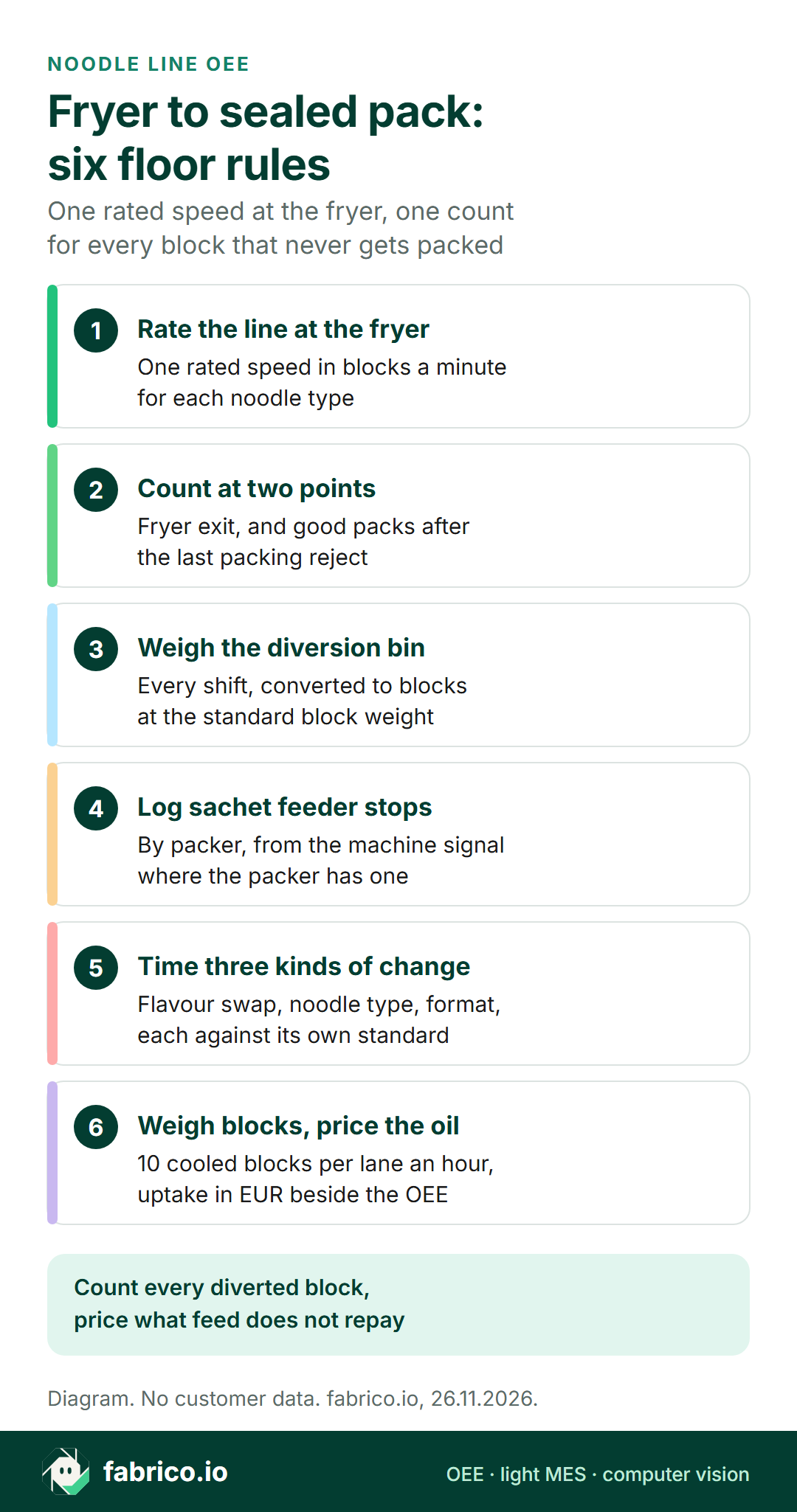
Text version of the diagram
- Rate the line at the fryer: one rated speed in blocks a minute per noodle type.
- Count at the fryer exit and after the last packing reject.
- Weigh the diversion bin every shift and convert to blocks.
- Log sachet feeder stops by packer, from the machine signal where possible.
- Time flavour swaps, noodle type and format changes, each against its own standard.
- Weigh cooled blocks each hour and price oil uptake next to the OEE figure.
- Week 1: write the rated speed per noodle type, the five count points, the changeover standards and a stop list under fifteen reasons. Start weighing the diversion bin every shift.
- Week 2: log every front end stop with a reason, and count sachet feeder stops per packer. Weigh 10 cooled blocks per lane every hour.
- Week 3: compare diverted blocks with logged packer stops. If the bin holds far more than the stops explain, there are stops nobody logged.
- End of week 3: price the top three losses with your own labour, material, salvage and margin figures, and pick one to fix first.
Use the fryer PLC from day one if it has a belt running signal and an exit counter. Hand counts of a 300 a minute flow are guesses, and the trend is the thing you are building.
Picking a way to measure the line
The options differ in how much the plant learns per hour of effort. Software prices vary by vendor and scope, so the table lists cost drivers, not list prices.
| Option | Cost driver | Fits | Weak spot |
|---|---|---|---|
| Paper and shift report | About 15 minutes of operator time a shift: EUR 4.28 at the Eurostat rate | One line, first month, agreeing the reasons | Sachet stops and speed loss stay invisible |
| PLC counters and a spreadsheet | Engineer days; ask your integrator for a day rate | One line with an open fryer PLC | Breaks when the engineer moves on |
| OEE software or light MES from machine signals | Ask the vendor for a price per line per month | Several lines, three shifts, losses in money | Needs reasons and standards agreed first |
| Full MES with recipes and batch records | A plant project; quote per site | Plants that need electronic batch records | Long rollout before the line sees a gain |
The third option fits a plant running three shifts on more than one line. OEE software reads the running signal and counter at the fryer and at each packer, takes stop reasons from the operator and shows the line figure per shift without anyone typing up a sheet.
What you see: a shift timeline, unclassified time waiting for a reason, and the operator's line-down screen, on sample lines. Book a demo.
Plays from YouTube. Google may set cookies when you press play. Privacy policy.
For tools compared by plant type, see OEE software for food and beverage, and for the wrappers and cup sealers, packaging line OEE software.
If recipes, release steps and shop floor records are on the list too, read about MES for food manufacturing, or a light MES that starts at the line and grows from there.
Who should pick which
Stay on paper only while the fryer PLC is closed and the first job is agreeing the reasons. Move to software once a plant runs three shifts or more than one line, or once the diverted blocks cost more each month than a line subscription.
Choose a full MES when a customer, regulator or group policy requires electronic batch records. Whatever the option, block weights and oil uptake come from sample weighing, so plan where those numbers will sit next to the line data.
Questions to ask a vendor
- Can the line be rated at the fryer while each packer keeps its own machine view?
- Can blocks diverted at packer stops be counted as a quality loss, from a signal or by entered weight?
- Can sachet feeder stops of under a minute be captured from the packer signal?
- Can flavour swaps, noodle type changes and format changes each be timed against their own standard?
- Can losses be priced with each product's selling price and margin?
- What happens to the data if the plant network drops for a shift?
- Is the quote per line, per machine or per plant, and what does it include?
Where Fabrico fits
Fabrico is made by the publisher of this article. It is OEE software and a light MES with computer vision. The parts that matter on a noodle line:
- OEE by line and shift from the core machine, the fryer, connected through the line PLC or a Fabrico IoT device.
- Micro-stops from the machine signal, and stop reasons chosen by the operator at the machine in a few taps, set up in the reason list.
- Scrap recorded by product and reason. A reject signal from the line PLC can be counted like any machine signal, or the reject count, such as weighed diverted blocks, can be entered.
- Changeovers tracked against a standard time, with planned and unplanned stops kept apart.
- With the selling price and margin of each product entered, losses are priced in money and stops are ranked by financial impact.
See the OEE, MES and computer vision features, or how a quote per plant is built on the pricing page.
Sources, accessed 26.11.2026: Eurostat, Labour cost levels by NACE Rev. 2 activity (lc_lci_lev); World Bank, Commodity Price Data (Pink Sheet), November 2026; European Central Bank, euro reference rate for the US dollar, monthly average; Qi et al., Effect of Oil Type and Emulsifier on Oil Absorption of Steam-and-fried Instant Noodles, Journal of Oleo Science 68(6), 2019; Kim and Lee, Effect of Frying Temperatures and Times on Cooking Properties of Ramyon, Korean Journal of Food Science and Technology 22(2), 1990; EUR-Lex, Regulation (EU) No 1169/2011 on food information to consumers; EUR-Lex, Council Directive 76/211/EEC on prepackaged products.
Frequently asked questions
What is a good OEE for an instant noodle line?
No neutral, published benchmark exists for noodle lines. Compare the line with itself under fixed counting rules, with the fryer as pacer and diverted blocks counted. The worked example here runs at 85.4%.
Which machine sets the rated speed on a noodle line?
The fryer on a fried line, or the dryer on a non-fried line. Its belt speed follows the fry or dry time, so keep one rated speed per noodle type.
Should packer stops count as downtime if the fryer keeps running?
Not as line downtime. Count the blocks diverted during the stop as a quality loss in the line OEE, and keep the stop minutes in each packer's own machine view.
Does frying oil uptake show up in OEE?
No. A block with more oil does not stop or slow the line. Weigh cooled blocks each hour and price uptake in euros next to the OEE figure.
How should diverted noodle blocks be priced?
At the material value the salvage does not recover. In the example, a block costs EUR 0.0451 in oil and dough and earns EUR 0.0085 as feed, so the loss is EUR 0.0366.
How can sachet feeder stops be cut?
Count them per packer from the machine signal first. Then fix the most frequent cause, such as strip tears or double feeds, and add a short buffer so the remaining stops no longer divert blocks.
See which noodle line loss costs the most. The demo shows OEE by line and shift from the core machine, stop reasons chosen by operators, changeovers against a standard time, and losses ranked by financial impact.
Latest from our blog




Real Fabrico tiles, sample data.