





 Login
 Blog
OEE in lokum production: trays, cutting and powder

In short
- Lokum (Turkish delight) is made in hours but sets for a full day. The cutting and packing line works with trays poured yesterday. If they have not set, the machine waits.
- OEE is read at the cutting and packing machine, because it makes the good boxes. Cooking and setting are recorded as reasons for its stops.
- In the example below, the shift loses 810 EUR. The largest item is the flavour changeover with cleaning out the nuts.
- Humidity in the room makes lokum sticky. Sticking to the knife is a short stop that shows only in speed loss.
OEE in lokum production is the share of planned time in which the cutting and packing machine makes good, powdered and closed boxes. The losses covered here are waiting for trays that have not set yet, flavour changeovers with cleaning, short stops when lokum sticks to the knife, stops of the powder doser, and rejects for crushed boxes and weight.
The article is for owners, technologists and production managers in lokum workshops and plants where cooking is done in batches and cutting and packing are done on a machine. You will find how the machine is measured, how setting is accounted for against it, and a calculation for one shift in euros.
The confectionery sector in Bulgaria in numbers
In the group "Manufacture of cocoa, chocolate and sugar confectionery" in Bulgaria, 197 enterprises with 3,683 persons employed were active in 2024, according to Eurostat structural business statistics (read on 27.11.2026). Lokum makers are in this group, together with makers of chocolate, sweets and halva.
Lokum is a product with few ingredients and a long process. Starch, sugar, water, flavouring and sometimes nuts. That is why the longest part of the product's path is spent not on a machine but in the trays.
From the cooker to the box
| Stage | What happens | Losses that are recorded |
|---|---|---|
| Cooker | Starch, sugar and water are cooked to the required thickness | Late batch, sample out of spec |
| Pouring into trays | The mass is poured and flavouring and nuts are added | No clean trays |
| Setting | The trays stand in a room until the next day | Trays not set, room full |
| Cutting and powdering | The slab is cut into cubes and coated with powder | Sticking to the knife, doser stop |
| Packing | The cubes are placed in boxes and closed | Crushed boxes, weight |
Availability, performance and quality are defined per ISO 22400-2 (read on 27.11.2026). The core machine is the cutting and packing machine: it decides how many boxes come out in the shift. The cooker and the setting room come before it, so their delays are recorded as reasons for its stops.
The cooker: a batch with a clock
Cooking lokum takes hours. Starch and sugar are cooked until the mass reaches the required thickness, and the technologist checks the sample. The cooker works in batches: one batch, one group of trays, one pouring time.
A cooker delay today shows up on the cutting machine tomorrow. That is why the time of each batch is recorded for the cooker: start, sample, pouring. If cooking takes longer, the reasons lie in the raw material, the heating or the sample, not in the cutting machine.
When there are two cookers, the plan staggers them so the trays are filled evenly and the setting room does not fill up all at once. The pouring time of the last tray of the day decides when cutting can start the next day.
The trays: washing and availability
Trays come back from the cutting machine, are washed, greased and wait for the next pour. If there are not enough trays, the cooker cannot pour, even when the mass is ready. The number of trays is capacity, just like the setting room.
So it pays to know how many trays are in use, how many are being washed and how many are ready. When the cooker waits for trays, that is a cooker loss, but it reaches the cutting machine the next day as an empty setting room.
Cube size and the ideal rate
Lokum is cut into cubes of different sizes, and the boxes are 250 g, 500 g and larger. A smaller cube needs more cuts and the machine cuts more slowly. The ideal rate is set per cube size and box size, not for the whole machine.
If the machine has a single rate taken from the fastest product, smaller cubes will show a speed loss that cannot be reduced. A good rule is that the ideal rate is the best sustained rate reached for that product in a normal shift.
The setting room: the plant's capacity
The poured mass must set before it is cut. If a tray is cut too early, the cubes lose their shape and stick. If it waits too long, the surface dries out and the powder does not hold.
The setting room holds a fixed number of trays. It decides how much lokum can come out per day, no matter how fast the machine runs. When it is full, the cooker cannot pour a new batch. When it is empty in the morning, the machine has nothing to cut.
On the cutting machine, waiting for trays is recorded as "waiting for product" with the sub-reason "trays not set" or "no poured trays". That shows whether the problem lies in yesterday's cooking plan, not in the machine today.
It helps if each tray carries its pouring time. Then the machine operator takes the oldest trays first, and the technologist sees how many hours each batch actually set.
Flavours and cleaning
Lokum is made with rose, lemon or mint, and with walnuts, hazelnuts or pistachios. Nuts are listed in Annex II to Regulation (EU) No 1169/2011 among the substances that cause allergies (read on 27.11.2026).
A changeover from one flavour to another without nuts is short: the machine is cleaned of powder and residue. A changeover from lokum with nuts to lokum without nuts requires full cleaning of the knife, the doser and the table, with a check before start-up. Order the week from the flavours without nuts to those with nuts, so there is only one full cleaning.
The colours in lokum are additives used under Regulation (EC) No 1333/2008 on food additives (read on 27.11.2026). When the colour changes, residue from the previous flavour is visible at once, so even the short cleaning has its own standard.
Sticking, humidity and powder
Lokum absorbs moisture from the air. When the room is humid, the cubes stick to the knife and to each other. The machine stops for half a minute, the operator cleans the knife and starts it again.
These short stops are under the downtime threshold and go into speed loss. If speed loss rises on certain days, compare it with the humidity in the room. The link with the weather outside shows whether the fix lies in the room's air conditioning, not in the machine.
The powder doser stops too: the powder clumps, the hopper runs empty or the sieve clogs. Record these stops as a separate reason. The powder is a mix of starch and sugar, and its use per shift is a number the technologist looks at next to OEE.
One shift of the cutting and packing machine in euros
The numbers are an example, not from a real customer. The machine packs 250 g boxes at an ideal rate of 30 boxes per minute. The shift has 450 planned minutes; a stop over 2 minutes counts as downtime. The ideal for the shift is 13,500 boxes.
In the middle of the shift the line moves from walnut lokum to rose lokum, that is, in the direction that needs full cleaning. The contribution per box is 0.25 EUR. For comparison, data from Aswath Damodaran (NYU Stern) give a gross margin of 23.23 % for US-listed food processing companies (data as of January 2026, read on 27.11.2026). Put in your own prices.
| Reason | Stops | Minutes | Recorded as | Boxes | EUR per shift |
|---|---|---|---|---|---|
| Changeover from a walnut flavour to a flavour without nuts | 1 × 32 min | 32 | downtime | 960 | 240.00 |
| Waiting for set trays | 3 × 8 min | 24 | downtime, sub-reason setting | 720 | 180.00 |
| Sticking to the knife | 44 × 30 s | 22 | speed loss | 660 | 165.00 |
| Powder doser | 5 × 4 min | 20 | downtime | 600 | 150.00 |
| Rejects: crushed boxes and weight | 300 boxes | quality | 300 | 75.00 | |
| Total | 98 | 3,240 | 810.00 |
How these numbers are reached:
- Downtime: 32 + 24 + 20 = 76 minutes, run time 374 minutes. Availability: 374 / 450 = 83.1 %.
- In 374 minutes the ideal is 11,220 boxes. Sticking to the knife takes 660. 10,560 are packed. Performance: 10,560 / 11,220 = 94.1 %.
- Rejects 300, good 10,260. Quality: 10,260 / 10,560 = 97.2 %.
- OEE: 83.1 % × 94.1 % × 97.2 % = 76.0 %. Check: 10,260 / 13,500 = 76.0 %.
- The loss: 3,240 boxes × 0.25 EUR = 810.00 EUR per shift.
Ranked by value, the flavour changeover comes first: 240.00 EUR, a loss that the order of the week can bring down to one cleaning. Second is waiting for trays: 180.00 EUR, a loss that comes from the previous day's cooking plan.
If each of the 500 shifts in the year (two shifts a day, 250 working days) has one such flavour changeover, it costs 120,000 EUR, and waiting for trays costs 90,000 EUR. The sums are real only if every lost box could have been sold; refine the estimate with the finance department.
Box weight and batch code
The cubes are cut from a slab whose thickness varies from tray to tray. If the machine fills the box by number of cubes, the weight varies with the thickness. Under Directive 76/211/EEC (consolidated text of 11.04.2009, read on 27.11.2026), the tolerable negative error for a 250 g box is 9 g, and the average weight of the batch may not be below the nominal weight.
That is why the checkweigher after packing is part of the line. When light boxes increase, check the pouring thickness in the trays before touching the machine. More on checkweigher rejects is in the article checkweigher rejects and quality in OEE.
The box carries a batch marking under Directive 2011/91/EU, with the exceptions in Article 2 (read on 27.11.2026). For lokum it helps if the batch code points to the cooking day and the cooker.
Who owns the cooker, the trays and the machine
| Loss | Owner | Data they need |
|---|---|---|
| Waiting for trays | The cooking technologist | Minutes of "waiting for product" with sub-reason, pouring time of the trays |
| Flavour changeover | Planning | Minutes against the standard per direction |
| Sticking to the knife | The shift supervisor | Speed loss by day and humidity in the room |
| Powder doser | The mechanic | Stops by reason and powder use |
| Weight rejects | Quality | Rejects by batch, average weight |
Mistakes in recording lokum
| Mistake | What you see later | How to avoid it |
|---|---|---|
| Waiting for trays is "machine downtime" | The machine looks like the problem | "Waiting for product" with sub-reason setting |
| All flavour changeovers are treated the same | The costly direction gets lost | Standard per direction: with nuts and without nuts |
| Sticking is not compared with humidity | The cause looks random | Speed loss by day and humidity |
| Powder is not measured | Use grows without explanation | Powder use per shift |
What to look at before the shift
Four numbers from yesterday are enough: the machine's OEE, the minutes of waiting for trays, the number of flavour changeovers and in which direction, and speed loss against humidity.
If waiting grows, the conversation is with cooking. If sticking grows, the conversation is with air conditioning maintenance. If the flavour changeovers go in the wrong direction, the conversation is with the plan. Powder use per shift completes the picture, because it shows how much product and how much powder go into the box.
What to choose for a lokum plant
| Method | Suitable when | What it misses |
|---|---|---|
| Tray and machine log | One machine, a few flavours | Short stops and sub-reasons |
| PLC counter into a spreadsheet | First estimate | Reasons and the link to setting |
| OEE software with a signal and reasons from the operator | A wide range of flavours and box sizes | Humidity and powder, if they are not entered |
Questions for the vendor:
- How is "waiting for product" recorded with a sub-reason for setting?
- Can the standard flavour changeover time depend on the direction?
- Can room humidity and powder use be entered for the shift?
- How is an ideal rate set per box size?
- Are counted boxes kept if the plant network drops?
More on confectionery lines is in the article OEE in confectionery and chocolate production, and on the table of changeovers by allergen in the article allergen changeover matrix.
How to start
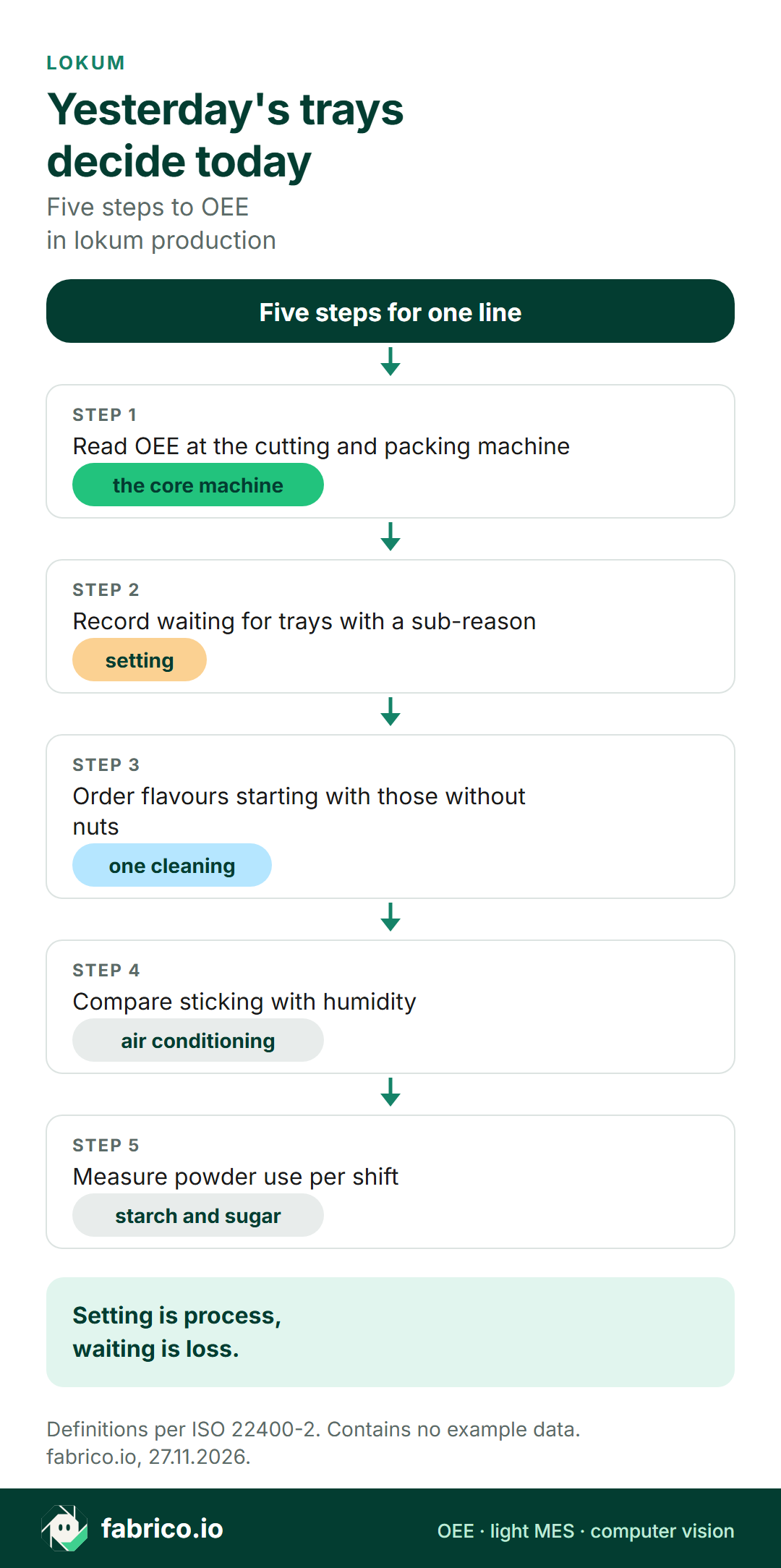
Text version of the diagram
- Read OEE at the cutting and packing machine.
- Record waiting for trays with the sub-reason setting.
- Order the flavours from those without nuts to those with nuts.
- Compare sticking to the knife with the humidity in the room.
- Measure powder use per shift.
Fabrico provides the measured rates per line; the plan itself is made in the ERP, the APS or the planning spreadsheet.
This week: write the pouring time on every tray; time one flavour changeover in each direction; record the room humidity every morning.
This quarter: a signal from the machine's PLC and reasons from the operator; a flavour changeover standard per direction; a cooking plan ordered to the capacity of the setting room.
Where Fabrico fits
Fabrico is made by the publisher of this article.
- What it is: an OEE platform and light MES with built-in maintenance management. It shows live OEE by line and shift.
- Connected line: OEE is read at the core machine, and waiting for product and blocked time are recorded as stop reasons.
- Data: machines connect through the line PLC or through a Fabrico IoT device; where there is no signal, a camera counts output.
- Reasons: stops above the threshold get a reason in a few taps, and stops under the set threshold (up to 10 minutes) go into speed loss. The camera does not identify the reason.
- Money: with the Financial Impact module every loss has a price in EUR.
- Video: where a camera covers the line, the video for the minute of a stop opens from the shift timeline, is streamed on request and not stored in Fabrico.
- Hosting and security: EU customers are hosted on AWS in Frankfurt. Certified to ISO/IEC 27001, ISO/IEC 20000-1 and ISO 9001. The gateway keeps data for up to 30 days if the network drops.
- Price: one quote per plant, based on machines and modules (pricing).
For food plants, see also the article MES for food manufacturing.
A result from a Bulgarian plant
At Ficosota, a maker of home care, hygiene and consumer goods, not food, the time without a recorded stop reason fell from 3.20 % to 0.40 % between June and September 2026.
The result is from 16 lines with OEE and the Financial Impact module, and OEE rose from 53.11 % to 59.62 %. The figures are approved by the customer.
Ficosota is also an investor in Fabrico (since January 2025) and an industrial partner in developing the OEE module; keep that in mind when reading the results.
See one shift of a lokum machine in Fabrico. In a demo you will see the stops by reason and what each one costs in euros.
Frequently asked questions
Which machine is OEE read at in lokum production?
At the cutting and packing machine, because it makes the good boxes. The cooker and setting are recorded as reasons for its stops.
Does setting time count in OEE?
No. Setting is process time. Only the machine's waiting counts in OEE, when set trays are missing. The capacity of the setting room is looked at separately, in trays per day.
Why does lokum stick to the knife?
Because the humidity in the room is high or the tray was cut before it set. Compare speed loss with humidity by day.
How should flavours be ordered through the week?
From the flavours without nuts to those with nuts. That way the full cleaning after nuts happens once, at the end of the week.
How much lighter can a 250 g box of lokum be?
By up to 9 g, that is, down to 241 g. Directive 76/211/EEC allows this error for packages from 200 to 300 g, and the average weight of the batch must be at least 250 g.
Is a camera needed in a lokum plant?
Not for a machine with a PLC. A camera helps where cubes are placed in boxes by hand, where it counts the finished boxes.
Latest from our blog






Real Fabrico tiles, sample data.