





 Login
 Blog
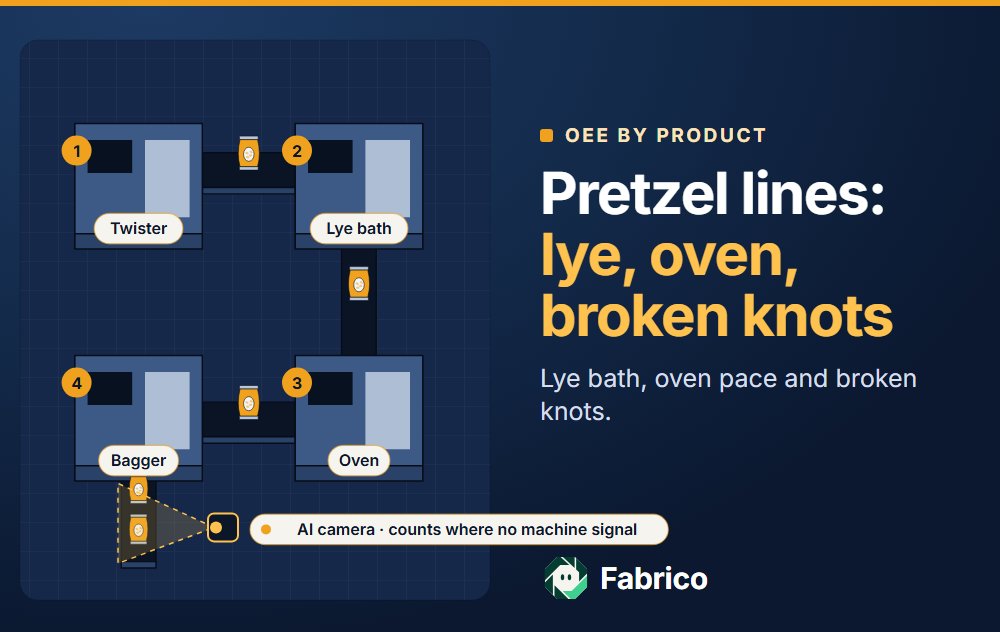
Pretzel Production Line OEE: Lye Bath, Oven Pace and Broken Knots

In short
- Count at the pacer: rate the line at the station with the lowest validated capacity. In the worked example that is the tunnel oven at 4.8 kg of baked pretzels a minute, not the former.
- Lye checks are planned time: a scheduled concentration check gets its own planned reason. A pump fault, a top-up nobody planned or a blocked spray curtain is an unplanned stop.
- Broken and misformed pieces are rejects: selling them as crumb recovers part of the value, so price them at the value not recovered.
- The example shift: OEE 79.4%, 450 kg short of ideal, EUR 560.32 of priced losses a shift and EUR 282,401.28 a year (sample figures, German labour cost).
- Salt is cheap, breakage is not: the extra salt costs EUR 4.62 a shift; the 52 kg of broken pieces cost EUR 67.60.
Pretzel production line OEE is availability x performance x quality, counted in good kilograms against the ideal rate of the slowest validated station. On the sample line in this article, that station is the tunnel oven.
Stops at the former or the lye bath, empty lanes and broken pieces all show up against that oven rate.
This page covers two line types: hard snack pretzels (knots, sticks, bites) and soft or frozen bakery pretzels. For fried snacks such as crisps and extruded puffs, see OEE for snack food lines, which covers fryer-paced lines. Here the focus is the lye bath, the knot and the bag.
Hard snack pretzels and soft bakery pretzels: two lines, one formula
Both lines run the same core steps: mix the dough, form it, rest it, dip it in lye, salt it, bake it. After that they split. Hard pretzels go through a drying stage to a low moisture crisp product, then cool and go to bags.
Soft pretzels come out of the oven ready to eat, or go to a freezer. Frozen lines leave either a baked and frozen pretzel, or a lye-dipped piece frozen raw for baking later. Either way the end of the line is a case packer or flow-wrapper, not a bag former.
The lye bath differs by product. In a KU Leuven study of hard pretzels, the dough was dipped for 45 s in 1.0% sodium hydroxide at 90 °C, baked 3 min at 250 °C and dried 10 min at 135 °C. Those were the study's conditions, not a standard.
For soft pretzels, the Bavarian food authority LGL describes treating the dough piece with a lye of about four percent, and calls 4% the usual concentration for pretzel lye. The bath on a soft line is about four times as strong as in that study.
- Hard line count point: kg of dried pretzels at the oven exit or the dryer exit, then good kg in bags.
- Soft line count point: pieces at the oven exit, then good pieces in cases.
- Same rule on both: one rated rate, one run signal, one reject list.
Which station sets the rated speed: former or oven
The rated speed is the capacity of the slowest station at the validated recipe. Rate the line at the former's nameplate speed instead, and if the oven cannot bake that much, every hour looks slow.
Find the pacer by writing down each station's validated capacity in the same unit. Use baked kg a minute for hard pretzels and pieces a minute for soft ones. The table shows the sample line used in the worked example below.
| Station | Validated capacity (sample) | Limit set by |
|---|---|---|
| Mixer | 5.5 kg/min | Batch size and mix time |
| Former (6 lanes) | 5.6 kg/min | Knots per lane per minute |
| Lye bath | 6.0 kg/min | Belt width and dip time |
| Tunnel oven | 4.8 kg/min | Band length and bake time |
| Dryer | 5.0 kg/min | Dwell time to target moisture |
| Baggers (2) | 5.3 kg/min | Bags per minute at 204 g |
In this example the oven is the pacer at 4.8 kg a minute, or 1,200 knots of 4 g. The former can run faster, so a short former stop does not always cost output if the rest belt holds a buffer. A long one empties the oven band.
The bake profile is fixed by product quality. A faster band means a shorter bake, so the oven speed is not a dial to turn for OEE. Change the rated speed only when quality has signed off a new profile.
On a soft line, the twister or a hand-twisting crew can set the pace instead, with the rest time between forming and the lye as a second limit.
If the oven waits for knots from the crew, it runs with gaps. That is a speed loss at the oven, owned by forming. The page on starvation and blocking shows how to book it.
The lye bath in OEE: planned check or loss
The lye bath is the station a plain bread or biscuit line does not have. It needs regular care: concentration checks, top-ups, sieve cleaning and a full drain and refill. The question is which of these minutes are planned and which are losses.
If the stop is on the plan with a fixed length, it is planned time with its own reason. If it happens because something drifted or broke, it is an unplanned stop. A planned check that overruns its slot is planned up to the slot, then a loss.
- Planned: the scheduled concentration check, the sieve clean at the end of a run, the weekly drain and refill.
- Unplanned availability loss: pump or spray curtain fault, blocked nozzles, mesh belt off track, an unscheduled top-up after a failed check.
- Quality loss: pale or dark pieces after the concentration or temperature drifted.
The quality link is real. The Leuven study found that higher dipping temperatures, longer dipping times and higher NaOH concentrations increased sample redness in the end product. Colour off spec goes to the reject list with the reason "colour after lye drift".
OEE does not measure the lye itself. Concentration, temperature and dip time are process values. They belong in the bath controls and the lab log. OEE counts the time the line stopped and the pieces that failed, and the operator logs the cause from the reason list.
Lye handling: the safety rules that shape the stop reasons
Sodium hydroxide is classified by concentration. The UKHSA compendium, quoting the GB CLP limits, lists 2% to under 5% as Skin Corr. 1B, "causes severe skin burns and eye damage", and 0.5% to under 2% as skin and eye irritant.
By those bands, a 4% bath like the one LGL describes is in the corrosive class. A 1% bath like the one in the Leuven study is in the irritant class, for skin and eyes. The bands rate concentration only, not the heat of a bath at 90 °C.
The same compendium says alkaline splashes to the eye should be treated as an ophthalmic emergency, and that dermal burns may at first be painless.
The US NIOSH Pocket Guide gives a recommended exposure limit of 2 mg/m³ as a ceiling for sodium hydroxide in air and gives first aid as "irrigate immediately" for the eye. Mist from a hot spray curtain is the exposure to think about here.
That changes two things in how the lye section is counted. First, a stop to clear a jam inside the lye section can take longer than a jam on a dry belt, because of protective equipment and lockout. Give it its own reason so the minutes are not blamed on slow operators.
Second, never set a target that rewards skipping those steps. Rank lye section stops by cause and fix the cause: belt tracking, nozzle blockage, dough sticking to the mesh. Do not rank them by how fast the crew cleared them.
Material matters too. The UKHSA compendium notes that sodium hydroxide solution attacks metals such as aluminium, forming hydrogen gas. The German risk agency BfR, in its 2014 annual report, recalls that it advised back in 2002 against aluminium baking trays for lye pretzels and rolls.
In the LGL test, which baked lye rolls, only the stainless steel sheet, the silicone-coated sheet at 4% lye and the release film kept aluminium at the flour's natural level. A tray change made for this reason is a planned project, not a daily stop.
US plants follow their own rule: under 21 CFR 184.1763, sodium hydroxide is affirmed as GRAS for use as a pH control agent and processing aid, at levels not above current good manufacturing practice.
Nine stations, nine loss codes
A pretzel line can lose output at any station, but each loss lands in one of three OEE buckets. Give each station its own short reason list, so the operator picks a station and a cause in two taps. The table is a starting list for a hard pretzel line.
| Station | Symptom | OEE bucket | First check |
|---|---|---|---|
| Mixer | Dough late to former | Availability (starved) | Batch timing vs line rate |
| Former | Open or double knots | Quality | Dough temperature, die wear |
| Former | One lane empty | Performance | Lane jam, cutter timing |
| Rest belt | Knots stuck together | Quality | Spacing, belt dusting |
| Lye bath | Curtain uneven or off | Availability | Nozzles, pump, sieve |
| Salter | Bare or over-salted pieces | Quality or material | Salt flow, vibrator setting |
| Oven | Pale or dark pieces | Quality | Lye log, burner, band speed |
| Dryer and cooler | Breakage at transfers | Quality | Drop heights, moisture |
| Bagger | Film splice, jaw stop | Availability if it backs up | Splice time, seal jaws |
Two rows need care. A single empty lane at the former is not a stop: the oven still runs, five lanes full. It is a speed loss. Count it as missing kilograms at the oven, and give it the reason "lane empty, former".
The bagger sits after the pacer. A bagger stop costs oven output only when the buffer between dryer and bagger fills and the line has to slow or divert. Product sent to bins during a bagger stop is a reject. The VFFS machine OEE page covers the bagger's own losses.
Short stops are the hidden part. A former that hesitates for 20 seconds forty times a shift loses over 13 minutes, and none of it reaches a tally sheet that logs stops over five minutes. Count them from the machine signal as micro-stops, a speed loss, not as noise.
Misformed knots and broken pieces as quality loss
The knot is the product. An open knot, a double knot or a stick with a bent end does not meet spec, even if it tastes right. Where it is caught decides what it costs.
- Caught before the lye: the dough goes back to the mixer as rework dough. The material is recovered, the time is not.
- Caught after baking: the piece is baked, salted and dried. It can only go to crumb or waste.
- Caught in the bag: a customer complaint, which no OEE figure shows.
Broken pieces come from transfers: the drop from the dryer onto the cooler belt, the elevator to the bagger, the weigher buckets. Each drop height is a place to check. A sieve before the bagger removes small pieces and salt; weigh what it catches every hour.
Count both as rejects in the quality factor, by reason. Then price them at the value the crumb sale does not recover. Selling broken pretzels as pieces or crumb returns some money; it does not make them good output.
A rule that saves arguments: a piece is good only if it leaves the line in a bag or case that meets spec. Everything else is a reject, even if part of its value comes back.
Knot, stick and bite: shape changeovers
A shape change touches the whole line. The former needs a new die or forming head, the oven a new bake profile, the salter a new rate and the bagger a new format. Each change type gets its own standard time, measured on the floor.
| Change | Main tasks | Count it as |
|---|---|---|
| Knot to knot, new size | Die swap, oven profile | Changeover vs its standard |
| Knot to stick | Forming head, cutter, oven profile, bag format | Changeover vs its standard |
| Stick to bite | Cutter, salter rate, weigher settings | Changeover vs its standard |
| Salted to unsalted | Salter off and cleaned, sieve change | Changeover vs its standard |
| Seasoned to plain | Seasoning drum clean | Cleaning: planned stop, own reason |
The first good bag after a change ends the changeover, not the moment the former restarts. Pieces baked on the old profile while the oven settles are rejects. Without that rule, half of each change hides in the quality factor.
Run the changeover minutes against the standard for each type, not one average for all. The changeover time page has the method for splitting internal and external tasks.
Worked example: a hard pretzel knot line in Germany
One shift on one sample line in Germany, making 200 g bags of salted knots. The line, its rates and its prices are invented for this page; no customer supplied them. Every step can be redone with a calculator.
- Shift: 480 min.
- Planned stops: lye concentration check and sieve clean 10 min, salter cleanout 15 min. Total 25 min.
- Planned production time: 480 - 25 = 455 min.
- Rated rate at the oven: 4.8 kg a minute (1,200 knots of 4 g).
- Ideal output: 455 x 4.8 = 2,184 kg.
Availability
Unplanned stops that stopped the oven band: former stops 14 min, lye curtain and pump 12 min, starved for dough 8 min, oven band tracking 6 min. Total 40 min. Run time is 455 - 40 = 415 min.
Availability = 415 / 455 = 91.2%. The 40 minutes cost 40 x 4.8 = 192 kg of output.
Performance
At full rate, 415 min of running would make 415 x 4.8 = 1,992 kg. The oven exit weighed 1,848 kg. The gap of 144 kg came from empty former lanes and a slower band after the lye stop.
Performance = 1,848 / 1,992 = 92.8%. The 144 kg equal 144 / 4.8 = 30 minutes of full-rate running.
Quality
Rejects by reason: misformed knots 40 kg, broken pieces 52 kg, colour off after lye drift 14 kg, product to the floor during a bagger stop 8 kg. Total 114 kg. Good output is 1,848 - 114 = 1,734 kg.
Quality = 1,734 / 1,848 = 93.8%.
OEE = 91.2% x 92.8% x 93.8% = 79.4%. Check: 1,734 good kg / 2,184 ideal kg = 79.4%. The line ended 450 kg short of ideal: 192 kg stops + 144 kg speed + 114 kg rejects.
Read the figure from the top. The stop bar is the largest single block, but speed and rejects together are bigger: 144 + 114 = 258 kg against 192 kg. A plant that tracks only stops sees less than half of the 450 kg.
The shift bill in euros, plus salt and bag weight
Lost minutes are priced at crew cost. Eurostat's labour cost levels put German manufacturing (NACE C) at EUR 49.5 an hour in 2025. A crew of six costs 6 x 49.5 / 60 = EUR 4.95 a minute.
The product values are sample figures: EUR 1.60 a kg of cost in a finished pretzel before packaging, and EUR 0.30 a kg recovered when broken or misformed pieces go to crumb. Salt is priced at a sample EUR 0.50 a kg.
Bag weight and salt
For E-marked bags, under the EU average system in Directive 76/211/EEC, the contents must not be less than the nominal quantity on average, and the tolerable negative error for 200 to 300 g is 9 g. A filler is then set above 200 g so the average holds.
In this example the baggers average 204 g. The 1,734 good kg fill 1,734 / 0.204 = 8,500 bags. The extra 4 g a bag is 8,500 x 4 g = 34 kg given away, worth 34 x 1.60 = EUR 54.40.
Salt is dosed at 2.5% of baked weight against a 2.0% spec. The extra 0.5% of 1,848 kg is 9.24 kg of salt, worth 9.24 x 0.50 = EUR 4.62. The money is small; the taste and the sodium on the label are the reasons to fix it.
Neither giveaway nor salt is an OEE loss: a bag at 204 g counts as good. Both sit next to OEE in the bill. The page on giveaway and overfill covers the weight side in depth.
| Loss | Quantity | Price basis | EUR a shift |
|---|---|---|---|
| Stops and speed | 40 + 30 = 70 min | EUR 4.95 a crew minute | 346.50 |
| Misformed and broken | 40 + 52 = 92 kg | 1.60 - 0.30 = EUR 1.30 a kg | 119.60 |
| Colour and floor | 14 + 8 = 22 kg | EUR 1.60 a kg | 35.20 |
| Bag giveaway | 34 kg | EUR 1.60 a kg | 54.40 |
| Extra salt | 9.24 kg | EUR 0.50 a kg | 4.62 |
| Total | 560.32 |
At two shifts a day and 21 working days, that is 42 shifts: 42 x 560.32 = EUR 23,533.44 a month. Over 12 months, 504 shifts: 504 x 560.32 = EUR 282,401.28 a year.
Crew minutes are 346.50 / 560.32 = 61.8% of the priced losses. The 52 kg of broken pieces alone cost 52 x 1.30 = EUR 67.60, more than 14 times the extra salt.
What the bill leaves out
- Lost sales: if the line is sold out, the 192 + 144 = 336 kg not made also cost margin. At a sample margin of EUR 1.10 a kg above the EUR 1.60 cost, that adds EUR 369.60 a shift, for EUR 929.92 in total.
- Planned lye checks: 10 min x 4.95 = EUR 49.50 a shift of crew time, outside OEE because it is planned.
- Energy, lye chemical and water: the oven uses energy during stops and the bath is topped up. They are real but not priced here.
- Complaints: misformed knots that reach a bag.
Decision: tally sheet, PLC counts or OEE software on a pretzel line
Three ways to collect the numbers above. Each fits a different plant. The difference is how many of the 450 kg each one can see, and how much crew time it costs to keep it running.
Tally sheet and hourly weighing. The shift leader writes stops over five minutes, weighs rejects each hour and reads the oven exit scale. Cost: about 10 minutes of a team leader a shift, 10 x 49.5 / 60 = EUR 8.25. It misses micro-stops and empty lanes.
PLC counts plus a daily join. The oven band run signal and the bagger counts come from the line PLC. Someone joins them with the stop list each day. One-off cost: ask the integrator for a quote. It sees speed loss but stop reasons still come from paper.
OEE software or a light MES on the oven signal. Run signals and counts come from the line, the operator picks stop reasons at the machine, and the system prices losses. Get the vendor's monthly price for one line in writing. See OEE software for what to compare.
What you see: a shift timeline, unclassified time waiting for a reason, and the operator's line-down screen, on sample lines. Book a demo.
Plays from YouTube. Google may set cookies when you press play. Privacy policy.
- Pick the tally sheet for a first baseline on one line, or a small soft pretzel bakery with hand twisting.
- Pick PLC counts when the oven and baggers already expose signals and one engineer can own the spreadsheet.
- Pick software when several lines, shifts or sites must be compared, or when losses need pricing every shift without a spreadsheet owner.
For plants that also need a wider system, MES for food manufacturing explains where a light MES ends and a full one starts. The comparison of OEE software for food and beverage lists the options side by side.
Before you buy: what to ask about a pretzel line
- Which station's signal will set the rated rate, and can it be changed per product when quality signs off a new bake profile?
- How is a single empty former lane counted, and where does it show?
- Can a lye concentration check be set up as a planned stop with a fixed length, with any overrun counted as a loss?
- How are rejects entered by station and reason, and can crumb value be set per reject type?
- How are changeovers measured, and does the end point follow the first good bag?
- If the plant network goes down mid-shift, are the oven and bagger counts kept and sent later?
- For one two-shift pretzel line, what is the monthly price, and which items cost extra?
From first count to a priced week
Start on one line with six steps, in order. The first week gives a baseline; the second shows whether the reasons are being used the same way on every shift.
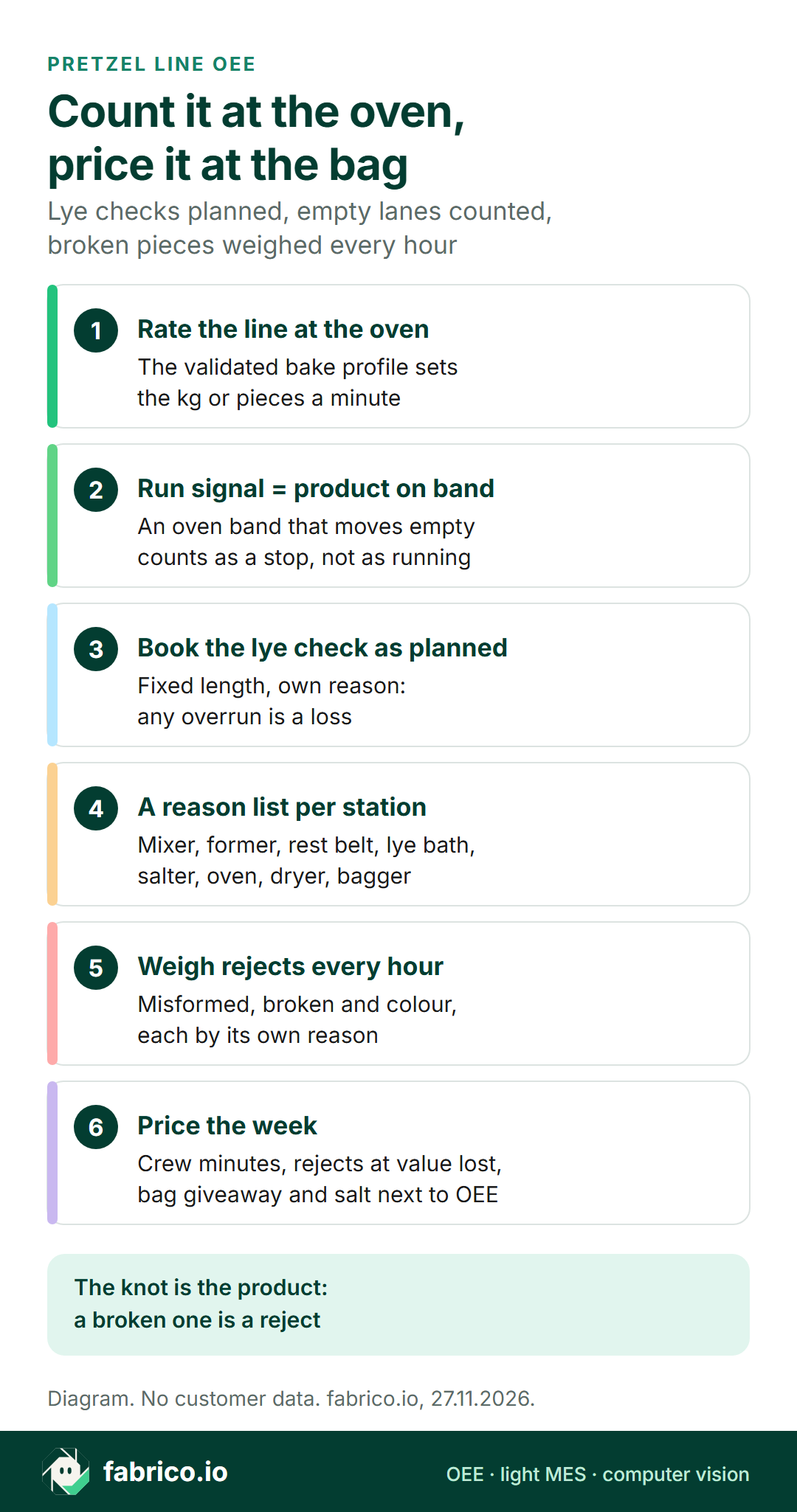
Text version of the diagram
- Rate the line at the oven: the validated bake profile sets the kg or pieces a minute.
- Take the run signal from product on the oven band, so an empty band counts as a stop.
- Book the scheduled lye check as a planned stop with a fixed length; any overrun is a loss.
- Give each station a short reason list: mixer, former, rest belt, lye bath, salter, oven, dryer, bagger.
- Weigh misformed, broken and colour rejects every hour, by reason.
- Price the week: crew minutes, rejects at the value not recovered, bag giveaway and salt next to OEE.
- Day 1: write the station capacity table and agree the pacer with quality.
- Day 1: fix the reason list, with lye section stops split from dry belt stops.
- Days 2 to 5: count, weigh rejects hourly and log the planned lye checks with their real length.
- Day 5: price the week with the bill above, using your own labour cost and product values.
- Week 2: compare shifts. Where one shift logs twice the lye stops of another, check the reason use before the machine.
Fix the largest priced loss first. In this example that is the 70 crew minutes, and within them the 40 minutes of stops, led by the former's 14.
Where Fabrico fits
Fabrico is OEE software and a light MES with computer vision. Fabrico is made by the publisher of this article. For a pretzel line, these facts matter:
- OEE by line and shift from the core machine, here the oven band, connected through the line PLC or a Fabrico IoT device.
- Stops from the machine signal, with micro-stops under the line's threshold counted as delay; for longer stops the operator chooses the reason at the machine in a few taps, with planned and unplanned stops kept apart, so a scheduled lye check stays planned.
- Scrap recorded by product and reason, such as misformed, broken or colour, and changeovers tracked against a standard time.
- With the selling price and margin of each product entered, losses are priced in money and stops are ranked by financial impact.
- Where a station has no usable signal, the camera add-on counts output.
See how the MES and OEE with computer vision feature works, or check pricing: one quote per plant by machines and modules.
Sources, accessed 27.11.2026: Eurostat, labour cost levels by NACE Rev. 2 activity (lc_lci_lev), Germany, manufacturing, 2025; Rombouts et al., KU Leuven, Cross-linking of wheat gluten proteins during production of hard pretzels, Amino Acids 42 (2012); LGL Bayern, Aluminium in Laugengebäck, Backunterlagen im Test; BfR, Annual Report 2014, aluminium in lye bakery wares; UKHSA, Compendium of chemical hazards: sodium hydroxide, incident management; NIOSH Pocket Guide to Chemical Hazards, sodium hydroxide; EUR-Lex, Council Directive 76/211/EEC on prepackaged products, consolidated; US GPO govinfo, 21 CFR 184.1763 Sodium hydroxide.
Frequently asked questions
Which OEE target should a pretzel line set?
Set it from the line's own baseline: two weeks of counts at the pacer, then a target for the largest loss in them. The sample line on this page runs at 79.4%.
Is the lye concentration check planned downtime?
Yes, if it is scheduled with a fixed length and its own reason. An unscheduled top-up after a failed check, or a check that overruns its slot, is an unplanned loss for the overrun minutes.
Where should output be counted on a pretzel line?
At the pacer for the rate, in this example the oven exit, and at the bagger or case packer for good output. Rejects are weighed between the two, by station and reason.
Are broken pretzels a quality loss if they are sold as pieces?
Yes. They did not leave the line as good product to spec. Count them as rejects and price them at the value the piece or crumb sale does not recover.
Does salt overuse count in OEE?
No. OEE counts time and pieces, and an over-salted pretzel in a bag at weight counts as good. Price extra salt and bag giveaway next to OEE, as material losses.
Can lye temperature and concentration go into OEE software?
OEE itself does not use them. They are process values that live in the bath controls and the lab log. Ask each vendor whether its system stores such values and how.
See a pretzel line's losses priced by shift. The demo shows OEE by line and shift from the core machine, stop reasons chosen by the operator, scrap by reason and losses priced in money.
Latest from our blog






Real Fabrico tiles, sample data.