





 Login
 Blog

OEE on a cereal bar line: cooling, cutting, weight

In short
- A cereal bar line has five main losses: start-up until the slab is firm enough to cut, the changeover with allergen cleaning, blocking from the flow wrapper, short stops at the cutter and rejects for broken bars.
- Weight giveaway is a separate account. A bar that weighs 26 g instead of 25 g is good for OEE, but every gram above nominal is raw material paid for.
- In the example below the shift loses 1,290.00 EUR in OEE and another 548.00 EUR in weight giveaway.
- The cooling tunnel decides whether the cutter can cut. If the slab comes out soft, the mix sticks to the blade and the line stops.
OEE on a cereal bar line shows how much of the planned time actually turns into good, cut bars ready for wrapping.
The losses covered here are start-up until the slab cools to a firmness that can be cut, the changeover from one recipe to another with cleaning, blocking from the wrapping machine, short stops at the cutter and rejects for broken or misshapen bars. Separate from OEE is weight giveaway.
The article covers the cooling tunnel, the ideal rate by recipe and size, weight giveaway as a separate account, and one shift calculated in euros. It is written for owners, production directors and process engineers in plants that make cereal, protein, fruit and muesli bars.
Bars in the Bulgarian food industry
According to Eurostat structural business statistics, in 2024 the group "Manufacture of other food products n.e.c." in Bulgaria had 465 enterprises with 3,816 persons employed (accessed 26.11.2026). Some bar makers fall into this group; others are in the confectionery group.
The range is wide: protein bars, no added sugar, with nuts, with fruit. For the plant this means more recipes, shorter runs and more changeovers. That is exactly where a large part of the time goes.
How a bar line works
| Section | What it does | Typical losses |
|---|---|---|
| Mixer | Mixes the grains, nuts and syrup | Late batch, uneven mix |
| Slab forming | Presses the mix into a slab of even thickness | Uneven thickness, sticking |
| Cooling tunnel | Cools the slab until it is firm enough to cut | Soft slab at start-up |
| Cutting | Cuts into strips, then into bars | Sticking to the blade, broken bars |
| Flow wrapper | Wraps each bar on its own | Film reel replacement, jams |
The definitions of availability, performance and quality follow ISO 22400-2 (accessed 26.11.2026). On a linked line, OEE is read at the core machine. Here that is the cutter, because it decides how many bars come out. Stops at the flow wrapper and the mixer are recorded as reasons on the cutter.
With a cutter that reports its state using the PackML state model (ISA-TR88.00.02, accessed 26.11.2026), "Held" is a stop caused by the cutter itself, while "Suspended" means the cutter is ready but the flow wrapper or the slab is not.
The cooling tunnel and slab firmness
The syrup binds the grains while the mix is warm and plastic. The cutter cuts cleanly only when the slab has cooled enough. If the slab leaves the tunnel too warm, the mix sticks to the blade, the bars get crushed, and the operator stops the line to clean the blade.
At start-up the tunnel has not yet reached its working temperature. For the first minutes the slab is soft and cuts slowly or not at all. Record those minutes as a reason of their own, "start-up until good slab", not as general preparation. If they grow, check when the cooling is switched on relative to the start of the shift.
The syrup temperature also has a limit. Hotter syrup makes the mix easier to form, but the slab cools more slowly. The process engineer sets an allowed range. Record the syrup temperature and the slab temperature at the tunnel exit, so you can see when the process leaves that range.
One gram too many: weight giveaway
Every bar has a nominal weight on the label. If the line is set with a large margin so that no bar comes out light, the slab is a little thicker and the bar a little heavier. For OEE that bar is good. For finance every gram above nominal is raw material given to the buyer.
Under Directive 76/211/EEC on prepackaged products (consolidated text of 11.04.2009, accessed 26.11.2026), the tolerable negative error for a pack of 5 to 50 g is 9 % of nominal, that is 2.25 g for a 25 g bar. The lot average, however, may not be below nominal.
So the goal is not "the more, the safer". The goal is an average weight just above nominal, with only as much margin as the spread of the line requires. Weigh a sample of bars every hour, record the average and the spread, and set a target weight per recipe.
Recipes and allergens
Bar recipes can contain many allergens: cereals with gluten, nuts, peanuts, sesame, milk, soy. Annex II to Regulation (EU) No 1169/2011 lists them among the substances or products that cause allergies or intolerances (accessed 26.11.2026).
The changeover from a bar with peanuts to a bar with no peanuts and no nuts requires a full clean of the mixer, the former and the cutter, with a check before start-up.
The changeover between two recipes with the same allergens is shorter. Set a standard time for every pair of recipes, and order the plan from the recipe with fewer allergens to the one with more.
That way the week has one or two long cleans instead of one a day. The minutes gained from the sequence are the cheapest availability improvement there is.
Ideal rate by recipe and size
The cutter cuts at a set number of strokes per minute, but the number of bars per stroke depends on the slab width and the bar size. A 40 g bar is wider than a 25 g bar, so fewer bars come out of the same slab.
A recipe with many nuts cuts more slowly, because the blade meets harder pieces.
So the ideal rate is set per product: recipe and size together. If the whole line has one rate, taken from the fastest product, the slow products will show speed loss that nobody can reduce. If the rate is taken from the slowest, the fast products will look better than they are.
A good rule is that the ideal rate is the best sustained rate reached for that product in a normal shift, not the number from the machine catalogue. Review it once a quarter.
The mixer and the feed of nuts and syrup
The mixer works in batches, while forming is continuous. If the next batch is late, because the nuts are not weighed or the syrup has not reached the right temperature, the former waits, and so does the cutter.
On the cutter this is recorded as "starved (waiting for product)" with a sub-reason for the mixer. Also record the time of each batch: when weighing started, when the mix was ready and when it was fed. That shows whether the weighing is late, or the mixing itself.
When nuts and fruit are weighed by hand for a recipe with a long list of ingredients, the weighing can become the bottleneck. If the weighing is done before the shift, in prepared containers per recipe, it no longer makes the line wait.
Slab, cutter, flow wrapper: the cost of one shift
The numbers are examples, not from a real customer. The line cuts 25 g bars at an ideal rate of 400 bars per minute on the cutter. The shift has 450 minutes of planned time; a stop of up to 2 minutes is a short stop, and over 2 minutes it is downtime. The ideal for the shift is 180,000 bars.
In the middle of the shift the line moves from a recipe with no nuts to a recipe with peanuts, in the recommended direction, so the clean takes 40 minutes, not several hours.
Prices in the example: 0.03 EUR contribution per bar and 4.00 EUR per kilogram of mix. The contribution is set low on purpose. For a reference point, see data from Aswath Damodaran (NYU Stern): a gross margin of 23.23 % for US-listed food processing companies (data as of January 2026, accessed 26.11.2026). For your own line, use your own prices.
| Cause | Count | Minutes | Recorded as | Bars | EUR per shift |
|---|---|---|---|---|---|
| Changeover with allergen cleaning | 1 × 40 min | 40 | downtime | 16,000 | 480.00 |
| Short stops at the cutter | 50 × 30 s | 25 | speed loss | 10,000 | 300.00 |
| Blocked by the flow wrapper | 5 × 4 min | 20 | downtime, sub-reason flow wrapper | 8,000 | 240.00 |
| Start-up until good slab | 1 × 15 min | 15 | downtime | 6,000 | 180.00 |
| Rejects for broken bars | 3,000 bars | quality | 3,000 | 90.00 | |
| Total in OEE | 100 | 43,000 | 1,290.00 | ||
| Weight giveaway, 1 g per bar | 137 kg | outside OEE | 548.00 |
How the numbers are reached:
- Downtime: 40 + 20 + 15 = 75 minutes, run time 375 minutes. Availability: 375 / 450 = 83.3 %.
- For 375 minutes the ideal is 150,000 bars. Short stops take 10,000. Bars cut: 140,000. Performance: 140,000 / 150,000 = 93.3 %.
- Rejects 3,000, good 137,000. Quality: 137,000 / 140,000 = 97.9 %.
- OEE: 83.3 % × 93.3 % × 97.9 % = 76.1 %. Check: 137,000 / 180,000 = 76.1 %.
- The loss in OEE: 43,000 bars × 0.03 EUR = 1,290.00 EUR per shift.
- Weight giveaway: the average weight is 26 g against a nominal of 25 g. 1 g × 137,000 good bars = 137 kg of mix × 4.00 EUR = 548.00 EUR.
By value, weight giveaway comes first: 548.00 EUR, a loss that OEE does not show. Second is the changeover: 480.00 EUR, and that is in the favourable direction, without a full clean.
If each of the 500 shifts in the year (two shifts, 250 days) looks like the example, weight giveaway costs 274,000 EUR, and changeovers 240,000 EUR, with one short changeover like this one in every shift.
The long cleans in the opposite direction are not in this sum; sequencing by allergen brings them down to one or two a week. The first task is for the slab setting, the second for the changeover standard. The sum in OEE is only real if every lost bar could have been sold; check with the finance team how to value it.
The flow wrapper after the cutter
Every bar is wrapped on its own in a flow wrapper. When the wrapper stops for a film reel replacement, a jam or a date code change, the bars in front of it pile up and the cutter has to stop.
On the cutter this is recorded as "blocked", with a sub-reason for the flow wrapper. That way the minutes stay with the machine that caused them.
The film reel replacement is a predictable stop. A reel lasts for a known number of bars, so the number of replacements in one shift is known in advance. If each replacement takes 4 minutes instead of 2, the difference is in the preparation: whether the new reel is next to the machine, whether the splice is ready.
Set a standard time for the reel replacement and compare the real minutes with it. A buffer between the cutter and the flow wrapper, even for one or two minutes, also protects the cutter from the short stops of wrapping. More on reporting such a machine is in the article flow wrapper OEE.
Every bar also carries a lot number. As Article 3 of Directive 2011/91/EU states, food may not be placed on the market without a lot marking (accessed 26.11.2026). Changing the code for a new lot is a short stop of the flow wrapper, and it should have its own reason.
Who owns the slab, the cutter and the weight
| Loss | Owner | Data the owner needs |
|---|---|---|
| Weight giveaway | Process engineer | Average weight and spread by hour and recipe |
| Changeover | Planner | Minutes against the standard for each pair of recipes |
| Short stops at the cutter | Mechanic | Number of stops per hour, compared with slab temperature |
| Blocked by the flow wrapper | Packing supervisor | Minutes of "blocked" with sub-reason flow wrapper |
| Start-up until good slab | Shift supervisor | Minutes from start-up to the first good strip |
Traps in reporting bar lines
| Trap | What you see later | How to avoid it |
|---|---|---|
| Weight is checked only for light bars | Product is given away every shift | Average weight against nominal |
| Start-up is "preparation" | The soft slab stays invisible | A separate reason with minutes |
| Blocked is "cutter downtime" | The cutter looks like the problem | "Blocked" with a sub-reason |
| All changeovers are treated the same | You cannot see which sequence is expensive | A standard for each pair of recipes |
The morning review: four numbers
Four numbers from yesterday are enough: line OEE read from the cutter, average weight against nominal, changeover minutes against the standard and "blocked" minutes from the flow wrapper.
If the weight grows, check the slab thickness. If stops at the cutter grow, check the temperature at the tunnel exit. The slab, the cutter and the weight have different owners, so each number goes to its own owner.
Three ways to measure a bar line
| Approach | Fits when | What it misses |
|---|---|---|
| Paper logbook and a scale | One recipe, a small line | Short stops and blocking |
| PLC counter into a spreadsheet | A first estimate | Causes and weight giveaway |
| OEE software with a signal and causes from the operator | Many recipes and allergens | Weight giveaway, if it is not weighed |
Questions for the vendor:
- How is "blocked" recorded with a sub-reason for the flow wrapper?
- Can the standard changeover time be different for each pair of recipes?
- How is an ideal rate set per recipe and bar size?
- Can a manually entered average weight be added to the shift?
- What happens to the bar count if the plant connection drops for an hour?
More on confectionery lines is in the article OEE in confectionery and chocolate production, and on snack lines in the article OEE on snack food lines.
How to start
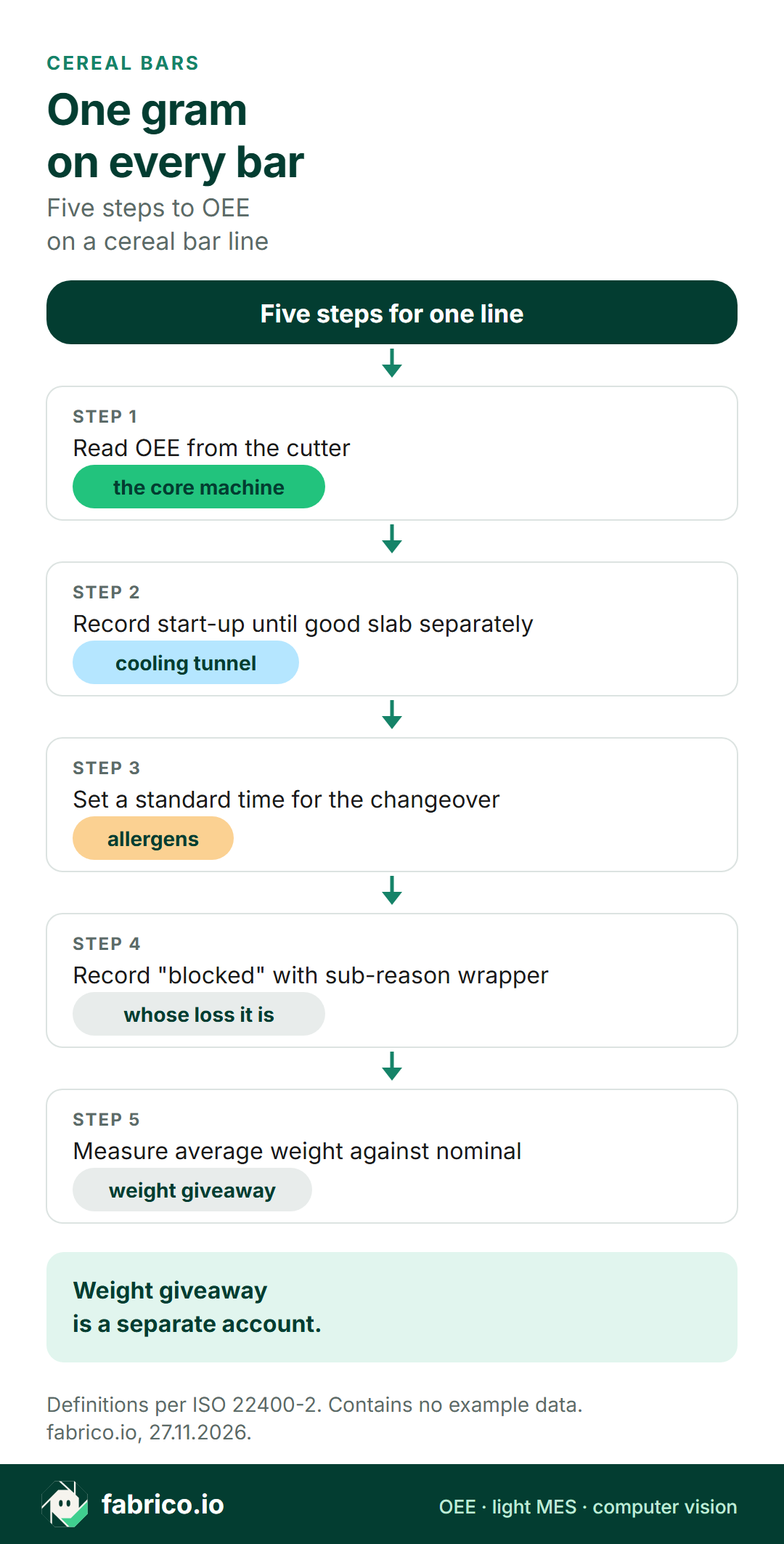
Text version of the diagram
- Read OEE from the cutter.
- Record start-up until good slab separately.
- Set a standard time for every changeover.
- Record "blocked" with a sub-reason for the flow wrapper.
- Measure the average weight against nominal.
Fabrico provides the measured rates per line; the plan itself is made in the ERP, the APS or the planning spreadsheet.
This week: weigh 20 bars an hour for three shifts; time the start-up until the first good strip; time one changeover with cleaning.
This quarter: a signal from the cutter and flow wrapper PLC, causes from the operator; a target weight per recipe; the first task for the slab or for the plan.
Where Fabrico fits
Fabrico is made by the publisher of this article.
- What it is: an OEE platform and light MES with built-in maintenance management. It shows live OEE by line and shift.
- Linked line: OEE is read at the core machine, and starved (waiting for product) and blocked are recorded as stop reasons.
- Data: machines connect through the line PLC or through a Fabrico IoT device; where there is no signal, the camera counts the output.
- Causes: stops above the threshold get a reason in a few taps, and those below the set threshold (up to 10 minutes) go into speed loss. The camera does not decide the cause.
- Money: with the Financial Impact module every loss has a price in EUR.
- Video: where the camera covers the line, the video for the minute of a stop opens from the shift timeline, is streamed on request and not stored in Fabrico.
- Hosting and security: EU customers are hosted on AWS in Frankfurt. Certified to ISO/IEC 27001, ISO/IEC 20000-1 and ISO 9001. The gateway keeps the data for up to 30 days if the network goes down.
- Price: one quote per plant, based on the machines and modules (pricing).
For food plants, see also the article MES for food manufacturing.
Result from a Bulgarian plant
At Ficosota, a maker of home care, hygiene and consumer goods, not food, the time with no recorded stop reason fell from 3.20 % to 0.40 % between June and September 2026.
The result comes from 16 lines with OEE and the Financial Impact module, and OEE rose from 53.11 % to 59.62 %. The figures are approved by the customer.
Ficosota is also an investor in Fabrico (since January 2025) and an industrial partner in developing the OEE module; keep that in mind when reading the results.
See the cutter, the flow wrapper and the weight of one shift in Fabrico. In a demo you will see the line's stops by cause and what each one costs in euros.
Frequently asked questions
Is weight giveaway part of OEE?
No. A bar above nominal weight is good. Weight giveaway is calculated separately from the average weight of a sample, and it has a price in euros.
How much lighter can a 25 g bar be?
Under Directive 76/211/EEC, the tolerable negative error for packs of 5 to 50 g is 9 %, that is 2.25 g, and the lot average may not be below nominal.
Which machine is OEE read from on a bar line?
The cutter, because it decides how many bars come out. The flow wrapper and the mixer are reported as reasons for its stops.
Why does the mix stick to the blade at the start of the shift?
Because the slab is still warm: at the start of the shift the tunnel has not yet reached its working temperature. Record those minutes as a reason of their own.
How should changeovers be sequenced?
From the recipe with fewer allergens to the recipe with more, so there are fewer long cleans. Each pair of recipes has its own standard.
Does a bar line need a camera?
If the machines have a PLC, the signal comes from it and a camera is not needed. A camera is useful where there is no signal, for example where bars are packed into cases by hand: there it counts the output.
Latest from our blog







Real Fabrico tiles, sample data.