





 Login
 Blog
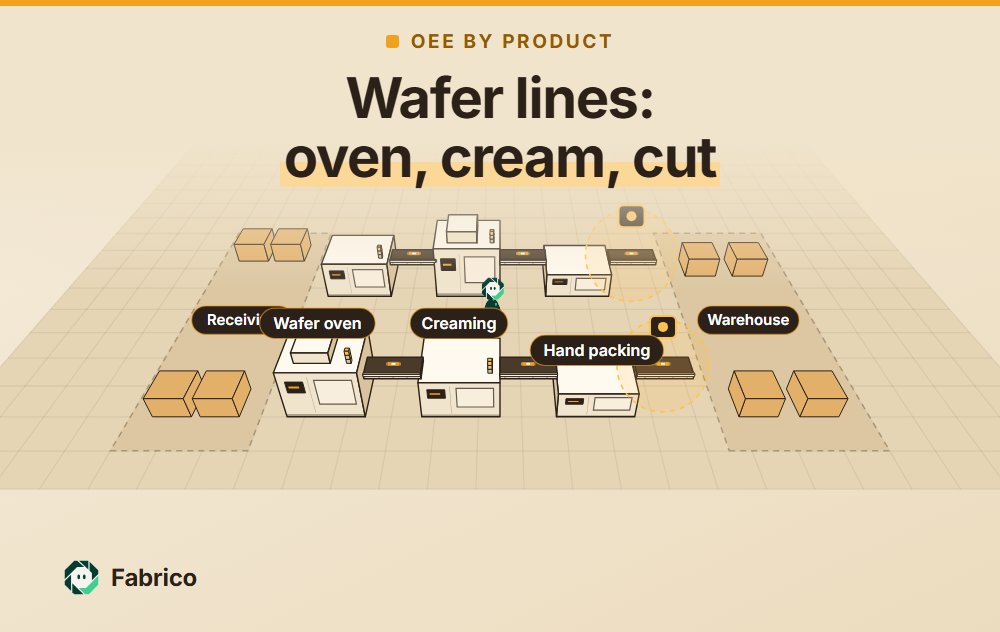
OEE on a wafer line: oven, cream, cutting and yield

In short
- A wafer line loses in four places: the oven plates, the cream changeover, broken sheets and cutting.
- The oven cannot stop for a few minutes. When something after it stops, the sheets go to rework. That is a quality loss, not downtime.
- In the example below, quality loses 456 EUR per shift, more than plate cleaning and more than all the short stops together.
- Cream is a separate account: overuse is not in OEE, but it is a real cost.
OEE on a wafer line measures how much of the planned time the line turns into good wafers, cut and packed. Five losses decide the result: oven stops to clean the plates, changeovers from one cream to another, sheets that break during cooling and assembly, trim and rejects at the cutter, and short stops while the blocks are assembled.
This article is for owners, production managers and process technologists in plants that make wafers and wafer products. It covers how to measure OEE on a line where the oven sets the pace, why quality loses so much, how to measure cream overuse, and a worked example for one shift in euros.
Wafers in Bulgaria in numbers
Wafers sit in one group with biscuits, rusks and preserved pastry goods. According to Eurostat structural business statistics, in 2024 this group in Bulgaria had 170 enterprises with 5,261 persons employed (accessed 26.11.2026). That is about 31 people per enterprise on average.
A wafer line is long and expensive, and the oven can run day and night. Every percentage point of yield turns into a large number of bars by the end of the week.
From batter to carton
| Section | What it does | Losses |
|---|---|---|
| Batter preparation | Mixes the batter for the sheets | Waiting for a batch, viscosity out of range |
| Plate oven | Bakes the sheets between hot plates | Stuck sheets, plate cleaning |
| Sheet cooling | Sheets take up moisture and stabilise | Broken and warped sheets |
| Cream spreading and assembly | Cream between the sheets, blocks | Short stops, cream overuse |
| Cooling tunnel | The cream sets | Full infeed when the cutter stops |
| Cutting | Blocks are cut into bars | Trim, crumbled bars |
| Packing | Flow wrapper, cartons | Film, seals, short stops |
On a linked line, OEE is read at the core machine, here the oven: it sets the pace and cannot run faster. Stops in the other sections are recorded as reasons against it. The measures themselves (availability, performance, quality) follow the definitions in ISO 22400-2 (accessed 26.11.2026).
To compare the sections, count in one unit: bars. A block is assembled from a set number of sheets and cut into a set number of bars. That way a broken sheet and a piece of trim at the cutter both have a price in the same measure.
The oven: cleaning the plates
A wafer oven has dozens of plates that travel in a loop. When a sheet sticks to a plate, the sheets that follow are spoiled too. The oven stops for cleaning.
Sticking depends on the batter, on plate temperature and on the time since the last cleaning. Record cleaning as its own reason, together with the number of sheets thrown away before the stop. If cleanings rise through the week, the preventive cleaning schedule is too far apart.
The oven is also where acrylamide forms. Regulation (EU) 2017/2158 sets mitigation measures for acrylamide and benchmark levels for certain foods, including biscuits and wafers (accessed 26.11.2026). That is why baking temperature and time are process limits that are not touched to raise the pace.
When something after the oven stops
The oven cannot stop for three minutes and then restart: the plates cool and the sheets come out different. So when the cutter or the packer stops, the oven keeps baking.
The sheets that have nowhere to go are collected for rework. They are baked, but they do not become good bars. In OEE this is a quality loss, not downtime.
That is exactly why quality loss on a wafer line is much larger than on an ordinary packing line. Every short stop after the oven turns into baked sheets that are lost. How to think about the buffer between the oven and packing is covered in the article OEE on a flow wrapper.
Sheet cooling: humidity and breakage
A freshly baked sheet is very dry and brittle. Before it gets cream, it has to take up a little moisture and stabilise. If it is too dry, it breaks during assembly. If it is too moist, it warps and the block comes out crooked.
So broken sheets are not the problem of one machine alone. They depend on the humidity in the cooling section, on how long the sheet stayed there and on the season. In summer and in winter the same line can have a different yield.
Record the number of broken sheets per hour and the humidity in the section. When the two sit side by side, the technologist knows whether to adjust the cooling or to look for a mechanical cause at assembly.
Newer machines can report their state using the PackML model (ISA-TR88.00.02, accessed 26.11.2026). "Suspended" means the machine is healthy and waiting; "Held" means it has its own problem. On a line with an oven, this difference shows whether assembly stopped for its own fault or was waiting for sheets.
Cream: changeover and overuse
The changeover. Switching from one cream to another means cleaning the depositing heads and the pipes. If the new cream has no hazelnuts and the old one had them, the cleaning is longer and it is verified. Annex II to Regulation (EU) No 1169/2011 lists the substances that cause allergies, including nuts and milk (accessed 26.11.2026).
Set a standard time for each pair of creams and record the difference. Order the creams from the lower risk to the higher risk, so there are fewer long cleanings.
Overuse. Depositing heads do not put on exactly the right amount every time. If the average is above the recipe, every block carries more cream than planned. This does not lower OEE, but it is cream the plant bought and did not sell. Weigh a few blocks per shift and show the average overuse next to OEE.
Cutting and weight
The cutter turns blocks into bars. The ends of every block are trim, and a block that is unevenly baked or warped gives crumbled bars. Both are rejects for OEE.
Trim also rises when the knives or cutting wires wear: the block crumbles at the edge. Record cutter rejects per hour together with the time since the last knife change. Then the knives are changed according to the data, not after rejects are already high.
The checkweigher after packing rejects light packs. Under Directive 76/211/EEC on prepackaged products (consolidated text of 11.04.2009, accessed 26.11.2026), the tolerable negative error for packs from 5 to 50 g is 9 %, and the average content of the batch may not be below the nominal. For a 20 g bar that is 1.8 g.
Example: one shift on a wafer line
The numbers are illustrative, not from a customer. The oven bakes 40 sheets a minute. Four sheets make one block, and one block gives 32 bars of 20 g. The ideal rate is 320 bars a minute, planned time is 450 minutes, and the ideal for the shift is 144,000 bars. The downtime threshold is 2 minutes.
Prices in the example: 0.04 EUR contribution per bar and 3.00 EUR per kilogram of cream. The contribution is deliberately modest: data from Aswath Damodaran (NYU Stern) give a gross margin of 23.23 % for US listed food processing companies (data as of January 2026, accessed 26.11.2026). Replace both prices with your own.
| Reason | Stops | Minutes | Recorded as | Bars | EUR per shift |
|---|---|---|---|---|---|
| Changeover to another cream | 1 × 35 min | 35 | downtime | 11,200 | 448.00 |
| Cleaning the oven plates | 2 × 10 min | 20 | downtime | 6,400 | 256.00 |
| Sheets to rework when something after the oven stops | 6 × 3 min | 18 | quality | 5,760 | 230.40 |
| Short stops at assembly | 30 × 30 s | 15 | speed loss | 4,800 | 192.00 |
| Broken sheets, 3 % of output | quality | 3,648 | 145.92 | ||
| Trim and crumbled bars | quality | 2,000 | 80.00 | ||
| Total in OEE | 33,808 | 1,352.32 | |||
| Cream overuse, 10 g per block | 3,800 blocks | outside OEE | 38 kg | 114.00 |
How the numbers are reached:
- Downtime: 35 + 20 = 55 minutes, run time 395 minutes. Availability: 395 / 450 = 87.8 %.
- For 395 minutes the ideal is 126,400 bars. Short stops cost 4,800. Output is 121,600 bars, or 3,800 blocks. Performance: 121,600 / 126,400 = 96.2 %.
- Rejects: 5,760 + 3,648 + 2,000 = 11,408, good 110,192. Quality: 110,192 / 121,600 = 90.6 %.
- OEE: 87.8 % × 96.2 % × 90.6 % = 76.5 %. Check: 110,192 / 144,000 = 76.5 %.
- Loss in OEE: 33,808 bars × 0.04 EUR = 1,352.32 EUR per shift. Cream overuse: 3,800 blocks × 10 g = 38 kg × 3.00 EUR = 114.00 EUR.
Ranked by money, the cream changeover comes first: 448 EUR. But if the losses are added up by factor, quality, in other words yield, loses 456.32 EUR. That is more than plate cleaning and more than all the short stops.
The first task is for the cream plan: fewer changeovers, ordered from the lower risk to the higher risk. The second is for yield: where exactly the sheets break, and how many sheets go to rework at every stop after the oven.
If each of the 500 shifts in the year (two shifts, 250 days) looks like the example, the quality loss is 228,160 EUR and the cream overuse is 57,000 EUR. Rework returns part of the sheets as crumbs into the cream, so agree with finance how to value it before showing euros at the morning meeting.
Who owns the oven, the cream and the cutter
| Loss | Owner | Data they need |
|---|---|---|
| Cream changeover | Planning | Minutes against the standard for each pair of creams |
| Plate cleaning | The oven technician | Cleanings per shift and time since the last one |
| Sheets to rework | The shift leader | Sheets at every stop after the oven, by section |
| Broken sheets | The technologist | Broken sheets per hour, compared with humidity at cooling |
| Cream overuse | The technologist and quality | Average block weight per shift |
Mistakes when counting sheets and bars
| Mistake | What you see later | How to avoid it |
|---|---|---|
| A different unit for each section | Sheets, blocks and packs cannot be compared | Everything in bars |
| Rework sheets are not counted | Quality looks good, yield is poor | Count the sheets at every stop after the oven |
| The cream is not weighed | Overuse is invisible | A few blocks per shift on a scale |
| OEE for each section separately | Every section looks fine, the line does not | OEE from the oven, the sections as reasons |
The oven line at the morning meeting
The meeting reads yesterday's OEE from the oven, quality in percent, sheets sent to rework and the average cream overuse.
If quality drops while availability does not change, the problem is after the oven: cutting, packing or cooling. If cleanings rise, the problem is in the plates. If cream overuse rises, check the depositing heads first, not the recipe.
A camera where bars are packed into cartons
Where bars are placed into cartons or display boxes by hand after the wrapper, there is no machine and no signal, and the count is written down at the end of the shift.
A camera above the table counts the cartons that leave. A gap in the count is a stop. The camera does not decide the reason and does not watch people: point it at the cartons, not at the aisles, and report by line and shift. There is more in the article camera or sensor for OEE by machine.
From a sheet counter to OEE software
| Method | Suits you when | What it misses |
|---|---|---|
| Paper log | One cream, one shift | Rework sheets and short stops |
| Oven sheet counter into a spreadsheet | A first assessment | Where the sheets are lost |
| OEE software with a signal from the oven and the packer, reasons from the operator | Several creams, round-the-clock running | Manual stations without a signal |
| The same plus a camera on manual carton packing | Manual packing into cartons | Almost nothing |
More about confectionery lines is in the article OEE for confectionery and chocolate, and about product sequence in OEE on a high-mix food line.
Questions for the vendor:
- Which machine is OEE read from on a line with an oven?
- Can the loss be counted in one unit for all sections?
- How are rework sheets recorded when something after the oven stops?
- How is a changeover standard set for each pair of creams?
- How do cutter and checkweigher rejects enter quality?
- What happens to the data if the plant network drops?
How to start
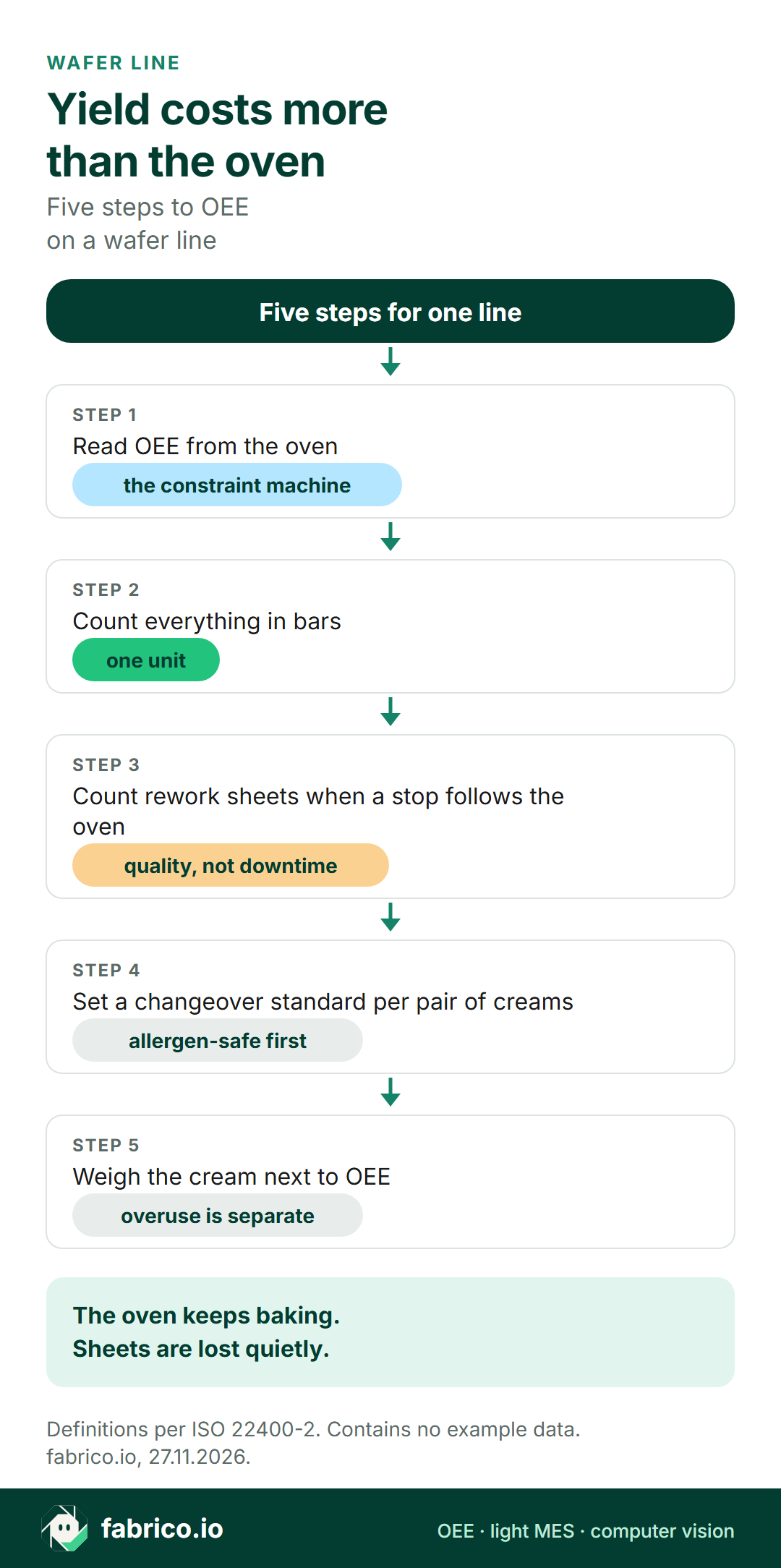
Text version of the diagram
- Read OEE from the oven.
- Count everything in bars.
- Count the rework sheets at every stop after the oven.
- Set a changeover standard for each pair of creams.
- Weigh the cream and put the overuse next to OEE.
Fabrico provides the measured rates per line; the plan itself is made in the ERP, the APS or the planning spreadsheet.
This week: weigh the trays of rework sheets at the end of three shifts; weigh ten blocks for cream; time one cream changeover.
This quarter: a signal from the oven and the packer, reasons from the operator; one unit for the whole line; the first task for the place where sheets break.
Where Fabrico fits
Fabrico is made by the publisher of this article.
- What it is: an OEE and light MES platform with built-in maintenance management. It shows live OEE by line and shift.
- Linked line: OEE is read at the core machine, and starved (waiting for product) and blocked states are recorded as stop reasons.
- Data: machines connect through the line PLC or through a Fabrico IoT device; where there is no signal, the camera counts output.
- Reasons: stops above the threshold get a reason in a few taps, and stops under the set threshold (up to 10 minutes) go into speed loss. The camera does not decide the reason.
- Money: with the Financial Impact module, every loss has a price in EUR.
- Video: where the camera covers the line, the video for the minute of a stop opens from the shift timeline. It is streamed on request and not stored in Fabrico.
- Hosting and security: EU customers are hosted on AWS in Frankfurt. Certified to ISO/IEC 27001, ISO/IEC 20000-1 and ISO 9001. The gateway keeps the data for up to 30 days if the network drops.
- Price: one quote per plant, based on machines and modules (pricing).
For food plants, see also the article MES for food manufacturing.
A result from a Bulgarian plant
At Ficosota, a maker of home care, hygiene and consumer goods rather than food, time without a recorded stop reason fell from 3.20 % to 0.40 % between June and September 2026. This is on 16 lines with OEE and the Financial Impact module, and OEE rose from 53.11 % to 59.62 %. The numbers are approved by the customer.
Ficosota is also an investor in Fabrico (since January 2025) and an industrial partner in developing the OEE module; keep that in mind when reading the results.
See a wafer line in Fabrico. In a demo you will see stops and rejects by reason, and what each one costs in euros.
Frequently asked questions
Which machine is OEE read from on a wafer line?
From the oven, which sets the pace and cannot run faster. Stops at assembly, cutting and packing are recorded as reasons against it.
Why does quality lose so much?
Because the oven keeps baking when something after it stops. Baked sheets with nowhere to go are sent to rework and counted as rejects.
Is cream overuse part of OEE?
No. A block with extra cream is good. Overuse is measured separately, by weighing blocks, and shown next to OEE.
Which unit should losses be counted in?
One unit for the whole line, most conveniently bars. That way a broken sheet, a piece of trim and a stop all have a price in one measure.
How do you reduce rework sheets?
First count them at every stop after the oven, by section. Then shorten the most frequent stops after the oven and check whether the buffer between cooling and assembly is large enough.
How light can a 20 g bar be?
Under Directive 76/211/EEC, the tolerable negative error for packs from 5 to 50 g is 9 %, that is 1.8 g, and the batch average may not be below the nominal.
Does a wafer line need a camera?
Not for the oven and the wrapping machines, which have a PLC. A camera makes sense at manual carton packing, where it counts output.
Latest from our blog





Real Fabrico tiles, sample data.