





 Login
 Blog

OEE in sausage production: from stuffing to the pack

In short
- Sausages pass through two different kinds of production: batch (stuffing, thermal processing, cooling) and continuous (slicing and packing). OEE is measured differently for each.
- The biggest loss on the packing line in the example is not its own. It is starved (waiting for product) because the smokehouse cycle ran late.
- In the example below the shift loses 3,889 EUR, and one third of that is waiting for product from the smokehouses.
- The fix is in the smokehouse plan, not in the packing machine.
OEE in sausage production measures how much of the planned time the lines turn into good sausages, packed and labelled. Time and product are lost to burst casings and stops on the stuffer and clipper, late smokehouse cycles, a packing line waiting for product, film changes on the thermoforming machine, packs without vacuum and weight rejects.
This article is for owners, production directors and food technologists in meat processing plants: sausages, frankfurters, hams and dry-cured sausages. It shows how to measure OEE on the batch and the continuous part, why packing waits, who owns each loss, and a worked example of one shift in euros.
Meat processing in Bulgaria in numbers
According to Eurostat structural business statistics, in 2024 Bulgaria had 210 enterprises producing meat products, with 7,838 people employed (accessed 26.11.2026). That is about 37 people per enterprise on average, more than the average for the food industry (about 15).
A plant of this size can have several stuffing lines, several smokehouses and one or two packing lines. The smokehouses and packing are linked, but they run at different rhythms. That link is exactly where the time is lost.
Two kinds of production in one building
| Section | How it works | How it is measured | Losses |
|---|---|---|---|
| Preparation and bowl cutter | Batches of meat emulsion | Batches per shift against the plan | Waiting for raw material, cleaning |
| Stuffing and clipping | Continuous, into casing | OEE by metres or pieces | Burst casing, casing change, clips |
| Thermal processing | Batch, trolleys in a chamber | Cycles per chamber against the standard | Late cycle, empty chamber, waiting to unload |
| Cooling and peeling | Batch or continuous | Time from the chamber to the pack | Trolleys that wait |
| Slicing and thermoforming | Continuous | OEE of the packing machine | Waiting for product, film, vacuum, weight |
For the continuous part, OEE is measured as on any packing line, using the definitions in ISO 22400-2 (accessed 26.11.2026). For the smokehouses a different measure is more useful: how many cycles each chamber ran and how many of them were within the standard time.
A packing machine that is starved (waiting for product) is not losing through its own fault. That time is recorded as "starved (waiting for product)", with a sub-reason for the section that ran late. Without the sub-reason, all those minutes look like a packing problem.
The smokehouse: the plant's clock
A smokehouse runs in cycles: loading the trolleys, drying, smoking, cooking, showering, unloading. A cycle lasts hours and cannot be sped up without changing the product.
That is why the smokehouse sets the rhythm of the whole plant. If one cycle runs 20 minutes late, packing waits 20 minutes. If a chamber stands empty because stuffing ran late, the loss shows only hours later, at packing.
For each cycle, record three moments: when it should have started, when it started and when it ended. The gaps show whether the problem is in stuffing (the chamber waits for trolleys), in the chamber itself (the cycle is longer than the standard) or in unloading (finished product sits in the chamber).
Product safety sets limits that are not touched. Article 5 of Regulation (EC) No 852/2004 requires food business operators to apply procedures based on HACCP principles (accessed 26.11.2026), and Regulation (EC) No 853/2004 sets the specific hygiene rules for food of animal origin (accessed 26.11.2026). If time and temperature in the chamber are critical control points in the HACCP plan, OEE does not change them; it shows what each delay around them costs.
Cooling and peeling: the trolleys that wait
Between the smokehouse and packing there is one more stop: cooling. Finished product has to be cooled to a set temperature before it is sliced or packed. Skinless frankfurters are also peeled.
Here the loss is invisible, because no machine stops. The trolleys just stand. If the chiller is full, the smokehouse cannot be unloaded. If it is empty, packing waits.
So the number of trolleys in cooling is a useful figure. Record it twice a shift. When it rises, the problem is after cooling; when it falls to zero, the problem is before it.
Stuffing and clipping
The stuffer with a clipper is a fast machine with short, frequent stops. The main ones are:
- Burst casing: depends on the casing, the pressure and the temperature of the meat emulsion.
- Casing change: routine, but every change is a stop.
- Clips: empty reel, crooked clip.
- Waiting for emulsion: the bowl cutter is not ready with the next batch.
Record bursts by casing batch. If they come in runs, check the casing batch before the machine. That way the talk with the casing supplier is based on numbers.
Packing: film, vacuum and weight
The thermoforming machine forms the pack from the bottom film, the product is placed in the pockets, and the top film is sealed under vacuum. With frankfurters the loading can be done by hand, as in the example below.
Film. The two reels run out at different times. Every reel change is a stop, and a poor splice gives rejects in the first cycles.
Vacuum. A pack without vacuum is rejected. The causes are product in the seal, a hole in the film or a sealing temperature out of range.
Weight. The checkweigher rejects light packs. Under Directive 76/211/EEC on prepackaged products (consolidated text of 11.04.2009, accessed 26.11.2026), the average content may not be below the nominal quantity, and for a pack of 300 to 500 g the tolerable negative error is 3 %. For a 400 g pack that is 12 g.
Overweight. Frankfurters are not all the same weight, so to stay above nominal the pack is filled heavier. Every extra gram is product the plant made and did not sell. The checkweigher gives the average weight per shift. Show it alongside OEE: it shows what an unstable stuffer costs before it ever stops.
The lot. Directive 2011/91/EU requires a lot marking on food, with the exemptions in Article 2; under Article 5 it is not needed when the label shows a best-before or use-by date with at least the day and month (accessed 26.11.2026). A pack whose lot or date code cannot be read is a reject.
Newer packing machines can report their state using the PackML state model (ISA-TR88.00.02, accessed 26.11.2026). "Suspended" means the machine is in order and waiting for product; "Held" means it has a problem of its own. That difference is exactly the difference between a packing loss and a smokehouse loss.
Example: one shift on a frankfurter line
The numbers are an example, not a customer's. 400 g packs, a thermoforming machine with an ideal rate of 96 packs per minute, 450 minutes of planned time, so the ideal for the shift is 43,200 packs. The stop threshold is 2 minutes. The frankfurters are placed in the pockets by hand.
The contribution in the example is 0.30 EUR per pack, a deliberately modest number: Aswath Damodaran's data (NYU Stern) gives a gross margin of 23.23 % for US-listed food processing companies (data as of January 2026, accessed 26.11.2026). Replace it with your own.
| Cause | Stops | Minutes | Recorded as | Packs | EUR per shift |
|---|---|---|---|---|---|
| Starved: late smokehouse cycle | 3 × 15 min | 45 | downtime, sub-reason smokehouses | 4,320 | 1,296.00 |
| Changeover to another product | 1 × 30 min | 30 | downtime | 2,880 | 864.00 |
| Short stops at manual loading | 50 × 30 s | 25 | speed loss | 2,400 | 720.00 |
| Film reel change | 4 × 6 min | 24 | downtime | 2,304 | 691.20 |
| Packs without vacuum | 700 packs | quality | 700 | 210.00 | |
| Light packs, rejected by the checkweigher | 300 packs | quality | 300 | 90.00 | |
| Rejected by the metal detector | 60 packs | quality | 60 | 18.00 | |
| Total | 124 | 12,964 | 3,889.20 |
How the numbers are reached:
- Downtime: 45 + 30 + 24 = 99 minutes, run time 351 minutes. Availability: 351 / 450 = 78.0 %.
- In 351 minutes the ideal is 33,696 packs. Short stops take 2,400 packs. Output was 31,296. Performance: 31,296 / 33,696 = 92.9 %.
- Rejects: 700 + 300 + 60 = 1,060, good packs 30,236. Quality: 30,236 / 31,296 = 96.6 %.
- OEE: 78.0 % × 92.9 % × 96.6 % = 70.0 %. Check: 30,236 / 43,200 = 70.0 %.
- One minute of the packing line is worth 96 × 0.30 = 28.80 EUR. The loss: 12,964 packs × 0.30 EUR = 3,889.20 EUR per shift.
Sorted by value, the first item is not on the packing machine: 1,296 EUR, one third of the loss, is waiting for product from the smokehouses. A new packing machine will not fix it.
The fix is in the smokehouse plan: when each chamber is loaded, when it is unloaded, and how many trolleys wait before packing. If three late cycles become one, packing gains half an hour per shift.
If each of the 500 shifts a year (two shifts, 250 days) has three late cycles as in the example, waiting for the smokehouses costs 648,000 EUR. The money is real only if the whole output is sold. In meat processing, check it separately for barbecue season and for winter. Agree the rule with finance.
The meeting: smokehouses, waiting, packing
The meeting needs yesterday's OEE of the packing line, starved minutes, and how many smokehouse cycles ran late against the plan.
If waiting is the most expensive cause, the talk is about the smokehouse plan, not about packing. If few cycles were late but waiting is high, check cooling and count the trolleys.
Owners: from the bowl cutter to the checkweigher
| Loss | Owner | Data they need |
|---|---|---|
| Waiting for product | Planning and the head of the thermal section | Start and end of each cycle against the plan |
| Changeover | Planning | Minutes against standard per product pair |
| Manual loading | The packing supervisor | Short stops by hour and number of people at the station |
| Film | The line crew | Reel changes against the standard |
| Vacuum and weight | The technologist and quality | Rejects by hour and average weight from the checkweigher |
| Burst casing | The technologist and purchasing | Bursts by casing batch |
Mistakes when tracking smokehouses and packing
| Mistake | What you see later | How to avoid it |
|---|---|---|
| Waiting is logged as "packing downtime" | Packing looks like the problem | "Starved (waiting for product)" with a sub-reason for the section |
| OEE of the smokehouse as for a continuous machine | Numbers nobody believes | Cycles against the standard and against the plan |
| Rejects counted at the end of the shift | Nobody knows when they happened | Live rejects from the checkweigher and the detector |
| Reports by operator | People stop recording reasons | Reports by line and shift |
A video camera for counting at manual loading
Manual loading into the pockets of the thermoforming machine is a station without its own signal. Without a signal, the count is written by hand at the end of the shift.
A camera above the outfeed counts the packs that pass. A pause in the count is a stop. The camera does not identify the reason and does not monitor people: frame the packs, report by line and shift. If the pauses pile up at the start of the shift, check the supply of product from cooling before the machine. More is in the article camera or sensor for OEE by machine.
Log, counter or software for meat processing
| Method | Fits when | What it misses |
|---|---|---|
| Paper log for smokehouses and packing | One smokehouse, one line | Short stops and the smokehouse to packing link |
| PLC counter on the packing machine | A first estimate of OEE | Why the machine waits |
| OEE software with a signal and reasons, plus smokehouse cycles | Several smokehouses and lines | Manual stations, if there is no camera |
| Full MES | Traceability from raw material to pack | Nothing, but it is a big project |
More on choosing between a light and a full MES for food is in the article MES for food manufacturing, and on product sequence in OEE on a high-mix food line.
Questions for the supplier:
- How is "starved (waiting for product)" recorded with a sub-reason for the section that ran late?
- Can a smokehouse cycle be compared with a standard and with a plan?
- How do checkweigher, vacuum detector and metal detector rejects enter quality?
- How are packs counted at a manual station without a signal?
- How is the ideal rate set per product?
- What happens to the data if the plant network drops?
How to start
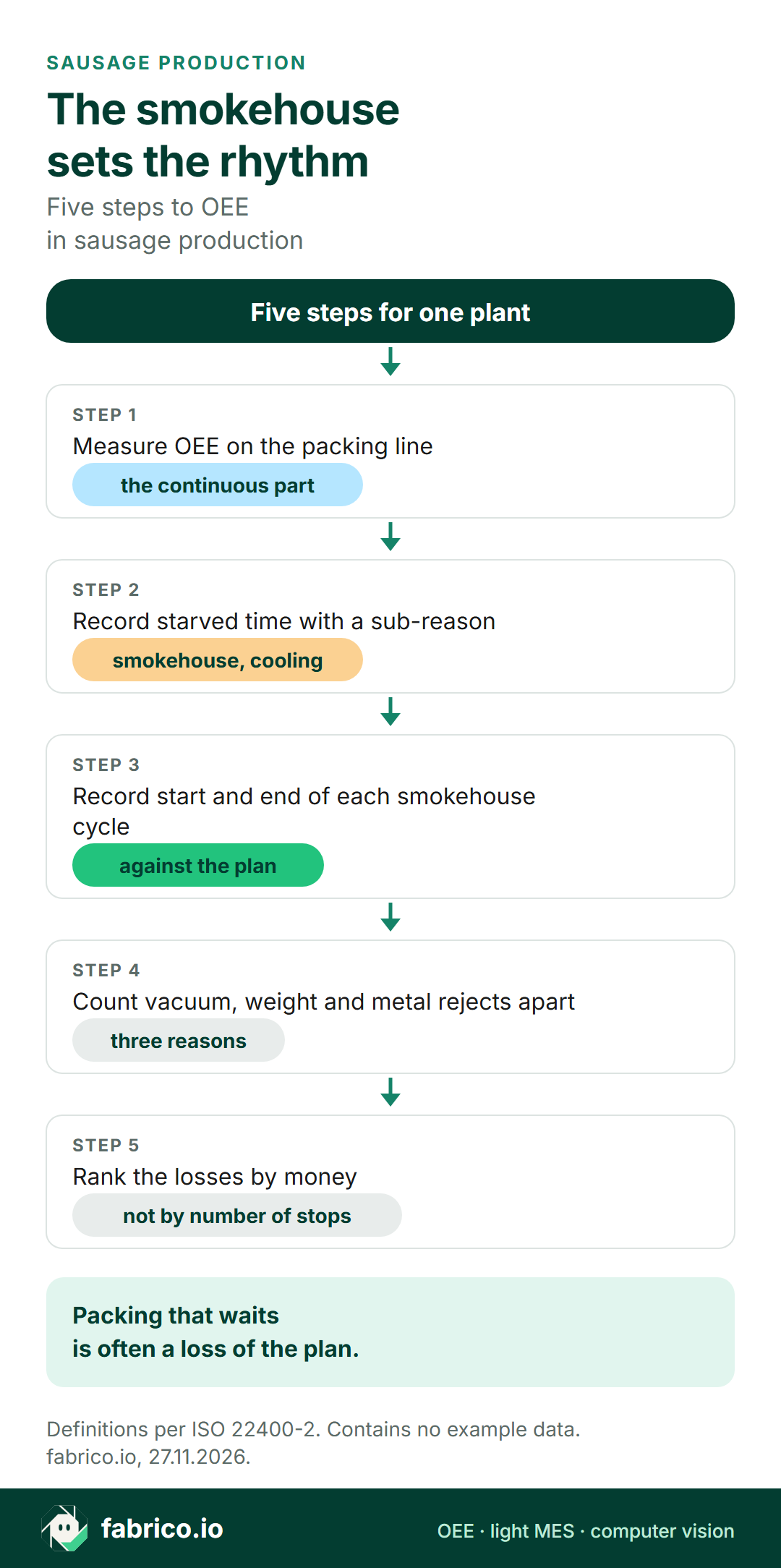
Text version of the diagram
- Measure OEE on the packing line.
- Record "starved (waiting for product)" with a sub-reason for the section.
- Record the start and end of each smokehouse cycle.
- Count vacuum, weight and metal rejects separately.
- Rank the losses by money.
Fabrico provides the measured rates per line; the plan itself is made in the ERP, the APS or the planning spreadsheet.
This week: for three days, record the start and end of every smokehouse cycle; count the minutes packing waited; work out what one minute of the packing line is worth.
This quarter: a PLC signal from the packing machine and reasons from the operator; "starved (waiting for product)" with a sub-reason; the first task on the smokehouse plan.
Where Fabrico fits
Fabrico is made by the publisher of this article.
- What it is: an OEE platform and light MES with built-in maintenance management. It shows live OEE by line and shift.
- Linked line: OEE is read at the core machine, and starved (waiting for product) and blocked time are recorded as stop reasons.
- Data: machines connect through the line PLC or through a Fabrico IoT device; where there is no signal, a camera counts output.
- Reasons: stops above the threshold get a reason in a few taps, and stops under the set threshold (up to 10 minutes) go into speed loss. The camera does not identify the reason.
- Money: with the Financial Impact module every loss has a price in EUR.
- Video: where a camera covers the line, the video for the minute of a stop opens from the shift timeline, is streamed on request and not stored in Fabrico.
- Hosting and security: EU customers are hosted on AWS in Frankfurt. Certified to ISO/IEC 27001, ISO/IEC 20000-1 and ISO 9001. The gateway keeps data for up to 30 days if the network drops.
- Price: one quote per plant, based on machines and modules (pricing).
For trays of ready meals, see the article OEE in ready meal production.
A result from a Bulgarian plant
At Ficosota, a maker of home care, hygiene and consumer goods, not food, the time without a recorded stop reason fell from 3.20 % to 0.40 % between June and September 2026. That is across 16 lines with OEE and the Financial Impact module, and OEE rose from 53.11 % to 59.62 %. The figures are approved by the customer.
Ficosota is also an investor in Fabrico (since January 2025) and an industrial partner in developing the OEE module; keep that in mind when reading the results.
See meat processing in Fabrico. In a demo you will see stops by reason and sub-reason and what each one costs in euros.
Frequently asked questions
How is OEE measured on a smokehouse?
A smokehouse runs in cycles, so it is more useful to measure cycles per chamber against the standard and against the plan: how many ran late, how many ran long, and how long the chamber stood empty.
Why does the packing line have low OEE if the machine is in order?
Because it may be waiting for product from the smokehouses. Record that time as "starved (waiting for product)" with a sub-reason for the section that ran late.
How light can a 400 g pack be?
Under Directive 76/211/EEC the tolerable negative error for packs of 300 to 500 g is 3 %, that is 12 g for 400 g, and the batch average may not be below the nominal quantity.
Is the metal detector part of OEE?
The rejected packs count in quality. The rejects themselves are also a food safety signal, investigated under the HACCP plan, outside OEE.
Does meat processing need a camera?
Only at stations without a usable signal, for example at manual loading into the thermoforming machine. There the camera counts the packs and a person records the reason.
Why do the trolleys in cooling matter?
Because that is where product waits without any machine stopping. The number of trolleys shows whether the loss is before cooling or after it.
How is overweight reduced?
Measure it first: the average weight from the checkweigher for each shift and product. Then stabilise the filling, and only then lower the target. The reverse order leads to rejects for light packs.
Where should a plant start?
With the packing line and the smokehouse cycle times. Together these two numbers show whether the loss is in packing or in the plan.
Latest from our blog







Real Fabrico tiles, sample data.