





 Login
 Blog
OEE for flour and sugar packing: changeover order

In short
- The changeover has a direction. Sugar to flour is short, because sugar carries no gluten. Flour to sugar needs a full clean. In the example below one direction takes 5 minutes, the other 35.
- In the example below the shift loses 475 EUR in OEE. The largest cause is the clean after flour, which the order of the plan can cut to once a week.
- Paper bags cost more in total than even the expensive changeover: in the example the magazine, the glue and the short stops below the threshold come to 180 EUR per shift, and the changeover to 175 EUR.
- Flour density changes during the day. The checkweigher has to correct the filler, or rejects rise or more product than needed goes into the bags.
OEE in flour and sugar packing answers one question: for how much of the planned time the packing machine filled good, closed bags within the permitted weight. The losses covered here are the changeover between products with cleaning, stops on paper bags, waiting for product from the silo or the sifter, short stops in bag feeding and checkweigher rejects.
This article is for owners, production directors and process engineers of mills and packing plants that pack flour, sugar and similar dry products in 1 to 5 kg bags. You will find how each factor is measured, why the direction of the changeover has a price, and an example of one shift in euros.
Mills and packing plants in Bulgaria
According to Eurostat structural business statistics, in 2024 Bulgaria had 107 enterprises whose main activity is "Manufacture of grain mill products" (accessed 26.11.2026). Flour and sugar are also packed by plants that buy bulk product and split it into small bags for retail.
In both cases the margin per bag is small and the volumes are large. One minute of downtime on the packing machine is dozens of bags, and one badly sequenced shift is thousands.
The line: silo, sifter, filler, bag
| Section | What it does | Typical losses |
|---|---|---|
| Silo and conveying | Feeds product to the packing machine | Bridging, empty hopper |
| Sifter and magnet | Removes foreign bodies | Blocked sifter, waiting |
| Auger filler | Doses by volume, with weight correction | Weight drift when density changes |
| Bag and closing | Picks a paper bag, fills, folds, glues | Double bag, torn bag, glue |
| Checkweigher and palletising | Separates light and heavy bags | Rejects, jams at the outfeed |
Availability, performance and quality here follow the definitions of ISO 22400-2 (accessed 26.11.2026). The measuring point for OEE is the packing machine, because every bag passes through it. Waiting for product from the silo and being blocked by palletising are recorded as reasons against it.
When the packing machine follows the PackML model (ISA-TR88.00.02, accessed 26.11.2026), "Suspended" shows that it is in working order but is waiting for product from the silo or its outfeed is blocked, and "Held" that it has stopped for a bag, glue or another cause of its own.
The direction of the changeover: from sugar to flour
Wheat flour contains gluten. Annex II to Regulation (EU) No 1169/2011 puts cereals containing gluten first in the list of substances or products causing allergies or intolerances (accessed 26.11.2026). Sugar carries no gluten.
That is why the changeover from sugar to flour is short: emptying the hopper, new bags and the label. If a little sugar remains in the flour, that is no problem for the buyer. The changeover from flour to sugar is different: the hopper, the auger and every spot where dust collects must be cleaned, and the clean must be checked before sugar starts.
In the example plant the changeover from sugar to flour takes 5 minutes, and from flour to sugar 35 minutes. The 30 minute difference comes entirely from the direction. If the plan packs sugar at the start of the week and flour after it, the long clean happens once a week instead of in every shift.
The same holds for other pairs. White flour after wholemeal shows dark bran specks, so the shorter direction is from white to wholemeal. Maize flour contains no gluten in itself, but packed after wheat flour it carries traces of it, so it goes before wheat flour. So each pair has its own direction and its own standard.
Set a standard for each direction separately, not one standard called "product changeover". The report then shows which direction happened and what it cost. There is more on the changeover table for allergens in the article on the allergen changeover matrix.
Dust and cleaning
Flour dust settles everywhere: in the auger, around the nozzle, on the frame. Cleaning with compressed air is fast, but it raises a cloud of dust that spreads along the line and can create an explosive atmosphere. A vacuum cleaner, in a version rated for a dust zone, is slower, but it does not spread the dust.
Dust is also a safety matter. Directive 1999/92/EC, in Articles 4 and 7, requires the employer to assess the risks from explosive atmospheres, including combustible dust, and to classify the zones (accessed 26.11.2026). For OEE this means cleaning is not the place to cut: the minutes are won by sequencing the plan and by having the tools ready, not by cleaning less.
Paper bags: the small stops
On the example line, flour and sugar are packed in 1 kg paper bags. Paper is fussier than film. A damp bag bends and the machine fails to pick it. Two bags stuck together go in at once. The glue for the bottom or the top cools down or builds up on the nozzle.
Such a stop lasts 20 or 30 seconds while the operator removes the bag. Below the threshold these stops get no reason and go into speed loss. If speed loss rises, check the bags first: supplier, batch, how they are stored. Bags left next to an open door in winter cause more stops than the same bags kept in a warm store.
Long stops on the bags, for example topping up the glue, changing the glue or cleaning the magazine, get a reason. That shows which of them repeat and which can be done before the shift.
Bridging in the hopper and waiting for product
Flour does not flow like sugar. Damp or compacted flour forms a bridge over the hopper outlet, and the auger starts to run empty. The packing machine stops because there is no product, or fills light bags that the checkweigher rejects.
The first is recorded as "waiting for product" with the sub-reason hopper or silo. The second shows up as rejects for a light bag. If both rise in the same hours, there is one cause: the feed. When the cause is the feed, a vibrator, aeration or a lower level in the hopper helps more than adjusting the filler.
Sugar has its own problem: in humid air it cakes into lumps that block the sifter. Record a blocked sifter as a separate reason, so it shows when it happens.
Bag size and the ideal rate
If one machine packs 1 kg and 2 kg bags, its rate in bags is different. A 2 kg bag takes longer to fill, and the machine makes fewer bags per minute. Set an ideal rate for each product and size separately, or the larger bag will show a speed loss that does not exist.
The changeover to a different size also has its own standard: bag format, dose setting, label. Keep it separate from the product changeover, because the two have different causes and different owners.
Flour to sugar: the numbers for one shift
This is an example shift, not data from a customer. The machine fills 1 kg paper bags and at the ideal rate makes 50 bags per minute. The shift has 450 planned minutes. A stop longer than 2 minutes is downtime, a shorter one is speed loss. At full rate the shift would give 22,500 bags. In the middle of the shift the machine switches from flour to sugar, in the long direction, with a full clean.
In the example each lost bag costs 0.10 EUR of margin. For reference: according to data from Aswath Damodaran (NYU Stern), the gross margin is 23.23 % for listed American food processing companies (data as of January 2026, accessed 26.11.2026). At such a margin 0.10 EUR corresponds to a selling price of about 0.43 EUR per bag (0.10 / 0.2323). Put in your own margin per bag.
| Reason | Stops | Minutes | Recorded as | Bags | EUR per shift |
|---|---|---|---|---|---|
| Changeover from flour to sugar with cleaning | 1 × 35 min | 35 | downtime | 1,750 | 175.00 |
| Bag magazine and glue | 6 × 3 min | 18 | downtime | 900 | 90.00 |
| Short stops on the bags | 36 × 30 s | 18 | speed loss | 900 | 90.00 |
| Waiting for product from the silo | 3 × 5 min | 15 | downtime, sub-reason silo | 750 | 75.00 |
| Checkweigher rejects | 450 bags | quality | 450 | 45.00 | |
| Total in OEE | 86 | 4,750 | 475.00 |
The calculation step by step:
- Downtime: 35 + 18 + 15 = 68 minutes, run time 382 minutes. Availability: 382 / 450 = 84.9 %.
- In 382 minutes the ideal is 19,100 bags. Short stops take 900. Bags filled: 18,200. Performance: 18,200 / 19,100 = 95.3 %.
- Rejects 450, good 17,750. Quality: 17,750 / 18,200 = 97.5 %.
- OEE: 84.9 % × 95.3 % × 97.5 % = 78.9 %. Check: 17,750 / 22,500 = 78.9 %.
- The loss: 4,750 bags × 0.10 EUR = 475.00 EUR per shift.
By value, the changeover from flour to sugar comes first: 175.00 EUR. Had the same changeover gone in the opposite direction, it would have taken 5 minutes instead of 35. The 30 minute difference is 1,500 bags, or 150.00 EUR per shift.
If each of the 500 shifts in the year (two shifts, 250 days) has such a changeover, in this example a plan with sugar at the start of the week and flour after it saves about 67,500 EUR a year, if the gain holds: 500 × 150 EUR, minus 50 weekly long cleans of 150 EUR each that remain. No new machine is needed.
The second task is the bags, although together they cost more: 180.00 EUR per shift from the magazine, the glue and the short stops combined. The sum is real if the extra bags are sold; check it with the finance department.
Density and the checkweigher
An auger filler doses by volume. Flour density, however, depends on moisture, on the batch and on how long it has stood in the hopper. Sugar is steadier, but it also changes with crystal size. When density drops, bags get lighter. When it rises, they get heavier.
The checkweigher after the filler sees this first. If it sends a signal back to the filler and corrects the dose, the drift is fixed within minutes. If it does not, the operator notices only when rejects grow, and may then raise the dose with a large margin.
Directive 76/211/EEC on prepackaged products (consolidated text of 11.04.2009, accessed 26.11.2026) allows a 1 kg bag to be up to 15 g lighter, but the average weight of the batch must be at least 1 kg. Checkweigher rejects must be counted by reason: light bag, heavy bag, no label. There is more on checkweigher rejects in OEE in the article on checkweigher rejects and quality in OEE.
Every bag also carries a batch number. Without a lot marking the bag cannot be placed on the market: this is a requirement of Directive 2011/91/EU (accessed 26.11.2026). For flour the lot should also point to the grain batch, and for sugar to the delivery of bulk product.
Owners for the changeover, the bags and the weight
| Loss | Owner | Data they need |
|---|---|---|
| Expensive changeover direction | Planning | Minutes against the standard, by direction |
| Bag magazine and glue | The mechanic | Stops by reason and by bag supplier |
| Short stops on the bags | The shift supervisor | Speed loss by hour and by batch of bags |
| Waiting for the silo | The mill or the bulk product store | Minutes of "waiting for product" with a sub-reason |
| Checkweigher rejects | Quality | Rejects by reason, average weight against nominal |
Common mistakes with dry bulk products
| Mistake | What you see later | How to avoid it |
|---|---|---|
| One standard for every changeover | The expensive direction disappears in the average | A standard per direction |
| Short stops on the bags have no reason | Speed loss with no explanation | Count stops per batch of bags |
| The checkweigher does not correct the filler | A large weight margin | Feedback from the checkweigher |
| Waiting for the silo counts as "packing downtime" | Packing looks like the problem | "Waiting for product" with a sub-reason |
The review at the start of the shift
At the morning review four things from the previous shift are checked: OEE of the packing machine, which direction the changeover went and what it cost, the number of short stops on the bags, and checkweigher rejects.
If the direction was wrong, the conversation is with planning. If short stops are rising, check the bags. If rejects are rising, check the density and the correction from the checkweigher.
What to choose for flour and sugar packing
| Method | Fits when | What it misses |
|---|---|---|
| Paper log | One machine, one product | Short stops and the direction |
| PLC counter into a spreadsheet | A first estimate | Reasons and sub-reasons |
| OEE software: signal from the machine, reason from the operator | Several products and sizes | The reason for short stops below the threshold |
Questions for the vendor:
- Can the standard changeover time depend on the direction, from product A to product B?
- Are there sub-reasons for "waiting for product", for example silo, sifter or hopper?
- How is the ideal rate set per product and bag size?
- How are checkweigher rejects shown by reason?
- Are bags counted during a network outage lost?
There is more on film packing machines in the article on vertical form fill seal machine OEE.
How to start
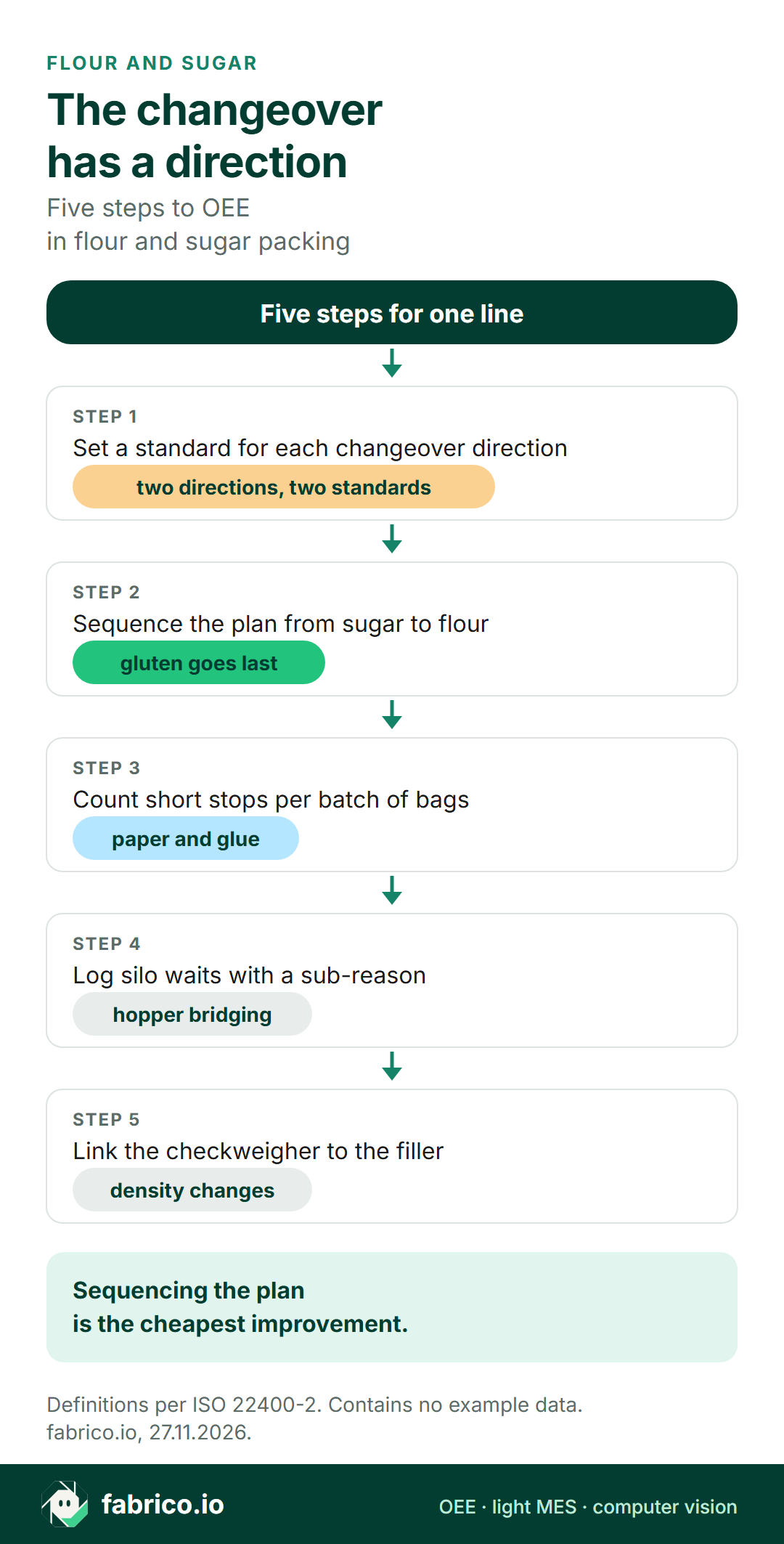
Text version of the diagram
- Set a standard for each changeover direction.
- Sequence the plan from sugar to flour.
- Count short stops per batch of bags.
- Log silo waits with a sub-reason.
- Link the checkweigher to the filler.
Fabrico provides the measured rates per line; the plan itself is made in the ERP, the APS or the planning spreadsheet.
This week: time one changeover in each direction; record the batch of bags in three shifts; check whether the checkweigher corrects the filler.
This quarter: a signal from the packing machine PLC, reasons from the operator; a standard per direction; a plan sequenced from sugar to flour.
Where Fabrico fits
Fabrico is made by the publisher of this article.
- What it is: an OEE platform and light MES with built-in maintenance management. It shows live OEE by line and shift.
- Connected line: OEE is read at the core machine, and waiting for product and blocking are recorded as stop reasons.
- Data: machines connect through the line PLC or a Fabrico IoT device; where there is no signal, a camera counts output.
- Reasons: stops above the threshold get a reason in a few taps, and those below the set threshold (up to 10 minutes) go into speed loss. The camera does not determine the reason.
- Money: with the Financial Impact module every loss has a price in EUR.
- Video: where a camera covers the line, the video for the minute of a stop opens from the shift timeline, is streamed on request and not stored in Fabrico.
- Hosting and security: EU customers are hosted on AWS in Frankfurt. Certifications ISO/IEC 27001, ISO/IEC 20000-1 and ISO 9001. The gateway keeps data for up to 30 days if the network drops.
- Price: one quote per plant, based on machines and modules (pricing).
For food plants, see also the article on MES for food manufacturing.
Result from a Bulgarian plant
At Ficosota, a maker of home care, hygiene and consumer goods rather than food, time with no recorded stop reason fell from 3.20 % to 0.40 % between June and September 2026.
The result comes from 16 lines with OEE and the Financial Impact module, and OEE rose from 53.11 % to 59.62 %. The numbers are approved by the customer.
Ficosota is also an investor in Fabrico (since January 2025) and an industrial partner in developing the OEE module; keep that in mind when reading the results.
See a shift with bags, changeovers and silo waits in Fabrico. In a demo you will see the line's stops by reason and what each one costs in euros.
Frequently asked questions
Why is the changeover from flour to sugar longer than the reverse?
Flour carries gluten and sugar does not. After flour the line must be cleaned and the clean checked before sugar starts. In the opposite direction this is not needed.
Which machine is OEE calculated from on a flour and sugar line?
From the packing machine, because it determines how many bags come out. The silo and palletising are counted as reasons for its stops.
Whose loss is the stop when the silo does not feed?
The silo's or the mill's. On the packing machine it is recorded as "waiting for product" with a sub-reason.
Why do bags get lighter without the filler setting being changed?
Because the flour density has changed while the filler doses by volume. Feedback from the checkweigher corrects the dose.
How is the changeover from white to wholemeal flour recorded?
As a separate direction with its own standard. White to wholemeal is the short direction, because the dark bran does not show in wholemeal flour.
Can cleaning be shortened with compressed air?
It gets faster, but it spreads the dust along the line. The minutes are better won by sequencing the plan and having the tools ready.
Latest from our blog





Real Fabrico tiles, sample data.