





 Login
 Blog
Slicing Line OEE: Slicer vs Packer, Losses by Station and Costs

In short
- Count good packs against the pacing machine: slicing line OEE is first-pass good packs divided by planned time x the rated packs per minute of whichever machine paces that format.
- The slicer can pace, not the packer: empty pockets on the thermoformer are a slicer loss, so do not book them as packer speed loss.
- Recycled rejects must not count twice: in the worked example, counting re-laid portions as good lifts OEE from 69.2% to 71.3% with no extra product made.
- Grams cost more than minutes: giveaway and log ends are invisible to pack-based OEE, yet they are 64% of the EUR 4,468 lost per day in the example.
- Map every loss to one station: loader, slicer, portion scale, interleaver, packer, checkweigher, labeller and supply each get their own codes and one owner.
OEE on a slicing line is the share of rated output that leaves the line as good, sealed, correctly weighed packs on the first pass. The rating comes from the machine that paces the format: in the example the slicer; on other formats it can be the thermoformer or tray sealer.
A line rated at 60 packs a minute owes 3,600 good packs every planned hour. This page sets the counting rules for sliced cooked ham, salami and cheese lines, maps each loss to a station, and prices a cooked ham line in Germany per shift, month and year.
How OEE works on a slicing line
The formula is the standard one. What makes a slicing line different is that the line converts mass into packs, and two of its biggest losses happen in grams, not in minutes or rejected packs.
- Availability = run time / planned production time.
- Performance = portions formed / (run time x rated packs per minute).
- Quality = first-pass good packs / portions formed.
- OEE = first-pass good packs / (planned production time x rated packs per minute).
The short form is the one to check by hand. If the line packed 2,493 first-pass good packs per planned hour against a rating of 3,600, OEE is 69.2%.
One rated speed per format
A slicing line runs many formats: 10 slices of ham in a flat stack, 16 slices of salami shingled, cheese in a folded pack. Each format has its own slice count, slice thickness and pack layout, so each needs its own rated packs per minute in a table on the line.
Take the rating from the validated setting for that product, not from the brochure maximum of the slicer. Change the table only for an engineering reason, never to improve a bad week.
Two count points, both on the first pass
- Portions formed come from the slicer or portion scale counter, before any reject gate.
- First-pass good packs are packs that pass the checkweigher, seal and label checks without being touched by hand.
- Re-laid or repacked portions are counted separately as rework. They are product saved, not output earned.
Which machine paces the line: slicer or packer?
A slicing line couples two fast machines with almost no buffer between them. The slicer cuts a log into portions; the thermoformer or tray sealer packs them in cycles of several pockets. Whichever is slower for the current format sets the line rate.
The table shows three formats on one line. The numbers are sample figures to show the logic, not machine specifications.
| Format | Slicer, packs/min | Packer, packs/min | Paces the line |
|---|---|---|---|
| Cooked ham 200 g, 10 slices stacked | 60 | 72 (8 pockets x 9 cycles) | Slicer, rated 60 |
| Salami 80 g, 16 slices shingled | 80 | 72 | Packer, rated 72 |
| Cheese 150 g, 8 slices interleaved | 66 | 72 | Slicer, rated 66 |
Three rules follow from this:
- The line rating is the lower of the two for that format. Rate the line, not each machine, when you report line OEE.
- Empty pockets belong to the pacing machine. On the ham format the thermoformer always runs with spare capacity. Its gaps are not a thermoformer speed problem, and its own machine OEE will look poor for a reason it cannot fix.
- Fix the pacer first. A minute lost at the slicer on the ham format is a minute of line output. A minute lost at the thermoformer may be partly absorbed if the slicer can briefly run ahead into a short buffer.
On formats where the packer paces, the reverse holds. Packer losses (film splices, forming, sealing, cutting) are covered on the pages on thermoforming OEE and tray sealer OEE.
When the two machines are close in speed, a stop at either one starves or blocks the other within seconds, which is why the stop code must name the station that started it.
The loss map, station by station
When a slicing line stops, the operator sees one red light. The cause sits at one station. Give each station its own stop codes, an A, P or Q tag and one owner. Add a fourth tag, Y for yield, for losses that are measured in grams and never show in pack counts.
| Station | Typical loss | Tag | Owner |
|---|---|---|---|
| Log supply and tempering | Logs not at slicing temperature, line waits for logs | A (starved), Q | Production planning, chill room |
| Loader and log feed | Gap or stop at each log change, misloaded logs | A, P | Operator |
| Slicer head and blade | Blade jams, blunt blade, torn or ragged slices | A, P, Q | Maintenance |
| Log end and heel | Start trim and end piece that never become a pack | Y | Production, engineering |
| Portion scale | Off-weight portions diverted for correction | Q, Y | Operator, QA |
| Interleaver or shingle former | Paper or film runs out or tears, shingle out of shape | A, Q | Operator |
| Transfer into pockets | Portions misplaced, folded or across the seal area | Q, P | Operator, engineering |
| Thermoformer or tray sealer | Film splice, seal or cut faults | A, Q | Maintenance |
| Checkweigher | Underweight packs, overweight setpoint | Q, Y | QA |
| Labeller and printer | Missing or wrong label, unreadable date | A, Q | Operator |
| Case packing and palletising | Packer stops because the end of line backs up | A (blocked) | Shift lead |
The Y rows are the reason this map differs from a filler or a bakery line. A slicer can run at full speed with zero stops and still lose money with every log, because grams go to heels and to overfilled packs.
Keep starved and blocked minutes as separate codes. They are real availability loss, but the fix is outside the slicer. A line that waits for tempered logs needs a planning change, not a maintenance call.
Log changes versus product changeovers
A slicing line sees two kinds of change, and they belong in different parts of OEE. Mixing them under one "changeover" code hides both.
Log changes: a performance or short-stop loss
Every log runs out. On a line with manual or semi-automatic loading the slicer pauses while the next log is placed and gripped. Each pause lasts seconds, but on a high-speed ham line a log may last only a couple of minutes, so the pauses add up.
- Count log-change pauses from the machine signal, not from the stop log. Nobody writes down a 20-second gap.
- Track pauses per log and logs per hour. A rise in either points at log length, loader set-up or logs arriving late from the chill room.
- Longer or more uniform logs cut both the pauses and the end losses per kilo sliced.
Product changeovers: an availability loss with a standard
A product change means a new recipe on the slicer (thickness, portion weight, slice count), possibly new interleaver paper, a new film or label, and a first-pack check. A change from a product with an allergen to one without may need a clean, as your hazard analysis sets.
- Give each type its own standard time: same product new pack size, new product same family, allergen or species change with a clean.
- Every changeover minute is availability loss. The standard is the target, not a free allowance.
- Sequence the day: plain before smoked, cheese without allergen before cheese with herbs, pork before beef if the plan allows.
The planned intermediate clean is a third case. Many hygiene plans require the slicer to be cleaned during the day. Count the validated cleaning time as planned, and every minute beyond it as a loss with its own code. Never shorten the clean to lift OEE; that is a food safety decision for QA.
Why the clean stays fixed: the EFSA opinion on Listeria monocytogenes in ready-to-eat foods found that "the food subcategory associated with the largest number of cases per year was cooked meat".
A study in the Journal of Food Protection on a commercial delicatessen slicer found that Listeria from a contaminated blade still reached about 100 CFU per slice after 30 slices.
Counting good packs when weight rejects are recycled
This rule can inflate slicing line OEE more than any other in the example. Off-weight portions are diverted at the portion scale, corrected by hand (a slice added or removed) and fed back onto the line. Some checkweigher rejects are opened and the product repacked.
If the corrected portions are counted as good when they pass the second time, quality looks almost perfect. The product was saved, but the line did not earn that output: it used the slicer, the packer and a person twice.
Here is the same day from the worked example under three counting rules.
| Counting rule | Good packs | Quality | OEE |
|---|---|---|---|
| First-pass good only, rework counted apart | 37,390 | 96.4% | 69.2% |
| Re-laid portions counted as good | 38,490 | 99.2% | 71.3% |
| Slicer counter taken as good output | 38,800 | 100% | 71.9% |
The checks: 37,390 / 54,000 = 69.2%, 38,490 / 54,000 = 71.3%, 38,800 / 54,000 = 71.9%. Same logs, same packs shipped, more than 2.5 points apart because of a definition.
Decision: count quality on the first pass only. Report rework next to OEE as two numbers: portions re-laid per shift and hours of hand correction. A falling rework count is the clearest sign that portion weight control is getting better.
Three practical points make the rule work:
- Tag rework at the point it re-enters. A separate infeed, a marked crate or a rework button keeps it out of the first-pass count.
- Book checkweigher rejects to their cause. An underweight pack is a portion scale or slicer loss, not a checkweigher loss. The page on checkweigher rejects sets out how to split them.
- Keep metal or foreign body rejects apart. They are food safety events with their own procedure, not weight losses to correct.
Giveaway and log ends: the losses OEE does not see
Pack-based OEE counts packs. A pack that weighs 204 g against a 200 g label counts as one good pack, exactly like a pack at 200 g. A heel that never becomes a pack does not count at all. Both are product the plant bought, cooked and paid to handle.
Giveaway is set by the legal floor and by process spread
The fill rules for packs of equal nominal quantity come from Council Directive 76/211/EEC: "the actual contents shall not be less, on average, than the nominal quantity". In Germany, section 9 of the Fertigpackungsverordnung sets the permitted shortfall at 9 g for 200 to 300 g packs, and 4.5% for 100 to 200 g.
The same section reads that the permitted shortfall may be exceeded by at most two in a hundred packs. The AGME information sheet for the German verification offices works it through for a 250 g pack: average at least 250 g, single packs down to 9 g short, and no pack under 232 g.
- The average rule is the one that binds in the example, because the portion scale holds the packs well inside the tolerance.
- Overfill above that average is a choice. It comes from the target the line runs at, set to keep checkweigher rejects low.
- Catch-weight packs differ. The AGME sheet notes that for packs of unequal nominal quantity, such as cheese or meat priced by weight, the permitted shortfall at packing is 1 to 10 g depending on the weight marked.
Lowering giveaway means narrowing the spread of portion weights, so the target can sit closer to the label. The method (target setting, standard deviation, trimming) is on the page on giveaway and overfill. This page only prices it for the slicing line.
Log ends: start trim and heel
Every log loses a start trim, cut until the face is clean, and a heel, the end held by the grippers that the blade cannot reach. On a 6 kg cooked ham log, 180 g of ends is 3% of the log.
- Weigh the ends from each shift into a marked crate. Grams per log is the number to trend, not kilos per day, which rise with volume.
- In the example, ends go to diced or processed product at a lower value. The loss is the difference between the sliced value and that lower value.
- Shorter logs, uneven log faces, gripper set-up and early log changes all add grams per log.
Report both numbers next to OEE every shift: average giveaway in grams per pack, and end losses in grams per log. Together they form a yield line that OEE alone never shows.
One day on a 60 pack a minute ham line
The worked example is one sliced cooked ham line in Germany: 200 g packs of 10 slices, a high-speed slicer, a portion scale, a thermoformer with 8 pockets and a checkweigher. Two shifts. The numbers are an example built for this page, not a customer's data.
- Staffed time: 2 x 480 = 960 minutes.
- Planned stops: two intermediate cleans of 30 minutes each, per the hygiene plan. Planned production time = 900 minutes.
- Rated speed: 60 packs a minute, paced by the slicer on this format (the thermoformer can do 72).
- Logs: 1,360 logs of 6 kg, 180 g of ends each, so 5,820 g sliced per log.
- Average pack weight: 204 g against 200 g nominal, so 4 g of giveaway.
| Stops on the day | Minutes | Station |
|---|---|---|
| Product changeovers (3 x 25, standard 18) | 75 | Slicer, packer |
| Log loading stops | 34 | Loader |
| Thermoformer faults and film splices | 26 | Packer |
| Blade jams and slicer faults | 22 | Slicer |
| Interleaver paper | 14 | Interleaver |
| Waiting for tempered logs | 12 | Supply (starved) |
| Blocked by case packing | 10 | End of line |
| Checkweigher and labeller | 9 | Checkweigher, labeller |
| Total | 202 |
The OEE follows in five lines:
- Run time = 900 - 202 = 698 minutes. Availability = 698 / 900 = 77.6%.
- Sliced mass = 1,360 x 5.82 kg = 7,915.2 kg. At 204 g a portion, that is 38,800 portions.
- Possible in run time = 698 x 60 = 41,880. Performance = 38,800 / 41,880 = 92.6%.
- Rejects: 1,160 off-weight portions diverted at the scale, 250 packs rejected at the checkweigher. First-pass good = 38,800 - 1,410 = 37,390. Quality = 96.4%.
- OEE = 37,390 / (900 x 60) = 37,390 / 54,000 = 69.2%.
The 3,080 portions missing from performance equal 51.3 minutes at rated speed. They come from slow running after restarts, gaps at log changes too short to log, and a blade that cuts slower as it dulls. Add the 202 stop minutes and the line lost 253.3 minutes of output.
Of the 1,160 diverted portions, 1,100 were corrected by hand and passed on the second pass; 60 went to processing. Handling all 1,160 diverted portions at about 10 seconds each took 3.2 hours of one person's time.
What each loss costs
The prices behind the example:
- Labour: Eurostat labour cost levels (lc_lci_lev) give EUR 49.5 per hour for German manufacturing (NACE C) in 2025.
- Crew: 5 people on loading, slicer, packer, checkweigher and end of line (sample figure). 5 x 49.5 / 60 = EUR 4.125 per minute.
- Sliced ham value: EUR 9.00 per kg ex works (sample figure).
- Ends and scrapped portions: sold on for processing at EUR 3.00 per kg (sample figure), so each kilo lost to ends costs EUR 6.00.
- Film, tray and label: EUR 0.12 per pack (sample figure).
- Margin: EUR 0.25 contribution per pack (sample figure), EUR 15.00 per minute at 60 packs.
- Calendar: 21 production days a month, 252 a year. A shift is half a day.
The raw material is only part of that value. The European Commission weekly pig price report put the EU average for Class E carcasses at EUR 140.2 per 100 kg in week 47 of 2026. Trimming, cooking and packing sit between that and a sliced kilo: use your own ex-works value.
The table prices the day at the crew rate, the floor value for minutes. Totals come from unrounded figures.
| Loss | Shift | Day | Month | Year |
|---|---|---|---|---|
| Log ends, 244.8 kg x 6.00 | 734 | 1,469 | 30,845 | 370,138 |
| Giveaway, 154.0 kg x 9.00 | 693 | 1,386 | 29,098 | 349,181 |
| Rejects, scrap and rework | 284 | 569 | 11,948 | 143,373 |
| Other stops, 93 min | 192 | 384 | 8,056 | 96,674 |
| Changeovers, 75 min | 155 | 309 | 6,497 | 77,963 |
| Speed loss, 51.3 min | 106 | 212 | 4,447 | 53,361 |
| Log loading stops, 34 min | 70 | 140 | 2,945 | 35,343 |
| Total, EUR | 2,234 | 4,468 | 93,836 | 1,126,032 |
The rejects row adds three parts: 250 checkweigher rejects at 0.204 x 6.00 + 0.12 = EUR 1.344 each (EUR 336), 60 scrapped portions at EUR 1.224 (EUR 73.44), and 3.22 hours of correction at EUR 49.5 (EUR 159.50).
Read the table and the chart together. By OEE, the day looks like a changeover and stop problem: availability is the weakest of the three factors at 77.6%. By money at the crew rate, the two grams rows lead with EUR 2,854 a day, against EUR 1,045 for all 253 lost minutes.
The ranking moves when the volume cannot be made up. At EUR 15 of margin a minute, the 253.3 lost minutes cost EUR 3,800 a day and overtake the grams. So the first question for the plant is: can a lost minute be made up before the retailer's delivery slot?
What a realistic improvement is worth
Three targets, each on the example's own numbers, if the gain holds:
- Giveaway from 4 g to 2 g a pack: 77.0 kg a day x EUR 9.00 = EUR 693 a day, EUR 174,591 a year.
- Ends from 180 g to 120 g a log: 81.6 kg a day x EUR 6.00 = EUR 490 a day, EUR 123,379 a year.
- Changeovers back to the 18 minute standard: 21 minutes x EUR 4.125 = EUR 87 a day, EUR 21,830 a year at the crew rate.
A floor plan for the first ten shifts
Most of the value comes from agreeing the rules, not from the tool. Ten shifts on one line is enough if the rules are written down before the first one.
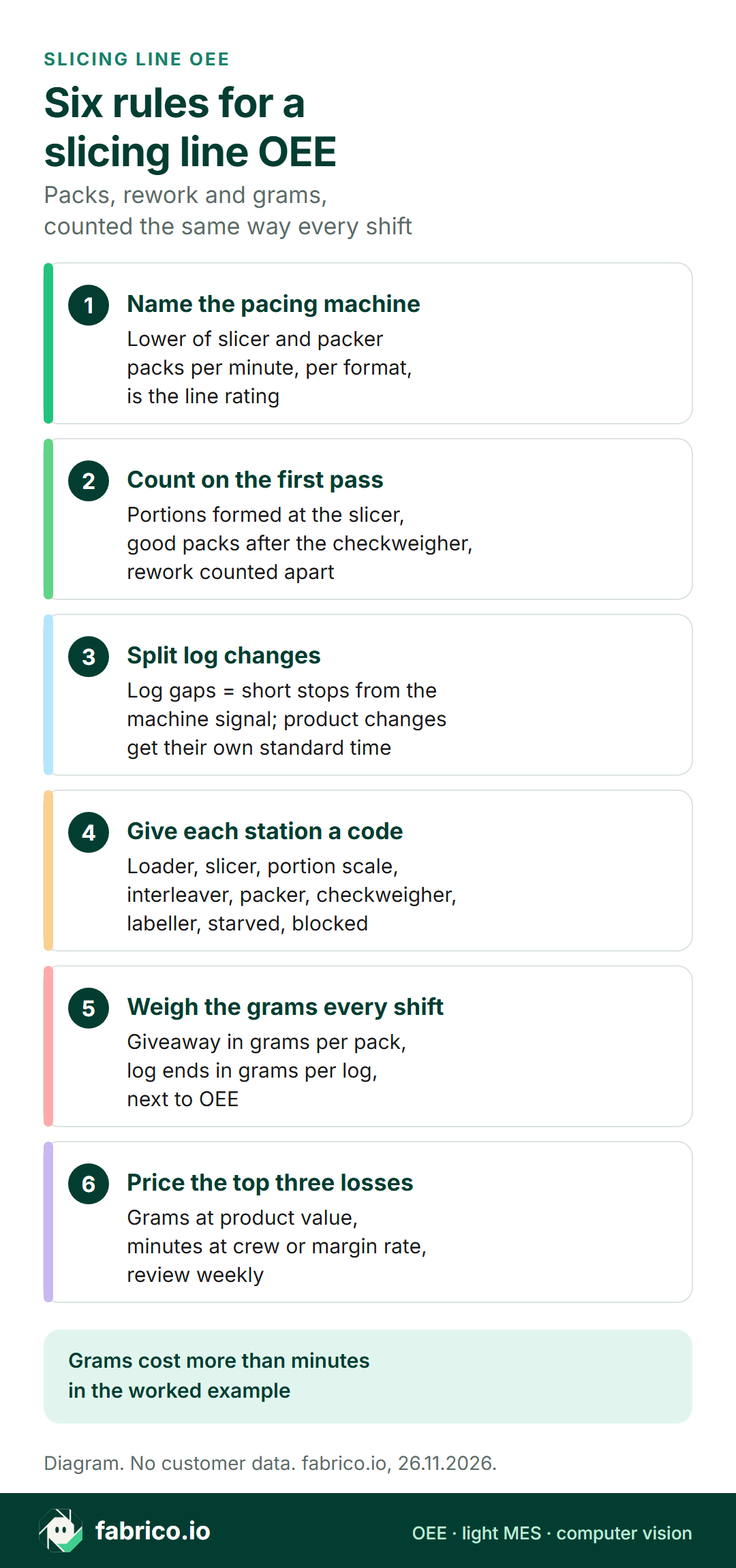
Text version of the diagram
- Name the pacing machine per format: the lower of slicer and packer packs per minute is the line rating.
- Count on the first pass: portions formed at the slicer, good packs after the checkweigher, rework apart.
- Split log changes from changeovers: log gaps are short stops from the machine signal, product changes get a standard time.
- Give each station a stop code: loader, slicer, portion scale, interleaver, packer, checkweigher, labeller, starved, blocked.
- Weigh the grams every shift: giveaway in grams per pack and log ends in grams per log, next to OEE.
- Price the top three losses: grams at product value, minutes at crew or margin per minute, and review weekly.
- Shift 1: write the rated speed table per format, mark the pacing machine, fix the two count points and the stop code list. Keep it under fifteen codes.
- Shifts 2 to 6: log every stop over two minutes with a code and station. Weigh the ends crate and note the average pack weight from the checkweigher each shift.
- Shifts 7 and 8: compare logged minutes with the gap between run time and staffed time. A large gap means log-change pauses or missing entries.
- Shifts 9 and 10: price the top three losses with your own labour, product value and margin, and pick one to attack first.
If the slicer or packer PLC has a running signal and a counter, use them from the first shift. Hand counts drift, and short log-change gaps never reach a paper sheet.
Choosing how to measure the slicing line
The options differ in what they can see. Prices for software vary by vendor and scope, so the table gives cost drivers, not list prices.
| Option | Cost driver | Fits | Blind spot |
|---|---|---|---|
| Paper sheet, ends crate and checkweigher printout | About 15 minutes of operator time a shift: EUR 12.38 at the Eurostat rate | One line, first month, agreeing codes | Log-change gaps and speed loss |
| PLC counters into a spreadsheet | Engineer days to map signals; ask your integrator for a day rate | One line with an open PLC and an engineer | Breaks when the engineer moves on |
| OEE software or light MES from machine signals | Ask the vendor for a price per line per month | Several lines, live shift numbers, losses in money | Needs codes and standards agreed first |
| Full MES with batch and recipe records | A plant project with integration work; quote per site | Plants that need electronic batch records | Long rollout before the slicer sees a gain |
The third option can suit a plant with two or more slicing lines. OEE software reads the running signal and counter from the pacing machine, takes stop reasons from the operator and shows availability, performance and quality by shift without anyone typing up a sheet.
What you see: a shift timeline, unclassified time waiting for a reason, and the operator's line-down screen, on sample lines. Book a demo.
Plays from YouTube. Google may set cookies when you press play. Privacy policy.
A light MES adds scrap by reason, changeover standards and shift reporting around the same signals. For a wider look at tools by plant type, see OEE software for food and beverage, and for the plant-wide view, MES for meat and poultry processing or MES for food manufacturing.
Who should pick which
Start on paper if the line has no PLC access yet and the first job is agreeing what a stop and a good pack are. Move to software once two or more lines run, or once grams and changeovers cost more each month than a line subscription.
Choose a full MES when a customer or group policy requires electronic batch records across the plant.
Whatever the tool, keep giveaway and end losses on the same daily page as OEE. OEE counts packs and minutes; grams come from the checkweigher statistics and the ends crate.
Questions to ask a vendor
- Can the line rating change with the format, so the pacing machine is rated correctly for each product?
- Can it count portions at the slicer and good packs after the checkweigher as two separate count points?
- How is rework kept out of the first-pass good count?
- Are log-change pauses counted from the machine signal, without operator entry?
- Can each type of changeover be timed against its own standard?
- Can losses be priced with each product's selling price and margin?
- Is the quote per line, per machine or per plant, and what does it include?
Where Fabrico fits
Fabrico is made by the publisher of this article. It is OEE software and a light MES with computer vision. The parts that matter on a slicing line:
- OEE by line and shift from the core machine, the slicer or packer that paces, connected through the line PLC or a Fabrico IoT device with sensors.
- Micro-stops from the machine signal, so log-change pauses show up without anyone writing them down.
- Stop reasons chosen by the operator at the machine in a few taps, with planned and unplanned stops kept apart for intermediate cleans.
- Changeovers tracked against a standard time, and scrap recorded by product and reason. A reject signal from the line PLC can be counted like any machine signal, or the reject count can be entered.
- With the selling price and margin of each product entered, losses are priced in money and stops are ranked by financial impact.
- Where a station has no usable signal, the camera add-on counts output.
See the OEE, MES and computer vision features, or how a quote per plant is built on the pricing page.
Sources, accessed 26.11.2026: Eurostat, Labour cost levels by NACE Rev. 2 activity (lc_lci_lev); EUR-Lex, Council Directive 76/211/EEC on prepackaged products; Federal Ministry of Justice, Fertigpackungsverordnung, section 9; AGME, Verbraucherschutz durch Fertigpackungskontrollen, 15.03.2024; EFSA BIOHAZ Panel, Listeria monocytogenes contamination of ready-to-eat foods and the risk for human health in the EU, EFSA Journal 2018; Vorst, Todd and Ryser, Transfer of Listeria monocytogenes during mechanical slicing, Journal of Food Protection 69(3), 2006; European Commission DG AGRI, Pigmeat statistics and weekly pig prices.
Frequently asked questions
What is a good OEE for a meat slicing line?
There is no neutral, published benchmark for slicing lines. Compare each line with itself week by week, under fixed rules for the rated speed per format, the count points and rework. The worked example on this page runs at 69.2%.
Is the slicer or the thermoformer the bottleneck?
It depends on the format. Compare the rated packs per minute of both for that product; the lower one paces the line, and its rating is the line rating for OEE.
Should recycled weight rejects count as good packs?
No. Count quality on the first pass and report rework separately. In the example, counting re-laid portions as good lifts OEE from 69.2% to 71.3% without one extra pack of product.
Is giveaway part of OEE?
Not in a pack-based OEE: an overfilled pack still counts as one good pack. Track average grams over nominal per pack next to OEE, and price it at product value.
How do I measure log end losses on a slicer?
Collect the start trims and heels per shift in a marked crate, weigh them and divide by the logs sliced. Trend grams per log, not total kilos.
Are log changes counted as changeovers?
No. A log change on the same product is a short pause, best counted from the machine signal as a short stop. A changeover is a new product or pack format and gets its own standard time.
See which slicing line losses cost the most. The demo shows OEE by line and shift from the core machine, micro-stops from the machine signal, stop reasons chosen by operators and losses ranked by financial impact.
Latest from our blog






Real Fabrico tiles, sample data.