





 Login
 Blog
OEE on a honey packing line: varieties, heat and rate

In short
- One honey filler has several correct rates. Liquid acacia honey fills much faster than crystallised sunflower honey.
- A single ideal rate for all varieties misleads. In the example below it pulls OEE down from 78.1 % to 61.6 %, even though the line ran no worse.
- Warming speeds up filling, but it has a limit. The honey directive caps the content of hydroxymethylfurfural, which rises when honey is overheated.
- The variety change and start-up warming are the most expensive items in the example: 1,368 EUR out of 2,760 EUR per shift.
OEE on a honey packing line shows what share of the planned time the line actually spends producing good jars that are capped and labelled. The losses covered here are warming the pipes and the hopper at start-up, the variety change and its cleaning, honey strings on the neck that get in the way of capping, and rejects for weight and label.
Honey has a feature that matters for OEE: it flows at a different speed depending on the variety and the temperature. So without a correct ideal rate for each variety, OEE does not tell the truth.
This article is for owners and production managers in businesses that pack honey into jars and plastic bottles. It covers how to set a rate per variety, what warming costs, how to count losses at capping, and a worked example for one shift in euros.
The variety decides how fast honey flows
Acacia honey stays liquid for a long time and flows easily. Linden and multifloral honey are thicker. Sunflower and rapeseed honey crystallise quickly and are filled as creamed honey or after softening.
The filler is the same, but the time to fill one jar is not. If the system calculates performance against the acacia rate, every hour of crystallised honey looks like speed loss. If it uses the rate of the slowest variety, slow running on acacia honey is hidden.
| Variety or type | How it behaves when filled | What it means for the ideal rate |
|---|---|---|
| Acacia | Liquid, flows fast | The highest rate on the line |
| Linden, multifloral | Thicker, flows more slowly | A medium rate |
| Sunflower, rapeseed | Crystallises quickly, filled like a cream | The lowest rate |
| Honey with comb or with nuts | Placed in the jar by hand | A separate rate for the manual station |
The definitions of availability, performance and quality follow ISO 22400-2 (accessed 26.11.2026). The standard says how performance is calculated against the ideal rate. Which ideal rate applies to each variety is decided by the technologist, and that decision has to be recorded in the system.
Heat: faster filling, but with a quality limit
Warming makes honey more fluid and speeds up filling. But honey is not syrup. Directive 2001/110/EC relating to honey (accessed 26.11.2026) sets requirements for its composition. They include a general upper limit of 40 mg/kg for hydroxymethylfurfural (HMF) and a lower limit for diastase activity.
Both measures get worse with overheating and with long holding at temperature. So the hopper temperature and the time the honey stays warm are process limits. They are not raised to gain speed.
The practical conclusion for OEE: the ideal rate for each variety is set at the temperature the technologist has accepted as safe. If someone raises the temperature, performance will look better, while the honey may fall outside the requirements.
Start-up warming and the variety change
Warming. Overnight, the honey in the pipes and the hopper thickens or crystallises. The line cannot start until it is warmed. That time is an availability loss, and it happens every day.
Record it as its own reason, not as "preparation". If warming takes 20 minutes every morning, over 250 working days that is more than 80 hours a year on one line. Check whether the warming can start earlier, on a timer, before the shift begins.
The variety change. Before a new variety, the filler, the pipes and the nozzles are emptied and cleaned so the varieties do not mix. The label and the batch code also change. Set a standard time for each pair of varieties and record the difference against it.
The sequence matters. When going from a lighter to a darker variety, the cleaning can be shorter than the other way round. Arrange the plan so that there are fewer long cleanings.
Honey strings and the capper
When the nozzle leaves the jar, the honey stretches into a string. If the string falls on the neck, the cap does not seat properly or it sticks. The capper stops, and the neck has to be wiped.
These are short, frequent stops. In the example below, 40 of them are under the downtime threshold and go into speed loss. Some, when honey builds up on the capping head, need several minutes of cleaning.
Strings depend on the variety, on the temperature and on the nozzle setting that cuts off the flow. So short stops at capping have to be visible by variety. If one variety has twice as many, the problem is in the setting for that variety.
Example: one shift with acacia and sunflower honey
The numbers are illustrative, not from a real customer. 400 g jars. The ideal rate is 60 jars a minute for acacia honey and 36 for crystallised sunflower honey. Planned time is 450 minutes and the downtime threshold is 2 minutes.
The line runs 180 minutes on acacia honey, then changes variety and runs 200 minutes on sunflower honey.
The margin in the example is 0.60 EUR per jar, a deliberately modest number: data from Aswath Damodaran (NYU Stern) give a gross margin of 23.23 % for US-listed food processing companies (data as of January 2026, accessed 26.11.2026). Replace it with your own.
| Reason | Stops | Minutes | Recorded as | Jars | EUR per shift |
|---|---|---|---|---|---|
| Warming the pipes and the hopper at start-up | 1 × 20 min | 20 | downtime | 1,200 | 720.00 |
| Change from acacia to sunflower honey | 1 × 30 min | 30 | downtime | 1,080 | 648.00 |
| Cleaning honey off the capper | 4 × 5 min | 20 | downtime | 960 | 576.00 |
| Short stops at capping | 40 × 30 s | 20 | speed loss | 960 | 576.00 |
| Rejects for weight and label | 400 jars | quality | 400 | 240.00 | |
| Total | 90 | 4,600 | 2,760.00 |
How the numbers are reached:
- Downtime: 20 + 30 + 20 = 70 minutes, run time 380 minutes. Availability: 380 / 450 = 84.4 %.
- Ideal output for the run time: 180 × 60 + 200 × 36 = 10,800 + 7,200 = 18,000 jars. Short stops take 960 jars, 10 minutes in each variety. Output is 17,040. Performance: 17,040 / 18,000 = 94.7 %.
- Rejects 400, good 16,640. Quality: 16,640 / 17,040 = 97.7 %.
- OEE: 84.4 % × 94.7 % × 97.7 % = 78.1 %.
- Minutes are valued at the rate of the variety that was on the line: warming before acacia honey (60 a minute), the change before sunflower honey (36 a minute), and the capper cleanings are 2 × 5 minutes in each variety (600 + 360 = 960 jars). The loss is 4,600 jars × 0.60 EUR = 2,760.00 EUR per shift.
If the system uses one rate, 60 jars a minute for all varieties, ideal output for 380 minutes becomes 22,800 jars. Performance drops to 17,040 / 22,800 = 74.7 %, and OEE to 61.6 %.
The line worked in exactly the same way. Nobody can reduce those 16.5 points of difference, because they are not a loss.
By value, start-up warming comes first: 720 EUR, every morning. Second is the variety change: 648 EUR. Together they are 1,368 EUR, almost half of the loss, and neither of them is a breakdown.
If each of the 250 working mornings in the year looks like the example, warming costs 180,000 EUR (720 EUR × 250). In this example, timer warming that finishes before the shift starts brings back part of that amount, if the gain holds. The money is real only if the whole output is sold; agree the valuation with finance.
Squeeze bottles: the second format
Where a plant also fills plastic bottles with a dispensing cap, the losses there are different. The bottle is light and falls over on the conveyor, the valve cap is harder to feed, and honey in the bottle neck gets in the way of capping even more than with a jar.
So the bottle is a separate product with its own ideal rate and its own changeover standard from jar to bottle. If both formats run on one line, time the changeover between them separately from the variety change.
Machines that follow the PackML model (ISA-TR88.00.02, accessed 26.11.2026) report their state by it. "Held" means the machine has its own problem, and "Suspended" means it is healthy and waiting. That shows whether the capper stopped because of a honey string, or was waiting for bottles.
Weight, label and batch for honey
The checkweigher rejects light jars. Under Directive 76/211/EEC on prepackaged products (consolidated text of 11.04.2009, accessed 26.11.2026), the tolerable negative error for packs from 300 to 500 g is 3 %, that is 12 g for a 400 g jar, and the batch average may not be below the nominal.
Honey on the glass also affects the label: a label on a sticky jar goes crooked or does not stick. Count label rejects separately from weight rejects, so it is clear whether the cause is in filling or in how clean the jar is.
Every jar has a batch number. Directive 2011/91/EU requires lot marking on prepackaged food (accessed 26.11.2026). For honey, when the batch is also the link to the apiary or to the blend, a wrong code is more than a reject: it breaks traceability.
Line hygiene is part of the same system. Article 5 of Regulation (EC) No 852/2004 requires food business operators to apply procedures based on HACCP principles (accessed 26.11.2026). When the cleaning between varieties is described in those procedures, OEE shows how long it takes.
Who owns warming, the variety change and capping
| Loss | Owner | Data they need |
|---|---|---|
| Start-up warming | The technician and the shift leader | Minutes from the start of the shift to the first jar, by day |
| Variety change | Planning | Minutes against the standard for each pair of varieties |
| Strings and cleaning at capping | The technologist | Short stops by variety and by hour |
| Weight rejects | Quality | Average weight and checkweigher rejects per shift |
| Label rejects | The line crew | Label rejects by variety |
Mistakes when setting the rate and the reasons
| Mistake | What you see later | How to avoid it |
|---|---|---|
| One ideal rate for all varieties | Crystallised honey looks like poor work | A rate per variety, approved by the technologist |
| Warming is "preparation" | The most expensive item is invisible | A separate reason with minutes |
| The rate is raised with the temperature | Better OEE, honey outside the requirements | Temperature is a limit, not a lever |
| Rejects counted at the end of the shift | Nobody knows which variety they came from | Checkweigher rejects by variety |
Warming, variety change, caps: yesterday's numbers
Four numbers from yesterday are enough for the morning meeting: line OEE for the shift, warming minutes, minutes of changeover between varieties against the standard, and short stops at capping by variety.
If warming grows, check when it started. If short stops grow on one variety, check the nozzle setting for it. One number, one check, one owner.
The manual station for honey with comb and nuts
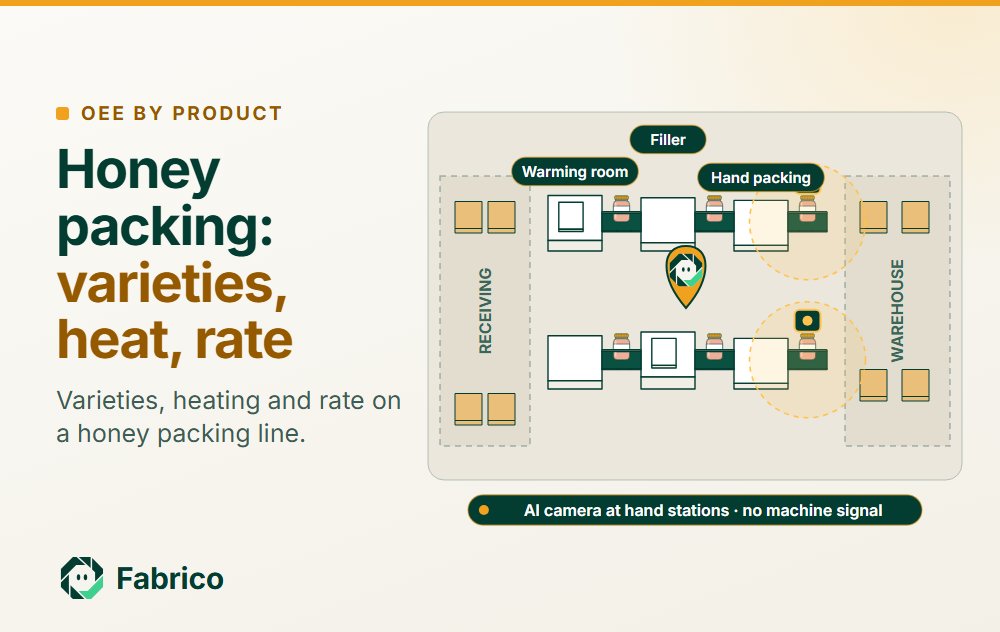
Honey with comb or with nuts is placed in the jar by hand. There is no machine and no signal there, and the count is written down at the end of the shift.
A camera above the station exit counts the jars that leave, and a gap in the count is a stop. The camera does not decide the reason and does not watch people: point it at the jars, not at the aisles, and report by line and shift. There is more in the article camera or sensor for OEE by machine.
What to ask the system vendor
| Method | Suits you when | What it misses |
|---|---|---|
| Paper log | One variety, small runs | Warming and short stops |
| PLC counter into a spreadsheet | A first assessment | The rate per variety and the reasons |
| OEE software with a rate per product and reasons from the operator | Several varieties every week | The manual station without a camera |
- Can the ideal rate be set per product, that is per honey variety?
- How is start-up warming recorded as a separate reason?
- How is a variety change recorded against a standard for the pair of varieties?
- How are short stops shown by product?
- How do checkweigher rejects enter quality?
- What happens to the data if the plant network drops?
For lines that fill and seal food containers, see OEE for food canning lines; for filling products of different thickness, see MES for cosmetics manufacturing.
How to start
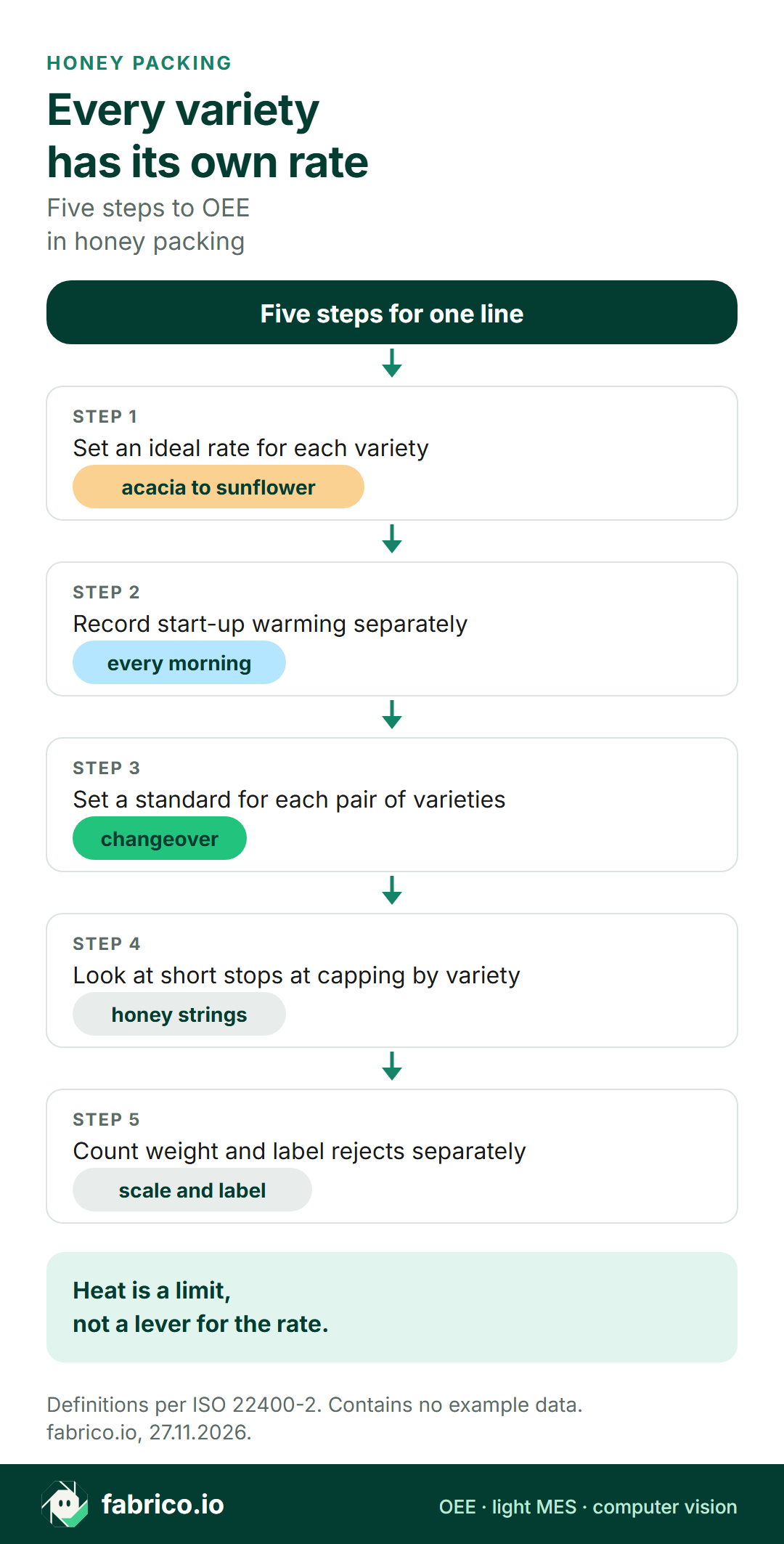
Text version of the diagram
- Set an ideal rate for each variety.
- Record start-up warming as a separate reason.
- Set a standard for the change between each pair of varieties.
- Look at short stops at capping by variety.
- Count weight and label rejects separately.
Fabrico provides the measured rates per line; the plan itself is made in the ERP, the APS or the planning spreadsheet.
This week: time the start-up warming on three mornings; write down the real rate for the two most common varieties; time one variety change.
This quarter: a signal from the filler and capper PLC, reasons from the operator; a rate per variety in the system; the first step towards shorter warming.
Where Fabrico fits
Fabrico is made by the publisher of this article.
- What it is: an OEE and light MES platform with built-in maintenance management. It shows live OEE by line and shift.
- Connected line: OEE is read at the core machine, and waiting for product (starved) and blocked are recorded as stop reasons.
- Data: machines connect through the line PLC or through a Fabrico IoT device; where there is no signal, a camera counts output.
- Reasons: stops above the threshold get a reason in a few taps, and stops under the set threshold (up to 10 minutes) go into speed loss. The camera does not decide the reason.
- Money: with the Financial Impact module, every loss has a price in EUR.
- Video: where a camera covers the line, the video for the minute of a stop opens from the shift timeline. It is streamed on request and not stored in Fabrico.
- Hosting and security: EU customers are hosted on AWS in Frankfurt. Certified to ISO/IEC 27001, ISO/IEC 20000-1 and ISO 9001. The gateway keeps the data for up to 30 days if the network drops.
- Price: one quote per plant, based on machines and modules (pricing).
For food plants, see also the article MES for food manufacturing.
A result from a Bulgarian plant
At Ficosota, a maker of home care, hygiene and consumer goods rather than food, time without a recorded stop reason fell from 3.20 % to 0.40 % between June and September 2026.
The result comes from 16 lines with OEE and the Financial Impact module, and OEE rose from 53.11 % to 59.62 %. The numbers are approved by the customer.
Ficosota is also an investor in Fabrico (since January 2025) and an industrial partner in developing the OEE module; keep that in mind when reading the results.
See a honey line in Fabrico. In a demo you will see the line's stops by reason and what each one costs in euros.
Frequently asked questions
Why does OEE on a honey line drop with crystallised honey?
When the system uses the rate of liquid honey for every variety, crystallised honey looks like speed loss. Set an ideal rate for each variety and performance will show only the real losses.
Can honey be warmed more so it fills faster?
Only within the limits the technologist has approved. Directive 2001/110/EC sets a limit for hydroxymethylfurfural, which rises with overheating, so temperature is not a lever for the rate.
Is start-up warming a loss?
Yes, it lowers availability every day. Record it as a separate reason and check whether it can start before the shift.
How is a variety change recorded?
As a changeover with a standard time for each pair of varieties. The difference against the standard shows where cleaning takes longer than it should.
How much lighter can a 400 g jar of honey be?
Under Directive 76/211/EEC, the tolerable negative error for packs from 300 to 500 g is 3 %, that is 12 g, and the batch average may not be below the nominal.
Why do caps not seat well with some varieties?
When the nozzle cuts off the flow late, honey strings fall on the neck and the cap does not seat properly. Strings depend on the variety and the temperature, so look at short stops at capping by variety.
Does a honey line need a camera?
No, if the machines have a PLC. A camera makes sense at the manual station for honey with comb or nuts, where it counts output.
Latest from our blog





Real Fabrico tiles, sample data.