





 Login
 Blog
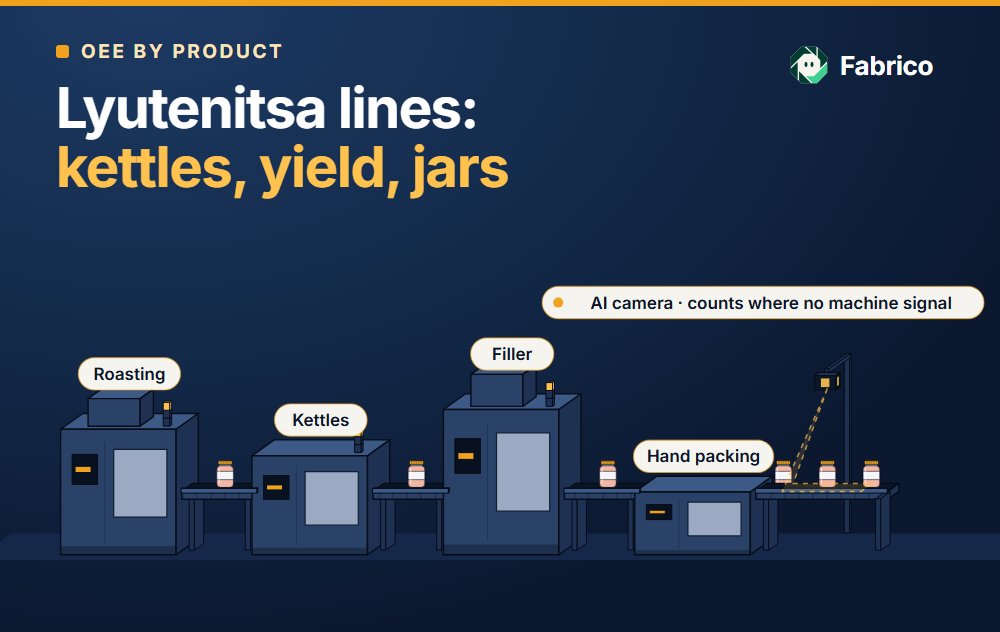
OEE in lyutenitsa production: kettles, yield, jars

In short
- A lyutenitsa line is two lines in one: batch kettles at the front, continuous jar filling at the back. When a kettle is late, the filler waits through no fault of its own.
- Pepper yield is a separate account. OEE does not show how many peeled peppers remain from the raw ones, and in the example this loss is larger than any stop reason.
- In the example below the shift loses 981.60 EUR in OEE and another 516.00 EUR from yield below standard.
- The first step is simple: record waiting for the kettle as its own reason and weigh the raw and the peeled peppers every shift.
OEE on a lyutenitsa line (a Bulgarian roasted pepper and tomato relish) shows how much of the planned time the filler actually spends filling good, closed and pasteurised jars. The losses covered here are waiting for the next batch from the kettle, the changeover from one recipe to another with a wash, short stops at capping and labelling, and rejects for fill level and vacuum.
Separate from OEE is yield: how many peeled peppers come out of the raw ones.
This article is for owners, production directors and process engineers in plants that make lyutenitsa, ajvar, kyopoolu (a roasted aubergine spread) and other vegetable spreads in jars. It explains how to measure each factor, how the kettles and the filler are reported together, how to count yield, and it walks through one shift in euros.
Vegetable processing in Bulgaria in numbers
According to Eurostat structural business statistics, in 2024 the group "Other processing and preserving of fruit and vegetables" in Bulgaria had 331 enterprises with 6,692 persons employed, about 20 people per enterprise on average (accessed 26.11.2026). Lyutenitsa makers fall into this group.
Lyutenitsa plants are busiest in the season, from August to October, when peppers and tomatoes are fresh. In the season every shift is expensive, because the raw material does not wait. A pepper that is not roasted today is worse tomorrow.
From pepper to jar: sections and losses
| Section | What it does | Typical losses |
|---|---|---|
| Roasting and peeling | Roasts the peppers and removes skin, seeds and stems | Low yield, oven stops |
| Grinding | Grinds the peeled peppers and the tomatoes | Jams, waiting for raw material |
| Kettles | Cook the batch with oil, sugar and salt | Late batch, wash at changeover |
| Filler and capper | Fill and close the jars hot | Short stops, broken glass |
| Pasteurisation and label | Tunnel, cooling, label, case | Full tunnel, label rejects |
The definitions of availability, performance and quality follow ISO 22400-2 (accessed 26.11.2026). On a linked line, OEE is read at the core machine. For lyutenitsa that is the filler: it decides how many jars come out. Stops at the kettles and the tunnel are recorded as reasons on the filler.
If the filler reports its state using the PackML state model (ISA-TR88.00.02, accessed 26.11.2026), the two states are different: "Suspended" means the filler is fine but is waiting for product or for space after it, while "Held" means it stopped because of its own problem.
The kettle and the filler: batch and flow
The kettle works in batches. It is filled, heated, cooked, checked and emptied. The filler works continuously. When a buffer vessel sits between the two, it holds one batch.
If the kettles take turns and one of them is 10 minutes late, the buffer empties and the filler stops. The filler operator only sees "no product". The cause is in the kettle: late raw material, a longer cook, a sample that did not pass.
So on the filler this stop is recorded as "starved (waiting for product)", with a sub-reason for the kettle. Without a sub-reason the filler looks like the weakest point, and its mechanic looks for a fault that does not exist. How such minutes are assigned to the right machine is covered in the article camera or sensor for OEE by machine.
It also helps to record the time of each batch: when the kettle is filled, when it is ready and when it is emptied. That shows whether the cooking is late, or the feed of ground peppers.
Pepper yield: an account outside OEE
From 100 kg of raw peppers, fewer kilograms remain after roasting and peeling. Skin, seeds, stems and part of the water come out. The process engineer knows the standard yield for a given variety and size.
Yield is not part of OEE: the jars that come out are good. But every point below standard means more peppers bought for the same amount of lyutenitsa. The causes vary: an oven with uneven temperature, peeling that is too aggressive, small or unripe peppers from the supplier.
So weigh the raw peppers at the inlet and the peeled peppers at the outlet every shift. Compare the percentage with the standard by supplier and by variety. The gap has a price in euros and an owner: the process engineer (oven and peeling) or procurement.
The season: fresh peppers and stored raw material
In the season the line runs on fresh peppers and roasting sets the rhythm for the whole plant. Outside the season the line can run on peeled peppers prepared during the season and frozen or stored another way. Then roasting is not involved, the yield is already paid for, and the bottleneck moves to the kettles and the filler.
So compare filler OEE separately for the two periods. If OEE is much lower in the season and the filler is the same, look for the difference in the feed first: the oven, the peeler or the deliveries. If OEE is low outside the season too, look at the kettles, the changeovers and the capping.
The ideal rate of the filler depends on the recipe and on the jar size, not on the season. Set it per product. If a thick recipe fills more slowly, that is its rate, not speed loss. A single rate for all recipes will show a loss that nobody can reduce.
In the season there is one more simple measure: the hours from delivery to roasting. Peppers that wait in the yard for more than a day lose water and quality, and yield with them. Record the delivery time and the roasting time for every delivery.
The changeover between recipes
When a plant makes several kinds, for example classic, hot, with more tomatoes and without sugar, the order of the recipes matters. The changeover from hot to classic requires washing the kettle, the pipes and the filler, otherwise the next batch will be hotter than the label says.
Set a standard for every pair of recipes and order the plan from the mildest to the hottest. That way the line moves in the cheaper direction and the wash stays short.
A recipe with allergens, for example with nuts or sesame, goes at the end of the week, and after it the line gets a full wash. Annex II to Regulation (EU) No 1169/2011 lists the substances that cause allergies, including nuts and sesame (accessed 26.11.2026).
Kettles, changeover and yield: one shift in euros
The numbers are examples, not from a real customer. The line fills 260 g jars, at an ideal rate of 80 jars per minute on the filler for both recipes. The shift has 450 minutes of planned time, and every stop over 2 minutes is recorded as downtime. The ideal for the shift is 36,000 jars.
Several kettles take turns, and in the middle of the shift the line moves from the hot to the classic recipe, the more expensive direction, with a full wash.
Prices in the example: 0.12 EUR contribution per jar and 0.80 EUR per kilogram of raw peppers.
The contribution is deliberately understated. For comparison, data from Aswath Damodaran (NYU Stern) shows a gross margin of 23.23 % for US-listed food processing companies (data as of January 2026, accessed 26.11.2026). Replace both prices with your own.
| Cause | Stops | Minutes | Recorded as | Jars | EUR per shift |
|---|---|---|---|---|---|
| Waiting for a batch from the kettle | 6 × 5 min | 30 | downtime, sub-reason kettle | 2,400 | 288.00 |
| Changeover with wash | 1 × 25 min | 25 | downtime | 2,000 | 240.00 |
| Short stops at the infeed and the labeller | 40 × 30 s | 20 | speed loss | 1,600 | 192.00 |
| Capper and broken glass | 4 × 4 min | 16 | downtime | 1,280 | 153.60 |
| Rejects for fill, vacuum and label | 900 jars | quality | 900 | 108.00 | |
| Total in OEE | 91 | 8,180 | 981.60 | ||
| Yield below standard, 5 points | 645 kg raw peppers | outside OEE | 516.00 |
How the numbers are reached:
- Downtime: 30 + 25 + 16 = 71 minutes, run time 379 minutes. Availability: 379 / 450 = 84.2 %.
- For 379 minutes the ideal is 30,320 jars. Short stops take 1,600. Jars filled: 28,720. Performance: 28,720 / 30,320 = 94.7 %.
- Rejects 900, good 27,820. Quality: 27,820 / 28,720 = 96.9 %.
- OEE: 84.2 % × 94.7 % × 96.9 % = 77.3 %. Check: 27,820 / 36,000 = 77.3 %.
- The loss in OEE: 8,180 jars × 0.12 EUR = 981.60 EUR per shift.
- Yield: the shift roasts 8,000 kg of raw peppers. At a standard of 62 %, 4,960 kg of peeled peppers come out; in reality 57 % comes out, that is 4,560 kg.
- At standard yield, the same 4,560 kg of peeled peppers would have come from 4,560 / 0.62 = 7,355 kg of raw peppers. So 645 kg more raw peppers were roasted, at 0.80 EUR, or 516.00 EUR.
By value, yield comes first: 516.00 EUR, a loss that no downtime report shows. Second is waiting for the kettle: 288.00 EUR, a loss that the report shows on the wrong machine if there is no sub-reason. The ranking depends on the prices: at a contribution of 0.22 EUR per jar, waiting for the kettle costs 528.00 EUR and moves ahead of yield.
If the fresh pepper season is 90 days with two shifts each and every shift looks like the example, yield below standard costs 92,880 EUR, and waiting for the kettle 51,840 EUR.
The first task is for the oven and for procurement, the second for the feed to the kettles. The money in OEE is only real if all the output sells; agree the estimate with the finance team.
Hot filling, vacuum and pasteurisation
Lyutenitsa is filled hot, the jar is closed at once, and after cooling the lid must be concave. A jar without vacuum is a reject. If vacuum rejects grow, check the product temperature at filling, the fill level and the lids before looking for a problem in the capper setting.
After capping, the jars go through a pasteurisation and cooling tunnel.
Regulation (EC) No 852/2004, Annex II, Chapter XI, requires producers who heat-treat food in hermetically sealed containers to check the main parameters regularly, including temperature, pressure, sealing and microbiology (accessed 26.11.2026). So the tunnel records are also food safety records.
When the tunnel fills up because case packing after it has stopped, the filler is blocked. On the filler this is recorded as "blocked", with a sub-reason for the tunnel or for case packing, exactly like waiting for the kettle on the other side.
Weight, lot and traceability
The jars pass a checkweigher. Under Directive 76/211/EEC on prepackaged products (consolidated text of 11.04.2009, accessed 26.11.2026), the tolerable negative error for a pack of 200 to 300 g is 9 g, and the lot average may not be below the nominal quantity.
Thick lyutenitsa is harder to fill than thin, and its weight varies more. If the filler is set with a large margin to avoid light jars, product is given away every shift. Track the average weight against nominal by recipe.
Every jar carries a lot number. Directive 2011/91/EU requires a lot marking on prepackaged food (accessed 26.11.2026). For lyutenitsa it helps if the lot points to the kettle and the roasting day. Then, after a complaint, you can see which pepper delivery went into it.
Who owns the kettles, the yield and the jars
| Loss | Owner | Data the owner needs |
|---|---|---|
| Yield below standard | Process engineer and procurement | Yield by supplier, variety and shift |
| Waiting for the kettle | Cooking supervisor | Minutes of "starved (waiting for product)" with sub-reason kettle, and batch times |
| Changeover | Planning | Minutes against the standard for each pair of recipes |
| Capper and glass | Mechanic | Stops by cause and hour |
| Vacuum and weight rejects | Quality | Rejects by recipe, average weight against nominal |
Reporting mistakes on lyutenitsa lines
| Mistake | What you see later | How to avoid it |
|---|---|---|
| Waiting for the kettle is "filler downtime" | The filler looks like the problem | "Starved (waiting for product)" with a sub-reason |
| Yield is not measured | Spending on peppers grows with no explanation | A scale at the inlet and the outlet every shift |
| All changeovers are treated the same | You cannot see which sequence is expensive | A standard for each pair of recipes |
| A large weight margin "just in case" | Product is given away every shift | Average weight against nominal |
What to check every morning: kettle, yield, vacuum
Four numbers from yesterday are enough: filler OEE, minutes waiting for the kettle, yield against standard and vacuum rejects.
If yield falls, check the delivery and the oven. If waiting grows, check the batch times. If vacuum rejects grow, check the temperature at filling. The kettle, the scale and the capping each have one person responsible, and every morning each of them knows their own number.
What to choose for a lyutenitsa plant
| Approach | Fits when | What it misses |
|---|---|---|
| Paper logbook and weighbridge notes | One line, one recipe | Short stops and sub-reasons |
| PLC counter into a spreadsheet | A first estimate | Causes and the link to the kettles |
| OEE software with a signal and causes from the operator | Several recipes and kettles | Yield, if it is not weighed |
Questions for the vendor:
- How is "starved (waiting for product)" recorded with a sub-reason for the kettle?
- How is a standard changeover time set for each pair of recipes?
- Can a manually entered weight of raw and peeled peppers be added to the shift?
- How is OEE shown for the season only?
- Where does the shift data stay if the plant network goes down?
More on lines with heat treatment is in the article OEE on food canning lines.
How to start
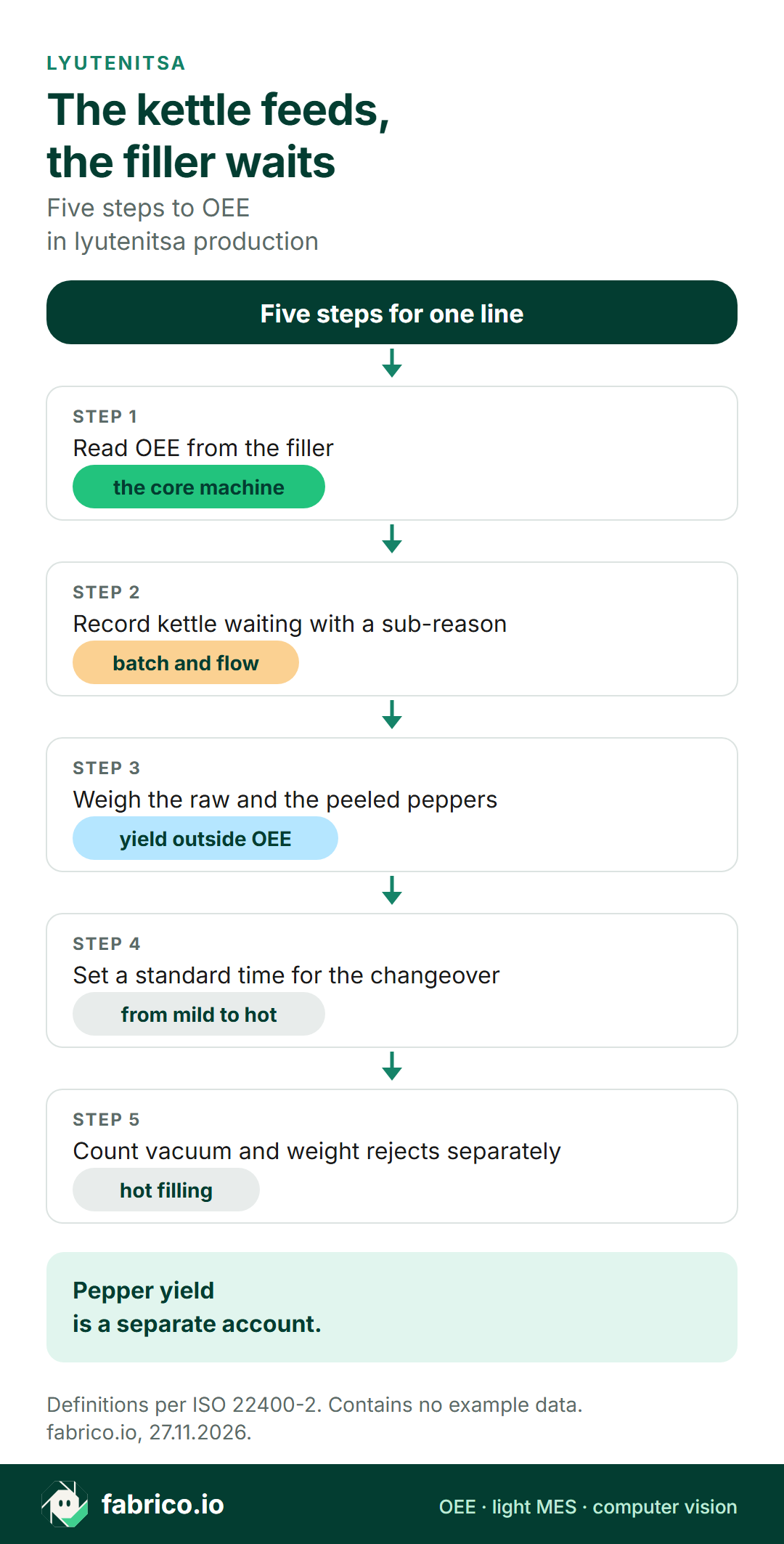
Text version of the diagram
- Read OEE from the filler.
- Record waiting for the kettle with a sub-reason.
- Weigh the raw and the peeled peppers every shift.
- Set a standard time for every changeover.
- Count vacuum and weight rejects separately.
Fabrico provides the measured rates per line; the plan itself is made in the ERP, the APS or the planning spreadsheet.
This week: record the batch times for three shifts; weigh the raw and the peeled peppers; time one changeover.
Before the next season: a signal from the filler PLC, causes from the operator with a sub-reason for the kettle; a yield standard by variety; the first task for the oven or for the feed.
Where Fabrico fits
Fabrico is made by the publisher of this article.
- What it is: an OEE platform and light MES with built-in maintenance management. It shows live OEE by line and shift.
- Linked line: OEE is read at the core machine, and starved (waiting for product) and blocked are recorded as stop reasons.
- Data: machines connect through the line PLC or through a Fabrico IoT device; where there is no signal, the camera counts the output.
- Causes: stops above the threshold get a reason in a few taps, and those below the set threshold (up to 10 minutes) go into speed loss. The camera does not decide the cause.
- Money: with the Financial Impact module every loss has a price in EUR.
- Video: where the camera covers the line, the video for the minute of a stop opens from the shift timeline, is streamed on request and not stored in Fabrico.
- Hosting and security: EU customers are hosted on AWS in Frankfurt. Certified to ISO/IEC 27001, ISO/IEC 20000-1 and ISO 9001. The gateway keeps the data for up to 30 days if the network goes down.
- Price: one quote per plant, based on the machines and modules (pricing).
For food plants, see also the article MES for food manufacturing.
Result from a Bulgarian plant
At Ficosota, a maker of home care, hygiene and consumer goods, not food, the time with no recorded stop reason fell from 3.20 % to 0.40 % between June and September 2026.
The result comes from 16 lines with OEE and the Financial Impact module, and OEE rose from 53.11 % to 59.62 %. The figures are approved by the customer.
Ficosota is also an investor in Fabrico (since January 2025) and an industrial partner in developing the OEE module; keep that in mind when reading the results.
See what a shift looks like in Fabrico. In a demo you will see the line's stops by cause and what each one costs in euros.
Frequently asked questions
Is pepper yield part of OEE?
No. The jars that come out are good. Yield is measured separately with a scale at the inlet and the outlet and compared with a standard by variety, and the gap has a price in euros.
Which machine is OEE read from on a lyutenitsa line?
The filler, because it decides how many jars come out. The kettles and the tunnel are reported as reasons for its stops.
Whose loss is the stop when a kettle is late?
It belongs to the kettle, or to the feed that supplies it. On the filler it is recorded as "starved (waiting for product)" with a sub-reason.
Why does a jar end up without vacuum?
A jar loses vacuum when the product temperature at filling is too low or when the lid does not seal. Record vacuum rejects by recipe and by hour.
How much lighter can a 260 g jar of lyutenitsa be?
Under Directive 76/211/EEC, the tolerable negative error for packs of 200 to 300 g is 9 g, and the lot average may not be below the nominal quantity.
Does OEE make sense if the plant only runs in the season?
Yes, that is exactly when every minute is expensive. Data from one season shows what to fix before the next.
Latest from our blog






Real Fabrico tiles, sample data.