





 Login
 Blog

OEE for spice packing: short runs and changeovers

In short
- On the example line, changeovers are the largest loss. Many SKUs, small orders and short runs mean five or six changeovers per shift.
- Run length decides everything. With a 12-minute changeover, it takes over a quarter of the time on a 30-minute run and under a twentieth on a 4-hour run.
- In the example below the shift loses 486.40 EUR, and 63 % of it is changeovers.
- Celery and mustard are allergens. The changeover after them to a product without these allergens needs a full clean, so sequencing the plan by allergen is the first measure.
OEE in spice packing shows what share of the planned time the packing machine actually turns into good, weighed and sealed sachets. The losses covered here are changeovers between SKUs, cleaning after blends with allergens, film and print stops, short stops from dust in the filler, and rejects for weight and seal.
This article is for owners, production directors and process engineers in plants that make spices, seasoning blends and flavourings and pack them in 10 to 100 g sachets. It covers how to measure each factor, how run length changes OEE, and a worked example of one shift in euros.
How many spice producers Bulgaria has
According to Eurostat structural business statistics, in 2024 there were 44 enterprises with 916 persons employed in the group "Manufacture of condiments and seasonings" in Bulgaria, an average of 21 people per enterprise (accessed 26.11.2026).
The enterprises are few, but their SKUs are many: black pepper, paprika, savory, sharena sol (the Bulgarian mixed salt), blends for grilling, for soup and for pickles. Each comes in several sizes and for several brands. One machine can pack 30 or more SKUs in a week.
How a spice line works
| Section | What it does | Typical losses |
|---|---|---|
| Mixer | Blends the spices to the recipe | Late blend, cleaning |
| Hopper and auger filler | Doses small portions by volume | Dust, bridging, weight drift |
| Packing machine | Forms, fills and seals the sachet | Changeover, film, seal |
| Print and code | Prints the lot and the date | Code change, poor print |
| Checkweigher and case packing | Separates light and heavy sachets | Rejects, manual case packing |
The definitions of availability, performance and quality follow ISO 22400-2 (accessed 26.11.2026). OEE is read from the packing machine, because it sets how many sachets leave the line. Waiting for a blend and being blocked by manual case packing are recorded as reasons against it.
If the sachet machine reports its state using PackML (ISA-TR88.00.02, accessed 26.11.2026), you can see the difference between "Suspended", when it is waiting for a blend, and "Held", when it has stopped because of the seal, the film or the filler.
Run length and the cost of a changeover
In the example below, changeovers cost more than all the other losses combined: 307.20 of 486.40 EUR. The cause is not the machine but the number of runs. A small order of 3,000 sachets for one brand means a run of about 40 minutes at a real rate of 75 sachets per minute, with a changeover before and after it.
The table shows what share of time goes to a 12-minute changeover at different run lengths.
| Run length | Changeover | Changeover share | When it happens |
|---|---|---|---|
| 30 minutes | 12 minutes | 28.6 % | Small order, private label |
| 60 minutes | 12 minutes | 16.7 % | Regular SKU, small size |
| 120 minutes | 12 minutes | 9.1 % | Core SKU |
| 240 minutes | 12 minutes | 4.8 % | The fastest-selling SKU |
The share is calculated as 12 / (run + 12). Two conclusions follow from the table. First, a shorter changeover gains more on short runs than on long ones. Second, merging two small orders for the same SKU into one run saves a whole changeover without touching the machine.
So measure not only the minutes of each changeover, but also the number of changeovers per shift and the average run length. These two numbers explain the OEE of a spice line better than any other. There is more on changeover standards in the article on changeover standards in FMCG.
Allergens: celery, mustard, sesame
Seasoning blends can contain celery, mustard or sesame. Annex II to Regulation (EU) No 1169/2011 lists celery, mustard and sesame among the substances that cause allergies (accessed 26.11.2026). Their dust spreads easily and stays in the hopper, the auger and the forming collar.
That is why the changeover after a blend with celery or mustard to a spice without allergens is long: a full clean and a check. The changeover between two spices without allergens, or between two blends with the same allergen group, is short.
Sequence the week by group: first the spices with no allergens, then the blends with one allergen, and last the blends with several that also contain the earlier allergens. Set a standard for the short and the long changeover separately, so the report shows which one happened. There is more on checking the clean in the article on allergen changeover validation.
Dust in the filler
Spices are fine and dusty. The dust sticks to the auger, gets into the sachet seal and makes it weak. A weak seal shows up as a reject at inspection or, worse, as a complaint from the shop.
Dust also causes short stops: a blocked nozzle, a film sensor covered in dust, sealing jaws that need cleaning. Each stop lasts 20 or 30 seconds and, being under the threshold, gets no reason. If speed loss rises on certain SKUs, such as paprika or ground blends, check dust first. If dust is the cause, extraction above the filler and cleaning the sealing jaws on a schedule help.
Moisture does the same in another way. Salt and blends with salt take up moisture from the air, cake in the hopper and form bridges over the auger. The dose becomes uneven and the checkweigher starts rejecting light sachets. If weight rejects rise on rainy days, the problem is in the warehouse and in the hopper, not in the machine.
Six SKUs, five changeovers: one shift in euros
The numbers are illustrative, not from a real customer. The machine packs 20 g sachets at an ideal rate of 80 sachets per minute. The plan gives the shift 450 minutes, and the threshold between a short stop and downtime is 2 minutes. Ideal output for the shift is 36,000 sachets. The shift has six SKUs, so five changeovers: three short ones between spices without allergens and two long ones after blends with celery.
The margin in the example is 0.04 EUR per sachet: about 23 % of an assumed producer price of 0.17 EUR for a 20 g sachet. That matches the gross margin in data from Aswath Damodaran (NYU Stern) for listed American food processing companies: 23.23 % (data as of January 2026, accessed 26.11.2026). Replace the price and the margin with your own.
| Reason | Stops | Minutes | Recorded as | Sachets | EUR per shift |
|---|---|---|---|---|---|
| Long changeovers after blends with celery | 2 × 30 min | 60 | downtime | 4,800 | 192.00 |
| Short changeovers | 3 × 12 min | 36 | downtime | 2,880 | 115.20 |
| Short stops from dust and the seal | 60 × 30 s | 30 | speed loss | 2,400 | 96.00 |
| Film and printing | 4 × 4 min | 16 | downtime | 1,280 | 51.20 |
| Rejects for weight and seal | 800 sachets | quality | 800 | 32.00 | |
| Total | 142 | 12,160 | 486.40 |
How the numbers are reached:
- Downtime: 60 + 36 + 16 = 112 minutes, run time 338 minutes. Availability: 338 / 450 = 75.1 %.
- In 338 minutes, ideal output is 27,040 sachets. Short stops take 2,400. Sachets filled: 24,640. Performance: 24,640 / 27,040 = 91.1 %.
- Rejects 800, good 23,840. Quality: 23,840 / 24,640 = 96.8 %.
- OEE: 75.1 % × 91.1 % × 96.8 % = 66.2 %. Check: 23,840 / 36,000 = 66.2 %.
- The loss: 12,160 sachets × 0.04 EUR = 486.40 EUR per shift. Changeovers are 192.00 + 115.20 = 307.20 EUR, or 63 %.
By value, the long changeovers after the celery blends come first: 192.00 EUR. If the two celery blends are packed one after the other at the end of the shift, there is one long clean, not two (a short changeover is enough between the two blends: 30 minus 12 minutes). The 18 minutes saved are 1,440 sachets, or 57.60 EUR per shift.
If each of the 500 shifts in the year (two shifts a day, 250 working days) has two celery blends, in this example sequencing by allergen saves 28,800 EUR (57.60 EUR × 500) with no new machine, if the gain holds. Merging small orders also removes some of the short changeovers. The amount is real only if the extra sachets are sold; check it with the finance team.
Merging orders and a frozen plan
When two orders for the same SKU, one for Monday and one for Thursday, are packed in the order they arrived, they become two runs. If warehouse space allows it, they are packed in one run. The second run and one changeover disappear, and OEE rises with no change to the machine.
A frozen plan also helps: in the last two or three days before packing, the plan is not touched. Every rush order squeezed in between two runs adds at least one changeover. If rush orders are frequent, record them as a separate changeover reason, so their cost shows.
The third measure is a minimum run per SKU, agreed with sales. It should not be the same for all SKUs: for a slow-selling SKU, a larger run means more stock. The table with the changeover share gives a common language for this conversation: how many minutes one small order costs and how many sachets it is.
The ideal rate per SKU
Fine spices such as paprika dose more slowly than coarse ones such as sharena sol, because the auger turns more slowly so as not to raise dust. A 100 g sachet takes longer to fill than a 10 g one. So the ideal rate is set per SKU and size, not for the whole machine.
If the machine has one rate, taken from the fastest SKU, the slow SKUs show a speed loss that cannot be reduced. A good rule is to make the ideal rate the best sustained rate reached for that SKU in a normal shift.
Weight and lot on the small sachet
Under Directive 76/211/EEC on prepackaged products (consolidated text of 11.04.2009, accessed 26.11.2026), the tolerable negative error for a pack of 5 to 50 g is 9 % of the nominal quantity, that is 1.8 g for a 20 g sachet. The average weight of the whole batch may not be below 20 g.
On small sachets one gram is a large percentage. The auger filler doses by volume, and the density of ground spices is different for each SKU. So at every changeover the dose is set as well, and the first sachets are checked on a scale. Those minutes are part of the changeover standard.
Every sachet carries a lot number. Under Directive 2011/91/EU, food without a marked lot may not be sold, with few exceptions (accessed 26.11.2026). On small sachets the lot code has to fit into a small space. For spices the lot should point to the raw material lot, because one raw material goes into many SKUs.
Owners: from the plan to the seal
| Loss | Owner | Data they need |
|---|---|---|
| Number and type of changeovers | Planning and sales | Changeovers per shift, average run length |
| Long changeovers after allergens | Planning and quality | Minutes against the standard, by type |
| Dust and seal | The mechanic | Short stops by SKU and by hour |
| Film and printing | The shift supervisor | Stops by reason |
| Weight rejects | Quality | Rejects by SKU, average weight against nominal |
Mistakes in tracking short runs
| Mistake | What you see later | How to avoid it |
|---|---|---|
| The changeover is not a separate reason | Availability is low with no explanation | Changeover with a type: short or long |
| Run length is not measured | Small orders seem to cost nothing | Average run length per week |
| Dose setting is logged as "running" | The changeover looks shorter | The dose is part of the standard |
| One ideal rate for all SKUs | Fine spices show speed loss | Ideal rate per SKU and size |
The weekly conversation with sales
In spice packing, part of the loss is fixed outside the plant floor. If sales know what one changeover costs, they can offer the customer a slightly larger order or less frequent delivery. Three numbers for the week are enough: the number of changeovers, the average run length and the loss in euros from changeovers.
Day to day, three other numbers are enough: line OEE measured at the packing machine, the number of long changeovers, and short stops by SKU.
What to choose for spice packing
| Method | Fits when | What it misses |
|---|---|---|
| Paper log | Few SKUs, long runs | Short stops and the changeover type |
| PLC counter into a spreadsheet | A first estimate | Reasons and run lengths |
| OEE software with a machine signal and operator reasons | Many SKUs and short runs | Manual case packing, if there is no signal or camera there |
Questions for the vendor:
- How is the ideal rate set per SKU and size?
- Can a changeover have a type, short or long, with its own standard?
- How are the number of changeovers and the average run length shown for the week?
- How does the operator select the SKU at a changeover?
- What happens to the sachet count while the plant network is down?
There is more on machines for small packs in the article on sachet and stick pack machine OEE.
How to start
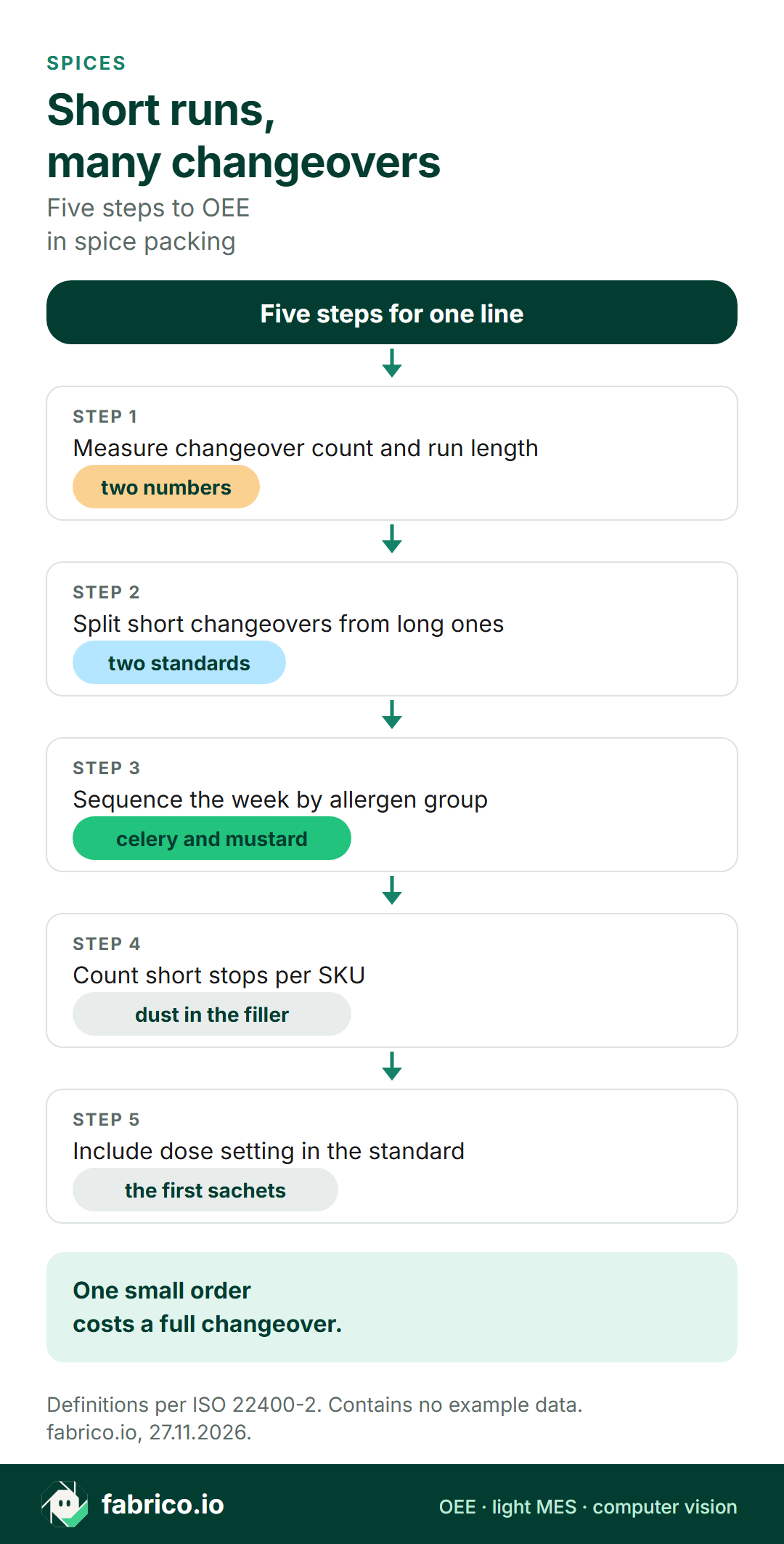
Text version of the diagram
- Measure the number of changeovers and the run length.
- Split short changeovers from long ones.
- Sequence the week by allergen group.
- Count short stops per SKU.
- Include dose setting in the standard.
Fabrico provides the measured rates per line; the plan itself is made in the ERP, the APS or the planning spreadsheet.
This week: count the changeovers and runs for five days; time one short and one long changeover; mark the SKUs with the most dust.
This quarter: a signal from the machine PLC, reasons and SKU from the operator; two changeover standards; a weekly conversation with sales about small orders.
Where Fabrico fits
Fabrico is made by the publisher of this article.
- What it is: an OEE platform and light MES with built-in maintenance management. It shows live OEE by line and shift.
- Connected line: OEE is read at the core machine, and waiting for product (starved) and blocked are recorded as stop reasons.
- Data: machines connect through the line PLC or a Fabrico IoT device; where there is no signal, a camera counts output.
- Reasons: stops above the threshold get a reason in a few taps, and those below the set threshold (up to 10 minutes) go into speed loss. The camera does not determine the reason.
- Money: with the Financial Impact module every loss has a price in EUR.
- Video: where a camera covers the line, the video for the minute of a stop opens from the shift timeline, is streamed on request and not stored in Fabrico.
- Hosting and security: EU customers are hosted on AWS in Frankfurt. Certified to ISO/IEC 27001, ISO/IEC 20000-1 and ISO 9001. The gateway keeps data for up to 30 days if the network drops.
- Price: one quote per plant, based on machines and modules (pricing).
How to set a rate per SKU on a line with many products is covered in the article on OEE on a high-mix food line; for the whole plant, see MES for food manufacturing.
Result from a Bulgarian plant
At Ficosota, a maker of home care, hygiene and consumer goods rather than food, time with no recorded stop reason fell from 3.20 % to 0.40 % between June and September 2026.
The result comes from 16 lines with OEE and the Financial Impact module, and OEE rose from 53.11 % to 59.62 %. The numbers are approved by the customer.
Ficosota is also an investor in Fabrico (since January 2025) and an industrial partner in developing the OEE module; keep that in mind when reading the results.
See a week of changeovers and stops in Fabrico. In a demo you will see the line's stops by reason and what each one costs in euros.
Frequently asked questions
What lowers OEE on a spice line?
The number of changeovers: in the example on this page they are 63 % of the loss for the shift. With many SKUs and short runs, changeovers take a large share of the time, even when each one is short.
How long should a run be?
It depends on the changeover. With a 12-minute changeover, it takes 16.7 % of the time on a 60-minute run and 9.1 % on a 120-minute run. The longer the changeover, the longer the run needed for the same share.
Why is the changeover after a celery blend longer?
Celery is in Annex II to Regulation (EU) No 1169/2011, the list of allergens. The regulation does not say how to clean the line; the example line does a full clean and a check before a product without celery starts.
Is dose setting part of the changeover?
Yes. Until the dose is set and the first sachets are checked, the machine makes no good output.
How much lighter can a 20 g sachet be?
By up to 1.8 g, that is down to 18.2 g: Directive 76/211/EEC allows a negative error of 9 % for packs of 5 to 50 g. The average weight of the batch must still be at least 20 g.
Is a camera needed on a spice line?
Packing machines with a PLC give their own signal. A camera helps where sachets are placed by hand into cases or on racks, where it counts the finished sachets.
Latest from our blog





Real Fabrico tiles, sample data.