





 Login
 Blog
OEE for kashkaval production: steam, moulds and wheels

In short
- The heart of a line for kashkaval, a Bulgarian pasta filata yellow cheese, is the cooker-stretcher. It works in kilograms per minute, and OEE is read from it.
- The curd has to ripen to the right acidity. If cheddaring runs late, the machine waits, and the report shows downtime where there is no problem.
- In the example below the shift loses 1,608 EUR. The largest item is waiting for the curd, followed by the mould change.
- The temperature of the water or steam is a parameter for both quality and rate. Record the adjustments as a reason of their own.
OEE in kashkaval production is the share of planned time in which the cooker-stretcher makes good, shaped wheels. The losses covered here are waiting for cheddared curd with the required acidity, changing the moulds for another wheel size, stops to adjust the temperature, short stops in curd feeding, and rejects for deformed or cracked wheels.
This article is for owners, technologists and production managers in dairies that make kashkaval from cow's, sheep's or mixed milk. It shows how the machine is measured, how cheddaring is recorded against it, and a calculation for one shift in euros.
Kashkaval and milk in Bulgaria
According to Eurostat dairy production data, in 2025 Bulgaria produced 82.51 thousand tonnes of cheese from cow's milk only and 4.48 thousand tonnes from sheep's milk only (updated 26.11.2026, accessed 27.11.2026). Kashkaval is part of these quantities.
The difference between the two milks matters for the line. Sheep's milk kashkaval is made in smaller batches and at a higher price per kilogram. Every minute of the machine costs more with it. So waiting for the curd on sheep's milk kashkaval costs more than the same wait on cow's milk kashkaval.
The stages from milk to wheel
| Stage | What happens | Losses that are recorded |
|---|---|---|
| Vat and cheddaring | Coagulum, whey separation, ripening of the curd | The curd has not reached the required acidity |
| Cutting the curd | The curd is cut into strips for feeding | Mill jam |
| Cooking and stretching | The curd is kneaded in hot water or with steam | Temperature adjustment, short stops |
| Moulding | Filling the moulds, cooling | Mould change, deformed wheels |
| Ripening and packing | Ripening, cutting, vacuum | Rejects at cutting and vacuum |
The definitions of availability, performance and quality follow ISO 22400-2 (accessed 27.11.2026). The core machine is the one that sets how much kashkaval leaves the shift. Here that is the cooker-stretcher: before it is the batch work of the vat, after it the moulds and ripening.
Cheddaring sets the start
The curd in the vat has to ripen until its acidity reaches the value at which it stretches. The technologist measures it and decides when the batch is ready. This time depends on the milk and the starter culture and changes from batch to batch.
When a batch runs late, the cooker-stretcher stands empty. Its operator sees only that there is no curd. At the machine this is recorded as "waiting for product" with the sub-reason "curd out of specification" or "late vat". Without a sub-reason the report will show the machine as the weakest point. The mechanic will look for a fault, and the technologist will not learn that the batch was half an hour late.
Also record the acidity at each batch release, together with the time. That shows which milk batches or which starter cultures lengthen the wait, and the conversation goes to the milk supply or to the technologist, not to the mechanic.
If there are several vats, the plan staggers them so that the machine gets curd without a break. The start time of each vat is a useful value for every shift: it sets when the next curd will arrive.
Water, steam and the machine's rate
The machine kneads the curd at a set temperature. If the water or steam is colder, the curd stretches less easily and the machine runs slower. If it is hotter, fat comes out and yield drops.
A temperature adjustment stops the machine for minutes. Record it as a reason of its own, not as "other". If adjustments rise at certain hours, check the boiler or the steam supply to the department at that time.
The ideal rate of the machine is set per product: cow's, sheep's or mixed, and per wheel size. Sheep's milk curd behaves differently from cow's milk curd, and its rate is different. One rate for all products shows a speed loss that does not exist.
The mill and curd feeding
Before cooking, the curd is cut into strips or milled so that it enters the machine evenly. If the strips are too large or the curd has stuck together, the mill jams and the machine gets curd in surges.
Each such jam is short: half a minute while the operator clears the feed. Below the downtime threshold these stops go into speed loss. If speed loss rises with certain batches, check the moisture and temperature of the curd before touching the machine.
It helps to have a small buffer in the feed before the machine. Then a short jam in the mill does not reach the cooking, and the machine runs evenly.
Fat in the water: a loss outside OEE
When cooking in hot water, part of the fat and protein stays in the water. The good wheels come out, and OEE does not see this loss. It shows as lower yield: fewer kilograms of kashkaval from the same amount of milk.
The water after cooking can be weighed, or the fat in it measured, per batch. When yield drops while OEE stays the same, the cause is in the temperature and the kneading time. So yield per batch is a separate number that the technologist reads alongside the machine's OEE.
The moulds and the size change
Kashkaval comes out as 1 kg wheels, smaller 400 g wheels or blocks for cutting. Each size needs its own moulds and a different setting for dosing the curd into the mould.
A mould change requires emptying the machine, changing the dosing part and checking the weight of the first wheels. Set a standard time for each pair of sizes. When two orders for one size fall on one day, put them back to back.
If the moulds are washed between shifts, keep the washing separate from the size change. They have different owners and different ways to shorten them. A second set of moulds, washed in advance, shortens the size change without touching the washing.
One shift on the cooker-stretcher in euros
The numbers are an example, not from a real customer. The ideal rate of the machine is 20 kg of curd per minute. The shift has 450 planned minutes, and a stop longer than 2 minutes is downtime. The ideal for the shift is 9,000 kg.
At the end of the shift the moulds are changed from 1 kg wheels to 400 g wheels for the next order. The contribution is taken as 0.80 EUR per kilogram. As a reference, Aswath Damodaran's data (NYU Stern) gives a gross margin of 23.23 % for US-listed food processing companies (data as of January 2026, accessed 27.11.2026). Replace the price with your own.
| Cause | Stops | Minutes | Recorded as | Kg of kashkaval | EUR per shift |
|---|---|---|---|---|---|
| Waiting for cheddared curd | 3 × 10 min | 30 | downtime, vat sub-reason | 600 | 480.00 |
| Mould change from 1 kg to 400 g | 1 × 25 min | 25 | downtime | 500 | 400.00 |
| Short stops in curd feeding | 40 × 30 s | 20 | speed loss | 400 | 320.00 |
| Temperature adjustment | 6 × 3 min | 18 | downtime | 360 | 288.00 |
| Rejects: deformed and cracked wheels | 150 kg | quality | 150 | 120.00 | |
| Total | 93 | 2,010 | 1,608.00 |
How the numbers are reached:
- Downtime: 30 + 25 + 18 = 73 minutes, run time 377 minutes. Availability: 377 / 450 = 83.8 %.
- In 377 minutes the ideal is 7,540 kg. Short stops take 400 kg. 7,140 kg were stretched. Performance: 7,140 / 7,540 = 94.7 %.
- Rejects 150 kg, good 6,990 kg. Quality: 6,990 / 7,140 = 97.9 %.
- OEE: 83.8 % × 94.7 % × 97.9 % = 77.7 %. Check: 6,990 / 9,000 = 77.7 %.
- The loss: 2,010 kg × 0.80 EUR = 1,608.00 EUR per shift.
Ranked by value, waiting for the curd comes first: 480.00 EUR, a loss that comes from the vats. Second is the mould change: 400.00 EUR, a loss that depends on the size plan.
If each of the 500 shifts in a year (two shifts a day, 250 working days) looks like the example, waiting for the curd costs 240,000 EUR, and the mould change 200,000 EUR if there is one in every shift. The sums are real only if every lost kilogram could have been sold; confirm the estimate with finance.
Cooling, ripening and vacuum
After the moulds the wheels are cooled and ripen for weeks. Ripening is process time and is not part of OEE. OEE includes only the waiting when a machine has nothing to do because the previous stage is not ready.
A cracked or deformed wheel shows when it is taken out of the mould. Record rejects by batch and by hour. If they rise at certain hours, check the temperature of the cooling water and the time in the moulds.
The hygiene rules for dairy products are in Regulation (EC) No 853/2004 (accessed 27.11.2026), and the microbiological criteria for ready-to-eat foods in Regulation (EC) No 2073/2005 (accessed 27.11.2026). Cleaning the machine to a schedule is part of the plan, with its own standard.
Weight, lot and label
Wheels and pieces are sold by nominal weight. Under Directive 76/211/EEC (consolidated text of 11.04.2009, accessed 27.11.2026), the tolerable negative error for 400 g is 12 g, and for 1 kg it is 15 g. The average weight of the lot may not be below the nominal quantity.
Dosing the curd into the mould sets the weight of the wheel. If the dose is set with a large margin, kashkaval is given away every shift. Average weight against nominal is a number worth watching per product.
Directive 2011/91/EU requires a lot marking on food, with the exemptions in Article 2 (accessed 27.11.2026). For kashkaval the lot helps link the wheel to the vat and the day of stretching.
Milk is listed in Annex II to Regulation (EU) No 1169/2011 among the substances that cause allergies or intolerances (accessed 27.11.2026). When switching between cow's and sheep's milk, the allergen is the same; the cleaning then protects the type of milk declared on the label.
Who owns the vats, the machine and the moulds
| Loss | Owner | Data they need |
|---|---|---|
| Waiting for the curd | The vat technologist | Release time and acidity of each batch |
| Mould change | Planning | Minutes against the standard per pair of sizes |
| Temperature adjustment | The energy engineer or the mechanic | Adjustments by hour and water temperature |
| Short stops | The shift supervisor | Speed loss by hour |
| Rejected wheels | Quality | Rejects by batch and by hour |
Mistakes in recording kashkaval
| Mistake | What you see later | How to avoid it |
|---|---|---|
| Waiting for the curd is "machine downtime" | The machine looks like the problem | "Waiting for product" with a vat sub-reason |
| One rate for cow's and sheep's | A speed loss that does not exist | Ideal rate per product and size |
| Adjustments are "other" | The boiler stays out of sight | A separate reason for temperature |
| Washing and the mould change are one | Nobody knows which to shorten | Two separate reasons |
The day's numbers in the dairy
Four numbers from yesterday give the picture: OEE at the cooker-stretcher, the minutes of waiting for the curd, the mould change minutes against the standard and wheel rejects by batch.
If waiting rises, the conversation is with the vats. If rejects rise, check the cooling. Every number has a person who can change it. Yield per batch is reviewed at the same meeting, because it shows a loss that OEE does not record.
What to choose for a kashkaval line
| Method | Fits when | What it misses |
|---|---|---|
| Paper log of the vats and the machine | One machine, one product | Short stops and sub-reasons |
| Kilogram counter from the PLC into a spreadsheet | A first estimate | Reasons and the link to the vats |
| OEE software with a signal and operator reasons | Cow's and sheep's, several sizes | Acidity, if it is not entered |
Questions for the supplier:
- Can the ideal rate be set in kilograms per minute per product?
- How is "waiting for product" recorded with a vat sub-reason?
- Can the standard mould change time differ for each pair of sizes?
- Can acidity be entered at batch release?
- What happens to the kilograms counted during a network outage?
More on changeover standards is in the article changeover standards in FMCG, and on batch and continuous stages in the article continuous and batch production.
How to start
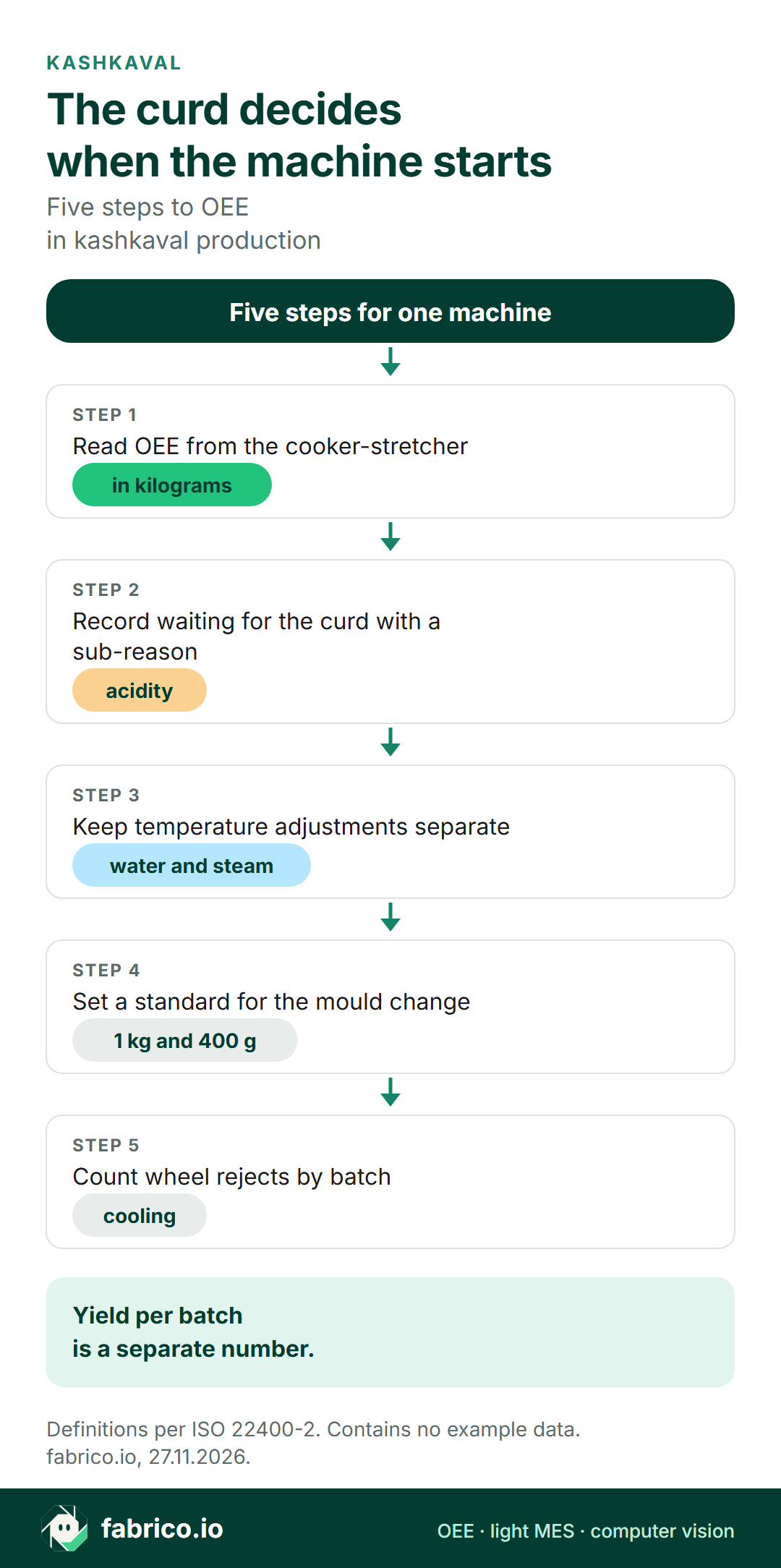
Text version of the diagram
- Read OEE from the cooker-stretcher.
- Record waiting for the curd with a vat sub-reason.
- Keep temperature adjustments as a separate reason.
- Set a mould change standard per pair of sizes.
- Count wheel rejects by batch.
Fabrico provides the measured rates per line; the plan itself is made in the ERP, the APS or the planning spreadsheet.
This week: for three shifts, record the release time of each vat and the time the machine received the curd; time one mould change; count rejects by batch.
This quarter: a PLC signal from the machine and reasons from the operator; an ideal rate per product; a vat plan aligned with the machine.
Where Fabrico fits
Fabrico is made by the publisher of this article.
- What it is: an OEE platform and light MES with built-in maintenance management. It shows live OEE by line and shift.
- Connected line: OEE is read at the core machine, and waiting for product and blocking are recorded as stop reasons.
- Data: machines connect through the line PLC or through a Fabrico IoT device; where there is no signal, a camera counts output.
- Reasons: stops above the threshold get a reason in a few taps, and stops under the set threshold (up to 10 minutes) go into speed loss. The camera does not identify the reason.
- Money: with the Financial Impact module every loss has a price in EUR.
- Video: where a camera covers the line, the video for the minute of a stop opens from the shift timeline, is streamed on request and not stored in Fabrico.
- Hosting and security: EU customers are hosted on AWS in Frankfurt. Certified to ISO/IEC 27001, ISO/IEC 20000-1 and ISO 9001. The gateway keeps data for up to 30 days if the network drops.
- Price: one quote per plant, based on machines and modules (pricing).
For food plants, see also the article MES for food manufacturing.
A result from a Bulgarian plant
At Ficosota, a maker of home care, hygiene and consumer goods, not food, the time without a recorded stop reason fell from 3.20 % to 0.40 % between June and September 2026.
The result comes from 16 lines with OEE and the Financial Impact module, and OEE rose from 53.11 % to 59.62 %. The figures are approved by the customer.
Ficosota is also an investor in Fabrico (since January 2025) and an industrial partner in developing the OEE module; keep that in mind when reading the results.
See how the vats and the machine look over one shift in Fabrico. In a demo you will see the stops by reason and what each one costs in euros.
Frequently asked questions
Which machine is OEE read from on a kashkaval line?
From the cooker-stretcher, because it sets how much kashkaval comes out. The vats and the moulds are recorded as reasons for its stops.
Whose loss is waiting for the curd?
The vats' or the milk's. At the machine it is recorded as "waiting for product" with a sub-reason, together with the acidity of the batch.
Does ripening count in OEE?
No. Ripening is process time. OEE includes only the time in which a machine waits because the previous stage is not ready.
Why do the wheels crack?
When the cooling water is too cold or the time in the moulds is short, the surface cracks. Record rejects by hour to see the link.
How much lighter can a 1 kg wheel of kashkaval be?
By up to 15 g. Directive 76/211/EEC allows this error for 1 kg packs, and the average weight of the lot must be at least 1 kg.
Should cow's and sheep's milk kashkaval have different rates?
Yes. Curd from different milk stretches differently, so the ideal rate is set per product and size.
Latest from our blog







Real Fabrico tiles, sample data.