





 Login
 Blog

OEE in rice and pulses packing: kilograms, not bags

In short
- Count in kilograms, not in bags. A 500 g bag is made faster than a 1 kg bag, so the bag count misleads whenever the size changes.
- In the example below, the same shift has an OEE of 81.6 % in kilograms and 67.7 % in bags with one rate for all sizes.
- Cleaning the raw material is part of the line. When the destoner or the sorter cannot keep up, the packing machine waits.
- Dust is a hidden loss: it gets into the bag seal and turns the bag into a reject.
OEE in rice, bean, lentil and pulses packing shows how much of the planned time the line actually spends making good, sealed and correctly weighed bags. The losses covered here are the changeover to another bag size, waiting for cleaned raw material, the film reel change, hopper jams, and bags with dust in the seal or below the allowed weight.
This article is for owners and production managers in plants that clean and pack rice, beans, lentils, chickpeas and similar dry foods. It explains why OEE is calculated in kilograms, how a size change is recorded, what dust does to the seal, and it walks through one shift in euros.
Bulgarian rice and pulses in numbers
According to Eurostat crop production data, Bulgaria harvested 59.10 thousand tonnes of rice in 2025 and 39.43 thousand tonnes of dry pulses in 2024 (accessed 26.11.2026).
According to Eurostat structural business statistics, the group "Manufacture of grain mill products", which also covers rice processing, had 107 enterprises in Bulgaria in 2024 (accessed 26.11.2026). Pulses are also packed by wholesale companies; the line and the losses are the same.
Why bags mislead
A vertical form-fill-seal machine makes a set number of bags per minute. A small bag fills and seals faster than a large one. So at 500 g the machine makes more bags per minute than at 1 kg, but fewer kilograms.
If OEE is calculated in bags with one ideal rate for all sizes, a shift with large bags looks slow and a shift with small bags looks good. Neither is true. If it is calculated in kilograms, with an ideal rate per size, the numbers tell the truth.
| Bag size | Bags per minute | Kilograms per minute | What it means |
|---|---|---|---|
| 500 g | 60 | 30 | Many bags, fewer kilograms |
| 1 kg | 40 | 40 | Fewer bags, more kilograms |
| 5 kg | 12 | 60 | In the example, another machine or by hand |
The rates in the table are examples. Yours come from the machine and are signed off by the process engineer. The definitions of availability, performance and quality follow ISO 22400-2 (accessed 26.11.2026). The counting unit, bags or kilograms, is your choice.
Cleaning the raw material
Before packing, the raw material goes through cleaning: a sieve for dust, a destoner and, where there is one, an optical sorter for discoloured grains. Cleaning is heavier for pulses, because lots from different suppliers are different.
When cleaning cannot keep up, the packing machine waits. That is not its loss. Record it as "starved (waiting for product)" with a sub-reason for cleaning, otherwise every minute looks like a packing problem.
If the packing machine reports its state using the PackML state model (ISA-TR88.00.02, accessed 26.11.2026), the difference is visible at once: "Suspended" means the machine is fine and waiting for product, while "Held" means it stopped because of its own problem. That shows whether a stop comes from packing or from cleaning.
One dirty lot with many stones or a lot of dust can slow cleaning for a whole shift. Record the raw material lot at every load. Then cleaning delays show up by supplier, and the conversation with that supplier happens with numbers.
Dust and the bag seal
Rice and pulses carry dust. During filling the dust rises and lands in the cross-seal area. The seal looks closed but does not hold. The bag fails the leak check or opens later in the warehouse.
So seal rejects are not only about jaw temperature. They depend on the product, the lot and the setting of the dust extraction. Count them by product and by hour. In the example below, lentils have three times the seal rejects of rice (300 bags against 100), and the cause is dust, not the machine.
Dust also affects the weigher and the hopper. Product bridges in the hopper and the portion does not drop on time. That gives short stops: in the example below, 30 stops of 30 seconds, recorded as speed loss.
The raw material store: moisture and pests
Rice and pulses sit in the store for weeks, sometimes months. Moisture and pests in the store do not stop the line today, but they stop it tomorrow: a damp lot causes bridging in the hopper, and a lot with pests goes back for recleaning or is rejected in full.
That is why store control is part of the food safety system. Article 5 of Regulation (EC) No 852/2004 requires food business operators to apply procedures based on the HACCP principles (accessed 26.11.2026).
OEE does not replace those procedures. It shows when a lot from the store starts to cost minutes on the line.
The changeover to another size
Going from 1 kg to 500 g is not just another setting. On a vertical packing machine, when the bag width changes, it means a new forming tube, a different film width and new settings for the doser and the bag length.
A product change at the same size is shorter: empty the hopper and the weigher, clean off the dust of the previous product and load a new label. It is still a changeover and it has its own standard. When the new product is lighter in colour, for example white beans after lentils, cleaning takes longer, because every grain of the old product shows.
Set a standard time for every pair of sizes. Record the first bags after start-up as changeover rejects when they come out with a bad seal or the wrong weight. The cheapest improvement, though, is in the plan: fewer changeovers, by running orders with the same bag size one after another.
Example: a shift with rice and lentils
The numbers are examples, not from a real customer. The line packs rice in 1 kg bags at an ideal rate of 40 kg per minute, then moves to lentils in 500 g bags at an ideal rate of 30 kg per minute.
Planned time is 450 minutes and the downtime threshold is 2 minutes. The line packs rice for 200 minutes and lentils for 191 minutes.
The contribution in the example is 0.20 EUR per kilogram, a deliberately modest figure for a low-cost raw material: data from Aswath Damodaran (NYU Stern) gives a gross margin of 23.23 % for US-listed food processing companies (data as of January 2026, accessed 26.11.2026). Replace it with your own.
| Cause | Stops | Minutes | Recorded as | Kilograms | EUR per shift |
|---|---|---|---|---|---|
| Changeover from 1 kg to 500 g | 1 × 25 min | 25 | downtime | 750 | 150.00 |
| Waiting for cleaned raw material | 3 × 6 min | 18 | downtime, sub-reason cleaning | 720 | 144.00 |
| Film reel change | 4 × 4 min | 16 | downtime | 560 | 112.00 |
| Bridging in the hopper | 30 × 30 s | 15 | speed loss | 530 | 106.00 |
| Dust in the seal and light bags | 450 bags | quality | 300 | 60.00 | |
| Total | 74 | 2,860 | 572.00 |
How the numbers are reached:
- Downtime: 25 + 18 + 16 = 59 minutes, run time 391 minutes. Availability: 391 / 450 = 86.9 %.
- Ideal output for the run time: 200 × 40 + 191 × 30 = 8,000 + 5,730 = 13,730 kg. Bridging in the hopper takes 530 kg (8 minutes on rice, 7 on lentils). Output is 13,200 kg. Performance: 13,200 / 13,730 = 96.1 %.
- Rejects: 100 rice bags with a bad seal (100 kg), 300 lentil bags with a bad seal (150 kg) and 50 light rice bags (50 kg), 300 kg in total. Good output 12,900 kg. Quality: 12,900 / 13,200 = 97.7 %.
- OEE: 86.9 % × 96.1 % × 97.7 % = 81.6 %.
- Minutes are valued at the rate of the product on the line at the time: the waiting happens on rice (40 kg per minute), the changeover on lentils (30 kg per minute), and the film reel is changed twice on each product (8 × 40 + 8 × 30 = 560 kg). The loss: 2,860 kg × 0.20 EUR = 572.00 EUR per shift.
The same shift in bags, with one rate of 60 bags per minute: the ideal for 391 minutes is 23,460 bags, and the output is 7,680 bags of rice and 11,040 bags of lentils, 18,720 in total. Performance drops to 79.8 % and OEE to 67.7 %.
The gap of 13.9 points is not a loss. It is the wrong unit.
By value, the changeover to another size comes first: 150 EUR. Right behind it is waiting for cleaned raw material: 144 EUR, a loss that does not belong to the packing machine. If each of the 500 shifts in the year (two shifts, 250 days) looks like the example, the two together cost 147,000 EUR.
The first task is for planning: fewer changeovers to another size. The second is for cleaning: which raw material lots slow it down. The money is only real if all the output sells; agree the estimate with the finance team.
Large bags and manual stacking
This section is about 5 and 10 kg bags filled on another machine or semi-manually, and 500 g and 1 kg bags packed into cases or onto pallets by hand. There is no signal there. The count is written at the end of the shift, and the stops are not visible at all.
A camera over the outlet of such a station counts the bags or cases that pass, and a pause in the count is a stop. The camera does not decide the cause and does not watch people: point it at the bags, not the walkways, and report by line and shift. A person records the cause.
Bag weight and lot
The checkweigher rejects light bags. Under Directive 76/211/EEC on prepackaged products (consolidated text of 11.04.2009, accessed 26.11.2026), the tolerable negative error for a 500 g bag is 3 %, that is 15 g, the same as for a 1 kg bag. The lot average may not be below the nominal quantity.
Every bag carries a lot number. Directive 2011/91/EU requires a lot marking on prepackaged food (accessed 26.11.2026). When the bag lot is linked to the raw material lot, one customer complaint leads straight to the supplier.
Owners: cleaning, hopper, seal
| Loss | Owner | Data the owner needs |
|---|---|---|
| Size change | Planning | Minutes against the standard for each pair of sizes |
| Waiting for cleaned raw material | Cleaning supervisor | Minutes of "starved (waiting for product)" by raw material lot |
| Bridging in the hopper | Technician | Short stops by product and by hour |
| Dust in the seal | Process engineer | Seal rejects by product and lot |
| Light bags | Quality | Average weight and checkweigher rejects |
Counting mistakes on dry food lines
| Mistake | What you see later | How to avoid it |
|---|---|---|
| OEE in bags with one rate | Large bags look like slow work | OEE in kilograms, rate per size |
| Waiting is "packing downtime" | Packing looks like the problem | "Starved (waiting for product)" with sub-reason cleaning |
| Seal rejects are one number for the whole shift | You cannot see which product causes them | Seal rejects by product |
| The raw material lot is not recorded | Dirty lots stay invisible | Lot at every load |
Kilograms, waiting and seal: what to check each morning
Three numbers from yesterday are enough: OEE in kilograms, the "starved (waiting for product)" minutes from cleaning, and seal rejects by product.
Look at waiting and seal rejects by product, not only for the whole shift. That shows whether the problem is in rice, lentils or beans, and who owns it.
If waiting grows, the conversation is about cleaning and the lots. If seal rejects grow on one product, it is about dust extraction. That way every number goes to the person who can change it.
Which system to choose for a dry food line
| Approach | Fits when | What it misses |
|---|---|---|
| Paper logbook | One product, one size | Short stops and waiting |
| PLC counter into a spreadsheet | A first estimate | Kilograms and causes |
| OEE software with a rate per product and causes from the operator | Many products and sizes | Manual stations without a camera |
Questions for the vendor:
- Can OEE be calculated in kilograms, with a rate per product and size?
- How is "starved (waiting for product)" recorded with a sub-reason for cleaning?
- How is a size change recorded against a standard?
- How do checkweigher rejects feed into quality?
- What happens to the data if the plant network goes down?
More on vertical packing machines on similar lines is in the article OEE on snack food lines, and how to choose between a camera and a sensor is covered in camera or sensor for OEE by machine. If cases are filled by a machine, see case packer OEE.
How to start
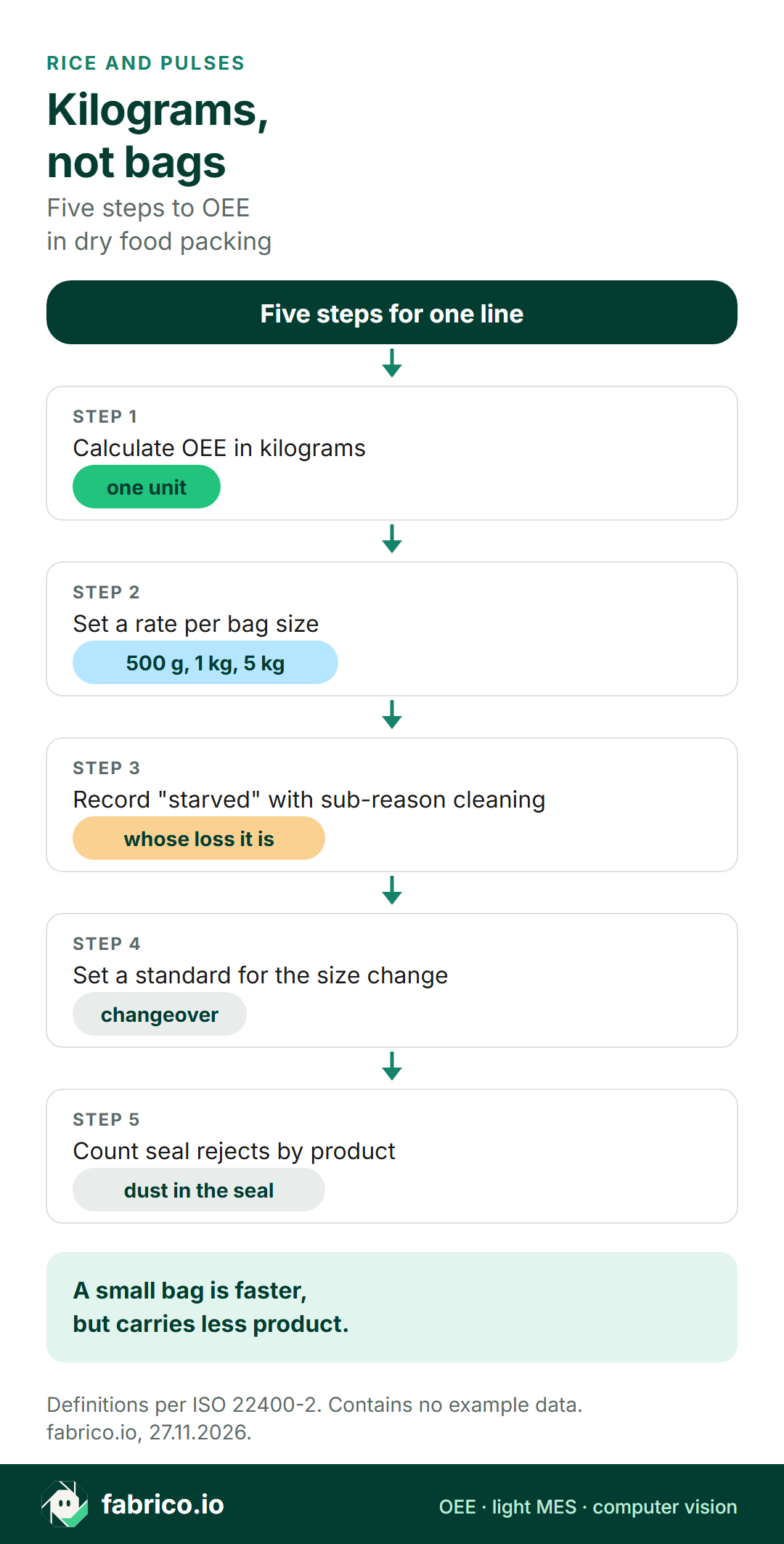
Text version of the diagram
- Calculate OEE in kilograms.
- Set a rate per bag size.
- Record "starved (waiting for product)" with sub-reason cleaning.
- Set a standard for the changeover to another size.
- Count seal rejects by product.
Fabrico provides the measured rates per line; the plan itself is made in the ERP, the APS or the planning spreadsheet.
This week: write down the real rate in kilograms for the two most common sizes; time one changeover to another size; count bags with a bad seal by product for three shifts.
This quarter: a signal from the packing machine PLC and causes from the operator; OEE in kilograms; the first task for cleaning or for planning.
Where Fabrico fits
Fabrico is made by the publisher of this article.
- What it is: an OEE platform and light MES with built-in maintenance management. It shows live OEE by line and shift.
- Linked line: OEE is read at the core machine, and starved (waiting for product) and blocked are recorded as stop reasons.
- Data: machines connect through the line PLC or through a Fabrico IoT device; where there is no signal, the camera counts the output.
- Causes: stops above the threshold get a reason in a few taps, and those below the set threshold (up to 10 minutes) go into speed loss. The camera does not decide the cause.
- Money: with the Financial Impact module every loss has a price in EUR.
- Video: where the camera covers the line, the video for the minute of a stop opens from the shift timeline, is streamed on request and not stored in Fabrico.
- Hosting and security: EU customers are hosted on AWS in Frankfurt. Certified to ISO/IEC 27001, ISO/IEC 20000-1 and ISO 9001. The gateway keeps the data for up to 30 days if the network goes down.
- Price: one quote per plant, based on the machines and modules (pricing).
For food plants, see also the article MES for food manufacturing.
Result from a Bulgarian plant
At Ficosota, a maker of home care, hygiene and consumer goods, not food, the time with no recorded stop reason fell from 3.20 % to 0.40 % between June and September 2026.
The result comes from 16 lines with OEE and the Financial Impact module, and OEE rose from 53.11 % to 59.62 %. The figures are approved by the customer.
Ficosota is also an investor in Fabrico (since January 2025) and an industrial partner in developing the OEE module; keep that in mind when reading the results.
See a dry food line in Fabrico. In a demo you will see the line's stops by cause and what each one costs in euros.
Frequently asked questions
Is OEE in rice packing calculated in bags or in kilograms?
In kilograms, when the line runs different sizes. Bags mislead, because a small bag is made faster but carries less product.
Whose loss is waiting for cleaned raw material?
It belongs to cleaning, not to the packing machine. It is recorded as "starved (waiting for product)" with a sub-reason for cleaning.
Why do lentil bags have more seal rejects?
When the lentils carry more dust, it gets into the seal. Count rejects by product and lot to see when it appears.
How many grams lighter can a 1 kg bag of rice be?
Under Directive 76/211/EEC, the tolerable negative error for packs from 500 to 1,000 g is 15 g, and the lot average may not be below the nominal quantity.
Is a bag size change a changeover?
Yes. It reduces availability and needs a standard for each pair of sizes, with the first bags after start-up counted as changeover rejects.
Why does bridging in the hopper appear only with some lots?
When a lot is damp or dusty, the product bridges in the hopper. Record the raw material lot at every load and compare short stops by lot.
Does a rice line need a camera?
No, if the machines have a PLC. A camera makes sense where bags are packed into cases by hand, or on an old machine with no accessible signal.
Latest from our blog





Real Fabrico tiles, sample data.