





 Login
 Blog
Plant-Based Meat Line OEE: Extruder Pace, Start-Up Scrap and Costs

In short
- Rate the line at the extruder, in kg per hour: the high-moisture extruder paces a plant-based meat line, so OEE is good extrudate kilos divided by planned time x rated kg per hour.
- Every start is a loss in two currencies: heat-up minutes hit availability, and the off-spec fibre made before the process settles hits quality.
- Sequence pea before soy: soybeans and gluten are listed allergens in EU law and pea is not, so the order of the day decides how many full wet cleans the line needs.
- Kilos at the die and packs at the end tell different stories: in the worked example, OEE is 70.3% at the extruder and 66.8% at the packer.
- Price the day: the example line loses EUR 2,579 a day, and the four starts alone cost EUR 702 of it.
OEE on a plant-based meat production line is the share of the extruder's rated output that leaves the cooling die as good, on-spec fibre, and then reaches the packer as first-pass good packs. The rating is in kilograms per hour at the extruder, not pieces at the end.
This page covers lines that dose protein and water, texturise in a high-moisture extruder, then cut, marinate, form, freeze and pack. It is about plant protein, not animal meat: for slaughter, cutting and poultry lines, see MES for meat and poultry processing.
Why the extruder sets the pace
A meat alternative line is a continuous process feeding a batch and piece process. The extruder runs as one long stream of wet fibre. Everything after it (cutter, tumbler, former, freezer, packer) has to take that stream.
When each of those stations runs faster than the extruder on the recipe of the day, the extruder is the pacer. A minute lost at the die is a minute of line output gone. A minute lost at the packer can be absorbed, as long as the freezer or a chilled buffer can hold product until the packer restarts.
What high-moisture extrusion is
A review in Critical Reviews in Food Science and Nutrition by Cornet and colleagues defines high-moisture extrusion cooking as "extrusion with a cooling die and a water content exceeding 50%". It reports water contents in practice of approximately 50 to 70%.
A 2023 review in Foods by Sengar and colleagues at Teagasc describes the process as running at a feed moisture above 40% and a barrel temperature of about 100 °C, followed by immediate cooling to build the aligned, fibrous structure.
The same review notes that multi-channel cooling dies with a "throughput capacity of 1000 kg/h have been used at commercial production capacity". That is the scale of the stream every downstream station has to handle.
Rate it in kg per hour
- The unit is wet extrudate per hour at the validated recipe setting, not the brochure maximum of the extruder.
- Each recipe gets its own rating. A soy and gluten blend and a pure pea recipe may run at different rates on the same die.
- Keep the rating table fixed. Change it only after an engineering trial, never to lift a bad week.
Pieces, burgers and nuggets come later. Counting them as the main OEE number hides the fact that the extruder decides how many there can be.
A loss map from dosing to packing
When the line stops, the shift lead sees a full freezer or an idle packer. The cause can sit several stations upstream. Each station needs its own stop codes and an A, P or Q tag, plus Y for yield losses that only a scale can see.
| Station | Loss to watch | Tag | Measured in |
|---|---|---|---|
| Protein and water dosing | Powder bridging in the feeder, late refill, water flow drift | A, Q | Minutes, kg |
| Extruder barrel | Heat-up from cold, torque or pressure trips | A, P | Minutes |
| Cooling die | Blockage, uneven cooling, fibre too soft or scorched | A, Q | Minutes, kg |
| Cutter or shredder | Blade wear, pieces out of size, fines | Q, Y | kg |
| Marinating | Tumbler batch waits, pickup off target | A, Y | Minutes, kg |
| Forming | Former blocked, burger or nugget weight off spec | A, Q | Minutes, pieces |
| Fryer, if fitted | Oil change, pieces sticking | A, Q | Minutes, kg |
| Freezer or chiller | Full belt blocks the line, broken pieces | A, Y | Minutes, kg |
| Packer and checkweigher | Film splice, seal rejects, giveaway | A, Q, Y | Minutes, packs |
On this map the extruder barrel and the cooling die form one thermal process, so a trip at the die is not a ten-second jam. It means a restart, and every restart makes off-spec fibre before the process settles.
Keep starved and blocked minutes on separate codes. If the extruder waits for a full freezer, the fix sits at the freezer, not at the die.
Build the codes once, in a short list with one owner each; the page on scrap reason codes covers how to keep the list usable.
Start-up scrap: the loss that looks like running
After every start, the extruder runs for a while before the fibre is right. Pressure, torque and die temperature move toward their set points, and the product coming out is too soft, too dense, or not fibrous enough to sell.
On a counter, those minutes look like production. The motor turns, mass leaves the die, and a simple running signal shows the line as up. That is how start-up scrap drops out of an OEE report.
Book it as quality loss, not as a stop
- Heat-up without feed is an availability loss with its own code, timed against a standard per start type.
- Off-spec fibre after feed starts is a quality loss. The extruder ran, but the kilos were not good.
- Slow running while ramping to rate is a performance loss. It shows as kilos missing against the rated kg per hour.
Weigh it every time
Divert off-spec fibre into a marked bin at the die and weigh it per start, not per day. A start from cold, a restart after a die blockage and a restart after a protein change each get their own line on the shift sheet.
Two numbers to trend: kilos of off-spec per start, and starts per day. The first improves with a fixed start-up sequence for water, protein and die cooling. The second improves by removing the trips that force restarts.
Rule of the line: a restart is never free. In the worked example below, a die trip costs 9 minutes and 55 kg of off-spec fibre, EUR 118 per event, before any lost sales.
Protein changeovers and allergen cleans
The cost of a protein change depends on what goes in next. Regulation (EU) No 1169/2011, Annex II, lists "cereals containing gluten" and "soybeans and products thereof" as substances causing allergies or intolerances. Peas are not on that list.
So a change from soy to pea, or from a gluten blend to a gluten-free recipe, removes an allergen. That needs a clean your hazard analysis validates, in this example a wet clean with the cooling die opened. A change from pea to soy adds an allergen and may need far less.
The Codex Code of Practice on Food Allergen Management (CXC 80-2020) advises scheduling to "process foods that do not contain allergens before foods with allergens", where feasible. On a plant-based line, that order can turn a full wet clean into a short purge, as the worked example shows.
| Change | What happens | Standard (sample) |
|---|---|---|
| Same recipe, new cut size | Cutter setting, first-piece check | 10 min |
| Same protein, new marinade | Tumbler and marinade line cleaned | 25 min |
| Pea to soy (allergen added) | Purge and restart, if the hazard analysis allows | 30 min |
| Soy to pea (allergen removed) | Full wet clean, die opened, verified | 80 min |
| Gluten blend to gluten-free | Full wet clean, die opened, verified | 80 min |
The standards are sample figures. Set yours from timed changeovers and the validated cleaning procedure, then count every minute as availability loss. The method for splitting internal and external steps is on the page on changeover time.
Three allergen traps on this line
- Powder dust at dosing. CXC 80-2020 advises that dry allergens prone to dust "should, where feasible, be scheduled at the end of a production/processing day".
- Rework. The code lists "errors in handling of rework" as a source of cross-contact. Off-spec soy fibre must never be reworked into a pea product.
- Fryer oil. The code says manufacturers "should evaluate the potential for allergen cross-contact due to cooking media, such as water or oil".
Never shorten a validated clean to lift OEE. The clean time is a food safety decision for QA. OEE should show the cost of the sequence that made the clean necessary.
Kilos at the die versus packs at the end
A plant-based line needs two OEE numbers, because mass changes on the way. Marinade adds weight, cutting and forming lose fines, the freezer breaks pieces, and the packer gives away grams above the label.
- Extruder OEE, in kg: good extrudate / (planned time x rated kg per minute). This is the pacer's number and drives the money.
- Line OEE, in packs: first-pass good packs / (planned time x rated packs per minute). The rated packs come from rated kg x marinade factor / nominal pack weight.
- The gap between them is the downstream yield loss: fines, broken pieces, giveaway and pack rejects.
Report both, side by side, every shift. If only the pack number is reported, start-up scrap and downstream fines blur into one figure and nobody owns either. If only the kilo number is reported, giveaway and fines vanish.
Products sold as quick-frozen add one more rule. Council Directive 89/108/EEC requires quick-frozen foodstuffs to be maintained "at -18 °C or lower" at all points. Count packs as good only once that is met; the page on OEE for frozen food production covers the freezer side.
Worked example: a pea and soy line in Germany
One high-moisture extrusion line in Germany makes frozen chicken-style pieces in 200 g bags. It runs a soy and gluten recipe in the morning and a pea recipe in the afternoon. Every figure in this example is a sample made for this page; none comes from a customer.
- Staffed time: 2 shifts x 480 minutes = 960 minutes of planned production time. The full end-of-day clean is in a separate sanitation shift.
- Rated speed: 480 kg of wet extrudate per hour, 8 kg a minute (sample figure).
- Marinade: adds 10% to the weight of the fibre (sample figure).
- Pack: 200 g nominal. Rated line output = 8 x 1.10 / 0.2 = 44 bags a minute.
| Stops on the day | Minutes | Station |
|---|---|---|
| Soy to pea change with allergen clean (standard 80) | 95 | Whole line |
| Morning heat-up from cold (standard 30) | 35 | Extruder |
| Die pressure trips, 2 restarts | 18 | Cooling die |
| Blocked by full freezer belt | 15 | Freezer |
| Protein feeder bridging | 12 | Dosing |
| Waiting for marinade | 8 | Marinating |
| Total | 183 |
Extruder OEE in kilos
- Run time = 960 - 183 = 777 minutes. Availability = 777 / 960 = 80.9%.
- Possible in run time = 777 x 8 = 6,216 kg. Extruded = 5,790 kg. Performance = 5,790 / 6,216 = 93.1%.
- Off-spec: 330 kg after the four starts (110 kg each after the cold start and the protein change, 55 kg after each die trip), plus 60 kg rejected while running.
- Good extrudate = 5,790 - 390 = 5,400 kg. Quality = 5,400 / 5,790 = 93.3%.
- OEE = 5,400 / (960 x 8) = 5,400 / 7,680 = 70.3%.
The 426 kg missing from performance equal 53.25 minutes at rated speed. Most of it is the ramp to rate after each start, and slower running on the pea recipe while the operator kept die pressure inside limits.
Line OEE in bags
- Good fibre plus marinade = 5,400 x 1.10 = 5,940 kg.
- Fines, trims and broken pieces after cutting, forming and freezing = 154.5 kg. Packed = 5,785.5 kg.
- Average bag weight 203 g, so 5,785.5 / 0.203 = 28,500 bags, with 3 g x 28,500 = 85.5 kg of giveaway.
- 300 bags rejected for seal or weight faults. First-pass good = 28,200 bags.
- Line OEE = 28,200 / (960 x 44) = 28,200 / 42,240 = 66.8%.
The 3.5-point gap between 70.3% and 66.8% splits into fines (1.8 points), giveaway (1.0) and pack rejects (0.7). None of it is visible at the die, and all of it is visible on a scale.
Pricing the day in euros
The prices behind the example:
- Labour: Eurostat labour cost levels (lc_lci_lev) give EUR 49.5 per hour for German manufacturing (NACE C) in 2025.
- Crew: 7 people on dosing, extruder, cutting, marinating, forming, freezer and packing (sample figure). 7 x 49.5 / 60 = EUR 5.775 per minute.
- Product value: EUR 5.06 per kg, the average from Destatis: 124,900 tonnes of meat substitutes worth EUR 632.6 million produced in Germany in 2025.
- Material in wet fibre: EUR 1.28 per kg at 60% water (sample figure); EUR 1.40 per kg once marinated (sample figure).
- Salvage: off-spec fibre and fines go to animal feed at EUR 0.08 per kg (sample figure), so each scrapped kilo costs the material value that feed does not recover: EUR 1.20 wet, EUR 1.32 marinated.
- Bag and label: EUR 0.10 per bag (sample figure).
- Calendar: 21 production days a month, 252 a year. Two shifts make a day.
The Destatis average covers the whole category, including spreads and tofu. Use your own ex-works price per kg when you redo the sums.
| Loss | Shift | Day | Month | Year |
|---|---|---|---|---|
| Allergen changeover, 95 min | 274 | 549 | 11,521 | 138,254 |
| Giveaway, 85.5 kg x 5.06 | 216 | 433 | 9,085 | 109,023 |
| Start-up off-spec, 330 kg x 1.20 | 198 | 396 | 8,316 | 99,792 |
| Speed loss, 53.25 min | 154 | 308 | 6,458 | 77,495 |
| Other stops, 53 min | 153 | 306 | 6,428 | 77,131 |
| Fines and trims, 154.5 kg x 1.32 | 102 | 204 | 4,283 | 51,393 |
| Morning heat-up, 35 min | 101 | 202 | 4,245 | 50,936 |
| Pack rejects, 300 bags | 55 | 109 | 2,293 | 27,518 |
| Off-spec while running, 60 kg | 36 | 72 | 1,512 | 18,144 |
| Total, EUR | 1,289 | 2,579 | 54,141 | 649,686 |
Minutes are priced at the crew rate, the floor value. Rows are rounded to the euro, and each total adds the rounded rows. Each rejected bag costs 0.2 x 1.32 + 0.10 = EUR 0.364, so 300 bags cost EUR 109.20; their 3 g of overfill is already in the giveaway row.
What the starts cost
Add up what the four starts caused: 35 minutes of heat-up (EUR 202.13), 18 minutes of die trips (EUR 103.95) and 330 kg of off-spec fibre (EUR 396.00). That is EUR 702.08 a day, 27% of the total, before counting the ramp-up speed loss.
A cold start costs 35 x 5.775 + 110 x 1.20 = EUR 334.13. A die trip costs 9 x 5.775 + 55 x 1.20 = EUR 117.98. Those two numbers belong on the wall next to the extruder.
When the line is sold out
The crew rate is the floor. If every bag can be sold, each lost minute costs margin.
At a contribution of EUR 1.20 per kg (sample figure), the line earns 8.8 x 1.20 = EUR 10.56 a minute, and the 14,040 bags it fell short of rated output cost EUR 3,369.60 a day.
What three changes are worth
- Run pea before soy: the soy to pea clean moves into the sanitation shift and the midday change becomes a 30 minute purge. 65 minutes x EUR 5.775 = EUR 375.375 a day, x 252 = EUR 94,594.50 a year at the crew rate.
- Remove the two die trips: 2 x EUR 117.975 = EUR 235.95 a day, x 252 = EUR 59,459.40 a year.
- Cut off-spec per full start from 110 to 70 kg: 80 kg x EUR 1.20 = EUR 96 a day, EUR 24,192 a year.
Setting up the count on one extrusion line
The rules matter more than the tool. Write them down before the first shift, and keep them identical across crews, so a week of data compares like with like.
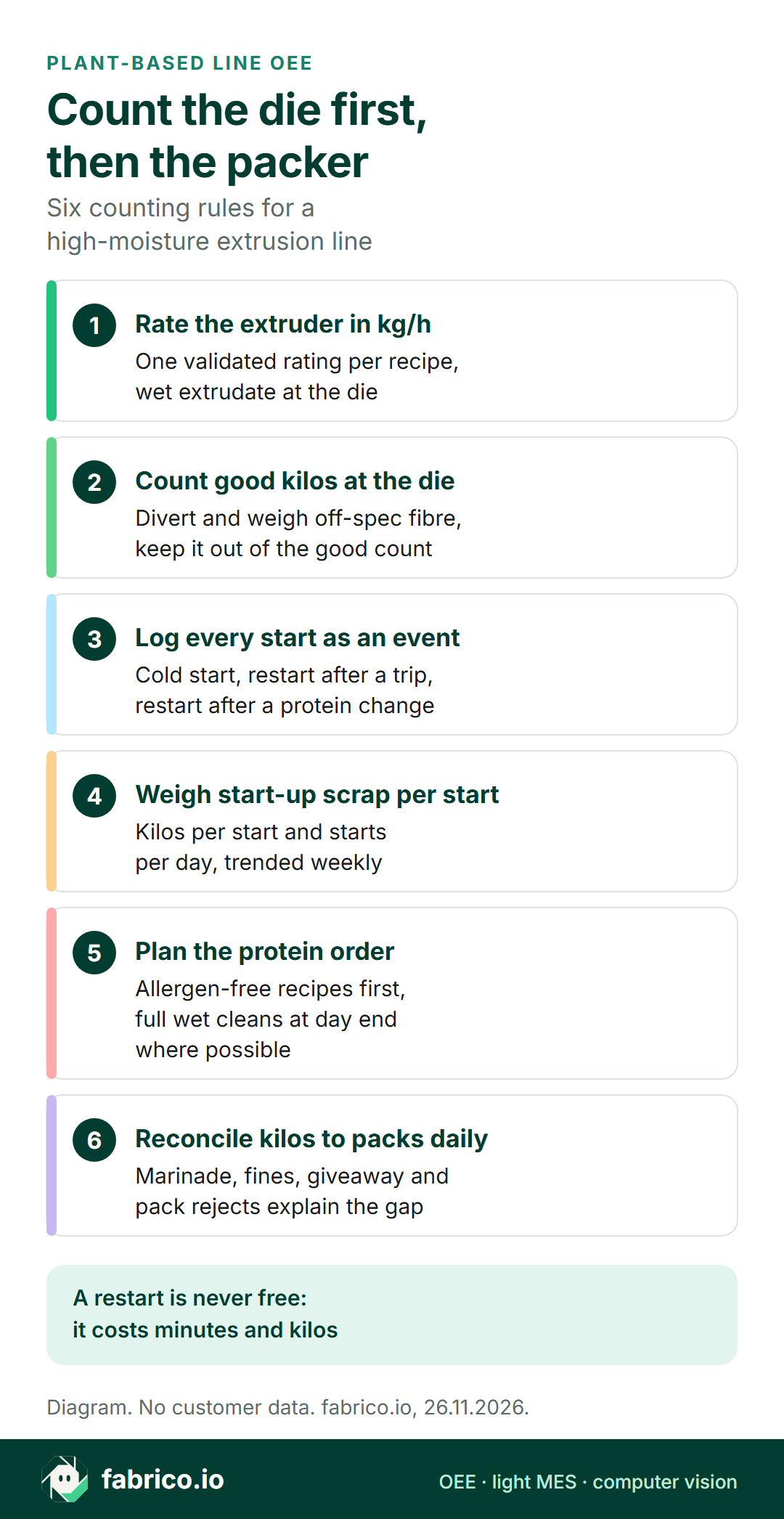
Text version of the diagram
- Rate the extruder in kg per hour: one validated rating per recipe, wet extrudate at the die.
- Count good kilos at the die: divert and weigh off-spec fibre, keep it out of the good count.
- Log every start as an event: cold start, restart after a trip, restart after a protein change.
- Weigh start-up scrap per start: kilos per start and starts per day, trended weekly.
- Plan the protein order: allergen-free recipes first, full wet cleans at the end of the day where possible.
- Reconcile kilos to packs daily: marinade, fines, giveaway and pack rejects explain the gap.
- Day 1: write the kg per hour rating per recipe, the stop code list (under fifteen codes) and the changeover types with their standards.
- Days 2 to 5: weigh off-spec per start and log every start type. Weigh fines and trims per shift at the cutter, former and freezer.
- Days 6 to 8: reconcile kilos at the die with bags at the packer each shift. A gap that will not close points at a missing weighing point.
- Days 9 and 10: put a euro figure on the three biggest losses from your own crew cost, material value and margin, then choose the first to attack.
If the extruder PLC has a running signal and a mass flow or feeder rate, use it from the first day. Hand logs miss short trips, and a stop log cannot show the ramp to rate after a restart.
Choosing a measurement setup
The options differ in what they can see and how long they last. The cost column names what drives each option's price, because software quotes change with scope.
| Option | Cost driver | Fits | Misses |
|---|---|---|---|
| Shift sheet, scrap bins and a floor scale | Sheet and bin weighing, about 15 minutes a shift (EUR 12.38 of German crew time) | One line, first month, agreeing codes | Short trips and ramp-up speed loss |
| PLC data into a spreadsheet | Engineer days to map signals; ask your integrator for a day rate | One line with open PLC access | Stop reasons, and it decays when the engineer leaves |
| OEE software or a light MES on the extruder signal | A subscription per line or site; get it in writing for your scope | Two or more lines, live shift numbers, losses in money | Needs codes and standards agreed first |
| Full MES with recipe, batch and allergen records | A plant project with integration work; quote per site | Groups that require electronic batch records | Long rollout before the extruder sees a gain |
The third option suits a site with two or more extrusion lines to compare. OEE software reads the running signal and output from the extruder, collects the operator's stop reasons and splits each shift into availability, performance and quality.
What you see: a shift timeline, unclassified time waiting for a reason, and the operator's line-down screen, on sample lines. Book a demo.
Plays from YouTube. Google may set cookies when you press play. Privacy policy.
A light MES adds scrap by reason, changeover standards and shift reports around the same signals. For a broader comparison see OEE software for food and beverage, and for the plant-wide view, MES for food manufacturing.
Which setup fits which plant
- Start on paper if there is no PLC access yet and the first job is agreeing what a start, a stop and a good kilo are.
- Move to software once two lines run, or once starts and changeovers cost more each month than a line subscription.
- Go to a full MES when a retailer or the group demands electronic batch records for the whole site.
Keep the extruder's process data where it is. Barrel temperatures, die pressure, moisture and energy live in the extruder control system; an OEE tool adds the time, count and loss view on top of it.
What to ask an OEE vendor about extrusion
- Can the rating be set in kg per hour per recipe at the extruder, with a separate pack count at the end of the line?
- Can a cold start, a restart after a trip and a protein changeover each have their own code and standard time?
- How is off-spec start-up fibre recorded, and does it stay out of the good count?
- Are short trips and slow running counted from the machine signal, without operator entry?
- Can a lost minute and a kilo of off-spec fibre each be priced from the recipe's own selling price and margin?
- What happens to the data when the plant network drops?
- Is the price set per extrusion line, per machine or per site, and which connections and training are in it?
Where Fabrico fits
Fabrico is made by the publisher of this article. It is OEE software and a light MES with computer vision. The parts that matter on an extrusion line:
- OEE by line and shift from the core machine, the extruder, connected through the line PLC or a Fabrico IoT device.
- Stops and micro-stops from the machine signal, so a die trip shows on the shift timeline without anyone writing it down.
- Stop reasons chosen by the operator at the machine in a few taps, from a reason list the plant sets up with entries such as "cold start" and "die trip".
- Changeovers tracked against a standard time, and scrap recorded by product and reason, so start-up off-spec has its own line.
- With the selling price and margin of each product entered, losses are priced in money and stops are ranked by financial impact. The gateway buffers machine data up to 30 days if the network drops.
See the MES and OEE solution overview, or how a quote per plant is built on the pricing page.
Sources, accessed 26.11.2026: Cornet et al., Thermo-mechanical processing of plant proteins using shear cell and high-moisture extrusion cooking, Critical Reviews in Food Science and Nutrition, 2021; Sengar et al., Effect of Process Variables and Ingredients on Controlled Protein Network Creation in High-Moisture Plant-Based Meat Alternatives, Foods 12(20):3830, 2023; EUR-Lex, Regulation (EU) No 1169/2011 on food information to consumers, Annex II; FAO/WHO Codex Alimentarius, Code of Practice on Food Allergen Management for Food Business Operators, CXC 80-2020; EUR-Lex, Council Directive 89/108/EEC on quick-frozen foodstuffs; Eurostat, Labour cost levels by NACE Rev. 2 activity (lc_lci_lev); Destatis, press release N033 of 18 May 2026 on meat substitute production.
Frequently asked questions
What is a good OEE for a plant-based meat line?
Compare it with the line's own history, not a figure from another kind of line. Compare each line with itself week by week under fixed rules for the kg per hour rating, the count points and start-up scrap. The worked example runs at 70.3% at the extruder.
Should OEE be measured in kg or in packs?
Both. Kilos of good extrudate at the die give the pacer's OEE; first-pass good packs give the line OEE. The gap between the two is downstream yield loss: fines, giveaway and pack rejects.
Is start-up scrap a quality loss or an availability loss?
Split it. Heat-up before feed is availability loss. Off-spec fibre made after feed starts is quality loss, and slow running while ramping to rate is performance loss.
Why run pea protein before soy?
Soybeans are a listed allergen in Annex II of Regulation (EU) No 1169/2011 and peas are not. Running pea first means the next change adds an allergen rather than removing one, which can need a shorter clean, as your hazard analysis sets.
Can off-spec extrudate be reworked?
Only into a product with the same allergen profile, and only where the hazard analysis allows it. Price it at the material value that rework or feed sales do not recover: EUR 1.20 per kg of wet fibre in the example.
Does a die blockage count as a changeover?
No. It is an unplanned stop with its own code, followed by a restart that makes off-spec fibre. In the example each trip costs 9 minutes and 55 kg.
See what every restart on your extrusion line costs. The demo shows OEE by line and shift from the core machine, micro-stops from the machine signal, stop reasons chosen by operators and losses ranked by financial impact.
Latest from our blog







Real Fabrico tiles, sample data.