





 Login
 Blog

OEE for brined white cheese production

In short
- White cheese moves at two speeds: the vat and the brine measure time in hours and days, the vacuum packer in packs per minute. OEE is read where the good packs are made.
- The brine room is the plant's buffer. When the blocks are not taken out and drained on time, packing stops, and the cause lies in another department.
- In the example below the shift loses 1,356 EUR. The largest item is the changeover from 400 g to 800 g on the vacuum packer.
- Rejects for lost vacuum and for weight are counted separately, by hour and by cheese lot, because their causes are different.
OEE on a brined white cheese (Bulgarian sirene) line is the share of planned time in which the vacuum packing machine makes good, weighed and sealed pieces. The losses covered here are waiting for blocks from the brine, the changeover to another pack weight, stops at the film and the sealing, short stops at cutting and piece feeding, and rejects for vacuum and weight.
This article is for owners, technologists and production directors in dairies that pack cheese in pieces under vacuum or in tins. It shows how each factor is measured, how the brine room is recorded against packing, and a calculation for one shift in euros.
Cheese in Bulgaria in numbers
According to Eurostat dairy production data, Bulgaria produced 90.73 thousand tonnes of cheese of all kinds, kashkaval included, in 2025, using 536.5 thousand tonnes of whole milk (data updated 26.11.2026, accessed 27.11.2026). These figures show how much milk passes through the vats before it reaches the pack.
For a dairy this means one thing: every kilogram of cheese carries about six kilograms of milk. When a pack is rejected at the end of the line, all the work before it is lost too.
The path of the cheese from the vat to the case
| Stage | What happens | Losses that are recorded |
|---|---|---|
| Vat | Renneting, cutting the coagulum | Late milk batch, sample out of specification |
| Moulding and pressing | Filling the moulds, draining | No moulds available, slow draining |
| Brine and ripening | Salting, ripening in tins or in a tank | Blocks not ready to be taken out |
| Cutting into pieces | Cutting the blocks into 400 or 800 g | Short stops, crumbling |
| Vacuum packer | Forming the film, vacuum, sealing | Changeover, film, leaks |
Availability, performance and quality are defined per ISO 22400-2 (accessed 27.11.2026). On a linked line, OEE is read at the core machine. Here that is the vacuum packer: it sets how many packs leave in the shift. Stops before it and after it are recorded as reasons for its downtime.
The vat and the moulds: batch before flow
The vat works in batches. The milk is heated and renneted, the coagulum is cut and released into the moulds. A set time passes from starting the vat to moulding, and the technologist keeps it in the recipe.
Moulding is the first place where the batch becomes a count: number of moulds, number of blocks. If the moulds are not washed in time, the vat waits. If draining is slow, the next vat waits too. That is a loss for the vat, but not for the vacuum packer, as long as the brine holds stock.
So for the vats it is worth recording the cycle time per batch: start, end and release. That shows when a vat ran late and whether the delay reaches packing weeks later. This data is also the basis of the ripening plan: how many blocks from which date will be ready on a given day.
If the vats are the bottleneck, a higher OEE on the vacuum packer does not add a single pack. Then the first measure is the vat cycle time, not the packing speed.
The brine as a buffer
The cheese blocks stay in brine for days and weeks. The brine room holds stock between the vats and packing. While it has ready blocks, packing does not depend on when the milk was renneted.
The buffer runs out in two cases. First, when the plan empties the ripe cheese faster than the vats fill it. Second, when the blocks are not taken out and drained before the shift starts. In both cases the vacuum packer stands still, and its operator can do nothing about it.
At the vacuum packer this is recorded as "waiting for product" with a brine sub-reason: unripe blocks, blocks not taken out, or waiting for a sample. The report then shows that the fix lies in the ripening plan or in the shift that takes out the blocks, not in the machine.
It also helps to record the renneting day of each lot. When packing waits, you see at once whether the brine holds cheese of the required age.
Pack weight and the vacuum packer changeover
The cheese is sold in pieces of 400 g, 800 g and larger packs for catering. Each pack weight needs its own forming tool on the machine, a different film width and a different cutting setting.
The changeover from 400 g to 800 g includes changing the tool and the film reel and checking the first packs for vacuum and weight. Set a standard time for each pair of pack weights and record the actual minutes. When two orders for one pack weight fall on one day, put them back to back: that way there is one changeover, not two.
Changing the label for another brand is shorter, because the tool stays. Keep it as a separate type of changeover so it does not mix with the long one. The first packs after a changeover go across the scale and through a vacuum check; those minutes are part of the standard, not line running time.
Leaks, vacuum and rejects
A piece of cheese with a crumbly edge or with drops of brine on its surface gets in the way of sealing. The seal does not hold, the vacuum leaks in the warehouse and the pack comes back. This is a quality loss if it is caught on the line, and a customer complaint if it is caught in the shop.
Record vacuum rejects by cheese lot and by hour. If they rise with certain lots, the problem is in draining or in cutting. If they rise at a certain hour, check the temperature of the sealing head and the film reel.
The microbiological criteria for cheese are in Regulation (EC) No 2073/2005, including those for Listeria in ready-to-eat foods (accessed 27.11.2026). The specific hygiene rules for dairy products are in Regulation (EC) No 853/2004 (accessed 27.11.2026). For OEE this means that cleaning the machine after a lot change is planned work with its own standard, not a loss to hide.
One shift on the vacuum packer in euros
The numbers are an example, not from a real customer. The machine packs 400 g pieces at an ideal rate of 40 packs per minute. The shift has 450 planned minutes, and a stop longer than 2 minutes is recorded as downtime. The ideal for the shift is 18,000 packs.
At the end of the shift the machine is changed over to 800 g pieces for the next shift's order. The contribution is taken as 0.30 EUR per pack. For comparison, Aswath Damodaran's data (NYU Stern) shows a gross margin of 23.23 % for US-listed food processing companies (data as of January 2026, accessed 27.11.2026). Use your own price.
| Cause | Stops | Minutes | Recorded as | Packs | EUR per shift |
|---|---|---|---|---|---|
| Changeover from 400 g to 800 g | 1 × 30 min | 30 | downtime | 1,200 | 360.00 |
| Short stops at cutting and feeding | 50 × 30 s | 25 | speed loss | 1,000 | 300.00 |
| Waiting for blocks from the brine | 4 × 6 min | 24 | downtime, brine sub-reason | 960 | 288.00 |
| Film and sealing | 6 × 4 min | 24 | downtime | 960 | 288.00 |
| Vacuum and weight rejects | 400 packs | quality | 400 | 120.00 | |
| Total | 103 | 4,520 | 1,356.00 |
How the numbers are reached:
- Downtime: 30 + 24 + 24 = 78 minutes, run time 372 minutes. Availability: 372 / 450 = 82.7 %.
- In 372 minutes the ideal is 14,880 packs. Short stops take 1,000. 13,880 were packed. Performance: 13,880 / 14,880 = 93.3 %.
- Rejects 400, good packs 13,480. Quality: 13,480 / 13,880 = 97.1 %.
- OEE: 82.7 % × 93.3 % × 97.1 % = 74.9 %. Check: 13,480 / 18,000 = 74.9 %.
- The loss: 4,520 packs × 0.30 EUR = 1,356.00 EUR per shift.
Ranked by value, the changeover comes first: 360.00 EUR. It depends above all on the plan: how many times a week the machine changes pack weight. Waiting for the brine is 288.00 EUR, a loss that the report shows against the vacuum packer if there is no sub-reason.
If each of the 500 shifts in a year (two shifts a day, 250 working days) has one such changeover, it costs 180,000 EUR, and waiting for the brine 144,000 EUR. The sum is real only if every lost pack could have been sold; confirm the estimate with finance.
Weight and lot on the piece
Under Directive 76/211/EEC on prepackaged products (consolidated text of 11.04.2009, accessed 27.11.2026), the tolerable negative error for a pack of 300 to 500 g is 3 %, that is 12 g for a 400 g piece. For 800 g it is 15 g. The average weight of the lot may not be below the nominal quantity.
The pieces are cut from a block, and the block loses brine as it drains. If the knife cuts by volume, the weight changes with draining. So the checkweigher after cutting is part of the line: it shows when blocks have come out wetter than normal.
The pack also carries a lot marking. Directive 2011/91/EU requires it for food, with the exemptions in Article 2 (accessed 27.11.2026). For cheese it helps if the lot points to the renneting day and the vat, because then a complaint about vacuum or taste reaches the exact milk batch.
Milk, allergens and cleaning
Milk is listed in Annex II to Regulation (EU) No 1169/2011 among the substances that cause allergies or intolerances (accessed 27.11.2026). Every product on the line contains it, so a changeover between cow's and sheep's milk cheese is not an allergen clean. It is a change of label and lot, with a check that the old packs have been removed from the line.
A full clean of the vacuum packer at the end of the day is another matter. How it is recorded in OEE is covered in the article CIP time in OEE.
Who owns the brine, the machine and the rejects
| Loss | Owner | Data they need |
|---|---|---|
| Waiting for blocks | The ripening supervisor | Minutes of "waiting for product" with a sub-reason, renneting day of each lot |
| Pack weight changeover | Planning | Minutes against the standard per pair of pack weights |
| Film and sealing | The mechanic | Stops by reason and hour |
| Short stops | The shift supervisor | Speed loss by hour and by lot |
| Vacuum and weight rejects | Quality | Rejects by cheese lot and by hour, average weight |
Mistakes in recording cheese
| Mistake | What you see later | How to avoid it |
|---|---|---|
| Waiting for blocks is "machine downtime" | The vacuum packer looks like the problem | "Waiting for product" with a brine sub-reason |
| One standard for every changeover | You cannot see which pack weight is expensive | A standard per pair of pack weights |
| Rejects are counted only per shift | You cannot see which lot leaks | Rejects by cheese lot |
| A label change is a "changeover" | Long and short ones get mixed | Two types of changeover |
Which numbers to look at in the morning
Four numbers from yesterday are enough: OEE at the vacuum packer, the minutes of waiting for the brine, the number of pack weight changeovers and vacuum rejects by lot.
If waiting rises, the conversation is with the ripening room. If rejects rise for one lot, check how it was drained. That way every number reaches the person who can change it. The renneting day of the cheese in the brine shows whether the problem will repeat tomorrow.
What to choose for a dairy
| Method | Fits when | What it misses |
|---|---|---|
| Paper packing log | One machine, one pack weight | Short stops and sub-reasons |
| PLC counter into a spreadsheet | A first estimate | Reasons and the link to the brine |
| OEE software with a signal and operator reasons | Several pack weights and brands | Rejects by lot, if the lot is not entered |
Questions for the supplier:
- How is "waiting for product" recorded with a brine sub-reason?
- Can the standard changeover time differ for each pair of pack weights?
- Can the cheese lot be entered against the shift, to see rejects by lot?
- How is the ideal rate set per pack weight?
- What happens to the pack count if the network drops midway through the shift?
More on checkweigher rejects is in the article checkweigher rejects and quality in OEE, and on changeover standards in the article changeover standards in FMCG.
How to start
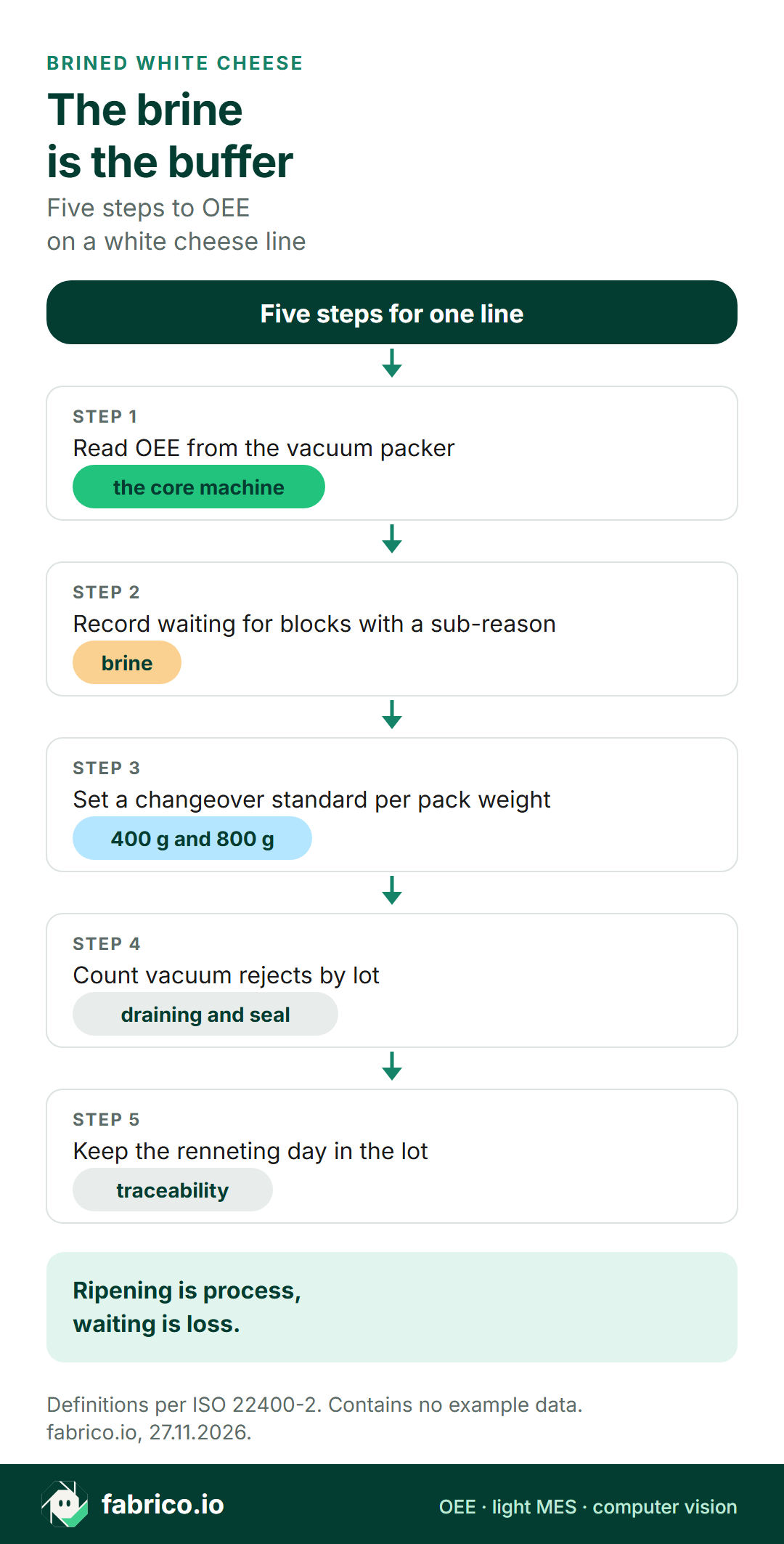
Text version of the diagram
- Read OEE from the vacuum packer.
- Record waiting for blocks with a brine sub-reason.
- Set a changeover standard per pair of pack weights.
- Count vacuum rejects by cheese lot.
- Keep the renneting day in the lot.
Fabrico provides the measured rates per line; the plan itself is made in the ERP, the APS or the planning spreadsheet.
This week: for three shifts, record when the blocks were taken out and when the machine started; time one changeover from 400 g to 800 g; count vacuum rejects by lot.
This quarter: a PLC signal from the vacuum packer and reasons from the operator; a standard per pair of pack weights; a ripening plan aligned with packing.
Where Fabrico fits
Fabrico is made by the publisher of this article.
- What it is: an OEE platform and light MES with built-in maintenance management. It shows live OEE by line and shift.
- Connected line: OEE is read at the core machine, and waiting for product and blocking are recorded as stop reasons.
- Data: machines connect through the line PLC or through a Fabrico IoT device; where there is no signal, a camera counts output.
- Reasons: stops above the threshold get a reason in a few taps, and stops under the set threshold (up to 10 minutes) go into speed loss. The camera does not identify the reason.
- Money: with the Financial Impact module every loss has a price in EUR.
- Video: where a camera covers the line, the video for the minute of a stop opens from the shift timeline, is streamed on request and not stored in Fabrico.
- Hosting and security: EU customers are hosted on AWS in Frankfurt. Certified to ISO/IEC 27001, ISO/IEC 20000-1 and ISO 9001. The gateway keeps data for up to 30 days if the network drops.
- Price: one quote per plant, based on machines and modules (pricing).
For food plants, see also the article MES for food manufacturing.
A result from a Bulgarian plant
At Ficosota, a maker of home care, hygiene and consumer goods, not food, the time without a recorded stop reason fell from 3.20 % to 0.40 % between June and September 2026.
The result comes from 16 lines with OEE and the Financial Impact module, and OEE rose from 53.11 % to 59.62 %. The figures are approved by the customer.
Ficosota is also an investor in Fabrico (since January 2025) and an industrial partner in developing the OEE module; keep that in mind when reading the results.
See one shift on a vacuum packer in Fabrico. In a demo you will see the stops by reason and what each one costs in euros.
Frequently asked questions
Which machine is OEE read from on a cheese line?
From the vacuum packer or the tin filling machine, because it makes the good packs. The vats and the brine are recorded as reasons for its stops.
Whose loss is the stop when the blocks are not ready?
The ripening room's, or that of the shift that takes out the blocks. At the vacuum packer it is recorded as "waiting for product" with a sub-reason.
Does ripening time count in OEE?
No. Ripening is process time. OEE includes only the time packing waits when ripe cheese is missing. Brine capacity is tracked separately: how many blocks from which date will be ready during the week.
Why does the vacuum leak?
When the edge of the piece is crumbly or has brine on it, the seal does not hold. Count rejects by lot to see which lot causes it.
How much lighter can a 400 g piece of cheese be?
By up to 12 g, that is down to 388 g. Directive 76/211/EEC allows 3 % for packs of 300 to 500 g, and the average weight of the lot must be at least 400 g.
Does a cheese line need a camera?
Not for a vacuum packer with a PLC. A camera helps where pieces or cases are placed by hand, and there it counts the finished output.
Latest from our blog






Real Fabrico tiles, sample data.