





 Login
 Blog
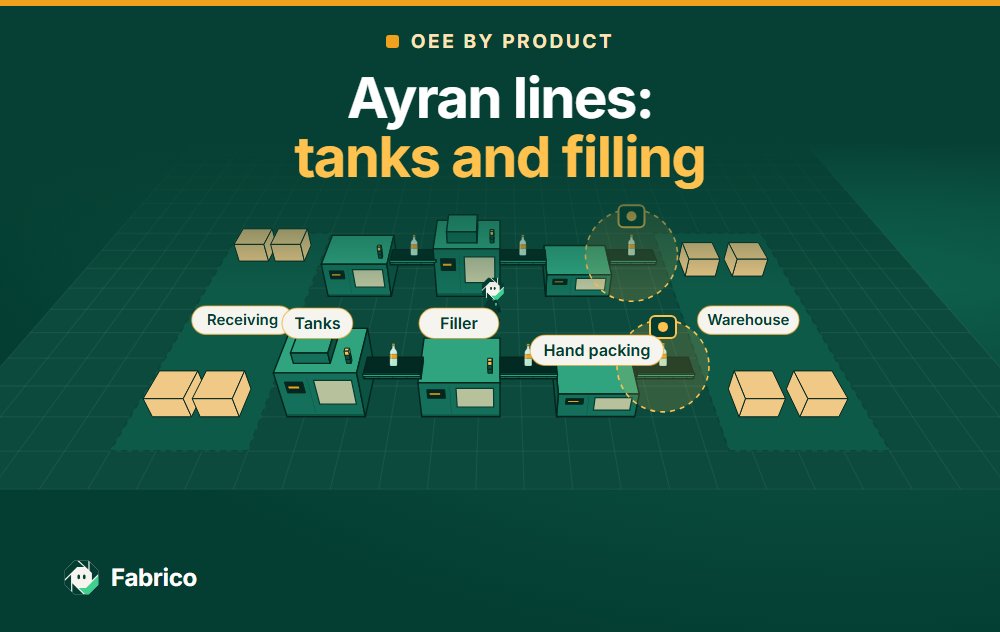
OEE on ayran and drinking yogurt lines: tanks and filling

In short
- The line plan is the tank plan. Fermentation takes its own time and cannot be rushed. If a tank is late, the filler stops, and without a sub-reason the report books the downtime on the filler.
- Product lost at start-up and changeover is a separate account. Ayran mixed with rinse water is dumped before the good bottles start. OEE does not see it.
- In the example below, the shift loses 886.40 EUR in OEE and another 120.00 EUR in dumped product.
- The first step is simple: record waiting for the tank with a sub-reason, and measure the litres dumped at every start-up.
OEE on a line for ayran (salted drinking yogurt) and dairy drinks measures how much of the planned time the filler turns into good bottles or cups, filled, capped and labelled. The main losses are waiting for fermented product from the tank, changeovers between products with a rinse, stops at the capper and the labeller, short stops in bottle feeding, and rejects for fill level, cap and label. Product lost at start-up and changeover sits outside OEE.
This article is for owners, production directors and process engineers in dairies that make ayran, probiotic drinks and fruit milk drinks. It shows how to measure each factor, how the tanks and the filler are recorded together, and a worked example of one shift in euros.
The Bulgarian dairy industry in numbers
According to Eurostat structural business statistics, in 2024 the group "Operation of dairies and cheese making" in Bulgaria had 263 enterprises with 7,438 people employed, an average of 28 people per enterprise (accessed 26.11.2026).
Ayran sells in high volume at a low price. It is filled in PET bottles or in cups. In both cases the filler is fast, and every minute of downtime costs more than a hundred bottles.
The line: from tank to case
| Section | What it does | Losses |
|---|---|---|
| Fermentation tanks | Ferment and cool the product | Tank not ready, acidity out of spec |
| Buffer tank | Feeds cooled product to the filler | Empty buffer, waiting |
| Filler and capper | Fills and caps the bottles | Caps, fill level, short stops |
| Label and code | Label, expiry date, lot | Reel change, wrong code |
| Grouping and case packing | Shrink film or case, pallet | Jams, filler blocked |
The definitions of availability, performance and quality follow ISO 22400-2 (accessed 26.11.2026). OEE is read from the filler, because it decides how many bottles come out. Waiting for the tank and blocking from grouping are recorded as reasons for its stops.
If the filler reports its state per PackML (ISA-TR88.00.02, accessed 26.11.2026), "Suspended" means it is healthy but the buffer tank is empty or the outfeed is full, and "Held" means it stopped for a cap, a label or another cause of its own.
The tanks set the plan
Ayran is made from fermented milk, thinned with water and salted. Fermentation takes hours and cannot be sped up without changing the taste. After it, the product is cooled and checked. Only then is the tank ready for filling.
So the filler plan is really the tank plan. If one tank is late with its check or its cooling, the buffer runs empty and the filler stops. The filler operator only sees "no product".
On the filler this is recorded as "starved (waiting for product)" with a tank sub-reason: fermentation, cooling or check. Without a sub-reason, the filler looks like the weakest point. With one, it is clear that the problem sits in the fermentation room.
It also helps to record the moment each tank is released for filling. The gap between "tank ready" and "filler starts"Record the time each tank is released for filling, and compare it with the time the filler starts on it. When ready tanks sit, fermentation is ahead of the line. When the filler sits without product, the culture has to go in earlier or one more tank is needed.
Product lost at start-up: an account outside OEE
At start-up and at every changeover, the first product in the pipes mixes with the rinse water. It is dumped until clean product comes out at the outlet. Then the good bottles come.
This product does not enter OEE. The bottles that come out are good, and the dumped ayran never reached a bottle. But it is milk that was paid for. On a small line this is tens of litres, on long pipe runs hundreds.
Measure the litres dumped at every start-up and every changeover, for example with a flow meter or with the level in the buffer tank. Compare them with a standard. If the litres grow, check when the operator switches from dumping to filling: on the reading of the turbidity or conductivity sensor, or later, "just to be safe".
Changeovers between products
One line can run several products: ayran with different fat content, probiotic drinks, fruit milk drinks. The changeover from ayran to a fruit drink is a short rinse. The opposite, from a fruit drink to ayran, needs a longer rinse, because the colour and flavour of the fruit must not stay in the ayran.
All these products contain milk. Annex II to Regulation (EU) No 1169/2011 lists milk and milk products, including lactose, among the substances that cause allergies (accessed 26.11.2026). If the fruit drink contains nuts or cereals containing gluten, the changeover from it back to ayran needs a full clean.
Set a standard for each direction of the changeover, and order the day from ayran towards the products with more ingredients. The full line clean at the end of the day is a separate question. How to record it in OEE is described in the article CIP time in OEE.
Tanks, filler, dumped product: one shift in euros
The numbers are an example, not from a real customer. The filler fills 500 ml PET bottles at an ideal rate of 120 bottles per minute. The shift has 450 planned minutes; every stop over 2 minutes is downtime. The full clean at the end of the day is not in planned time. The shift ideal is 54,000 bottles. Mid-shift, the line moves from ayran to a fruit drink, the cheap direction, with a short rinse.
The prices in the example: 0.08 EUR contribution per bottle and 0.40 EUR per litre of dumped product. The contribution is modest, because ayran is a cheap product. As a reference, data from Aswath Damodaran (NYU Stern) gives a gross margin of 23.23 % for American listed food processing companies (data as of January 2026, accessed 26.11.2026). Replace both prices with your own.
| Reason | Stops | Minutes | Recorded as | Bottles | EUR per shift |
|---|---|---|---|---|---|
| Waiting for product from the tank | 3 × 8 min | 24 | downtime, tank sub-reason | 2,880 | 230.40 |
| Changeover to a fruit drink | 1 × 20 min | 20 | downtime | 2,400 | 192.00 |
| Caps and label | 5 × 4 min | 20 | downtime | 2,400 | 192.00 |
| Short stops in bottle feeding | 40 × 30 s | 20 | speed loss | 2,400 | 192.00 |
| Rejects for fill level, cap and label | 1,000 bottles | quality | 1,000 | 80.00 | |
| Total in OEE | 84 | 11,080 | 886.40 | ||
| Product dumped at start-up and changeover | 2 × 150 L | outside OEE | 120.00 |
How the numbers add up:
- Downtime: 24 + 20 + 20 = 64 minutes, run time 386 minutes. Availability: 386 / 450 = 85.8 %.
- In 386 minutes, the ideal is 46,320 bottles. Short stops take away 2,400. Filled: 43,920. Performance: 43,920 / 46,320 = 94.8 %.
- Rejects 1,000, good 42,920. Quality: 42,920 / 43,920 = 97.7 %.
- OEE: 85.8 % × 94.8 % × 97.7 % = 79.5 %. Check: 42,920 / 54,000 = 79.5 %.
- The loss in OEE: 11,080 bottles × 0.08 EUR = 886.40 EUR per shift.
- Dumped product: 150 litres at start-up and 150 litres at the changeover, 300 litres in total × 0.40 EUR = 120.00 EUR.
By value, waiting for the tank comes first: 230.40 EUR, a loss the report puts on the filler if there is no sub-reason. Three causes follow at 192.00 EUR each, each with its own owner.
At 500 shifts a year (two shifts, 250 days), waiting for the tank costs 115,200 EUR, and dumped product up to 60,000 EUR (if every shift has a start-up; with one clean a day, there are half as many start-ups). The first task is the fermentation plan, the second is the switch point at start-up. The money in OEE is only real if all the output is sold; agree the estimate with finance.
Hygiene, temperature and shelf life
Regulation (EC) No 853/2004 sets specific hygiene rules for milk and dairy products, including the temperature of raw milk and its processing (accessed 26.11.2026). Regulation (EC) No 852/2004 requires every food business to apply procedures based on HACCP principles (accessed 26.11.2026).
For OEE this means two things. First, product that stood longer in the buffer at the wrong temperature may not be fit for sale, and such rejects are a quality loss. Second, stops caused by product temperature need a reason of their own, because they are also a food safety record.
The shelf life of ayran is short. Product that is filled but not sold in time is a loss for the plant, even though it counts as good in OEE. So OEE is read together with the sales plan: a higher OEE does not help if the warehouse fills up with ayran that will not sell.
Bottle size and the ideal rate
One filler can fill 250 ml, 500 ml and 1 litre bottles. The large bottle takes longer to fill, so the machine makes fewer bottles per minute. Set an ideal rate for each product and size separately. Otherwise the litre bottle will show a speed loss that does not exist.
A changeover to another bottle size is separate from a changeover to another product: change parts on the infeed, setting the filling heads and changing the label. The two have different standards and different owners, so record them with different reasons.
A good rule is that the ideal rate is the best sustained rate reached for that size in a normal shift, not the number in the machine catalogue.
Caps, fill level and label
Some filler stops on an ayran line happen at the capper: a cap that did not sit, a jam in the cap feed, a change of the cap box. Each one is short, but over a shift they add up to dozens. If they grow after a new cap delivery, check the cap lot before adjusting the capping head.
The fill level is checked with a sensor after the filler. Ayran foams, and the foam makes the level reading unreliable. If rejects for fill level grow, check the product temperature and the filling speed before touching the sensor.
Under Directive 76/211/EEC on prepackaged products (consolidated text of 11.04.2009, accessed 26.11.2026), the tolerable negative error for a 500 ml pack is 15 ml, and the batch average may not be below the nominal quantity. Every bottle also carries a lot number: a lot indication is required by Directive 2011/91/EU (accessed 26.11.2026), except in the cases in Articles 2 and 5 (for example, when the use-by date shows the day and the month). For ayran it helps if the lot points to the tank.
Who owns the tanks, the filler and the product
| Loss | Owner | What data they need |
|---|---|---|
| Waiting for the tank | The head of fermentation | Minutes "starved (waiting for product)" with a sub-reason, and the release time of every tank |
| Dumped product | The process engineer | Litres at every start-up and changeover against the standard |
| Changeover | Planning | Minutes against the standard per direction |
| Caps and label | The mechanic | Stops by reason and hour |
| Rejects for fill level | Quality | Rejects per product, product temperature |
Mistakes in recording dairy drinks
| Mistake | What you see later | How to avoid it |
|---|---|---|
| Waiting for the tank is "filler downtime" | The filler looks like the problem | "Starved (waiting for product)" with a sub-reason |
| Dumped product is not measured | Milk "disappears" between intake and the warehouse | Litres at every start-up |
| All changeovers are treated the same | No one sees which direction is expensive | A standard per direction |
| OEE is read without the sales plan | A full warehouse with short shelf life | OEE together with the plan |
The morning review with fermentation
In the morning meeting with the head of fermentation, four numbers from yesterday are reviewed: filler OEE, the minutes of waiting for the tank, the litres of dumped product, and the rejects for fill level.
If the waiting grows, the conversation is with fermentation, not with the filler mechanic. If the litres grow, check the switch at start-up. Each of these numbers has its own owner in the table above.
What to choose for an ayran line
| Method | Fits when | What it misses |
|---|---|---|
| Paper log | One filler, one product | Short stops and sub-reasons |
| PLC counter into a spreadsheet | A first estimate | The reasons and the link to the tanks |
| OEE software with a signal and reasons from the operator | Several products and tanks | Dumped product, if it is not measured |
Questions to ask the vendor:
- How is "starved (waiting for product)" recorded with a tank sub-reason?
- Can the standard changeover time depend on the direction?
- Can manually entered litres of dumped product be added to the shift?
- How is the full clean excluded from planned time?
- What happens to the bottle count if the network drops in the middle of the shift?
More on fillers is in the articles filler OEE on a bottling line and stops on a yogurt cup filler.
How to start
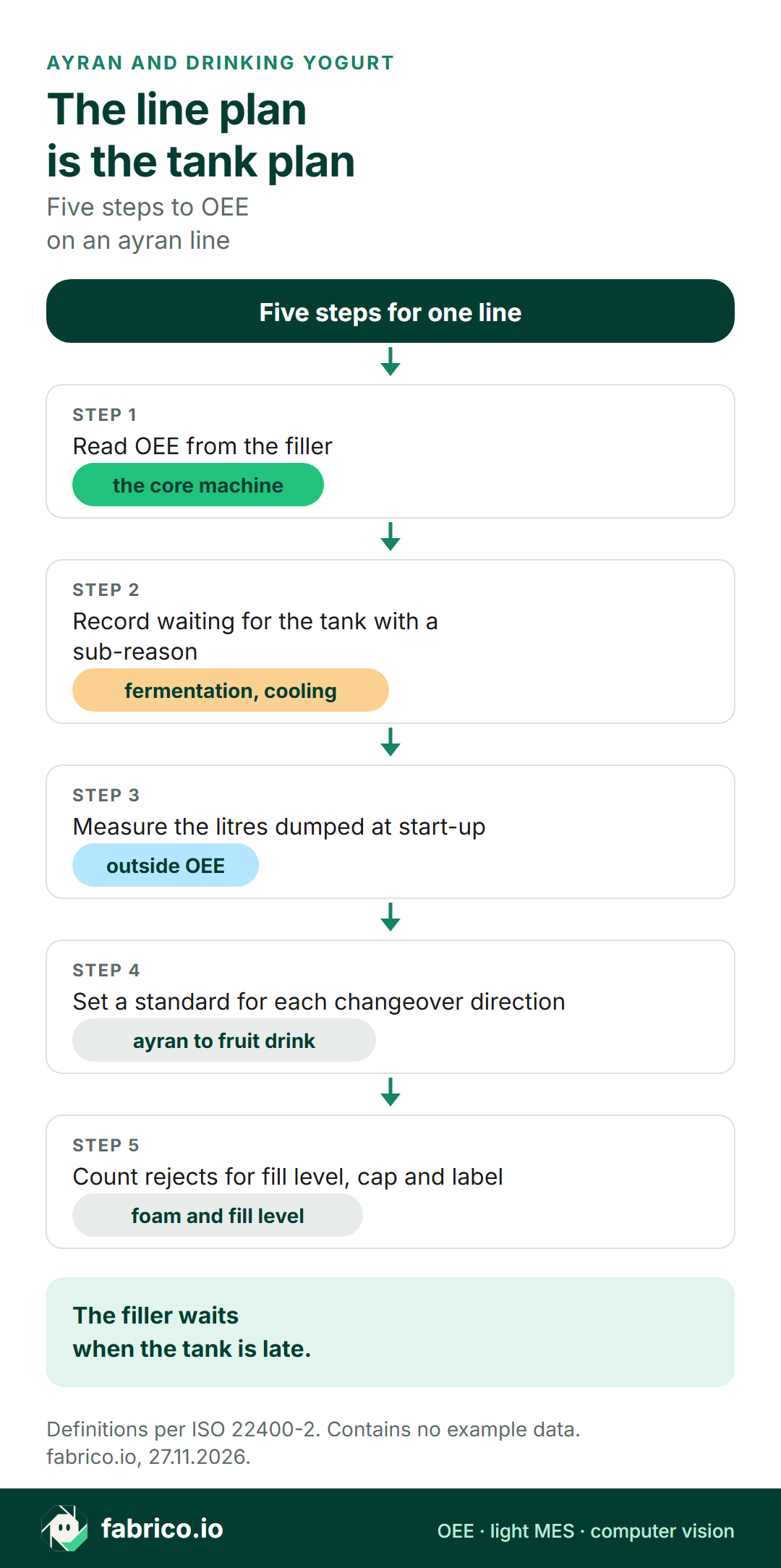
Text version of the diagram
- Read OEE from the filler.
- Record waiting for the tank with a sub-reason.
- Measure the litres dumped at start-up and changeover.
- Set a standard for each direction of the changeover.
- Count rejects for fill level, cap and label separately.
Fabrico provides the measured rates per line; the plan itself is made in the ERP, the APS or the planning spreadsheet.
This week: record the release time of every tank for three days; measure the litres at one start-up; time one changeover.
This quarter: a PLC signal from the filler, reasons from the operator with a tank sub-reason; a standard for dumped product; a fermentation plan ordered around the filler.
Where Fabrico fits
Fabrico is made by the publisher of this article.
- What it is: an OEE platform and light MES with built-in maintenance management. It shows live OEE by line and shift.
- Linked line: OEE is read at the core machine, and starved (waiting for product) and blocked are recorded as stop reasons.
- Data: machines connect through the line PLC or a Fabrico IoT device; where there is no signal, a camera counts the output.
- Reasons: stops above the threshold get a reason in a few taps, and stops under the set threshold (up to 10 minutes) count as speed loss. The camera does not decide the reason.
- Money: with the Financial Impact module, every loss has a price in EUR.
- Video: where a camera covers the line, the video for the minute of a stop opens from the shift timeline, is streamed on request and not stored in Fabrico.
- Hosting and security: EU customers are hosted on AWS in Frankfurt. Certified to ISO/IEC 27001, ISO/IEC 20000-1 and ISO 9001. The gateway keeps the data for up to 30 days if the network drops.
- Price: one quote per plant, based on the machines and modules (pricing).
For food plants, see also the article MES for food manufacturing.
A result from a Bulgarian plant
At Ficosota, a maker of home care, hygiene and consumer goods rather than food, the time with no recorded stop reason fell from 3.20 % to 0.40 % between June and September 2026.
The result comes from 16 lines with OEE and the Financial Impact module, and OEE rose from 53.11 % to 59.62 %. The numbers are approved by the customer.
Ficosota is also an investor in Fabrico (since January 2025) and an industrial partner in developing the OEE module; keep that in mind when reading the results.
See how the tanks and the filler show up in one shift in Fabrico. In a demo you will see the line stops by reason and what each one costs in euros.
Frequently asked questions
Which machine is OEE read from on an ayran line?
The filler, because it decides how many bottles come out. The tanks and grouping are recorded as reasons for its stops.
Whose loss is the stop when the tank is not ready?
Fermentation's. On the filler it is recorded as "starved (waiting for product)" with a tank sub-reason.
Does product dumped at start-up count in OEE?
No. It never reached a bottle. It is measured separately in litres and compared with a standard, and the difference has a price in euros.
Does the full clean count in planned time?
The plant decides, but the rule has to be the same for all lines. It is described in detail in the article on CIP time in OEE.
How much less can a 500 ml bottle of ayran contain?
Under Directive 76/211/EEC, the tolerable negative error for 500 ml is 15 ml, and the batch average may not be below the nominal quantity.
Why do rejects for fill level grow?
Check the foam first: the product temperature and the filling speed, before touching the fill level sensor.
Latest from our blog





Real Fabrico tiles, sample data.