


 Login
 Blog
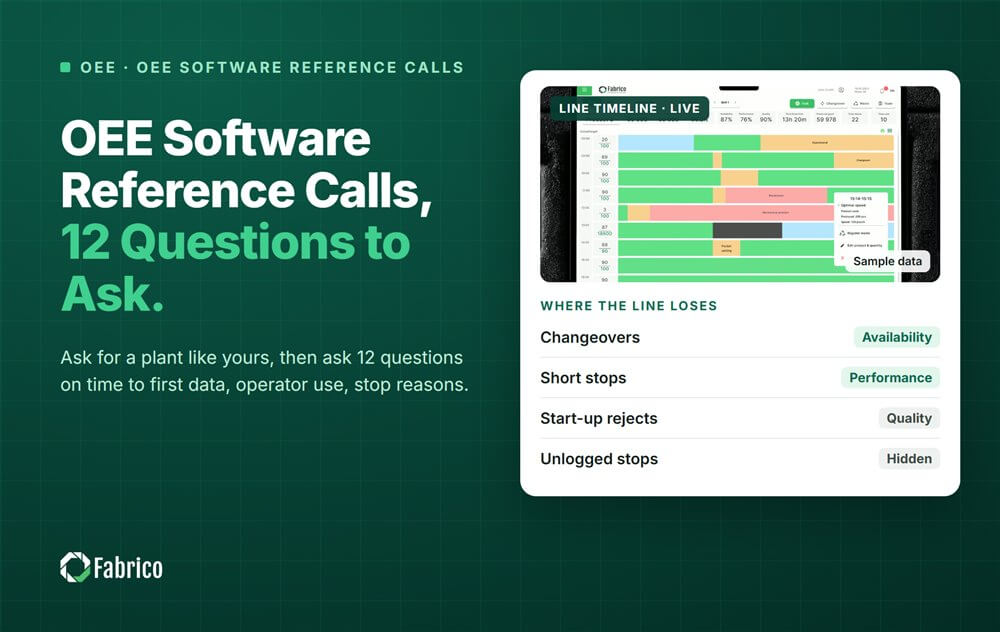
OEE Software Reference Calls: 12 Questions to Ask

Key takeaways
- On an OEE software reference call, ask the same 12 questions on time to first data, operator use, stop reasons, what went wrong and IT effort.
- The best reference is in your industry, on your type of line, at a plant past its pilot.
- Speak to someone who uses the software every day, such as a line lead, not only the person who bought it.
- Listen for red flags: no baseline, no dates, nothing went wrong.
- Write notes in one shared sheet, so two calls compare line by line.
The short answer: a reference call lets you hear from a plant that already runs the software, without the vendor in the room. Pick a plant with your type of line and use the same 12 questions on every call. Write the answers in one sheet so the calls compare.
The demo went well. Then you ask the vendor's reference how night shift enters stop reasons, and there is a long pause. That pause tells you more than the demo did.
This guide is for plant managers, continuous improvement leads and IT people checking OEE (overall equipment effectiveness) software. It comes from Fabrico, a vendor of OEE and light MES software with computer vision on stops. We sit on the other side of these calls. The questions work for any tool.
Who should I ask to speak to?
Ask each vendor on your shortlist for two references, and be specific:
- Same industry. A dairy and a machine shop have very different stops.
- Same line type. A fast packing line with many short stops is not a slow batch process.
- Past the pilot. A plant that rolled out to more lines can tell you what scaling was like.
- A daily user. A line lead, shift lead or continuous improvement engineer, plus the sponsor if you can get both.
Also ask for one reference where the rollout was hard. A vendor who offers that is usually confident in how it handles problems.
How do I set up the call?
Ask the vendor to make the introduction, then hold the call without them. People speak more freely when the vendor is not listening.
Send the questions a day ahead, so the reference can check their numbers. Keep the call under an hour. Bring two people: one asks, one writes. Respect their time: they are doing the vendor a favour.
What are the 12 questions to ask?
Group them in six short blocks. Ask for numbers where you can, and for examples where you cannot.
Time to first data
- How long was it from the signed contract to the first stop data on a screen?
- How long until people trusted the OEE number, and what had to be fixed first?
Operator use
- How do operators enter a stop reason, and how long does it take at the line?
- What share of stops have a reason today, and how has that changed?
- What did operators push back on, and what changed their mind?
Stop reasons
- Who built the stop reason list, and how many reasons does it have now?
- How are short stops handled: counted, grouped or filtered out?
What went wrong
- What went wrong during the rollout, and how did the vendor respond?
- What would you do differently if you started again?
IT effort
- How many hours did IT and controls engineers spend, and on what?
- What did your security review ask, and how does machine data leave the plant?
The result
- What has changed on the line that you can measure, against which baseline, and would you buy again?
Push hardest on question 12. Our guide to why OEE numbers go wrong shows how a change in definitions can move OEE with no real change on the line. For questions 10 and 11, our guide for IT and OT managers buying OEE software lists what a security review covers.
What red flags should I listen for?
- Only the sponsor is available. The person who chose the tool has a reason to defend it.
- Nobody past the pilot. McKinsey found in 2018 that less than a third, 30%, of manufacturers had moved digital programs from pilot to scale. Ask why the reference has not scaled.
- "Nothing went wrong." Every rollout has problems. A reference who cannot name one was not close to it.
- Results with no baseline or dates. "OEE went up a lot" tells you nothing.
- A huge stop reason list. Long lists push operators to pick "other". See our guide to stop reason codes operators will use.
How should I take notes on a reference call?
- Use one sheet for every call, with the 12 questions as rows.
- Write the reference's own words for key answers, in quotes.
- Mark each answer as a fact, such as a number or a date, or as an opinion.
- Score each block from 1 to 5 straight after the call, while it is fresh.
- Share the sheet with the buying team the same day.
Facts beat opinions. "First data in five weeks" can be checked against what the vendor told you. "It was easy" cannot.
Sample: what do notes from 2 reference calls look like?
Sample line (illustrative numbers, not a customer): a beverage plant compares two shortlisted vendors. Call 1 is with a dairy filling line that runs Vendor A. Call 2 is with a bakery packing line that runs Vendor B.
| Question | Call 1: Vendor A, dairy | Call 2: Vendor B, bakery |
|---|---|---|
| 1. Contract to first stop data | About 5 weeks (fact) | About 4 months, waited on network approval (fact) |
| 2. When OEE was trusted | Month 3, after fixing ideal speeds for 2 products | "We still argue about it" (opinion) |
| 3. Stop reason entry | Tablet at the line, two taps | Paper sheet, typed in by the shift lead |
| 4. Stops with a reason | About 80%, up from 40% | "Most of them" (no number) |
| 5. Operator pushback | Feared blame; OEE shown by line, not by person | Double entry on paper and screen |
| 6. Stop reason list | 28 reasons, cut from 60 | 110 reasons |
| 7. Short stops | Counted and shown | Filtered out under 2 minutes |
| 8. What went wrong | Wrong counts on one filler, fixed in week 1 | "Nothing really" |
| 9. Do differently | Agree OEE definitions before go-live | No answer |
| 10. IT and controls hours | About 40 | About 120 |
| 11. Security review | Hosting region, user roles, one firewall rule | Not finished |
| 12. Measured change, buy again | Fewer short stops on the capper, baseline kept; yes | No baseline; unsure |
- Coded stops at Call 1: 80 / 40 = 2 times as many stops with a reason as at the start.
- IT effort: 120 / 40 = 3 times the hours at Call 2.
- Block scores, 1 to 5, Call 1: 5 + 4 + 4 + 4 + 4 + 5 = 26 of 30.
- Block scores, Call 2: 2 + 2 + 2 + 1 + 2 + 1 = 10 of 30.
Call 2 does not prove Vendor B is weak. It proves this reference could not show it is strong. Next, the team asks Vendor B for a second reference past its pilot. It asks Vendor A how many lines its dairy customer has added since.
Mistakes plants make with reference calls
- Letting the vendor pick both references and sit in on the call.
- Asking "are you happy?" instead of the 12 questions.
- Taking notes in a different format for each call, so nothing compares.
- Accepting a vague answer instead of asking for a second reference.
- Forgetting IT, then finding the security questions at the end.
Where Fabrico fits
Fabrico is a computer vision enabled Manufacturing Performance Platform. OEE and light MES come first, so expect these 12 questions about us too.
- Automatic downtime logging: a machine connects through a PLC (programmable logic controller), a Fabrico IoT device or an AI camera.
- The operator confirms the reason in one tap: the camera suggests a stop reason, and the clip stays as evidence.
- OEE live by line and shift, not by named operator.
- Losses ranked by money, so the stop that costs most comes first.
On question 1: devices are connected in about one month, and the full rollout takes 3 to 4 months. You start on one line, with a baseline and a decision date agreed in advance. There is no free plan and there are no tiers: each plant gets a quote. Our light MES guide explains what the software covers.
Frequently asked questions
How many reference calls should I make?
Two per shortlisted vendor is a good target, so three vendors means about six calls. One call can be a lucky pick. Two calls, at plants with different line types or sizes, show whether the story holds. Use the same 12 questions every time so the notes compare.
Should the vendor be on the reference call?
No. Ask the vendor to make the introduction, then speak to the reference alone. People are more open about what went wrong when the vendor is not listening. A good vendor expects this and will not ask to join. Keep the reference's answers private afterwards.
What if the vendor has no reference in my industry?
Ask for the closest match by line type instead. A fast packing line in another sector may teach you more than a slow line in your own. Then lean more on the pilot: agree the success criteria and a decision date before it starts, so it becomes your own reference.
Can I find references without the vendor?
Yes. Peers at other plants, user groups, trade fairs and review sites can point you to plants that run a tool. On review sites, check the reviewer's role, the date and the company size. A reference you find yourself is often more candid than one the vendor picked.
Which reference call question matters most?
Question 12: what changed on the line that you can measure, against which baseline. It shows whether the plant measures results at all. A clear answer has a number, a baseline and a period. A vague answer means the result may be a feeling, not a measurement.
Put your questions to Fabrico
Bring one line and your 12 questions. We will answer them on screen, with your own stops and losses.
Latest from our blog


Real Fabrico tiles, sample data.