





 Login
 Blog
Power cut on a production line: cost, OEE logging and restart

In short
- The restart is the cost: in the example below, 20 minutes without power cost a juice line 945 EUR, and the 20 minutes themselves are only 24 EUR of that.
- One external reason: the cut stays in OEE availability as unplanned downtime, under its own reason. Restart time and restart scrap go on separate lines.
- The law covers long outages: in Bulgaria, the Energy Act penalty applies to time beyond 48 hours within 72 hours, not to a 20-minute cut.
- UPS and settings first: in the example, a UPS on the controls pays back in 16-17 months, while a generator for short cuts never pays back.
- Your logs are the evidence: the time to the second and the list of machines that stopped are what a talk with the grid operator rests on.
A 20-minute power cut stops a production line for an hour or more. The outage itself is the small part of the bill. The large part is the restart: sterilising, reheating, scrap and overtime to catch up.
In the example below, one such event costs 945 EUR on a juice line and 1,223 EUR on a cell of four injection moulding machines.
For the data to hold up, log the cut as an external unplanned reason inside OEE availability, separate from machine failures. Log the restart and the restart scrap on their own lines.
After a year you have a real event count and a real cost per event. With those two numbers you can decide whether a UPS, a generator or a talk with the distribution system operator (DSO) is worth it.
Grid cut, voltage dip or plant fault
From the line, all three events look the same: machines stop and alarms light up. The cause and the fix are different. So the first job is to work out which of the three happened, while people are still standing at the machines.
- Grid cut: everything stops in the same second, including the lights, the compressors and the offices. Neighbouring plants may go dark too.
- Voltage dip: a drop that lasts a fraction of a second. The lights flicker but stay on. Variable speed drives, contactors and some controllers drop out. Some machines keep running, others stop.
- Plant fault: a main breaker, the plant's own transformer station or a distribution board trips. One hall or one line stops while the rest of the site runs.
- Machine failure: one machine stops and the line follows because a buffer runs empty or full. This is not a power cut, even when the cause is electrical.
The line between short and long interruptions matters too. The Bulgarian regulator's (KEVR) quality indicator methodology (accessed 26.11.2026) defines a short interruption as up to 3 minutes, or up to 5 minutes at sites with on-duty operating staff. Short interruptions are left out of the network continuity indicators.
The causes of dips and harmonics, and the engineering fixes, belong to the article on power quality in manufacturing. This page has a different focus: what one event costs the line, and how to log it so the numbers survive a review.
What to note in the first 10 minutes
- The time of the stop to the second, from the machine panel or the controller, not from memory.
- Which machines stopped and which kept going. A photo of the alarm list is enough.
- Whether the lights are on and the compressors are running. This separates a cut from a dip.
- Whether the main breaker or a breaker in the line's board has tripped.
- A call to the DSO's fault line: the time of the call and what you were told.
- What is inside the machines: the batch in the filler, product in the pasteuriser or oven, melt in the screw, the temperature in the cold room.
- The time power came back, and the time of the first good unit after that.
Those last two times are not the same thing. The gap between them is the restart, and it can be longer than the outage. If only the first time is logged, the loss looks two or three times smaller than it is.
How to classify a power cut in OEE
A grid cut is external unplanned downtime. It happens inside planned production time, so it is an availability loss. The temptation is to take it out of OEE on the grounds that the plant did not cause it. That makes the number look better and hides a loss the plant still pays for.
The better approach keeps the stop in availability, under its own reason that can be filtered. Production sees the full loss, and maintenance is not blamed for an event outside the fence. The formula and its edge cases are covered in the article on OEE availability.
A planned outage announced in advance by the DSO is a different case. If the plan was changed and the shift was not scheduled, that time falls outside planned production time. If the line was scheduled and stopped, it is unplanned downtime.
The logic is the same as for any planned vs unplanned downtime: decide once and write it into the rules.
| Event | OEE bucket | Stop reason | Who owns the fix |
|---|---|---|---|
| Grid cut over 3 min | Availability, unplanned | Power cut (external) | Energy manager, DSO contract |
| Short interruption up to 3 min | Availability, unplanned | Short interruption (external) | Energy manager: UPS, settings |
| Voltage dip, line drops out | Availability, unplanned | Voltage dip | Maintenance and energy manager |
| Announced planned outage | Planned, if the plan was changed | DSO planned outage | Planning |
| Fault in a plant board or transformer | Availability, unplanned | Internal supply fault | Maintenance |
| Restart after a cut | Availability, own reason | Restart after power cut | Production |
| Restart scrap | Quality | Scrap at restart after power cut | Quality and production |
The last two rows matter most. If the restart is logged under "power cut", nobody sees that 20 minutes without power became 60 minutes without product. If the scrap goes into the shift's general scrap, the cost of the event disappears.
How start-up losses relate to scrap in normal running is explained in the article on start-up loss vs reduced yield loss. Scrap after a power cut is a start-up loss with an external cause, and it gets its own reason.
What one power cut costs, step by step
The cost of one event has four parts. The minutes without power can be the smallest of them.
- Stop minutes: the paid crew waits and the line makes nothing.
- Restart minutes: heating, sterilising, purging, waiting for temperature and first checks. Water, steam and chemicals belong here too.
- Scrap: the product that was inside the machine when it stopped, plus the first units after start-up.
- Catch-up: overtime if the line has free hours, or lost margin if it runs 24/7.
The electricity you did not buy hardly matters. If the line draws 250 kW, 20 minutes without power is 83.3 kWh. At 0.1452 EUR/kWh that is 12.10 EUR. The loss sits in the product and the hours, not in the power bill.
The 0.1452 EUR/kWh figure is the average for non-household consumers in Bulgaria using 500-1,999 MWh a year, excluding VAT and recoverable taxes, for the first half of 2026, from Eurostat dataset nrg_pc_205, accessed 26.11.2026.
Lawrence Berkeley National Laboratory (LBNL) shows the same pattern across US utility customers. In its meta-analysis of interruption costs (accessed 26.11.2026), a momentary interruption costs a medium or large commercial and industrial customer 12,952 USD, and a one-hour outage 17,804 USD, in 2013 dollars.
The momentary event costs 73% of the one-hour event. The stop, the restart and the damage all arrive in the first minute, and each further minute adds relatively little. That is why fixes aimed at short events can pay back faster than fixes aimed at long ones.
The 20-minute power cut ledger: juice line and moulding cell
This is an example calculation, not a customer's data. Every price and time below is an assumption for the example: swap in your own. Two operations, the same 20-minute cut, two very different bills.
Line A: hot-fill juice
- A crew of 6 at 12 EUR/h, so 72 EUR per hour for the line.
- Restart of 40 min: re-sterilising the pasteuriser and filler, with water, steam and chemicals worth 60 EUR.
- Product in the pasteuriser and buffer tank: 1,500 L at 0.40 EUR/L. When the line stops, it has not completed its heat treatment and is diverted.
- The first 300 bottles after start-up are out of spec, at 0.35 EUR each for bottle, cap, label and juice.
- The line runs two shifts, so the lost hour is caught up with overtime at a 50% premium.
Cell B: four injection moulding machines
- Four machines at 720 parts/h each, margin 0.30 EUR per part, so 864 EUR/h for the cell.
- The cell runs 24/7, so lost time cannot be caught up. The margin is lost.
- Restart of 45 min: heating the barrel and mould, purging, letting the cycle settle.
- Scrap per machine: 4 kg of purge at 2.00 EUR/kg and 120 unstable parts at 0.45 EUR.
- Two operators at 18 EUR/h for the whole cell.
| Cost element | Line A (juice) | Cell B (moulding) |
|---|---|---|
| Stop, 20 min | 24 EUR | 288 EUR (margin) |
| Restart | 108 EUR (40 min plus utilities) | 648 EUR (45 min margin) |
| Scrap | 705 EUR | 248 EUR |
| Catch-up or operators | 108 EUR (1 h overtime) | 39 EUR (operators, 65 min) |
| Total per event | 945 EUR | 1,223 EUR |
Line A, line by line:
- Stop: 72 × 20/60 = 24 EUR.
- Restart: 72 × 40/60 = 48 EUR, plus 60 EUR utilities, 108 EUR in total.
- Scrap: 1,500 × 0.40 = 600 EUR, plus 300 × 0.35 = 105 EUR, 705 EUR in total.
- Catch-up: 1 h × 72 × 1.5 = 108 EUR. Total 945 EUR.
Cell B, line by line:
- Stop: 864 × 20/60 = 288 EUR of lost margin.
- Restart: 864 × 45/60 = 648 EUR of lost margin.
- Scrap: (4 × 2.00 + 120 × 0.45) × 4 machines = 62 × 4 = 248 EUR.
- Operators: 2 × 18 = 36 EUR/h, × 65/60 = 39 EUR. Total 1,223 EUR.
The contrast is the useful part. The line with free hours pays mainly for scrap and overtime. The cell that runs around the clock loses margin with every minute. So the same fix pays back very differently in the two operations.
From one event to a year
A voltage dip costs almost as much as a long cut. The line drops out, and the restart and scrap are the same. Only the stop minutes are missing. For Line A one dip costs 108 + 705 + 72 (40 min of catch-up) = 885 EUR. For Cell B it costs 648 + 248 + 27 = 923 EUR.
Assumption for the example: in a year there are 3 cuts of 20 minutes and 5 dips that stop the line. Line A then loses 3 × 945 + 5 × 885 = 7,260 EUR, and Cell B loses 3 × 1,223 + 5 × 923 = 8,284 EUR. The event count is the weakest number in the sum: take it from your own logs.
What pays back in this example
- UPS on the controls plus ride-through settings: assumed at 5,000 EUR per line. If it removes 4 of the 5 dips, it saves 3,540 EUR a year on Line A (4 × 885) and 3,692 EUR on Cell B (4 × 923). Payback: about 17 months for A and 16 for B.
- Generator: assumed at 50,000 EUR. It picks up the load after a few seconds, when the line has already dropped out. Restart and scrap remain. It saves only the stop minutes: 60 EUR per event for A (24 + 36 catch-up) and 300 EUR for B (288 + 12). At 3 cuts a year that is 180 and 900 EUR. Payback: more than 50 years.
- Whole-load protection: a UPS or battery for the entire line plus a generator, assumed at 80,000 EUR. Even if it removes all 8 events, payback is about 11 years for A and 9.7 years for B.
In this example, if the event count holds, the first purchase is a UPS on the controls, not a generator. A generator pays back when outages last hours, or when product is at risk: a cold store, a freezer, a fermentation, or melt that sets solid in an extruder.
The answer flips quickly if two numbers change. If cuts last 4 hours each, stop minutes become the main loss and a generator starts to pay. If dips happen 20 times a year, a UPS pays back in months. That is why the logging comes before the purchase.
Restart standard work after a power cut
The most expensive mistake after a cut is a fast restart. Switching everything on at once loads the supply, and product with doubtful treatment can reach a customer. A good procedure fits on one page, runs in a fixed order, and is drilled at least once a year.
- Safe state: power loads are switched off until the supply is stable. Nobody enters a machine without lockout.
- Wait: the restart begins after the DSO confirms, or after a plant-defined period of stable supply, for example 5 minutes.
- Utilities first: compressors, cooling water, steam, vacuum. Without air and water the line does not start properly.
- Controllers and recipes: programs and recipes are loaded, the clock is right, counters have not reset.
- Purge: product from the pasteuriser and holding tube goes to divert. The filler is emptied or sterilised. Melt in the screw is purged. The oven is cleared of product.
- Start from the back: palletiser, packing and conveyors first, then the filler and pasteuriser. That way the product has somewhere to go.
- First-off checks: fill level, seal, cap, date code, metal detector test pieces, checkweigher.
- Release and log: quality signs off the first good unit. Log the time of the first good unit and the scrap under "restart after power cut".
A general frame for starting a line is in the article on line start-up standard work. The post-outage procedure is a variant of it with two differences: the purge, and the check of the product that was inside the machines when they stopped.
Cold rooms and freezers
Cold rooms and freezers have a separate rule. Doors stay shut, the temperature is logged every 15 minutes, and the decision on the product is made from the log, not from a feeling. Here a generator can pay back sooner, because the risk is the whole stock in the room, not one batch.
What the grid operator owes the plant
In Bulgaria, the Energy Act allows the network operator to interrupt supply temporarily without prior notice. As Article 73(1) reads, this is allowed when an accident occurs or to prevent one, when there is a risk to human health or life, and in several other listed cases.
Under Article 73(2), the operator must notify customers in advance of the time and length of an interruption for repairs, switching operations and other actions that can be planned. Under paragraph 3, an interruption under paragraph 1, points 1-7, may not exceed 48 hours.
Paragraph 4 (new, State Gazette No. 67 of 2025) adds a penalty. When an interruption exceeds a total of 48 hours within a 72-hour period, the operator pays affected end customers a penalty for the time beyond 48 hours.
The amount is set in the operator's general terms. No penalty is due under a declared restriction regime (Energy Act, lex.bg, accessed 26.11.2026).
What this means for the plant: a 20-minute cut carries no statutory penalty. Protection against short events comes from the plant's own equipment and its contract, not from compensation.
Voltage quality is described by EN 50160. It specifies the main characteristics of the voltage at a network user's supply terminals in public networks under normal operating conditions. The current edition is EN 50160:2022+A1:2025 (BSI page), accessed 26.11.2026.
The KEVR methodology, adopted in 2010, refers to the Bulgarian edition BDS EN 50160 and makes two useful points. Claims for proven non-conformity of voltage are settled in the general terms of the network contracts or in commercial contracts. And where voltage characteristics are negotiated explicitly, the limits are written into the contract.
At EU level, Directive (EU) 2019/944, Article 59(1)(m), gives the regulator the duty of setting or approving standards for quality of service and quality of supply, or contributing to them with other competent authorities (accessed 26.11.2026).
The Council of European Energy Regulators compares countries. In the 7th CEER benchmarking report on quality of supply (accessed 26.11.2026), unplanned minutes lost per customer range from 9 to over 2,400 a year, and interruptions from 0.2 to over 13 a year.
Bulgaria is not among the countries in those charts. In the report's table of definitions, Bulgaria lists a long interruption as over 3 minutes, in line with the KEVR methodology.
Your own logs as evidence
A talk with the DSO is shorter with data. A 12-month list with date, time to the second, duration, machines stopped and the time of the call shows whether the problem sits in the feeder, in the plant's transformer station or in the machines. A power quality analyser on the main board adds the shape of each dip.
Without that list the conversation stays at the level of impressions. With it, the plant can ask for a report on its own feeder, match the times, and discuss a second supply or contracted voltage characteristics.
Decision: what to buy and who should choose
The five options are not exclusive. A plant can start with the first, add the second and third, and reach the fourth only with long outages or product at risk. The prices are the assumptions from the example: get quotes for your own case.
- Log only: 0 EUR and about an hour to set up the reasons. For every plant, as step one. Owned by the production manager.
- UPS on the controls: 5,000 EUR per line in the example, plus battery replacement every few years. For lines with frequent dips and short interruptions. Owned by maintenance and the energy manager.
- Ride-through and auto-restart settings: mostly engineering hours. Drives can ride through short dips and contactors can be held in. Auto-restart only where the risk assessment allows it. Owned by maintenance and the machine supplier.
- Generator or battery storage (BESS): 50,000-80,000 EUR in the example. For long outages, the cold chain and product at risk. Owned by the managing director and the CFO, based on at least a year of logs.
- Talk with the DSO: a second feed from another feeder, advance notice of planned outages, contracted voltage characteristics. The cost depends on the connection. Owned by the managing director with the energy manager.
Questions for the electrical contractor or the DSO
- How many short and long interruptions has this feeder had in the last 12 months, and can a report be provided?
- How many days in advance are planned outages announced, and through which channel?
- Is a second supply from another feeder possible, and what does the connection cost?
- Which loads on the line drop out during a voltage dip, and for how many milliseconds can they ride through?
- What UPS do the line's controls need, how long must it hold, and when are the batteries replaced?
- How many seconds does the generator take to pick up the load, and which machines will drop out anyway?
- Can voltage characteristics under EN 50160 be written into the contract, and who measures them?
How to start
The first four weeks need no purchase. You need three or four new reasons in the list, one template for the first 10 minutes and a one-page restart procedure.
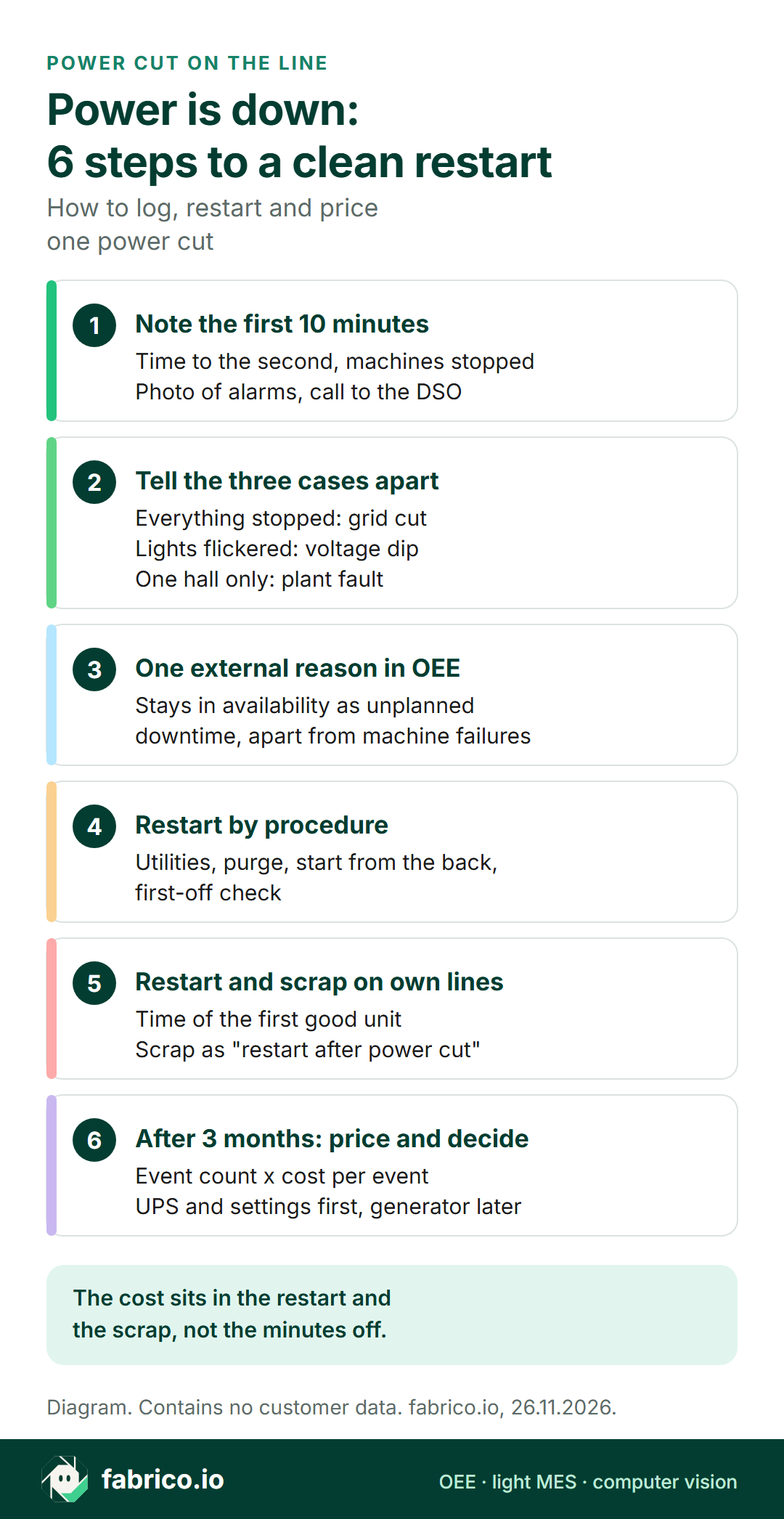
Text version of the diagram
- Log the time to the second and which machines stopped.
- Tell a grid cut, a dip and a plant fault apart.
- Keep one external reason inside OEE availability.
- Restart by procedure: utilities, purge, first-off check.
- Log the restart and the scrap on separate lines.
- After 3 months, price the year and pick the fix.
After three months you have an event count and a cost per event. With those, the example's calculation can be redone with real numbers. If the cost of a minute is not yet worked out, the method is in the article on cost of downtime per minute.
If stop reasons are kept on paper, short cuts and dips are the first to vanish: nobody writes them down, because the line is back in minutes. This is where equipment downtime tracking software helps, with the operator choosing the reason at the machine.
Where Fabrico fits
Fabrico is an OEE platform and light MES. It shows OEE live by machine, line and shift. Operators choose the stop reason in a few taps, so "power cut", "voltage dip" and "restart after power cut" can be separate reasons. Stops are split into planned and unplanned, and scrap is logged by product and reason.
Analytics by hour, shift and day and a top-20 stoppages table show how often events happen and how long they last. The Financial impact module prices the losses in money.
The stop comes from the machine signal, and the operator chooses whether it was a cut, a dip or a plant fault. If the internet link drops, the gateway buffers data for up to 30 days. See OEE and light MES.
Frequently asked questions
Do power cuts count in OEE?
Yes. If the line was scheduled to run, the cut is an availability loss. Give it its own reason so it can be filtered and does not mix with machine failures.
Does the grid operator owe compensation for a short power cut?
In Bulgaria, under Article 73(4) of the Energy Act, a penalty is due when an interruption exceeds a total of 48 hours within 72 hours, and only for the time beyond 48 hours. For short cuts and dips, the options sit in the general terms and the contract.
What should a plant buy first, a UPS or a generator?
For short cuts and dips, a UPS on the controls plus drive settings comes first. A generator picks up the load after seconds, when the line has already stopped. It pays back with long outages or product at risk.
How can you tell a power cut from a voltage dip?
If the lights and compressors stopped, it was a cut. If the lights only flickered and the drives dropped out, it was a dip. A power quality analyser on the main board gives the exact answer.
How long does a restart after a power cut take?
It depends on the line. In the example it is 40 minutes for a juice line and 45 minutes for moulding machines, longer than the cut itself. Measure it from the return of power to the first good unit.
Should the restart be a separate stop reason?
Yes. Otherwise 20 minutes without power look like 20 minutes of loss, when the real loss is an hour. A separate reason shows what the restart costs and whether the procedure shortens it.
See power cuts as their own reason in OEE. The demo shows how operators choose the reason in a few taps and how stops are ranked by financial impact.
Latest from our blog






Real Fabrico tiles, sample data.