





 Login
 Blog
Siemens Opcenter vs Rockwell FactoryTalk: match products to plant jobs

In short
- Where to look first: look at Siemens Opcenter if recipes, raw-material lots and lab tests run your food or CPG lines (Opcenter Execution Process). Look at Rockwell's FactoryTalk CPGSuite if you run high-volume CPG lines at several sites (CPGSuite), and at Plex MES if one cloud platform should tie the line to the ERP (Plex MES). Pages accessed 27.11.2026. If you only need OEE and stops on a few lines first, a light MES may come first.
- Two portfolios, not two products: each name covers a family. Compare the two products that do the same plant job, for example Opcenter Execution Process with CPGSuite, or Opcenter X with Plex MES.
- Prove it on one line: a 6-week pilot on a ketchup line measures three losses: the allergen clean-down at changeover, short stops at the capper and checkweigher rejects.
- In this example: fixing those three losses lifts OEE from 72.1% to 77.8% and adds 2,262 good bottles a shift, worth EUR 19,950.84 a month and EUR 239,410.08 a year if the gain holds.
Neither name on your shortlist is a single product. Siemens describes Opcenter as a portfolio for manufacturing operations management (Siemens, Opcenter, accessed 27.11.2026). Rockwell's MES page speaks of a "portfolio of MES offerings" that includes FactoryTalk MES and the Plex platform (Rockwell Automation, MES, accessed 27.11.2026).
So the real question is which Siemens product and which Rockwell product do your plant's job, and what a pilot on one line should prove. This page maps jobs to product pairs, describes both portfolios from the vendors' own pages, then runs one ketchup line through both.
Two portfolios, not two products
ISA-95, also published as IEC 62264, models manufacturing operations management as level 3 activities, with an interface to the level 4 business systems (ISA, ISA-95 standards page, accessed 27.11.2026). Both vendors sell several products inside level 3. The map pairs them by the job each one is built for.
The table adds two more jobs and one pilot test per pair: only products that pass the same test on the same line can be weighed against each other. Each cell is sourced in the vendor sections below.
| Plant job | Siemens Opcenter | Rockwell | Prove it in the pilot by |
|---|---|---|---|
| Recipes, batches and packing on food or CPG lines | Opcenter Execution Process, for CPG, food and chemicals | FactoryTalk CPGSuite, or Plex MES for Food & Beverage | One recipe change logged with its raw-material lot |
| Complex discrete or multi-industry production | Opcenter Execution Discrete | FactoryTalk ProductionCentre | One work order followed through every station |
| MES in the cloud, one module at a time | Opcenter X, for smaller firms | Plex MES, multi-tenant SaaS | One order from the ERP to the line and back |
| OEE and stops before a full MES | Opcenter Intelligence or Insights Hub OEE | Plex Production Monitoring, cloud OEE dashboards | Two shifts of OEE rebuilt by hand |
| Quality plans and checks | Opcenter Quality, from planning to monitoring | Plex MES closed-loop quality | One reject reason traced to its sample results |
| Planning and sequencing | Opcenter APS, down to detailed sequencing | Plex MES finite scheduling to work centers | One week of orders with real changeover times |
| Pharma batch records | Opcenter Execution Pharma, electronic batch records | MES for Life Sciences (PharmaSuite) | One batch record reviewed to release |
If the wider market is still open, the best MES software comparison weighs seven systems and asks who needs a full suite. For what an MES does on the floor, start with MES software.
Siemens Opcenter, from Siemens' own pages
What it is built around
Siemens frames manufacturing operations management (MOM) as "the real-time software layer that links product lifecycle management (PLM) to automation" (Siemens, Opcenter portfolio, accessed 27.11.2026). Its product list runs from Opcenter APS through Execution, Quality, Research, Development and Laboratory, Intelligence, Intra Plant Logistics, Opcenter X and Opcenter X Intosite.
Opcenter Execution has one MES per type of production: Discrete, Process, Electronics, Medical Device and Diagnostics, Pharma and Semiconductor. Its page lists forward and backward traceability, control of resources and materials, and up-to-the-minute performance reporting (Siemens, Opcenter Execution, accessed 27.11.2026).
Opcenter APS covers planning from months and years ahead down to detailed sequencing (Siemens, Opcenter APS, accessed 27.11.2026).
Where it runs
- Opcenter X is "modular manufacturing software designed specifically for Small and Medium-sized Businesses (SMBs)". Its MES packages come via SaaS, a virtual private cloud (VPC) or on premises (Siemens, Opcenter X, accessed 27.11.2026).
- Opcenter Intelligence comes as a Cloud and an On-Premises product (Siemens, Opcenter Intelligence, accessed 27.11.2026). The MES solution page adds multi-plant architecture support with an open database (Siemens, MES software, accessed 27.11.2026). Where Opcenter Execution would run is a point for the pilot agreement.
Industries it names
For food plants the product is Opcenter Execution Process. Siemens says it handles CPG, food and beverage and chemical manufacturing, including packaging, labeling and palletizing (Siemens, Opcenter Execution Process, accessed 27.11.2026).
It tracks raw-material traits such as acidity or viscosity, and time-sensitive ones such as ripeness and shelf life. The other Execution products name job shops and complex assembly, electronics, medical devices, pharma and semiconductors.
Across Siemens as a whole, food and beverage sits under consumer packaged goods, with subindustries from bakery and confectionery to breweries, dairy, edible oil, soft drinks and sugar (Siemens, Food and beverage, accessed 27.11.2026).
How plant data gets in
- Siemens describes Opcenter Execution as digitally linking enterprise systems with automated manufacturing equipment. On the MES solution page, the IT/OT integration item computes overall equipment effectiveness and real-time KPIs, under Opcenter Execution and Insights Hub.
- Insights Hub OEE "automatically measures Overall Equipment Effectiveness (OEE) of your lines" (Siemens, Insights Hub, accessed 27.11.2026). Opcenter Intelligence connects to Siemens, third-party and proprietary systems and shows operators the current downtime causes.
What the plant team configures
Siemens points to low-code: Opcenter Execution screens are tailored with Mendix, with pre-defined templates for standardization (Siemens, MES software, accessed 27.11.2026). Opcenter Execution Process is introduced in a measured, incremental, layered way, replacing legacy systems step by step.
In Opcenter X a plant starts with the modules for its highest-impact areas and extends later. The Essentials package covers order management, track and trace, and non-conformance management. Opcenter Intelligence ships standard dashboards from which users build their own.
If Opcenter is fixed on your shortlist, the page on Siemens Opcenter alternatives sorts six other options by job, and the Siemens Opcenter OEE review covers its OEE side.
Rockwell FactoryTalk MES and Plex, from Rockwell's own pages
What it is built around
Rockwell groups its MES under FactoryTalk and Plex. The MES page offers single-plant, multi-plant or industry-specific suites, and links products from FactoryTalk ProductionCentre and CPGSuite to Plex MES, Plex Production Monitoring and a Plex quality management system (Rockwell Automation, MES, accessed 27.11.2026).
FactoryTalk ProductionCentre is a multi-industry MES platform, and Rockwell says complexity is what it "was built for" (Rockwell Automation, FactoryTalk ProductionCentre, accessed 27.11.2026).
Plex MES is a "single-instance, multi-tenant edge-to-cloud SaaS production platform" for real-time, paperless production management. Its page lists finite scheduling, closed-loop quality, inventory with end-to-end traceability and production management (Rockwell Automation, Plex MES, accessed 27.11.2026).
Where it runs
- The MES page describes its products as "available via cloud or on-premise", with cloud and hybrid solutions in the portfolio. Plex MES offers options from cloud-only to hybrid configurations, chosen per site.
- Plex Production Monitoring runs as software in the cloud (Rockwell Automation, Plex Production Monitoring, accessed 27.11.2026). Where CPGSuite or ProductionCentre would run is a point for the pilot agreement.
Industries it names
The MES page offers industry MES for tire, battery, life sciences and consumer packaged goods. ProductionCentre lists pharmaceutical, automotive, CPG, electronics, EV and battery, fashion, tire, and metals and mining. Plex MES is tailored for discrete, hybrid and regulated industries, with videos for metals, automotive and food and beverage.
Food plants get their own page, which offers Plex MES for Food & Beverage and FactoryTalk CPGSuite (Rockwell Automation, MES for Food & Beverage, accessed 27.11.2026).
CPGSuite is "designed specifically for the Consumer Packaged Goods industry" and built for high volumes and highly automated processes in several locations (Rockwell Automation, FactoryTalk CPGSuite, accessed 27.11.2026).
How plant data gets in
- ProductionCentre stresses deep machine integration. Plex MES connects people and systems, with connectivity to the ERP and to third-party external systems.
- Plex Production Monitoring is "Powered by Kepware", and Rockwell says "no hardware or customized software is required". It measures production cycles, job metrics, quality, downtime, scrap and machine status. The food page describes records of key data elements for critical tracking events, collected automatically.
What the plant team configures
ProductionCentre rests on industry templates and best practices that "can then be configured to meet your needs". Plex MES lists what a plant sets up: scheduling of jobs to work centers, quality procedures run from the control plan, and digital work instructions through Connected Worker.
Plex Production Monitoring gives dashboards and scoreboards with cycle times, capacity utilization and OEE. CPGSuite offers process enforcement and traceability while manufacturing at scale.
If Rockwell is fixed on your shortlist, the Rockwell Automation and Plex OEE review covers Rockwell-heavy plants, and the guide to OEE software integration with Rockwell FactoryTalk covers FactoryTalk Historian, View and ProductionCentre.
Job by job: where the two portfolios differ
Both portfolios list execution, track and trace, quality, scheduling and OEE dashboards, so rows where they read alike are left out. These six rows are where the vendors' own pages point in different directions.
| Where they differ | Siemens Opcenter | Rockwell FactoryTalk and Plex | Check in the pilot |
|---|---|---|---|
| What the MES links to first | Product design: MOM links PLM to automation | Business systems: Plex links to the ERP and third parties | Which system sends order, recipe and spec to the line |
| Food and CPG detail | Raw-material traits and recipes, tied to the LIMS | Key data elements for FSMA 204, and HACCP | One lot traced from raw material to pallet |
| Cloud model | Opcenter X via SaaS, VPC or on premises | Plex as one multi-tenant SaaS, cloud-only to hybrid | Where data sits and who runs updates |
| Tailoring screens | Low-code with Mendix and templates | Industry templates; Connected Worker instructions | One screen changed by the plant team alone |
| Machine data for OEE | Insights Hub OEE and Opcenter Intelligence | Plex Production Monitoring, powered by Kepware | Same OEE as a hand count over two shifts |
| Several plants | Multi-plant architecture; line and plant benchmarking | Multi-plant suites; CPGSuite proven at multi-site scale | The pilot line's model copied to a second line |
The first row decides more than it seems. NIST's review of smart manufacturing standards groups integration along three lifecycle dimensions: product, production system and business (NIST, Current Standards Landscape for Smart Manufacturing Systems, 2016, accessed 27.11.2026).
Siemens' portfolio page leads from the product side, the PLM link. Plex MES leads from the business side, the ERP link. If recipes and specs live in a PLM system, test the Opcenter path first; if the plant runs from the ERP, test the Plex link first.
A 2020 review in Computers in Industry highlights that an MES should interconnect all components of cyber-physical systems, with semantic metadata giving the context for interoperability (Jaskó et al., Computers in Industry 123, 2020, accessed 27.11.2026).
On the floor that is one test: does every pilot record arrive with its line, product, order, lot and shift?
For one more Opcenter pairing, see Siemens Opcenter vs AVEVA MES.
Worked example: one ketchup line, piloted in both portfolios
The line and all numbers are sample data: no customer's figures and no vendor's results. They show what a 6-week pilot measures in either portfolio. For the functions a food plant needs from any system, see MES for food manufacturing.
The line and the six weeks
- Line: ketchup in 500 g squeeze bottles: filler, capper, checkweigher, labeler. One format for the whole pilot, ideal rate 90 bottles a minute.
- Shifts: 3 a day with 440 planned minutes each, on 21 days a month: 63 shifts a month.
- Recipes: classic ketchup and a hot sauce with mustard. Leaving the mustard recipe needs a full allergen clean-down, standard 40 minutes with the swab check; one a shift in this example.
- Week 1: connect the count after the checkweigher, the filler and capper stop signals and the reject counter; agree the stop reasons.
- Weeks 2-3: a baseline of 30 shifts. Weeks 4-5: fix three losses. Week 6: compare.
What one baseline shift looked like
Every row is stated in bottles at 90 a minute, so the column sums to the 39,600 bottles that 440 minutes allow.
| Where the shift went | Per shift | Bottles at ideal rate |
|---|---|---|
| Changeover with allergen clean-down (standard 40 min) | 56 min | 5,040 |
| Breakdowns over 5 minutes | 21 min | 1,890 |
| Short stops at the capper (66 × 30 s) | 33 min | 2,970 |
| Slow running | 6 min equivalent | 540 |
| Checkweigher rejects | 612 bottles | 612 |
| Good bottles | 28,548 bottles | 28,548 |
| Planned time | 440 min | 39,600 |
- Availability: (440 - 56 - 21) / 440 = 363 / 440 = 82.5%
- Bottles counted: (363 - 33 - 6) × 90 = 324 × 90 = 29,160
- Performance: 29,160 / (363 × 90) = 29,160 / 32,670 = 89.3% (89.26% before rounding)
- Quality: (29,160 - 612) / 29,160 = 28,548 / 29,160 = 97.9% (97.90%)
- OEE: availability × performance × quality = 72.1%, rounded at the end. Check: 28,548 / 39,600 = 72.09%.
The stop reasons told the rest. Operators named the cap chute for 49 of the 66 short stops. The clean-down ran 16 minutes over standard, 11 of them waiting for quality to release the line. Two-thirds of the rejects, 408 of 612, were underweight bottles of the thicker hot sauce.
What you would configure and check in each portfolio
The Siemens column draws on the Execution Process, Intelligence and Insights Hub pages, the Rockwell column on the Plex MES and Production Monitoring pages, all cited above. The last column is one proof for both pilots.
| Pilot step | In Siemens Opcenter | In Rockwell FactoryTalk and Plex | Same proof for both |
|---|---|---|---|
| Count and stops, week 1 | Line OEE in Insights Hub OEE or Opcenter Intelligence | Line OEE on Plex Production Monitoring dashboards | Count within 1% of packed cases for 5 shifts |
| Allergen clean-down | Recipe change in Execution Process; swab as a quality test linked to the LIMS | Clean-down as a quality procedure from the control plan; steps in Connected Worker | Each clean-down shows start, end, standard and release time |
| Short stops at the capper | Current downtime causes in Opcenter Intelligence | Downtime and machine status in Plex Production Monitoring | Every 30-second stop listed with a reason, matching a paper log |
| Checkweigher rejects | Final-product tests in Execution Process; ask for the split by recipe | Quality and scrap in Plex Production Monitoring; ask for the split by recipe | Rejects by recipe equal the checkweigher's counter |
Short stops need their own check. In this example they cost 2,970 bottles a shift, while the 16 minutes the clean-down ran over standard cost 1,440. A system that kept only long stops would hide them.
After the fixes, if the gain holds
- Clean-down: swab kit staged at the line, quality called 15 minutes before each wash ends: 56 to 46 minutes.
- Capper: a worn guide in the cap chute replaced: 66 to 40 short stops, 40 × 30 s = 20 minutes.
- Filler: a separate fill setting for the hot sauce: rejects 612 to 420. Breakdowns and slow running unchanged.
- Availability: (440 - 46 - 21) / 440 = 373 / 440 = 84.8% (84.77%)
- Bottles counted: (373 - 20 - 6) × 90 = 347 × 90 = 31,230
- Performance: 31,230 / 33,570 = 93.0% (93.03%)
- Quality: 30,810 good / 31,230 counted = 98.7% (98.66%)
- OEE: 30,810 / 39,600 = 77.8% (77.80%), up 5.7 points
- Extra good bottles: 30,810 - 28,548 = 2,262 a shift
Each fix can be priced alone, with the other losses held at their measured minutes. The contribution margin in this example is EUR 0.14 a bottle.
| Fix | Counted as | Extra good bottles a shift | EUR a shift, in this example |
|---|---|---|---|
| Cap chute guide | (33 - 20) min × 90 | 1,170 | 163.80 |
| Clean-down release | (56 - 46) min × 90 | 900 | 126.00 |
| Fill setting | 612 - 420 rejects | 192 | 26.88 |
| Total | 1,170 + 900 + 192 | 2,262 | 316.68 |
So 2,262 × EUR 0.14 = EUR 316.68 a shift; × 63 shifts = EUR 19,950.84 a month; × 12 = EUR 239,410.08 a year, if the gain holds and the extra bottles find buyers. Margin only: the sauce and bottle in each reject are not counted.
If demand is flat, count time instead: 2,262 bottles at 90 a minute are 25.1 minutes of running a shift (25.13 before rounding), about 26 hours a month. The method is the same in both portfolios.
Decision table: where to look first
Every row names the pilot to run first. The "why" column paraphrases the vendor pages cited earlier on this page.
| If this is you | Look first at | Why (from the vendor's own page) | Prove it in the pilot by |
|---|---|---|---|
| Food or CPG plant where lots and lab results set the line | Opcenter Execution Process | Names CPG and food; tracks acidity and viscosity; ties to the LIMS | One recipe change with its lot and lab result on the order |
| High-volume, automated CPG lines in several plants | FactoryTalk CPGSuite | Built for high volumes and automated processes in multiple locations | The pilot line's model copied to a second line |
| Recipes and specs kept in a PLM system | Siemens Opcenter | MOM is the real-time layer linking PLM to automation | One spec change reaching the line without retyping |
| Plants in several industries or complex flows | FactoryTalk ProductionCentre | Multi-industry MES platform, industry templates, deep machine integration | One template set up on the pilot line |
| Smaller firm, MES in the cloud one module at a time | Opcenter X | Modular MOM for small and mid-sized firms; SaaS, VPC or on premises | One lot traced and one non-conformance closed |
| MES, quality and the ERP link on one cloud platform | Plex MES | Multi-tenant SaaS with ERP and third-party connectivity | One order from the ERP to the line and back |
| Line OEE and downtime before any MES | Plex Production Monitoring or Opcenter Intelligence | Cloud OEE dashboards with no new hardware; machine, line and plant performance | Two shifts of OEE rebuilt by hand |
If neither suite matches the size of the plant, the guide to MES alternatives for mid-sized plants compares lighter options. For CPG plants there is also a comparison of OEE platforms for consumer goods manufacturing.
The card puts the decision on one page for the shortlist meeting.
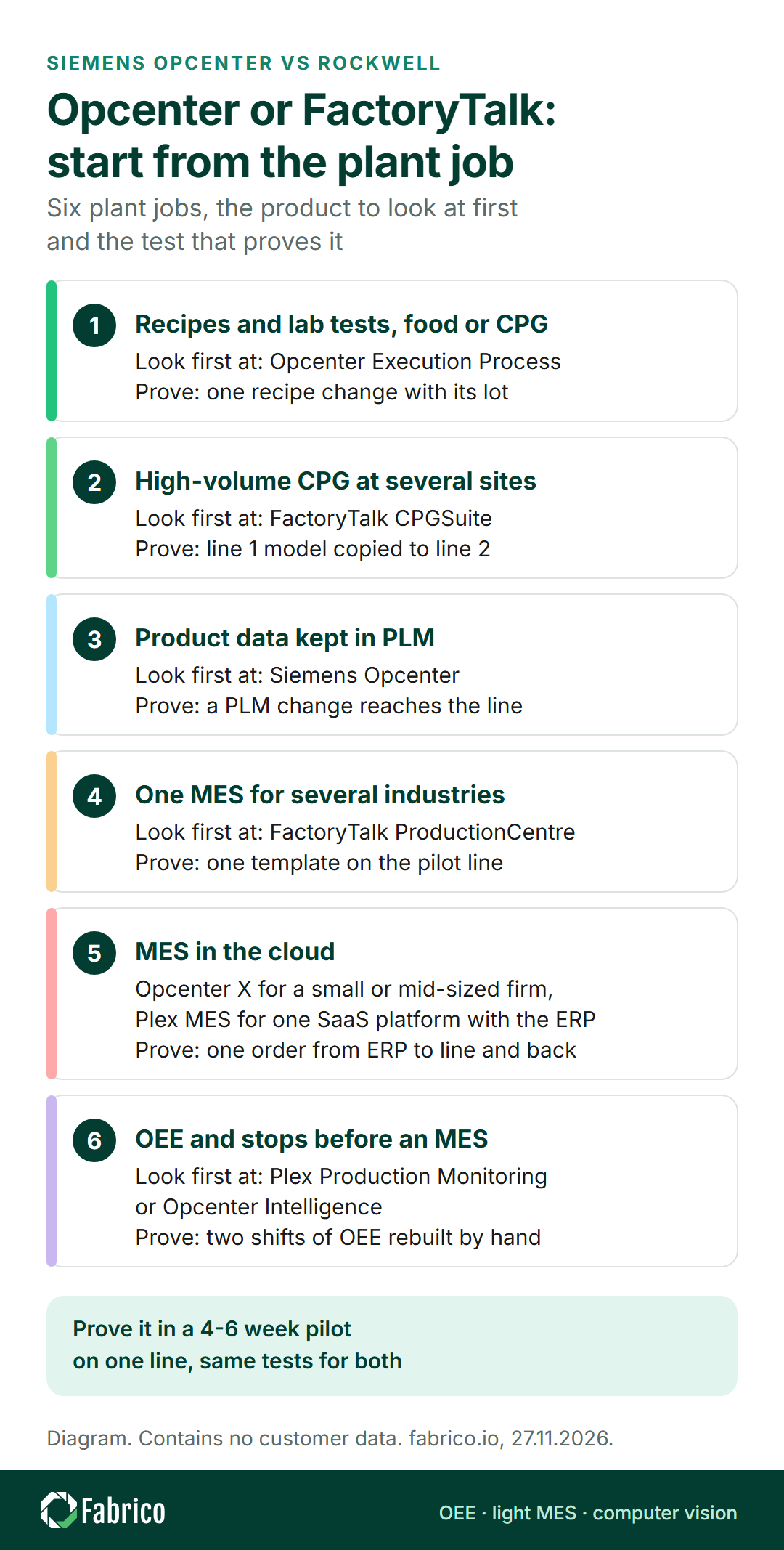
Text version of the diagram
- Recipes and lab tests on food or CPG lines: look first at Opcenter Execution Process. Prove: one recipe change logged with its lot.
- High-volume CPG at several sites: look first at FactoryTalk CPGSuite. Prove: the line 1 model copied to line 2.
- Product data in a PLM system: look first at Siemens Opcenter. Prove: a PLM change reaches the line.
- One MES across several industries: look first at FactoryTalk ProductionCentre. Prove: one template on the pilot line.
- Cloud MES: Opcenter X for a small or mid-sized firm, Plex MES for one SaaS platform with the ERP. Prove: one order from the ERP to the line and back.
- OEE and stops before an MES: look first at Plex Production Monitoring or Opcenter Intelligence. Prove: two shifts of OEE rebuilt by hand.
- Test every choice on one line over 4-6 weeks, running the same checks for both vendors.
Questions to ask both vendors
Put these to both account teams before the pilot is signed, and ask for the answers on paper.
- Which products, by name, would run the pilot line, and which must be in place on day one?
- Which formula sits behind the OEE figure, and can the pilot team recompute two shifts on paper from the logged stops and counts?
- How short a stop is kept as its own event at a capper, and how does an operator give it a reason?
- Is an allergen clean-down recorded as a changeover, a quality procedure or both, and where is the release by quality kept?
- How long does a trace from one finished lot back to its raw-material lots take, and in what format can it leave the system?
- What moves between the system and the ERP (orders, recipes, results), and which way does each one travel?
- After the pilot, what can the plant team change without the vendor: a recipe, a stop reason, a second line?
Two standards help score the answers. ISO 22400-2 defines each KPI with a formula, its elements, its unit and how it behaves over time, and ISO lists the 2014 edition as due for revision (ISO 22400-2:2014, ISO committee page, accessed 27.11.2026).
ISA-95 Part 2 specifies the content exchanged between level 3 and level 4 systems (ISA page cited above), so question 6 can be answered in its terms.
Question 5 matters for plants that ship food to the US. The FDA Food Traceability Rule covers persons who manufacture, process, pack or hold foods on the Food Traceability List, and requires records of key data elements for critical tracking events (FDA, Food Traceability Final Rule, accessed 27.11.2026).
Unless exempt, a firm gives the FDA an electronic sortable spreadsheet within 24 hours of a request, or a reasonable time the FDA agrees, during an outbreak, recall or other threat to public health.
FDA says Congress directed it not to enforce the rule before 20 July 2028. Check each product against the Food Traceability List (FDA, accessed 27.11.2026).
What to do this week
- List what the plant already runs: PLCs, SCADA, historian, ERP and any PLM system. It shows which data path each vendor would use.
- Write the plant job in one sentence and find its row in the map. That row names the two products to compare.
- Pull last month's figures for one line: changeover minutes, the checkweigher's reject counter and the packed count. They are the pilot's yardstick.
- Ask both vendors for a named product list for that line, with the seven questions, in writing.
- Name two owners, one from operations and one from IT, who sign off the pilot result together.
Where Fabrico fits
Fabrico comes in when a plant wants clean line data before it commits to either suite.
- Product: an OEE platform and light MES, with maintenance built in.
- OEE: live by line and shift, read at the core machine on a linked line, from the line PLC or a Fabrico IoT device.
- Losses: operators add the stop reason in a few taps; changeovers run against a standard time; scrap is logged by product and reason.
- Money: the Financial impact module prices each loss per SKU, so stops come ranked by financial impact.
- Several sites: each site's key OEE figures sit in one screen against the group average.
Fabrico is made by the publisher of this article.
Details sit on the MES and OEE software overview, and a demo can be built around your own line data.
Frequently asked questions
What is the difference between Siemens Opcenter and Rockwell FactoryTalk?
Both are portfolios. Opcenter groups Siemens' MOM products, with an MES per type of production and the Opcenter X cloud line. Rockwell's MES portfolio combines FactoryTalk ProductionCentre and CPGSuite with Plex MES and Plex Production Monitoring.
Is FactoryTalk ProductionCentre the same as Plex MES?
No. Rockwell lists them as separate offerings. ProductionCentre is a multi-industry MES platform with industry templates; Plex MES is a single-instance, multi-tenant SaaS platform from edge to cloud.
Which Opcenter product is meant for food and beverage plants?
Opcenter Execution Process. Siemens says it covers CPG, food and beverage and chemical manufacturing, with formula, recipe and batch management and packaging work such as labeling and palletizing.
What is FactoryTalk CPGSuite?
Rockwell describes it as an MES designed for the consumer packaged goods industry, built for high volumes and highly automated processes at several sites. Rockwell's food and beverage page offers it next to Plex MES for Food & Beverage.
Do Opcenter and FactoryTalk run in the cloud?
Parts of both do. Opcenter X comes via SaaS, VPC or on premises, and Opcenter Intelligence as Cloud or On-Premises. Rockwell offers its MES via cloud or on-premise, and Plex runs from cloud-only to hybrid.
Can Opcenter or FactoryTalk measure OEE?
Both portfolios name OEE. Siemens says Insights Hub OEE measures the OEE of your lines, and Rockwell's Plex Production Monitoring shows OEE on dashboards and scoreboards. In a pilot, rebuild two shifts by hand to check the formula.
Before the suite decision, see one line in EUR. The demo shows changeovers against a standard time, scrap by product and reason, and which stops cost the most, ranked by financial impact.
Latest from our blog
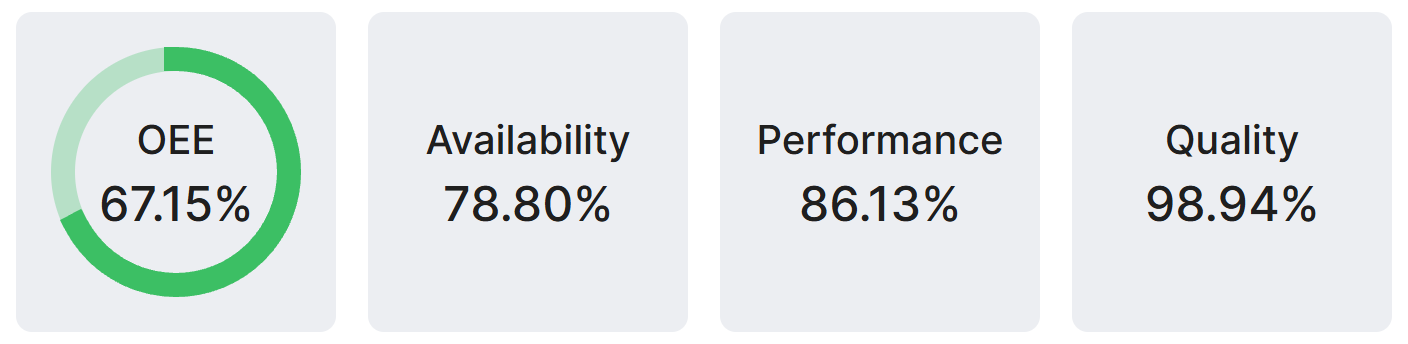
Fabrico screen, sample data.