





 Login
 Blog

Toll manufacturing pricing: a line-hour rate from real OEE

In short
- Price toll work from a line-hour rate and measured OEE: not from nameplate speed. In this example the rate is EUR 80.96 per hour and the price is EUR 4.35 per 100 bags at 62% OEE.
- Nameplate speed is a trap: in this example, pricing on 3,000 bags an hour instead of the real 1,860 loses EUR 72,648 a year.
- A target OEE undercuts the price too: pricing on 75% OEE when the line runs at 62% gives a EUR 12,384 loss for the year instead of the EUR 37,836 profit at the measured-OEE price.
- Stops caused by the client's material are billed separately at the hourly rate. Under the Bulgarian Obligations and Contracts Act (Art. 260), the contractor must warn at once if the material supplied is unsuitable.
- Per unit or per hour: at exactly 62% OEE both models give almost the same monthly invoice (EUR 24,274.05 and EUR 24,288.00). The difference is who carries the risk when OEE moves.
How do you price toll manufacturing? Start from a rate for one hour of line time: labour, depreciation, maintenance, energy, overheads and margin. Divide that rate by the good units the line really makes in an hour, which is nameplate speed × measured OEE. In this example that gives EUR 80.96 per hour and EUR 4.35 per 100 bags.
This guide shows what goes into the rate, why nameplate speed and a target OEE undercut the price, who pays for stops caused by the client's material, and which clauses belong in the contract. The legal texts are read as of 27.11.2026, with Bulgarian law where the plant is in Bulgaria. This is a reading, not legal advice.
Toll manufacturing: what the client supplies and what the plant sells
In toll manufacturing the client supplies the raw material and the packaging, and the plant supplies the line, the people and the time. The client pays for the work, not for the material. In contract manufacturing the plant buys everything and sells the finished product.
| Item | Toll manufacturing | Contract manufacturing |
|---|---|---|
| Raw material and printed packaging | From the client | Bought by the plant |
| Raw material price risk | With the client | With the plant |
| What is invoiced | Line hours or units made | Finished product |
| Material waste | Within an agreed allowance | At the plant's cost |
| The number that sets the price | Good units per line hour | Cost per unit |
Under the Bulgarian Obligations and Contracts Act this is a contract for work. The contractor undertakes, at its own risk, to make something to the other party's order, and the other party undertakes to pay (Art. 258).
Unless agreed otherwise, the contractor makes the order with its own means (Art. 259). In toll work the client's material is exactly that "agreed otherwise", so the contract spells it out.
What goes into a line-hour rate
The hourly rate collects everything the plant pays while the line is planned for the client. The divisor is planned time, not the calendar: in this example 2 shifts × 7.5 hours × 240 days = 3,600 hours a year.
| Item | How it is calculated | In this example, EUR per hour |
|---|---|---|
| Line labour | People × cost per person-hour | 4 × 10.20 = 40.80 |
| Depreciation | Line price / years of life / hours | 360,000 / 10 / 3,600 = 10.00 |
| Maintenance and spares | Annual spend / hours | 14,400 / 3,600 = 4.00 |
| Energy and compressed air | kWh per hour × price | 18 × 0.20 = 3.60 |
| Building, warehouse, quality, management | Share of annual overheads / hours | 43,200 / 3,600 = 12.00 |
| Cost per hour | Sum | 70.40 |
| Rate with a 15% margin | 70.40 × 1.15 | 80.96 |
The person-hour is EUR 10.20 because that is what an hour of labour cost employers in Bulgarian manufacturing in 2025, according to Eurostat (Eurostat, dataset lc_lci_lev, accessed 27.11.2026). Your own person-hour comes from your payroll.
The client's material is not in the rate. Cases, if the plant buys them, are invoiced per unit, separately from the hour.
Depreciation: real life, not the tax rate
The Bulgarian Corporate Income Tax Act puts machines, production equipment and apparatus in category II, with an annual tax depreciation rate of up to 30% (Art. 55(1) and (2)). For brand-new assets that are part of an initial investment the rate can reach 50% (Art. 55(3)).
The act was last amended in State Gazette issue 55 of 16 June 2026 (lex.bg text of the act, accessed 27.11.2026). That rate serves tax, not pricing.
At 30%, first-year depreciation is 360,000 × 0.30 = EUR 108,000, or EUR 30.00 per hour. That is three times the EUR 10.00 for a 10-year life. A rate built on the tax percentage is high in the first years and falls later, while the line stays the same.
Worked example: packing nuts for a retail brand
The plant, the client and every price here illustrate the maths; none of them comes from a real customer.
- The line is a multihead weigher with a vertical bagger. Nameplate speed is 50 bags of 200 g a minute, or 3,000 bags an hour.
- The client supplies the nuts and the printed film. The plant supplies the line, four people, the energy and the cases.
- Measured OEE over the last 3 months is 62%. It is calculated without the stops caused by the client: those are logged separately.
- Good bags per hour are 3,000 × 0.62 = 1,860.
- Planned hours are 3,600 a year, or 300 a month (20 days × 2 shifts × 7.5 hours).
- The price includes 12 changeovers a month of 45 minutes each; they sit inside the measured OEE.
The price per bag is the rate divided by the good bags: 80.96 / 1,860 = EUR 0.04353, or EUR 4.35 per 100 bags after rounding.
Nameplate speed, target OEE or measured OEE: three prices for one bag
The same rate gives three different prices depending on which bags-per-hour figure it is divided by. The yearly result is at the real 1,860 bags an hour.
| Price basis | Bags per hour | EUR per 100 bags | Result for the year, EUR |
|---|---|---|---|
| Nameplate speed | 3,000 | 2.70 | -72,648 |
| Target OEE 75% | 2,250 | 3.60 | -12,384 |
| Measured OEE 62% | 1,860 | 4.35 | +37,836 |
The maths for nameplate speed: 80.96 / 3,000 = 0.02699, or EUR 2.70 per 100 bags. The line really makes 1,860 bags an hour and earns 1,860 × 0.027 = EUR 50.22 against a cost of EUR 70.40. The loss is EUR 20.18 an hour, or EUR 72,648 over 3,600 hours.
A 75% target OEE gives 2,250 bags and a price of 80.96 / 2,250 = 0.03598, or EUR 3.60 per 100. Revenue is 1,860 × 0.036 = EUR 66.96 an hour: EUR 3.44 below cost, or a EUR 12,384 loss for the year.
At measured OEE, revenue is 1,860 × 0.0435 = EUR 80.91 an hour. The profit is EUR 10.51 an hour, or EUR 37,836 for the year, if OEE holds at 62%.
What OEE means in the contract
OEE measures the different types of production losses. Muchiri and Pintelon review how it evolved, discuss two industrial applications and analyse the differences between theory and practice (Muchiri and Pintelon, International Journal of Production Research, 2008, accessed 27.11.2026).
For the contract the lesson is practical. The formula, the planned time and the stops that do not count go into the contract. Otherwise the plant's 62% and the client's 62% are two different numbers.
Who pays for stops: the client's material and changeovers
In the example month, the client's film has bad splices that stop the machine for 8 hours in total. The nuts arrive a day late and the line waits 7 hours. Those 15 hours are not the plant's loss.
- Without a clause: the 15 hours go into the plant's OEE and the plant pays for them: 15 × 70.40 = EUR 1,056 of cost with no revenue.
- With a clause: the hours are billed at the rate: 15 × 80.96 = EUR 1,214.40.
The client ordered 20 changeovers instead of the 12 included. The 8 extra ones take 8 × 45 minutes = 6 hours. The fee for one changeover is 45 / 60 = 0.75 hours × 80.96 = EUR 60.72, or EUR 485.76 for the eight.
Setting the standard changeover time follows the method in changeover standards for FMCG.
The invoice for the month
Of the 300 planned hours, 300 - 15 - 6 = 279 hours of production remain for the plant. They yield 279 × 1,860 = 518,940 bags.
- Bags: 518,940 / 100 × 4.35 = 5,189.40 × 4.35 = EUR 22,573.89.
- Stops caused by the client: EUR 1,214.40.
- Extra changeovers: EUR 485.76.
- Total: EUR 24,274.05.
If the same month is billed by the hour only, the total is 300 × 80.96 = EUR 24,288.00. The EUR 13.95 difference comes from rounding the price to 4.35.
Who carries the risk when OEE drops
If the plant's OEE falls to 55% for a month through its own fault, the bags become 279 × 3,000 × 0.55 = 460,350, and the invoice under the mixed model is 4,603.50 × 4.35 + 1,214.40 + 485.76 = EUR 21,725.39.
| Model | Invoice at 62% OEE | Invoice at 55% OEE | Client pays per 100 bags |
|---|---|---|---|
| Mixed: per unit + hours + fees | 24,274.05 | 21,725.39 | 4.68 / 4.72 |
| Per hour only | 24,288.00 | 24,288.00 | 4.68 / 5.28 |
Under the mixed model the plant receives 24,288.00 - 21,725.39 = EUR 2,562.61 less than under the hourly model, and the client pays almost the same per 100 bags. Under the hourly model the plant receives the same amount, and the client's price per 100 bags jumps from EUR 4.68 to EUR 5.28.
For a line running its own products, the maths of a stop is different: see what a minute of downtime costs.
What Bulgarian contract law says about the client's material
This reading covers the contract-for-work chapter of the Bulgarian Obligations and Contracts Act (last amended in State Gazette issue 35 of 27 April 2021, accessed 27.11.2026).
- Art. 260: the contractor must warn the other party at once if the material supplied is unsuitable for proper performance, and ask for suitable material. If the other party does not provide it, the contractor may withdraw from the contract. A contractor who gives no warning is liable for the damage caused.
- Art. 263: the risk of accidental loss of or damage to the material lies with the party that supplied it, unless the other party is in delay.
- Art. 264: the client accepts the work, inspects it and raises objections. For hidden defects, the client notifies the contractor as soon as they are found. Without objections, the work is deemed accepted.
- Art. 266(2): if, during performance, the duly determined price of material or labour changes, the remuneration changes accordingly.
- Art. 267(2): the contractor is entitled to remuneration if the work became impossible, in whole or in part, because the material supplied by the client was unfit and the contractor warned in time.
What these texts do not say. They say nothing about OEE, line hours or late delivery of material. So who pays for waiting hours is settled in the contract.
Art. 266(2) speaks of a "duly determined" price. Whether that covers market rises in energy and labour needs a lawyer's view; an indexation clause in the contract is the clearer route.
Art. 260 also has a practical side for the plant. The warning about bad film goes out at once and in writing, with the stop hours from the shift. That way a client-caused stop is documented, not argued over at month end.
Payment and acceptance terms: the Bulgarian Commerce Act and Directive 2011/7/EU
Art. 303a of the Bulgarian Commerce Act (last amended in State Gazette issue 69 of 31 July 2026, accessed 27.11.2026) sets payment terms between traders:
- Para. 1: the payment term is up to 60 days. A longer term may be agreed by exception, where the nature of the goods or services or another important reason requires it, if it is not a gross abuse of the creditor's interest and does not offend good morals.
- Para. 3: if no term is agreed, payment is due 14 days after the invoice or payment request is received.
- Para. 4: where inspection or acceptance applies, the term for it is 14 days from receipt of the goods or services; a longer one is agreed by exception.
At EU level, Directive 2011/7/EU, Article 3(5), requires that the payment period fixed in a contract between undertakings does not exceed 60 calendar days, unless otherwise expressly agreed and provided it is not grossly unfair to the creditor.
Article 3(4) caps an acceptance procedure at 30 calendar days on the same condition (Directive 2011/7/EU, accessed 27.11.2026).
For toll work the conclusion is simple: a monthly invoice with the OEE and stop report attached, and a payment term of up to 60 days. The inspection period for the finished goods is written in explicitly.
Clauses for a toll manufacturing contract: 8 points
- OEE definition: the formula, the planned time and the stops that do not count (those caused by the client).
- Price: a rate per hour and a price per 100 units at the agreed OEE, reviewed every quarter.
- Client-caused stops: unsuitable material under Art. 260 or late delivery; written notice within the shift; billing at the hourly rate.
- Changeovers: the number included in the price and a fee for each extra one at the standard time.
- Material usage: the allowed waste of product and packaging in %, who pays above it, and how the reconciliation is kept.
- Indexation: labour and energy tied to a public index, once a year, with a formula.
- Acceptance and claims: the inspection period, hidden defects under Art. 264, and who pays for re-packing.
- Payment and report: a term of up to 60 days under Art. 303a; a monthly OEE and stop report attached to the invoice.
Point 5 is where toll work resembles a supplier claim: the reconciliation of film and product decides who pays for what. How to keep such a reconciliation for packaging is shown in the guide to the packaging supplier claim.
Per unit, per hour or mixed: how to choose
| Model | Who carries the OEE risk | When it suits |
|---|---|---|
| Per unit on measured OEE | The plant | Repeat product, stable material, at least 3 months of OEE history |
| Per line hour | The client | New product, trials, a specification that changes from order to order |
| Mixed: per unit + client-caused hours + changeover fee | Shared | Long-term contract with volume and a monthly report |
A plant with no OEE history for the product starts per hour. After 3 months of measured data it can offer a price per unit, because it now knows the good units per hour.
A client with large repeat volume prefers a price per unit: it is simple to build into the client's own cost. The mixed model gives both sides what they want: the per-unit price stays, and client-caused hours and extra changeovers are paid separately.
In this example the rate is reviewed when one of its items moves by more than 5%: labour, energy or line loading. Fewer planned hours make depreciation and overheads per hour higher.
7 questions for the client before you quote
- How many orders and changeovers a month, and what is the smallest batch?
- Who supplies the packaging, and to what specification: width, reel diameter, splices?
- What product and packaging waste does the client accept, and who pays above it?
- How many days before the run does the material arrive, and what happens if it is late?
- Do the products contain allergens, and what cleaning does a switch between them need?
- Will the client accept a monthly OEE and stop report as the basis for the invoice?
- What payment and acceptance terms does the client propose?
Where Fabrico fits
The quote and the contract stay with sales and in the ERP. Fabrico is a platform for OEE with a light MES, and it supplies the measured numbers they rest on. It shows live OEE by line and shift, and on this linked line, OEE is read at the core machine: the bagger.
Operators add the stop reason in a few taps, so "film splice" and "waiting for client material" are separate lines with hours, ready for the invoice. Changeovers are tracked against a standard time, and the top-20 stoppages table shows what eats the hour.
The Financial impact module prices the losses in EUR for each SKU, and analytics by shift, week and month give the monthly report for the client. Stops by reason sit in downtime tracking, the modules are on the light MES page, and for pricing there is one quote per plant by machines and modules.
The line-hour price in 6 steps
The diagram follows the maths of the example: from hourly costs to the report behind the invoice.
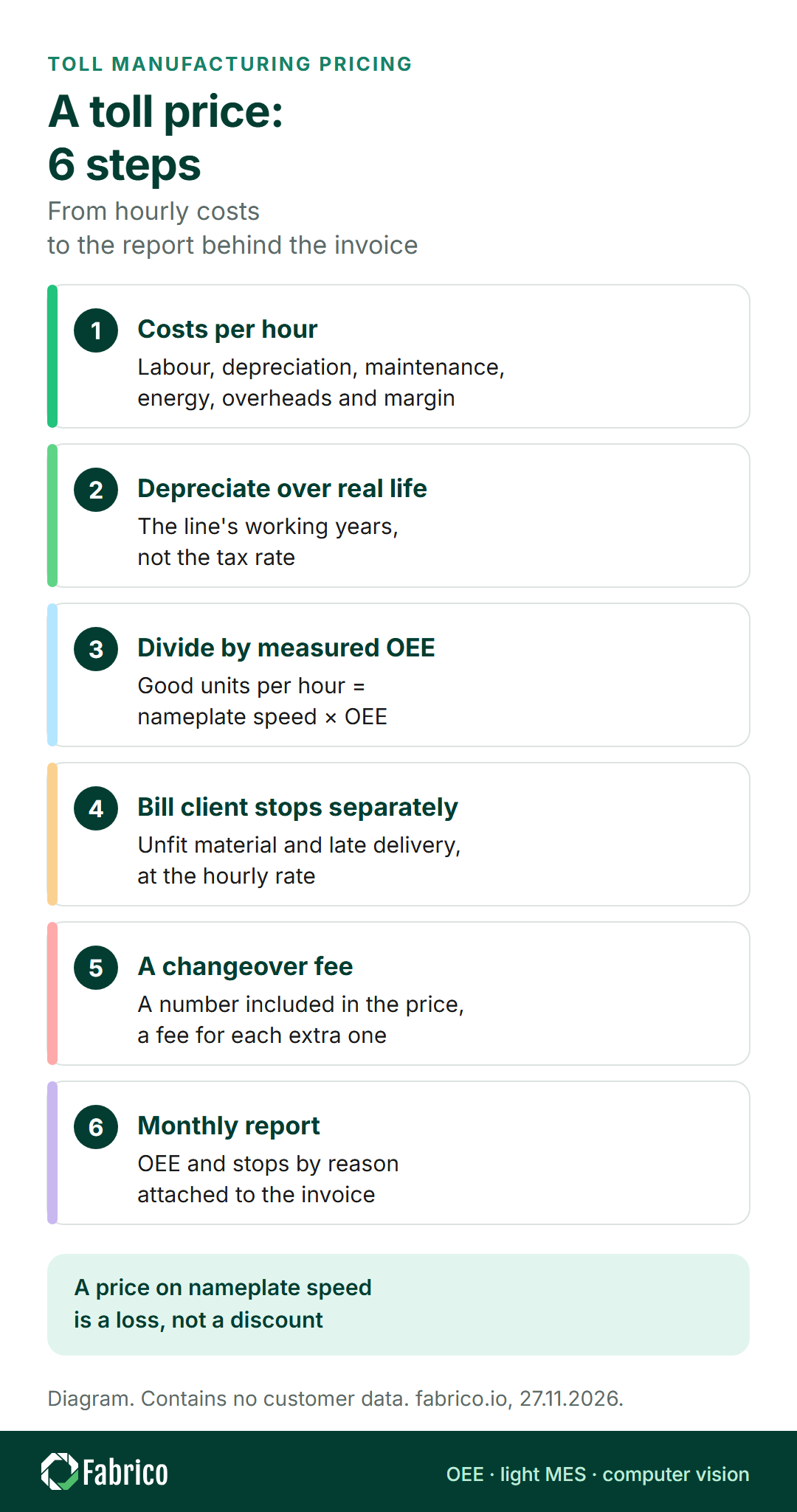
Text version of the diagram
- Collect the costs per hour: labour, depreciation, maintenance, energy, overheads.
- Depreciate over the line's real life, not the tax rate.
- Divide by good units per hour: nameplate speed × measured OEE.
- Separate client-caused stops: material and delays, billed at the hourly rate.
- Price changeovers: an included number and a fee for each extra one.
- Monthly report: OEE and stops by reason attached to the invoice.
Frequently asked questions
How is toll manufacturing priced?
Add up the line's costs for one planned hour and add a margin. Divide that rate by the good units per hour, which is nameplate speed × measured OEE. In this example EUR 80.96 per hour / 1,860 bags = EUR 4.35 per 100 bags.
What goes into an hourly rate for a production line?
Line labour, depreciation over the real life of the line, maintenance, energy and compressed air, a share of plant overheads, and the margin. The client's material does not.
Who pays for downtime when the client's material is unfit?
In Bulgaria, the Obligations and Contracts Act (Art. 260) requires the contractor to warn at once about unsuitable material, and Art. 267(2) gives a right to remuneration if the work became impossible because of unfit material and the contractor warned in time. Stop hours are settled by a contract clause.
Should a toll price use nameplate speed or OEE?
Measured OEE. In this example, a price on nameplate speed loses EUR 72,648 a year, while a price on 62% measured OEE earns EUR 37,836.
What payment term applies to a toll manufacturing contract?
In Bulgaria, Art. 303a of the Commerce Act allows up to 60 days, and longer only by exception. If no term is agreed, payment is due 14 days after the invoice is received.
What is the difference between toll and contract manufacturing?
In toll manufacturing the client supplies the raw material and the packaging and pays for the work. In contract manufacturing the plant buys the materials and sells the finished product, so it also carries their price risk.
Put measured OEE in your toll quote, not the catalogue speed. The demo shows shift-by-shift OEE for the line, each stop with its reason, changeovers against the standard time, and the euro cost of losses per SKU.
Latest from our blog





Real Fabrico tiles, sample data.