





 Login
 Blog
FORCAM ENISCO alternatives: 5 options by the job you need done

In short
- Start from the machine park: if networked CNC controls carry over half of your planned hours and the first job is downtime and part counts, look at MachineMetrics. If older presses and manual stations take a large part of the park, look at Tulip. If one plant needs a full modular MES, look at MPDV HYDRA X. For job shops and complex assembly, look at Siemens Opcenter, and if you build industrial equipment, medical devices or electronics, look at Critical Manufacturing.
- What FORCAM ENISCO offers: FORCAM ENISCO GmbH offers FORCAM MES, an on-premise MES with MES FLEX and the entry-level MES LITE, and ENISCO, an industrial data platform with shop-floor apps.
- Count the park before the demos: the readiness table on this page sorts every machine into five groups by how its stops and parts can be counted: from the controller, from wired signals, from an added sensor or camera, or by the operator.
- In this example: a 5-week pilot on one mechanical press lifts OEE from 65.0% to 70.2%, worth EUR 9,828 a month and EUR 117,936 a year if the gain holds.
- Send the same seven questions to every vendor: one of them asks how a press with no controller output gets its stops and counts.
Plants look for FORCAM ENISCO alternatives when their machine park or their scope calls for a different fit. A shop of networked machining centres, a hall of older mechanical presses and an assembly area full of manual stations need three different ways to count stops and parts.
This page first sets out what FORCAM ENISCO offers, from its own pages. Then comes a readiness table you fill in for your park, five alternatives described from their vendors' own sites, a decision matrix, a press pilot priced in EUR and the questions to send every vendor.
FORCAM ENISCO in its own words
The company is FORCAM ENISCO GmbH. Its English home page offers three paths to digital manufacturing, and two of them are software for the shop floor (FORCAM ENISCO home page, accessed 27.11.2026):
- FORCAM MES: an on-premise manufacturing execution system, with AI Ready MES FLEX, MES LITE and Schedule4SF.
- ENISCO: industrial data management and hybrid solutions, with the AC4DC data platform and the shop-floor apps Solve4SF, Quality4SF and Inventory4SF.
The MES FLEX page calls it an "AI-ready MES for your smart factory" that combines machine data acquisition, production context and a semantic data model (FORCAM ENISCO, MES FLEX, accessed 27.11.2026). Its functions include:
- production monitoring of OEE, utilisation and downtime in real time;
- end-to-end process traceability, and performance analysis with reports, visualisations and alarms;
- manufacturing data management for production data, order data and DNC;
- energy monitoring, a control centre for fine planning, and apps from FORCAM partners.
For connectivity the page names "standardized machine plug-ins and ERP adapters", with templates for machine types and vintages. The Bridge API is its open programming interface for third-party systems. Data can stay on the plant's own infrastructure, and the page also describes a multi-cloud-enabled setup with hybrid edge and cloud options.
MES LITE is "the entry-level solution for digital production", aimed at small and medium-sized enterprises (FORCAM ENISCO, MES LITE, accessed 27.11.2026). Its availability package records downtime reasons, setup times and status history.
That package runs on four standard digital signals: machine switched on, automatic on/off, machine producing and machine stopped. The OEE package adds order reference, quantity recording and quality analysis. Older machines connect through an I/O controller and newer ones through EDGE CONNECT.
The home page names six industries: automotive, electronics manufacturing, furniture, medical technology, mechanical engineering and aerospace. It also states 100k+ connected machines.
Machine-park readiness check: how each machine gets counted
An MES can only show the OEE of a machine that sends it a stop and a part, or of a station where someone enters them. Before any demo, sort your park by how that information can reach a system. The five groups below run from new machining centres to a manual deburring bench.
Older machines need the most thought. In a systematic review of 32 papers, Alqoud, Schaefer and Milisavljevic-Syed write that small and medium enterprises in particular look for financially viable alternatives to replacing legacy systems. They describe retrofitting as upgrading old systems with sensors and IoT components, and compare three approaches (Alqoud et al., Manufacturing Review, 2022, accessed 27.11.2026).
| Machine group | How stops and parts are counted | Settle before the pilot | Machines | Share of hours |
|---|---|---|---|---|
| 1. Networked CNC controls (machining centres, lathes) | Read from the controller: running, stopped, part count, program | Is the interface enabled, and is the machine on the network? | ___ | ___ % |
| 2. Controls without a network (older CNCs, hydraulic presses, moulding machines) | Digital signals wired to an I/O module; a cycle signal gives the count | Which signal marks one good cycle, and who wires it? | ___ | ___ % |
| 3. No usable signal (mechanical presses, manual lathes, saws) | An added sensor (current clamp, stroke sensor), a camera at the outfeed, or a count by the operator | Is one stroke one part, or does the die make two? | ___ | ___ % |
| 4. Manual stations (assembly, deburring, inspection, packing) | An operator app or terminal: start, stop, scans, quantities | Who enters stops, and in how many taps? | ___ | ___ % |
| 5. Cells where several machines feed one output (robot cell, press with transfer) | Count at the last station; stops from the machine that sets the pace | Which machine is the bottleneck? | ___ | ___ % |
Fill in the last two columns with the maintenance lead and the shift plan. Weigh the groups by planned hours, not by machine count: two presses on three shifts matter more than six lathes kept for repair jobs.
The four standard signals FORCAM ENISCO lists for MES LITE make a useful minimum for group 2: on, automatic, producing, stopped. Ask every alternative how it gets the same four from a machine in group 3.
A sample park, filled in
A tier supplier with 42 machines and stations, in sample data:
- Group 1: 16 machining centres and lathes, 48% of planned hours.
- Group 2: 10 older CNCs and hydraulic presses, 24%.
- Group 3: 6 mechanical presses and saws, 10%.
- Group 4: 8 assembly and inspection stations, 14%.
- Group 5: 2 robot cells, 4%.
In this sample, a product that reads only networked controls covers 48% of the hours on day one. The other 52% needs wiring, a sensor, a camera or an operator app, so that is where the pilot has to prove itself.
Three working rules for reading the table
- If group 1 holds more than half of the hours, start with products that read controllers natively and add the older machines in a second step.
- If groups 3 and 4 together hold a third or more, ask each vendor to show a sensor and an operator app on your floor, not on slides.
- If order feedback, quality and personnel matter as much as machine data, compare full MES products on the ISA-95 level 3 activities you need.
These rules are this page's own method, not an industry standard, so set your own thresholds before the first demo. The sample park sits between rules 1 and 2: a mixed park, which is why the pilot below runs on a group 3 press.
Five FORCAM ENISCO alternatives, from machine data to full MES
The order runs from parks where machine data comes first to full MES scope across several sites. It follows the situation, not merit.
Every fact comes from that vendor's own pages, accessed 27.11.2026. The guide to MES alternatives for mid-sized plants compares lighter options, and the comparison of best MES software covers the wider market.
MachineMetrics: CNC controls first, older machines on sensors
MachineMetrics calls its product an "AI-powered manufacturing operations system" that runs on real-time machine data and is purpose-built for discrete manufacturing (MachineMetrics home page, accessed 27.11.2026). The home page describes stops captured regardless of duration, OEE from machine data, and part counts taken from the spindle.
Its Connect page cites 1,000+ machine controllers. It says modern controls are read natively and older equipment connects through sensors and IO adapters (MachineMetrics, Connect, accessed 27.11.2026). MachineMetrics Edge runs as industrial hardware or as a virtual machine on infrastructure the plant already owns.
The industry pages linked from the home page cover aerospace and defense, automotive, contract manufacturers, job shops, medical devices, industrial and heavy equipment, and firearms.
Look at it if networked CNC machines carry the larger share of your hours and the first job is downtime, utilisation and part counts, with older machines added on sensors. The site's next step is a demo request.
Tulip: manual stations and older machines in one set of apps
Tulip describes itself as a frontline operations platform. Its home page shows apps in which operators run each step in sequence with enforced checks. It also says Tulip connects "CNC machines, devices, and legacy equipment" to ERP and other enterprise systems (Tulip home page, accessed 27.11.2026).
For machines without usable controls, Tulip's edge connectivity page offers a Machine Kit with two current clamps that attach to the machine's power source, for real-time utilisation data. Machine states and downtime reasons are configurable, and the page speaks of combining machine data with operator context (Tulip, Edge connectivity, accessed 27.11.2026).
Tulip's industries page names ten: automotive and boating, industrial equipment, electronics, contract manufacturing, aerospace and defense, medical device and diagnostics, pharmaceutical manufacturing, food and beverage, consumer goods, and luxury goods (Tulip, Industries, accessed 27.11.2026).
Look at it if groups 3 and 4 hold a large share of your hours and the plant wants operator apps and machine states in one system. The site offers a demo booking.
MPDV HYDRA X: one modular MES for every production area
MPDV calls HYDRA X "the modular Manufacturing Execution System for all production areas" (MPDV, MES HYDRA X, accessed 27.11.2026). The page names operational and machine data acquisition, quality and material management, and maintenance, human resources and energy management, all joined in one central system.
Links to other systems run through MPDV's integration platform MIP. The same page says HYDRA X serves discrete manufacturing and has also been at home in the process industry.
MPDV's industries page lists plastics production, metal processing, electronic production, automotive, medical technology, pharma, cosmetics, flavor and fragrance, food, and fine chemicals and adhesives. It also names APS FEDRA for production planning (MPDV, production industries, accessed 27.11.2026).
Look at it if one plant wants machine data, quality, materials and human resources in one modular MES, with plastics or metal processing at the core of the business. The page invites you to talk to an expert.
Siemens Opcenter: job shops and complex assembly inside a MOM portfolio
In Siemens' words, Opcenter is a "unified manufacturing operations management (MOM) solutions portfolio". Its capabilities cover manufacturing execution, quality management, production planning and scheduling, and enterprise manufacturing intelligence (Siemens, Opcenter, accessed 27.11.2026).
For a discrete plant, the Execution page offers Opcenter Execution Discrete, an MES for discrete manufacturing job shops and complex assembly operations. The page also lists MES products for process, electronics, medical device, pharma and semiconductor production, and describes digitally linking enterprise systems with automated manufacturing equipment (Siemens, Opcenter Execution, accessed 27.11.2026).
For smaller companies, the portfolio page names Opcenter X, delivered as SaaS and built from modules for what Siemens calls the SMB market.
Look at it if job-shop routings or complex assembly fill your floor and the MES should sit inside a portfolio that also covers quality, scheduling and intelligence. The page's next step is "Contact us".
Critical Manufacturing: electronics, devices and equipment makers
Critical Manufacturing presents "the MES-powered Industrial Operations Platform" for discrete manufacturers. Its focus industries are industrial equipment, medical devices, electronics and semiconductor (Critical Manufacturing home page, accessed 27.11.2026). According to the home page, equipment, IoT, ERP, PLM and enterprise systems share one data layer.
Its MES for Industry 4.0 page lists equipment integration and says standard and IoT interfaces are connected by configuration rather than code, with Connect IoT as the integration offering. It adds that customers can deploy a single baseline MES across multiple sites (Critical Manufacturing, Industry 4.0 page, accessed 27.11.2026).
Look at it if the plant makes industrial equipment, medical devices or electronics with several steps per unit, and one MES has to serve more than one site. The site offers a demo.
When the filled-in table points to a narrower start, such as stops and counts on a dozen machines, read the guide to light MES and the comparison of light MES vs OEE software. Smaller shops can begin with the guide to lightweight MES for small manufacturers.
Decision matrix: from park profile to shortlist
Only rows that separate the products are shown. Each reason comes from the vendor page cited above, and each test fits a pilot of 4-6 weeks. The last row is for plants that keep FORCAM ENISCO and extend it.
| If this is you | Look first at | Why (from the vendor's own page) | Prove it in the pilot by |
|---|---|---|---|
| Networked CNC controls carry over half of the planned hours | MachineMetrics | Connects 1,000+ machine controllers; modern controls read natively | Ten CNCs connected in week 1, part counts within 1% of the job's booked quantity |
| Older presses, saws and manual stations hold a third of the hours or more | Tulip | Machine Kit with current clamps; machine data combined with operator context | One old press on clamps and one manual station in the same downtime view |
| One plant wants machine data, quality, materials and human resources in one MES | MPDV HYDRA X | Modular MES for all production areas, linked through MIP | One work order from ERP release to good and scrap feedback on the pilot cell |
| Job-shop routings or complex assembly, with MES as part of a MOM portfolio | Siemens Opcenter | Opcenter Execution Discrete for job shops and complex assembly | One routing with several operations run and closed in the system |
| Electronics, medical devices or industrial equipment across several sites | Critical Manufacturing | Discrete focus on those industries; one baseline MES across sites | The pilot setup copied to a second line, with the hours logged |
| FORCAM ENISCO stays and older machines must join it | FORCAM ENISCO MES LITE | Brownfield machines through the I/O controller, four standard signals | Two older machines on the I/O controller, stops checked against a paper log |
Worked example: a 5-week pilot on one mechanical press
All figures are sample data, invented to show the method: no customer's numbers and no vendor's results. The press is a group 3 machine from the readiness table. It gives no usable controller signal, so the pilot adds one.
The press and the 5-week plan
- Machine: a 250-tonne mechanical press with a coil feed, stamping steel brackets for car seat frames. One part per stroke, ideal rate 30 strokes a minute.
- Time: two shifts a day of 450 planned minutes, 20 production days a month, so 40 shifts a month.
- Week 1: fit a stroke sensor on the crank for run and stop, count parts at the outfeed chute, and agree 10 stop reasons and a 35-minute standard for a die change.
- Weeks 2-3: a baseline of 20 shifts with nothing changed on the press.
- Week 4: two fixes.
- Week 5: compare and decide.
Baseline: where 450 press minutes went
Each loss is converted into brackets at the ideal rate. Together the rows make 450 × 30 = 13,500 brackets, the ideal output of one shift.
| Loss | Per shift | Brackets at ideal rate |
|---|---|---|
| Die change (one a shift, standard 35 min) | 58 min | 1,740 |
| Breakdowns and feeder faults over 5 min | 36 min | 1,080 |
| Coil changes (2 × 9 min) | 18 min | 540 |
| Short stops (48 × 30 seconds) | 24 min | 720 |
| Slow running | 14 min equivalent | 420 |
| Scrap: splits and burrs | 225 brackets | 225 |
| Good brackets | 8,775 brackets | 8,775 |
| Planned time | 450 min | 13,500 |
OEE from the table, step by step:
- Availability: (450 - 58 - 36 - 18) / 450 = 338 / 450 = 75.1%
- Brackets counted: (338 - 24 short stops - 14 slow running) × 30 = 300 × 30 = 9,000
- Performance: 9,000 / (338 × 30) = 9,000 / 10,140 = 88.8%
- Quality: 8,775 good / 9,000 counted = 97.5%
- OEE: 0.751 × 0.888 × 0.975 = 65.0%. Check without rounding: 8,775 / 13,500 = 65.0%.
The stop reasons explained the gap. Each die change ran 23 minutes over its standard: the next die waited for the crane, and the first part waited for the quality lab. Operators gave the strip guide on the coil feeder as the reason for 31 of the 48 short stops.
Two fixes in week 4, carried to EUR
The team stages the next die on a cart during the last hour of each run and moves the first-part check to a gauge at the press. The die change falls from 58 to 44 minutes. An adjusted strip guide cuts short stops from 24 to 14 minutes a shift.
Breakdowns, coil changes, slow running and the scrap rate stay as they were.
- Availability: (450 - 44 - 36 - 18) / 450 = 352 / 450 = 78.2%
- Brackets counted: (352 - 14 short stops - 14 slow running) × 30 = 324 × 30 = 9,720
- Performance: 9,720 / (352 × 30) = 9,720 / 10,560 = 92.0%
- Good brackets: 9,720 × 0.975 = 9,477
- OEE: 9,477 / 13,500 = 70.2%, up 5.2 points
- Extra good brackets: 9,477 - 8,775 = 702 a shift
In this example each good bracket adds EUR 0.35 of contribution margin. So 702 × EUR 0.35 = EUR 245.70 a shift; × 40 shifts = EUR 9,828.00 a month; × 12 months = EUR 117,936.00 a year if the gain holds. That assumes the customer's call-offs take the extra brackets.
If call-offs stay flat, the same gain is press time. The baseline makes 40 × 8,775 = 351,000 brackets a month. At 9,477 a shift, that volume needs 351,000 / 9,477 = 37.0 shifts (37.04 before rounding), so in this example about 3 shifts a month are free for another part number.
The money stands only if the counts are right. Before pricing anything, reconcile the outfeed count with the brackets booked into stock for at least 5 shifts, and check that every stop over 5 minutes carries a reason.
Questions to send every vendor on the shortlist
Put the questions in writing, attach your filled-in readiness table, and ask for answers per machine group. Answers tied to your own park compare far better than slides.
- Which of the five machine groups in the attached table does a standard connector cover, and which need custom work, and by whom?
- A press or lathe gives no controller signal: what produces its stops and its count (a sensor, an I/O module, a camera or the operator), and who mounts it?
- How does a die change or setup appear: as a planned stop measured against a standard time, with the overrun shown?
- Below what length does a stop count as a short stop, can the plant set that limit, and which formula does the OEE figure follow?
- Which order data comes from the ERP, and what goes back after each job: good parts, scrap, times?
- What happens to machine data when the network to the server drops for an hour or for a day?
- For a plant that runs FORCAM ENISCO today, which machine connections and reason lists can be reused, and what runs in parallel during the pilot?
On question 4, ask which standard the formula follows. The ISO committee page for ISO 22400-2:2014 describes a set of KPIs for manufacturing operations management, each given with its formula, elements, time behaviour and unit. That 2014 edition is due for revision (ISO 22400-2:2014, accessed 27.11.2026).
On question 5, ISA describes ISA-95, also known as IEC 62264, as mainly about the interface between levels 3 and 4: operations on the shop floor and business planning in the ERP. Its Part 5 covers business-to-manufacturing transactions (ISA, ISA-95 standard, accessed 27.11.2026).
Before the first vendor call
- Fill in the readiness table with the maintenance lead: machines and share of hours for each group.
- Walk to the three oldest machines with an electrician and note which signal could mark one cycle on each.
- Choose the pilot machine from the group with the largest share of hours and the weakest data today.
- Start a paper stop log on that machine for three shifts, die changes and setups included.
- Send the seven questions with the table to two or three vendors.
- Note the contribution margin per part and the shift pattern, so the pilot can be priced on its last day.
All six steps fit into one week and take only staff time. They turn the first vendor meeting into a talk about your machines.
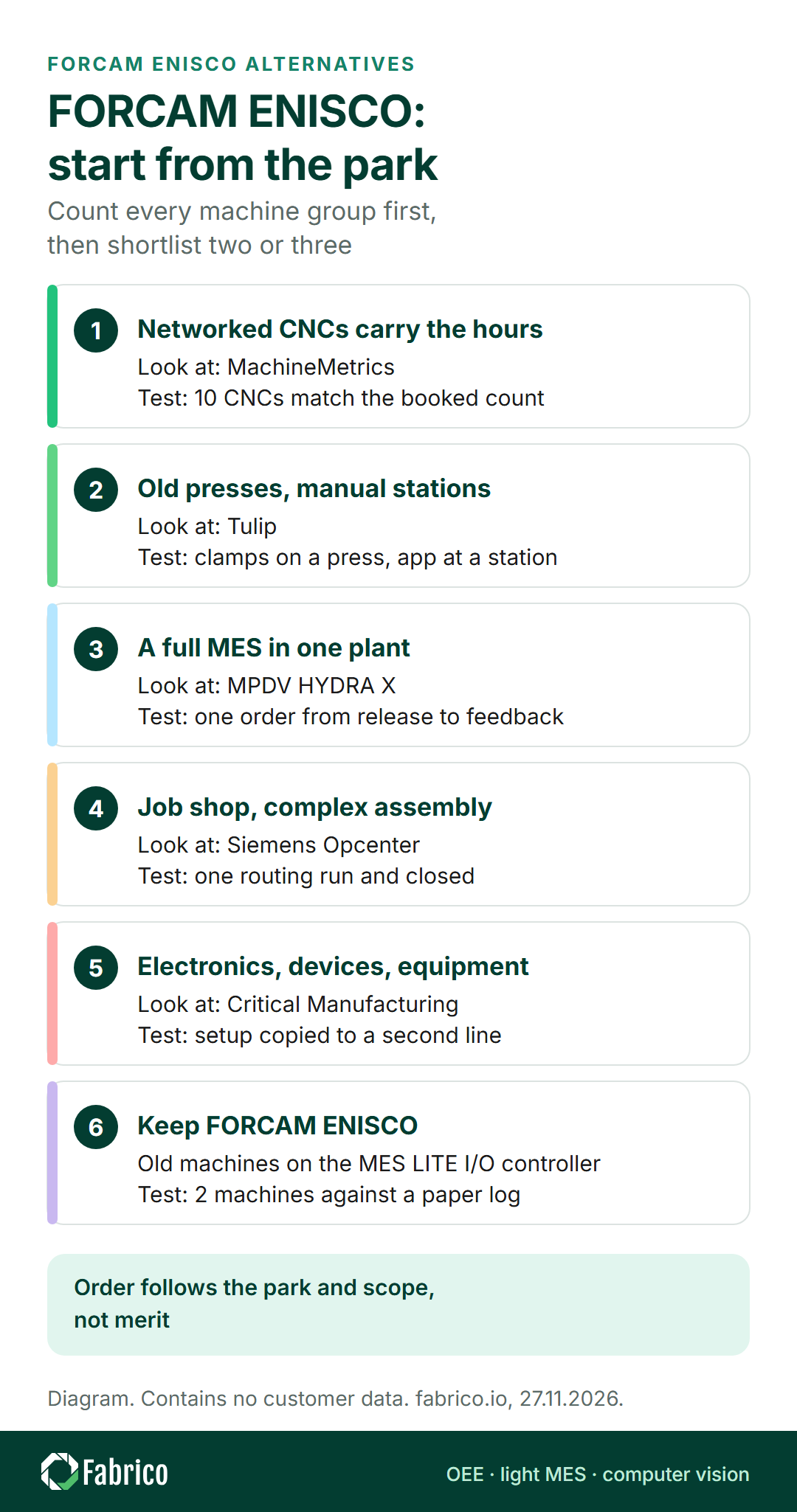
The machine-park decision card
The card puts the five situations, the option to keep and extend FORCAM ENISCO, and one pilot test for each on a single page. Bring it to the meeting that picks two or three vendors for a pilot.
Text version of the diagram
- Networked CNC controls carry the hours: look at MachineMetrics. Test: 10 CNCs whose counts match the booked quantity.
- Old presses and manual stations: look at Tulip. Test: current clamps on one press and an app at one station.
- A full MES in one plant: look at MPDV HYDRA X. Test: one order from ERP release to feedback.
- Job shop or complex assembly: look at Siemens Opcenter. Test: one routing run and closed in the system.
- Industrial equipment, medical devices or electronics: look at Critical Manufacturing. Test: the setup copied to a second line.
- Keep FORCAM ENISCO: add older machines through the MES LITE I/O controller. Test: two machines checked against a paper log.
Where Fabrico fits
Fabrico suits a first step narrower than a full MES: OEE, stops and scrap on a set of machines, including ones with no usable signal, before any MES contract is signed.
- Product: a light MES and OEE platform, with maintenance included.
- OEE: live by line and shift; for a stand-alone press or machining centre, by machine and shift.
- Connection: the machine's PLC or a Fabrico IoT device. On a press with no usable signal, a camera that covers it counts output.
- Stops, scrap and die changes: operators add the stop reason in a few taps, planned and unplanned stops are counted apart, scrap is logged by product and reason, and each die change or setup is tracked against its standard time.
- Money: losses get a EUR value per SKU in the Financial impact module, and stops are ranked by what they cost. If the network drops, the gateway buffers data for up to 30 days.
Fabrico is made by the publisher of this article.
For machines in group 3, see computer vision for OEE. To see it on one of your presses or CNCs, book a demo.
Frequently asked questions
What is FORCAM ENISCO?
FORCAM ENISCO GmbH offers FORCAM MES, an on-premise MES with MES FLEX and the entry-level MES LITE, and ENISCO, an industrial data platform built on AC4DC with shop-floor apps. Its pages name automotive, electronics, furniture, medical technology, mechanical engineering and aerospace.
What is the difference between MES FLEX and MES LITE?
MES LITE is the entry-level solution for small and medium-sized enterprises, offered as an availability package and an OEE package, with older machines on an I/O controller. MES FLEX covers traceability, order and DNC data, energy monitoring, fine planning and partner apps on a semantic data model, and MES LITE can be upgraded to it.
What are the alternatives to FORCAM ENISCO?
By situation: MachineMetrics for networked CNC parks, Tulip for older machines and manual stations, MPDV HYDRA X for a full modular MES in one plant, Siemens Opcenter for job shops and complex assembly, and Critical Manufacturing for electronics, medical devices and industrial equipment.
How can an MES connect old machines without a controller?
By adding a signal: a current clamp or stroke sensor wired to an I/O module, a camera that counts parts at the outfeed, or an entry by the operator at a terminal. Each vendor on this page describes its own route, so test it on your oldest machine during the pilot.
Which FORCAM ENISCO alternatives read CNC controls directly?
MachineMetrics says it connects 1,000+ machine controllers and reads modern controls natively. Tulip's home page names CNC machines among the equipment it connects to enterprise systems. MPDV names machine data acquisition for HYDRA X, Siemens describes linking enterprise systems with automated manufacturing equipment, and Critical Manufacturing lists equipment integration. Ask each vendor which controls on your machine list it reads without added hardware.
Does FORCAM MES run on premises or in the cloud?
FORCAM ENISCO presents FORCAM MES as an on-premise MES, with production data on the plant's own infrastructure. Its MES FLEX page also describes a multi-cloud-enabled solution and says hybrid setups of edge and cloud are possible.
Want one press or CNC priced in EUR? A demo walks a single machine through OEE live by machine and shift, the reason an operator taps in for each stop, and stops ranked by financial impact.
Latest from our blog




Real Fabrico tiles, sample data.