





 Login
 Blog
Siemens Opcenter alternatives: 6 options by the job you need done

In short
- Pick by the job: for one process standard across several plants, look at DELMIA Apriso; for food, consumer goods or batch lines, AVEVA MES or Parsec TrakSYS; for electronics, medical devices or industrial equipment, Critical Manufacturing; for apps your own engineers build, Tulip; on an Ignition SCADA, the Sepasoft MES modules.
- What Opcenter is: Siemens describes Opcenter as a MOM portfolio: MES products by industry, quality, planning and scheduling, intelligence, lab work and intra-plant logistics, plus Opcenter X as modular software as a service for the SMB market.
- Prove it on one line first: a 6-week pilot on one filling line shows what a system records. In this example the pilot finds 12,198 jars of lost output per shift and a fix worth EUR 11,793.60 a month, if the gain holds.
- Ask every vendor the same 7 questions: scope by ISA-95 activity, who configures the first line, how OEE is calculated, interfaces to the ERP and SCADA, and what a second line takes.
Plants look at Siemens Opcenter alternatives when they need to match a system to one specific job: a single standard for a group of plants, recipes on a food line, the history of every unit in discrete assembly, or a first result on one line.
This guide lists six alternatives, each described only from its vendor's own pages, and sorts them by that job.
After the six, you get a decision matrix, a 6-week pilot on one jar filling line carried through to OEE and EUR, the questions to put to every vendor and the steps for this week.
What Siemens Opcenter covers, in Siemens' own words
Siemens describes Opcenter as "a unified manufacturing operations management (MOM) solutions portfolio" (Siemens, Opcenter, accessed 27.11.2026). The portfolio page names these parts:
- Opcenter Execution: MES products for discrete, process, electronics, medical device and diagnostics, pharma and semiconductor production.
- Opcenter Quality: quality planning, control and monitoring.
- Opcenter APS: production planning and scheduling.
- Opcenter Intelligence: visibility of the actual production status and manufacturing data analytics.
- Opcenter Research, Development and Laboratory: development work for formulated products.
- Opcenter Intra Plant Logistics: material flow from the warehouse to the shop floor.
- Opcenter X: software as a service with a modular approach to MOM for the SMB market, plus Opcenter X Intosite, a cloud-based 3D digital twin.
The Execution page describes each MES by the production it serves (Siemens, Opcenter Execution, accessed 27.11.2026). Discrete is for job shops and complex assembly. Electronics is for printed circuit board, mechanical assembly and box-build production.
Medical Device and Diagnostics includes electronic device history records. Pharma offers paperless manufacturing with electronic batch recording, and Semiconductor addresses semiconductor production operations.
The portfolio page also carries a customer story from The Absolut Company in Åhus, Sweden, filed under consumer products and retail. For how Opcenter handles OEE in particular, read the Siemens Opcenter OEE review.
Why plants look at other options: four buyer jobs
A search for alternatives starts with a job, not with the current system. Four questions decide which product deserves a pilot. They apply to Opcenter as much as to any other suite on the shortlist.
Scope: which operations activities the plant needs
ISA-95, also known as IEC 62264, deals with the interface between levels 3 and 4: manufacturing operations and the business systems above them. Its Part 3 is titled Activity Models of Manufacturing Operations Management (ISA, ISA-95 standard, accessed 27.11.2026).
Use that frame as a checklist. Write down which level 3 activities the plant needs now and which can wait: production tracking, batch records, quality, inventory, maintenance, scheduling.
A plant that needs genealogy, batch records and quality across sites is shopping for a broad MOM. A plant that needs OEE, stop reasons and scrap on five lines first may be better served by a light MES, with orders and planning left in the ERP.
Time to first value on one line
The second question is what one line will show after 4-6 weeks, and who does that work: the vendor, an integrator or the plant's own engineers. The answer differs by product and by delivery model, so ask for it in writing before any plant-wide contract.
The IT stack already in the plant
A plant that runs AVEVA System Platform, Ignition SCADA or a 3DEXPERIENCE PLM can save interfaces by choosing the MES that shares that stack. Where the stack is mixed, standard interfaces matter more than the product name.
NIST's review of the smart manufacturing standards landscape gives standards three roles, one of them to "reduce risk of technology adoption and development" (Lu, Morris and Frechette, NISTIR 8107, 2016, accessed 27.11.2026). Ask each vendor which interfaces are standard and which are projects.
Plant size and the number of sites
One plant with three lines and twenty plants on three continents are different purchases. A group of plants weighs central templates and one process standard. A single plant weighs what its own team can configure and run after the integrator leaves.
For the wider category, the best MES software guide compares suites, MES software explains what an MES records, and the guide to MES alternatives for mid-sized plants compares lighter options.
Six Siemens Opcenter alternatives, sorted by the job
The six products below are ordered by the job, from the widest multi-plant scope to the lightest start on one line, not by merit. Every fact comes from the vendor's own page, linked in its section and accessed 27.11.2026. Each section ends with a way to prove the fit in a pilot.
DELMIA Apriso: one process standard for a group of plants
Dassault Systèmes describes DELMIA Apriso as a manufacturing operations management solution built to modernise and optimise global production operations (Dassault Systèmes, DELMIA Apriso, accessed 27.11.2026).
The page says it connects ERP systems with shop floor automation to unify production across multiple sites, and that process deployment across plants can be managed centrally.
Its FAQ lists production execution, quality control, warehouse management, time and labor tracking and equipment maintenance. On the ERP side the page counts over 40 standard connection points. On the engineering side it describes closed-loop synchronisation with the 3DEXPERIENCE PLM platform.
Look at it if several plants should run one process standard deployed from the centre, with links to the ERP and to product engineering. Prove it by defining one routine centrally, a changeover or a quality check, and timing how long it takes to reach a second line.
AVEVA MES: food, consumer goods and batch lines
AVEVA calls its Manufacturing Execution System a hybrid cloud MES, used on premises or through a hybrid-cloud deployment (AVEVA, Manufacturing Execution System, accessed 27.11.2026). Its FAQ names make-to-order and make-to-stock processes in food and beverages, consumer goods and specialty chemical.
The page lists measuring OEE KPIs and schedule adherence in real time, and enforcing the bill of material and pre-weight recipes. It also mentions storing execution data from multiple MES sites in the cloud.
For integration it offers native integration for AVEVA System Platform, and it describes a model-driven approach to standardising MES across sites.
Look at it if the plant runs food, consumer goods or batch production and already uses AVEVA System Platform. Prove it with recipe enforcement on one batch and OEE on the same line from the tags that already exist. A detailed Opcenter vs AVEVA MES comparison puts the two side by side.
Critical Manufacturing: complex discrete products
Critical Manufacturing presents an MES-powered industrial operations platform for manufacturers of discrete products. It names a special focus on semiconductor, electronics, medical devices and industrial equipment (Critical Manufacturing, MES for Industry 4.0, accessed 27.11.2026).
The page says the system is designed for the Industrial Internet of Things, mobile devices, automation and sensors. It describes one solution to integrate standard and IoT interfaces with no code configuration, and names equipment integration, augmented reality and digital twin technologies.
Look at it if the plant builds electronics, medical devices or industrial equipment, the same discrete fields that Opcenter Execution covers, and every unit needs its own history. Prove it by tracing one serial number through every step of one line, with the equipment data attached.
Parsec TrakSYS: configured MES apps for food and CPG lines
Parsec calls TrakSYS a purpose-built MES platform with configurable, production-ready MES applications (Parsec, TrakSYS, accessed 27.11.2026). The page names food and beverage, life sciences, consumer packaged goods, specialty chemicals, automotive and industrial manufacturing.
For food and beverage it stresses quality, traceability and uptime in high-speed, high-volume settings. Its functions include measuring and improving OEE with real-time performance tracking, consistent batch execution with traceability, and low-code tools to connect the ERP, SCADA, LIMS and historians.
Delivery can be led by Parsec, by a certified integrator, by the customer's own team, or by a mix of the three.
Look at it if a food, beverage or CPG plant wants OEE and batch on configured applications and wants to choose who delivers them. Prove it with OEE and stop reasons on one line, built by the team that would do the rollout. The guide to MES for food manufacturing covers the category for food plants.
Tulip: apps your own engineers build
Tulip presents itself as a frontline operations platform where apps are built on a common data model with no coding required (Tulip, Platform, accessed 27.11.2026). Machines, sensors, cameras, enterprise systems and operator entries connect to the same data model.
Its composable MES page describes "a composable, AI-native manufacturing execution system" and gives technical and engineering teams no-code tools with governance (Tulip, Composable MES, accessed 27.11.2026). It names a cloud-native architecture with an open API, reusable building blocks, and starting with the biggest challenges first.
Look at it if process or CI engineers want to build and change the station apps themselves, one process at a time. Prove it by having one engineer build a changeover or in-process check app during the pilot without outside help, and by agreeing who maintains it afterwards.
Ignition with Sepasoft MES modules: MES on the SCADA already in place
Inductive Automation describes Ignition as one industrial platform for SCADA, IIoT, MES and more: server software that acts as the hub for the plant floor, with web clients launched from an on-premise or cloud-based server (Inductive Automation, Ignition, accessed 27.11.2026).
Sepasoft builds its MES suite on the Ignition platform (Sepasoft, MES Suite, accessed 27.11.2026). Its modules include OEE Downtime, Track & Trace, Batch Procedure, SPC, Settings & Changeover and Finite Scheduling.
The MES and the HMI/SCADA layers use the same client and designer. Sepasoft states that its MES scales from a single site to a global enterprise.
Look at it if the plant already runs Ignition and its integrator wants MES functions in the same tool. Prove it by adding the OEE and downtime module to the existing Ignition project on one line, and by checking who maintains the reason list and the shift calendar.
If the job is narrower, OEE, stops and scrap on a handful of lines, compare light MES vs OEE software first. The guide to lightweight MES for small manufacturers covers single-site plants.
Decision matrix: where to look first
Each row is a situation that separates one product from the others. The "why" column repeats only what that vendor's own page says, and the last column is the test that settles it on one line.
| If this is you | Look first at | Why (from the vendor's own page) | Prove it in the pilot by |
|---|---|---|---|
| Several plants, one process standard, ERP and PLM links | DELMIA Apriso | Connects the ERP with shop floor automation across sites; deployment managed centrally | Rolling one central routine out to a second line |
| Food, consumer goods or batch lines on AVEVA System Platform | AVEVA MES | Names food and beverages and consumer goods; pre-weight recipes; native System Platform integration | A recipe check on one batch plus OEE from existing tags |
| Electronics, medical devices, semiconductor or industrial equipment | Critical Manufacturing | Discrete products with these four industries in focus; IoT and equipment integration | Tracing one serial number through one line |
| Food, beverage or CPG lines that want configured apps and a choice of delivery team | Parsec TrakSYS | Configurable MES apps; OEE tracking; batch execution; four delivery models | OEE and stop reasons on one line, built by the rollout team |
| Engineers who want to build and change the apps | Tulip | No-code apps on a common data model; composable MES with an open API | One engineer building one app without outside help |
| A plant already on Ignition SCADA | Ignition with Sepasoft | MES modules built on Ignition; same client and designer as SCADA | Adding OEE and downtime to the existing project |
A plant that fits two rows pilots both products on the same line, one after the other, with the same baseline. Then the results compare like for like.
Worked example: a 6-week pilot on one jar filling line
The example below is sample data, not a customer's, and it claims no vendor's results. It shows what a buyer would measure in a pilot with any of the six products, and how the losses carry through to OEE and EUR.
The line and the pilot plan
- Line: sauce jars, a filler and a capper, ideal rate 100 jars a minute.
- Time: two shifts a day with 480 planned minutes each, 21 working days a month, so 42 shifts a month.
- Week 1: connect the jar count at the capper and the filler stop signal, agree a list of 12 stop reasons and a 25-minute changeover standard.
- Weeks 2-3: baseline, no changes on the line.
- Weeks 4-5: act on the two losses that can be fixed fastest.
- Week 6: compare and decide.
What the baseline measured, per shift
The baseline is the average of the 20 shifts in weeks 2 and 3. Every loss is converted into jars of ideal output, so the rows add up to the 48,000 jars the line could make in 480 minutes.
| Where the shift went | Per shift | Jars of ideal output |
|---|---|---|
| Changeover (one a shift, standard 25 min) | 40 min | 4,000 |
| Breakdowns and stops over 5 min | 32 min | 3,200 |
| Short stops and slow running | 40.8 min equivalent | 4,080 |
| Scrap: underfilled jars and cap rejects | 918 jars | 918 |
| Good jars | 35,802 jars | 35,802 |
| Planned time | 480 min | 48,000 |
In all, the shift loses 12,198 jars against its ideal output: 48,000 - 35,802. From the table, OEE takes four steps:
- Availability: (480 - 40 - 32) / 480 = 408 / 480 = 85.0%
- Performance: 36,720 jars counted / (408 min × 100) = 36,720 / 40,800 = 90.0%
- Quality: 35,802 good / 36,720 counted = 97.5%
- OEE: 0.85 × 0.90 × 0.975 = 74.6% (74.5875% before rounding). Check: 35,802 / 48,000 = 74.6%.
The jar counter splits the speed loss. There were 52 short stops a shift averaging 30 seconds, 26 minutes in all, 34 of them at the capper. Slow running took the other 14.8 minutes.
Why count short stops at all: in a peer-reviewed study of bottling lines at San Benedetto, micro downtime, defined as stops under 15 minutes, covered 57 percent of the inefficiency on the least efficient line studied (Zennaro et al., International Journal of Quality & Reliability Management, 2018, accessed 27.11.2026). A pilot that logs only long stops can miss that loss.
What the fix is worth, if the gain holds
In weeks 4 and 5 the team acts on the two losses it can fix fastest. A prepared changeover cart and a checklist bring the changeover from 40 to 28 minutes. Adjusting the cap chute lifts performance from 90% to 92%. Breakdowns and scrap stay as they were.
- Availability: (480 - 28 - 32) / 480 = 420 / 480 = 87.5%
- Jars counted: 420 × 100 × 0.92 = 38,640
- Good jars: 38,640 × 0.975 = 37,674
- OEE: 0.875 × 0.92 × 0.975 = 78.5% (78.4875% before rounding), up 3.9 points
- Extra good jars: 37,674 - 35,802 = 1,872 a shift
In this example the contribution margin is EUR 0.15 a jar. So 1,872 × EUR 0.15 = EUR 280.80 a shift. Over 42 shifts that is EUR 11,793.60 a month, and over 12 months EUR 141,523.20 a year, if the gain holds and the extra jars can be sold.
If demand is flat, the same gain shows up as time. Ten shifts a week make 358,020 good jars today. At 37,674 good jars a shift, the same volume needs 9.5 shifts (rounded), so in this example about 4 hours of line time a week are freed.
Use your own margin, rate and shift pattern. The method is the same with any of the six products: count, add the reason, convert to jars, then to EUR.
Questions to ask every vendor
Send the same questions to each vendor on the shortlist and ask for written answers, so the replies compare line by line.
- Which ISA-95 level 3 activities does the product cover as standard, and which need configuration or code?
- What will one line show after 4-6 weeks, and who does the work: the vendor, an integrator or plant staff?
- How is a stop signal collected from an older machine that has no usable PLC signal?
- How is OEE calculated: what counts as planned time, where do short stops go, and which KPI formulas does the product follow?
- Which interfaces to the ERP, the SCADA and the historian exist as standard, and which are projects?
- How does a second line or a second plant get the same setup: a copied template or a new project?
- Who maintains the reason lists, shift calendars and screens after go-live, and with what training?
On question 4, a reference helps. ISO 22400 defines key performance indicators used in manufacturing operations management. ISO 22400-2:2014 specifies a selected number of KPIs with their formula, time behaviour and unit (ISO 22400-2:2014, accessed 27.11.2026).
The ISO page lists the 2014 edition as to be revised. A vendor that names its formulas makes pilot results from two products comparable.
What to do this week
- Write the job on one page: the three losses that cost the most on one line, and what must stay in the ERP.
- Pick the pilot line: a filling or packaging line with a clean output count and a known changeover standard.
- Pull two weeks of the data you already have: shift reports, stop logs and scrap counts. This paper baseline is what the pilot will test.
- Shortlist two or three products from the matrix and send each the seven questions above.
- Agree the pilot success line in advance: for example, the baseline OEE, the changeover against its standard, and short stops counted with reasons.
- Book the people: the line lead, a maintenance technician and an IT contact for the network and the signals.
None of these steps needs a contract. They make the first vendor meeting about your line instead of a general demo.
The decision card for the shortlist meeting
The card puts the six jobs on one page for the meeting where the shortlist is agreed. Each line starts from the need and names where to look first.
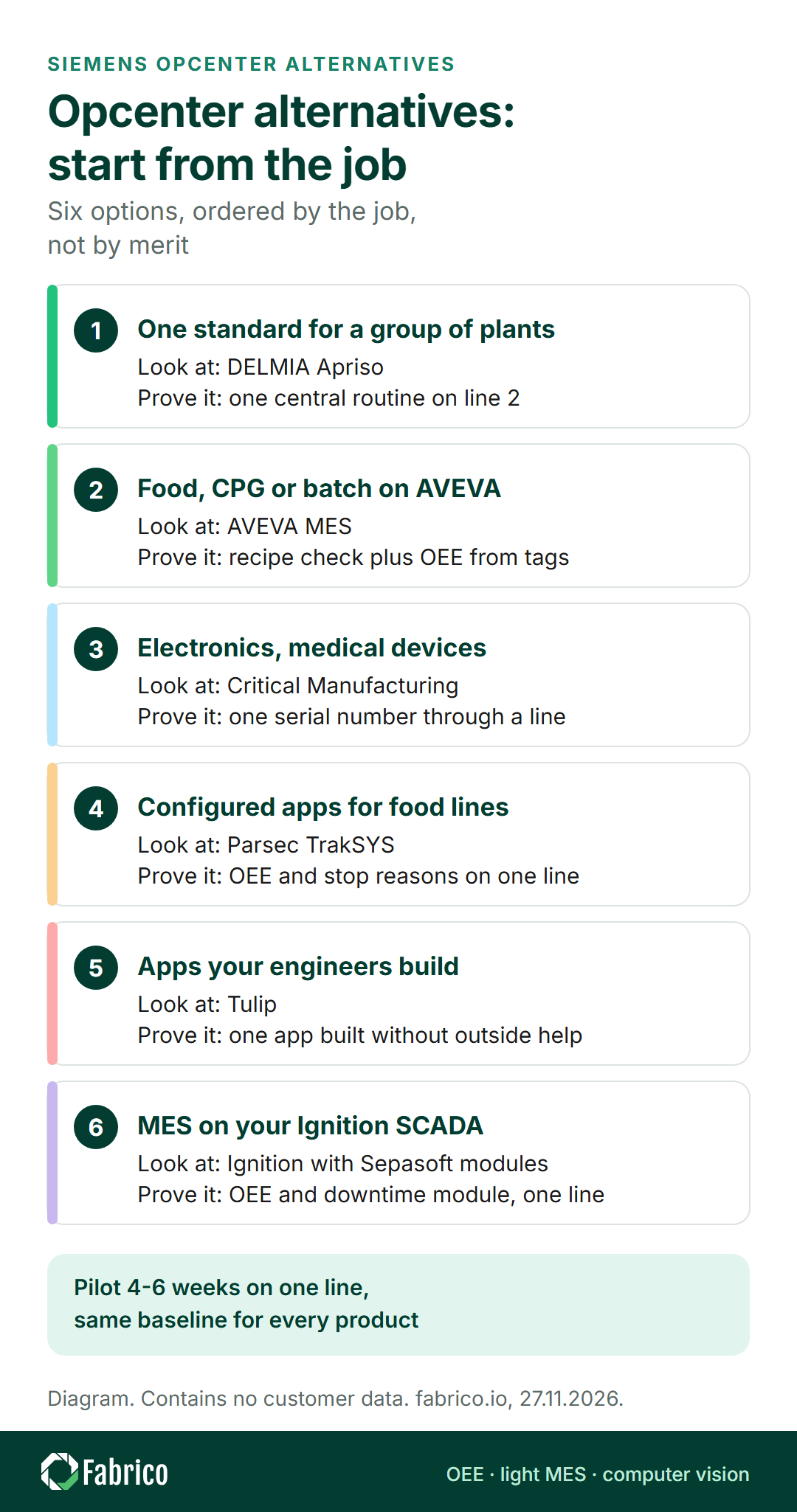
Text version of the diagram
- One standard for a group of plants: look at DELMIA Apriso.
- Food, consumer goods or batch on AVEVA System Platform: look at AVEVA MES.
- Electronics, medical devices or industrial equipment: look at Critical Manufacturing.
- Configured MES apps for food and CPG lines: look at Parsec TrakSYS.
- Apps your own engineers build: look at Tulip.
- MES on the Ignition SCADA you run: look at Ignition with Sepasoft MES modules.
Where Fabrico fits
For a plant whose first job is OEE, stops and scrap on a few lines, before a wider MOM decision:
- Fabrico is an OEE platform and light MES with maintenance built in.
- It shows live OEE by line and shift; on a linked line OEE is read at the core machine. Operators add the stop reason in a few taps, and planned and unplanned stops are kept apart.
- Scrap is recorded by product and reason, and changeovers are tracked against a standard time.
- Machines connect through the line PLC or a Fabrico IoT device; where a camera covers the line, it counts output.
- The Financial impact module prices losses per SKU and sorts stops by their financial impact. The plan stays in the ERP or a spreadsheet; Fabrico supplies measured rates.
Fabrico is made by the publisher of this article.
See the OEE and light MES overview or book a demo.
Frequently asked questions
What is Siemens Opcenter used for?
Siemens describes Opcenter as a unified MOM portfolio. It covers manufacturing execution by industry, quality management, planning and scheduling, manufacturing intelligence, lab work for formulated products and intra-plant logistics.
Is Siemens Opcenter an MES or a MOM suite?
Both terms apply. Siemens calls Opcenter a MOM portfolio, and the Opcenter Execution products inside it are MES products for discrete, process, electronics, medical device, pharma and semiconductor production.
What are the alternatives to Siemens Opcenter?
By the job: DELMIA Apriso for one standard across several plants, AVEVA MES and Parsec TrakSYS for food, consumer goods and batch lines, Critical Manufacturing for complex discrete products, Tulip for engineer-built apps, and Sepasoft modules for plants on Ignition.
What is Opcenter X?
Siemens describes Opcenter X as software as a service with a modular approach to MOM for the SMB market. Opcenter X Intosite, a cloud-based digital twin, belongs to the same family.
Which Opcenter alternatives name food and beverage plants?
Of the six here, AVEVA names food and beverages and consumer goods on its MES page, and Parsec names food and beverage and consumer packaged goods for TrakSYS. A pilot on one of your own lines shows the fit.
Can an MES be tested on one line before a plant-wide rollout?
Yes. A 4-6 week pilot on one line, with a baseline, a fix and a comparison, shows what the system records and what the losses cost. Agree the success line before the pilot starts.
Want to see one line's losses in EUR? The demo shows live OEE by line and shift, stops with the reasons operators add in a few taps, scrap by product and reason, and the losses priced per SKU.
Latest from our blog


Real Fabrico tiles, sample data.