





 Login
 Blog
Parsec TrakSYS alternatives: 6 options by the job you need done

In short
- Start from your situation: if several plants need one process standard, look at DELMIA Apriso or AVEVA MES. If plant engineers will build and own the system, look at Ignition with Sepasoft MES modules or Tulip. If the data already exists but sits in separate systems, look at Sight Machine; if process variability costs the most margin, look at Braincube.
- What TrakSYS is: Parsec calls it a purpose-built MES platform for batch, discrete and continuous production, and food and beverage plus consumer packaged goods are two of the six industries on its page.
- Decide with a pilot, not a demo: a 30-day pilot on one line, scored on seven weighted criteria, shows which product records your losses as they happen.
- In this example: two fixes on a yogurt cup line lift OEE from 68.6% to 73.2%, worth EUR 12,224.52 a month and EUR 146,694.24 a year if the gain holds.
Plants look for Parsec TrakSYS alternatives for different reasons. One group wants a standard it can roll out to every site. Another wants its own engineers to build the system. A third wants answers from data it already collects before it changes how orders run.
Each reason points to different products. This page describes six alternatives using only their vendors' own pages, maps them to three plant situations, and gives you a 30-day pilot scorecard plus a worked example on a dairy line in EUR.
What Parsec says TrakSYS is built for
Parsec describes TrakSYS as a "purpose-built MES platform" and as a unified MES platform for real-time operations (Parsec, TrakSYS, accessed 27.11.2026). The same page says it supports batch, discrete and continuous manufacturing.
Parsec lists six industries. Two of them, food and beverage and consumer packaged goods, are the industries this page is written for. The other four are life sciences, automotive, specialty chemicals and industrial manufacturing. For food plants, Parsec stresses product quality, traceability and uptime on fast lines that run high volumes.
The functions Parsec lists on its own pages:
- Performance: OEE measured and improved through performance tracking in real time. The performance page adds changeover management, planning and scheduling, and enterprise reporting (Parsec, Performance, accessed 27.11.2026).
- Batch, quality and traceability: consistent batch execution, quality standards with deviation monitoring, and tracking of materials and processes through production.
- For food plants: digital quality checks, recipe and batch management, yield monitoring and waste reduction, and traceability and recall management. Parsec also says TrakSYS enforces HACCP and GMP compliance digitally (Parsec, Food & Beverage, accessed 27.11.2026).
- Integration: connections to ERP, SCADA, LIMS and historians with low-code tools.
On delivery, Parsec names four models: Parsec-led, system integrator-led, customer DevOps-led and a hybrid of the three. Its method runs through discovery, design, deployment and adoption, for a first plant or a global rollout.
If TrakSYS stays on your shortlist, the TrakSYS vs PINpoint comparison sets it next to one other MES.
Three plant situations that start a TrakSYS comparison
A comparison is easier when it starts from the job the plant needs done rather than from a feature list. Three situations lead food, beverage and CPG teams to look past one vendor. Each one has a different owner and a different first question.
Several plants, one way of working
The job: the same processes, KPIs and reports at every site, with orders coming down from the ERP and results going back up. IT and the group operations team lead this project.
ISA-95, also published as ANSI/ISA-95 and IEC 62264, primarily deals with the interface between level 3, manufacturing operations management, and level 4, business planning and logistics (ISA, ISA-95 standard, accessed 27.11.2026). In this situation the first question is how one template moves from plant to plant across that interface.
Plant engineers build and own the system
The job: add MES functions with the plant's own control and process engineers doing most of the configuration, and keep changing it after go-live. The engineering team leads.
The first question here is not what the product does on day one. It is what a plant engineer can build, change and support alone in month six.
Answers from existing data before new execution software
The job: the plant already has controls, historians, a SCADA and an ERP. The CI or operations team wants to see where output and margin go before it changes how work orders run on the floor.
Operations lead, and the first question is whether the data already collected can be joined into one consistent picture of each line.
Situation to shortlist, in one table
The rows below are the ones that split the six products. Each "why" comes from the vendor's own page, cited in the next section.
| If this is you | Look first at | Why (vendor's own page) | Prove it in the pilot by |
|---|---|---|---|
| A group of plants must run one process standard | DELMIA Apriso | Rolls out standardised workflows to several facilities at once | Copying the pilot line setup to a second line and logging the hours |
| Food or consumer goods lines with recipes and a bill of materials | AVEVA MES | Enforces the BOM and pre-weight recipes; names food and beverages | Running one recipe batch through the weigh step in the system |
| Ignition already runs the SCADA | Ignition with Sepasoft MES modules | Sepasoft MES is built on the Ignition platform | OEE and downtime on one line from tags that exist today |
| Engineers want to build and change their own screens | Tulip | No-code capabilities for technical and engineering teams | A plant engineer building one changeover app without the vendor |
| Data sits in historians, MES and ERP with no shared model | Sight Machine | Connects OT and IT systems into one structured model of the plant | The same OEE from the model as from a hand count |
| Output swings with conditions on a process line | Braincube | Captures the conditions, constraints and variability that affect performance | Naming the variables behind one loss on one product |
Six alternatives, grouped by situation
The six products below follow the order of the three situations; that order says nothing about merit. Each description draws only on that vendor's own pages, accessed 27.11.2026. For the wider field, see the guide to best MES software; the guide to MES alternatives for mid-sized plants compares lighter options.
DELMIA Apriso: one process standard across sites
In Dassault Systèmes' words, DELMIA Apriso is a MOM solution. It links ERP systems with the automation on the shop floor, so that production at multiple sites runs as one (DELMIA Apriso product page, accessed 27.11.2026).
The functions on the page cover execution, quality control, the warehouse, time and labor, and equipment maintenance. For the ERP link the page cites more than 40 standard connection points, and it describes standardised workflows rolled out to several facilities at once.
Look at it if the brief is a group standard, written once and deployed to every plant in the group, with the ERP link at the centre. First step on the page: speak with a DELMIA expert through the contact form.
AVEVA MES: model-driven MES for food and consumer goods
Among the repetitive volume environments it serves, AVEVA's MES page lists food and beverages and consumer goods, as well as specialty chemical (AVEVA MES product page, accessed 27.11.2026).
The page describes OEE KPIs and schedule adherence measured in real time, enforcement of the bill of materials and pre-weight recipes, and automated quality sample plans. For several sites it describes a "model-driven MES approach" with reusable equipment templates.
AVEVA MES runs on premises or in a hybrid-cloud deployment, with native integration for AVEVA System Platform.
Look at it if food or consumer goods lines need recipe and BOM control and the same KPIs at more than one site. First step on the page: watch a demo or speak with an AVEVA product expert.
Ignition with Sepasoft MES modules: execution added to the SCADA
Inductive Automation positions Ignition as the server-side hub for everything on the plant floor, covering SCADA, IIoT and MES. Clients open in a browser from a server that sits on premises or in the cloud (Ignition product page, accessed 27.11.2026).
Sepasoft's MES suite runs on top of Ignition, the page says (Sepasoft home page, accessed 27.11.2026). The module list on the page runs from OEE Downtime and SPC to Batch Procedure, Track & Trace and Settings & Changeover, and Sepasoft says the suite can grow from one site to a global enterprise.
Look at them if Ignition already runs the plant's SCADA and the control engineers will own the MES. First steps on the pages: Ignition offers a download to try it, and Sepasoft offers a design consult and a Quick Start Program.
Tulip: apps that plant engineers compose
Tulip calls its product "a composable, AI-native manufacturing execution system" (Tulip, Composable MES, accessed 27.11.2026). The page offers technical and engineering teams no-code tools to compose solutions, with an open API on a cloud-native architecture.
The rollout Tulip describes starts with the highest-impact operations and the biggest challenges first, in place of an all-or-nothing deployment. Tulip's industries page lists ten industries, among them food and beverage, consumer goods, pharmaceutical manufacturing and medical devices (Tulip, Industries, accessed 27.11.2026).
Look at it if the plant has engineers who want to build, test and change their own screens, one operation at a time. First step on the page: request a demo or map the plant with Tulip.
Sight Machine: one data model over the systems you have
Sight Machine says it connects every OT and IT system, from controls and historians to MES and ERP, and maps the physical plant into one structured model. It turns raw signals into production events and KPIs (Sight Machine, accessed 27.11.2026).
Its Manufacturing Context Layer page names four core schemas: cycles, parts, downtime and defects. It gives OEE as availability × performance × quality and stresses KPIs defined once and applied consistently (Sight Machine, Manufacturing Context Layer, accessed 27.11.2026).
Look at it if the plant already collects data in several systems and the first job is one consistent picture across lines or sites. First step on the page: request a demo.
Braincube: process conditions and variability
Braincube presents its product as real-time process optimization that turns variability into margin (Braincube, accessed 27.11.2026). Its platform page calls it a Productivity Management System, working on live and historical production data (Braincube, Platform, accessed 27.11.2026).
The first of its steps, Reveal, is to capture the real conditions, constraints and variability affecting performance. Later steps steer the process and keep operators, engineers and systems aligned.
Look at it if output and yield on a process line move with raw material and running conditions, and the CI team wants to know which variables matter. First step on the page: contact sales.
When the first need is smaller, for example OEE, stops and scrap on two or three lines, read the guides to light MES and to MES for food manufacturing.
Side by side: focus, plant fit and first step
The table puts TrakSYS next to the six. "Plant fit" is what each vendor's page names, so it shows where a vendor points, not every plant it serves.
| Product | Built around | Plant fit named on its pages | First step on its page |
|---|---|---|---|
| Parsec TrakSYS | A configurable MES platform for batch, discrete and continuous production | Food and beverage, CPG, life sciences, specialty chemicals, automotive, industrial | Speak with an advisor; a tailored proposal |
| DELMIA Apriso | A MOM standard deployed across sites with the ERP | Manufacturers unifying production across multiple sites | Speak with a DELMIA expert |
| AVEVA MES | Model-driven MES with recipe and BOM enforcement | Food and beverages, consumer goods, specialty chemical | Watch a demo; speak with an expert |
| Ignition with Sepasoft | MES modules on the Ignition platform | A single site up to a global enterprise | Download Ignition to try; Sepasoft design consult |
| Tulip | Composable no-code apps on an open API | Ten industries, among them food and beverage, consumer goods and pharma | Request a demo; map the plant |
| Sight Machine | One data model over OT and IT systems | Plants with controls, historians, MES and ERP in place | Request a demo |
| Braincube | Real-time process optimization against variability | Production where conditions keep changing | Contact sales |
Sight Machine names MES among the systems it connects, and Braincube works on live and historical production data. A plant can start with either one and decide on execution software later, with better data in hand.
A 30-day pilot scorecard you can copy
A demo shows the product. A pilot shows your line inside it. The scorecard turns a pilot into a pass or fail that you agree with each vendor before day one, so every product is tested the same way.
The weights suit a filling or packaging line. Change them to fit your job, but fix them before the pilot starts.
| Criterion | Weight | How to measure on the floor | Pass mark |
|---|---|---|---|
| 1. Stop capture | 25 | Compare stop minutes in the system with a paper log kept by the line lead for 3 shifts | 95% of stop minutes carry a reason by day 30 |
| 2. Count accuracy | 20 | Reconcile the system count with packed cases for 5 shifts | Within 1% on every shift |
| 3. OEE you can rebuild | 15 | Recompute 2 shifts by hand from the raw stop and count records | Hand result within 0.5 points |
| 4. Operator effort | 15 | Time 20 stop-reason entries at the line | Median under 15 seconds; no paper log after week 2 |
| 5. Changeover view | 10 | Check each changeover in days 20-30 against its standard time | Every changeover shows start, end and standard |
| 6. Plant ownership | 10 | A plant engineer adds a stop reason and changes a shift calendar | Done without the vendor |
| 7. Second line | 5 | Ask for the hours and people needed to add the next line | A written plan with hours |
Scoring is simple: a pass earns the full weight and a fail earns zero. A product passes the pilot at 75 points or more, with criteria 1 and 2 both passed. Without those two, the pilot data cannot carry a business case.
Where the criteria come from
Criterion 1 depends on the reason list as much as on the count.
In a peer-reviewed case study of an automated ice cream line, Tsarouhas analysed eight months of data and examined six major losses with Pareto analysis: equipment failure, setup and adjustment, idling and minor stoppage, reduced speed, process defects and reduced yield (Tsarouhas, International Journal of Productivity and Performance Management, 2020, accessed 27.11.2026).
A pilot stop list grouped under those six headings sorts the losses the same way in every product you test.
Criterion 3 needs a shared definition. Per the ISO committee page, ISO 22400 sets out KPIs for manufacturing operations management, and Part 2 gives each one with its formula and elements, its time behaviour and its unit (ISO 22400-2:2014 on committee.iso.org, accessed 27.11.2026). The same page marks that 2014 edition for revision.
Ask every vendor which formula its OEE follows, then rebuild two shifts by hand. If the numbers match, two pilots on two products can be compared.
Worked example: 30 days on a yogurt cup line
Every number below is invented to show the method: no customer's data and no vendor's results. The example follows criteria 1 and 2 on one line, then prices the measured losses in EUR.
The line and the 30 days
- Line: 150 g yogurt cups, a cup filler and sealer feeding a case packer, ideal rate 150 cups a minute.
- Time: three shifts a day of 450 planned minutes, 22 production days a month, so 66 shifts a month.
- Days 1-5: connect the cup count after the sealer and the filler stop signal, agree 14 stop reasons grouped under the six losses, and set a 40-minute standard for a flavour changeover with rinse.
- Days 6-19: a baseline of 30 shifts with no changes on the line.
- Days 20-30: two fixes, then a comparison.
The baseline, per shift
Each loss is converted into cups at the ideal rate, so the rows add up to 67,500 cups: 450 minutes × 150 cups.
| Loss | Per shift | Cups at ideal rate |
|---|---|---|
| Flavour changeover with rinse | 52 min | 7,800 |
| Breakdowns over 5 minutes | 38 min | 5,700 |
| Short stops (90 × 20 seconds) | 30 min | 4,500 |
| Slow running | 15 min equivalent | 2,250 |
| Scrap: seal and weight rejects | 945 cups | 945 |
| Good cups | 46,305 cups | 46,305 |
| Planned time | 450 min | 67,500 |
From the table, OEE in four lines:
- Availability: (450 - 52 - 38) / 450 = 360 / 450 = 80.0%
- Performance: 47,250 cups counted / (360 min × 150) = 47,250 / 54,000 = 87.5%
- Quality: 46,305 good / 47,250 counted = 98.0%
- OEE: 0.80 × 0.875 × 0.98 = 68.6%. Check: 46,305 / 67,500 = 68.6%.
The reasons told the rest of the story. Operators gave lidding film feed at the sealer as the reason for 61 of the 90 short stops. The changeover ran 12 minutes over its 40-minute standard, mostly while film rolls were fetched from the store.
What two fixes are worth, if the gain holds
In days 20-30 the team made two changes. Film rolls staged before each changeover and a light-to-dark flavour order cut the changeover from 52 to 43 minutes. A film tension adjustment at the sealer cut short stops from 30 to 18 minutes a shift. Breakdowns, slow running and the scrap rate stayed as they were.
- Availability: (450 - 43 - 38) / 450 = 369 / 450 = 82.0%
- Cups counted: (369 - 18 - 15) × 150 = 336 × 150 = 50,400
- Performance: 50,400 / (369 × 150) = 50,400 / 55,350 = 91.1% (rounded)
- Good cups: 50,400 × 0.98 = 49,392
- OEE: 49,392 / 67,500 = 73.2% (73.17% before rounding), up 4.6 points
- Extra good cups: 49,392 - 46,305 = 3,087 a shift
Take a contribution margin of EUR 0.06 a cup in this example. Then 3,087 × EUR 0.06 = EUR 185.22 a shift; × 66 shifts = EUR 12,224.52 a month; × 12 months = EUR 146,694.24 per year, if the gain holds and buyers take the extra cups.
If the extra cups cannot be sold, count the gain as line time instead. In this example 3,087 cups at 150 a minute are 20.6 minutes of running at the ideal rate per shift (20.58 before rounding), time that can go to cleaning, a product trial or a shorter week.
The money only stands if the pilot also passed criteria 1 and 2. With 95% of stop minutes carrying a reason and the count within 1% of packed cases, these numbers can go into a business case. Put in your own rate, margin and shift pattern; the steps stay the same.
Seven questions to send each vendor before the pilot
Send the same list in writing to every vendor on the shortlist. Written answers to identical questions can be laid side by side, and they become part of the pilot agreement.
- Which screens and reports will the pilot line show on day 30, and which of them come as standard rather than built for this pilot?
- What has to be wired, installed or configured on the pilot line, and who does each part: the vendor, an integrator or plant staff?
- Can two pilot shifts be recomputed by hand from the raw stop and count records, and which KPI formula does the product use for OEE?
- How does a recipe or SKU change reach the line: from the ERP, from a batch system or typed in at the line?
- Which orders, materials and results cross between the product and the ERP, and in which direction?
- Which changes can a plant engineer make alone after the pilot: a new stop reason, a new SKU, a new shift pattern?
- Which dairy, beverage or food plant of a similar size can be called as a reference, and what did its second line take?
On question 5, ISA's page says the goal of ISA-95 Part 2 is to "reduce the risk, cost and errors associated with implementing the interface" between enterprise and control systems. An answer framed in ISA-95 terms is easier to compare across vendors.
This week: five steps before the first vendor call
- Name the situation in one sentence: a group standard, a system your engineers own, or answers from existing data.
- Pick one pilot line with a clean output count after the last machine and one person who owns the result.
- Start a paper stop log on that line now for three shifts. It becomes the reference for criterion 1.
- Copy the scorecard, set your weights and pass marks, and send it with the seven questions to two or three vendors.
- Write down the margin per unit and the shift pattern, so the pilot result can be priced the day it ends.
None of these steps needs a purchase order, and each one makes the first vendor meeting about your line.
One card for the shortlist meeting
The card below puts the three situations, the six products and the pass rule on one page, for the meeting where two or three products go forward to a pilot.
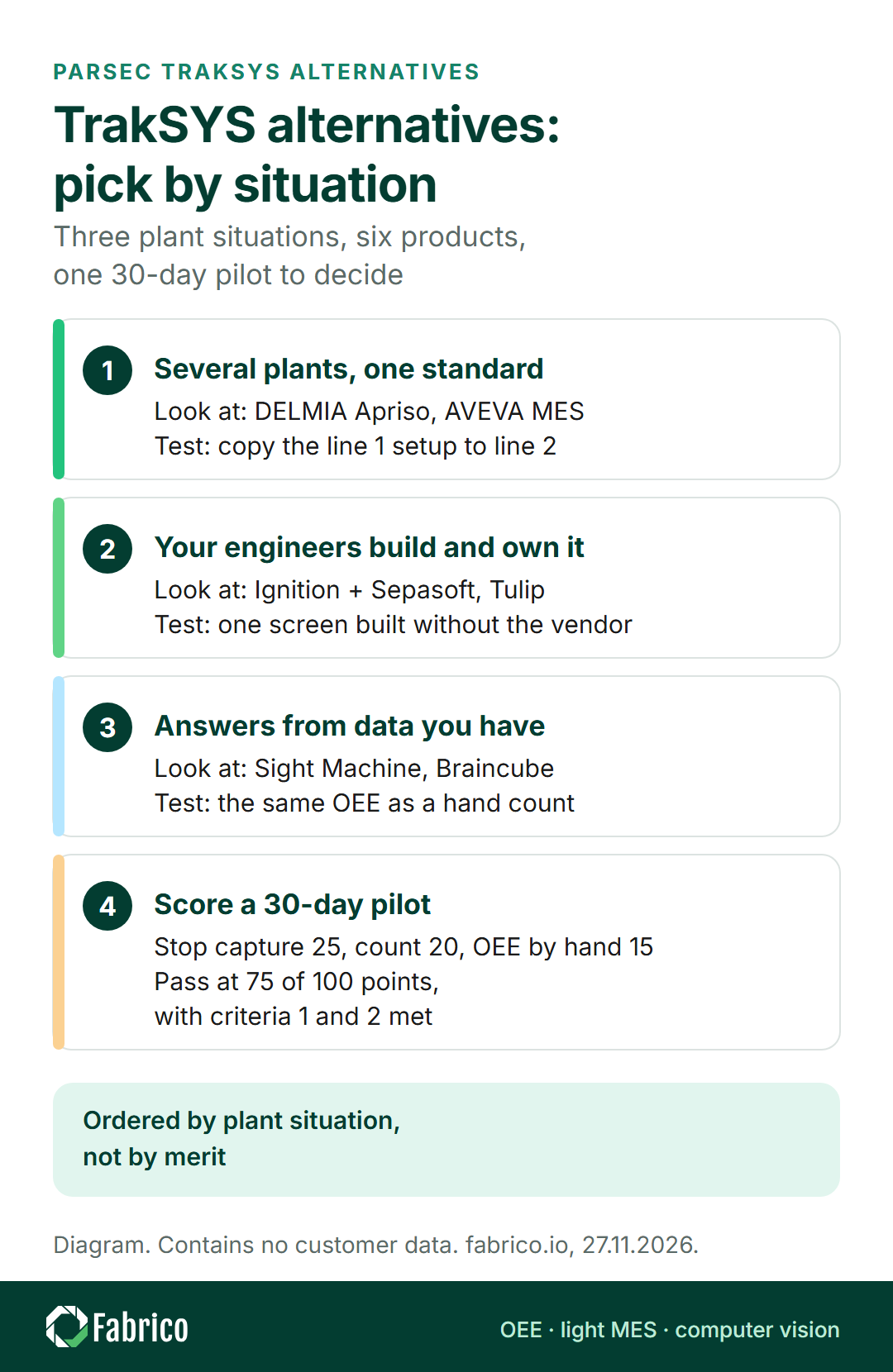
Text version of the diagram
- Several plants, one standard: look at DELMIA Apriso or AVEVA MES. Test: copy the line 1 setup to line 2.
- Your engineers build and own it: look at Ignition with Sepasoft MES modules or Tulip. Test: one screen built without the vendor.
- Answers from data you already have: look at Sight Machine or Braincube. Test: the same OEE as a hand count.
- Score a 30-day pilot: stop capture 25, count accuracy 20, OEE rebuilt by hand 15. Pass at 75 of 100 with criteria 1 and 2 met.
Where Fabrico fits
Fabrico is relevant when the first step is narrower than an MES: OEE, stops and scrap on one line or a handful, while the larger decision stays open.
- What it is: an OEE platform and light MES; maintenance is built in.
- OEE: live by line and shift. For a linked line such as a cup filler and sealer, it is read at the core machine.
- Stops and scrap: operators add the stop reason in a few taps; planned stops are counted apart from unplanned ones, and scrap is logged per product and per reason.
- Changeovers: tracked against a standard time, the same check as criterion 5 of the scorecard.
- Money and connection: losses are priced per SKU in the Financial impact module, with stops ranked by financial impact. Data comes from a Fabrico IoT device or the line PLC; where a camera covers the line, it counts output.
Fabrico is made by the publisher of this article.
The OEE and light MES overview has the details; to see it with one of your lines in mind, book a demo.
Frequently asked questions
What is Parsec TrakSYS used for?
Parsec describes TrakSYS as a purpose-built MES platform. Its pages cover OEE and performance tracking, changeovers, batch execution, quality, traceability and inventory, with connections to ERP, SCADA, LIMS and historians.
Is TrakSYS an MES?
Yes. Parsec calls TrakSYS a unified MES platform and says it supports batch, discrete and continuous manufacturing.
Which industries does TrakSYS serve?
Parsec lists six: consumer packaged goods, food and beverage, specialty chemicals, life sciences, automotive and industrial manufacturing. For food plants it stresses quality, traceability and uptime on fast, high-volume lines.
What are the alternatives to Parsec TrakSYS?
By situation: DELMIA Apriso and AVEVA MES for one standard across plants, Ignition with Sepasoft MES modules and Tulip for systems your engineers build, and Sight Machine and Braincube for answers from data you already collect.
Which TrakSYS alternatives run on an existing SCADA?
Sepasoft's MES suite is built on the Ignition platform from Inductive Automation, so a plant that already runs Ignition as its SCADA can add MES modules such as OEE Downtime and Track & Trace to it.
How long should an MES pilot run?
The length is the buyer's choice. This page uses 30 days on one line: five days to connect, a baseline of two weeks, and the rest to fix two losses and compare.
Want a EUR figure on one line's losses? A demo walks through OEE live by line and shift, stop reasons added by operators in a few taps, and losses priced per SKU.
Latest from our blog


Real Fabrico tiles, sample data.