


 Login
 Blog
TrakSYS vs PINpoint MES: Recipe, Torque or Serial First

In short: TrakSYS vs PINpoint MES for manufacturing execution turns on where your first problem sits. If your plant mixes batch or continuous process with assembly, or needs GxP batch records, look at TrakSYS first; if it is all discrete assembly where torque, variants and device history records decide quality, look at PINpoint first. Both vendors' pages name OEE, so the tie-breakers are who changes routes after go-live, how a manual station is timed, and price.
- Price, as published on 15.11.2026: Parsec lists TrakSYS plans starting at $1,999 to $15,999 a month on annual terms; Advantive shows no public price for PINpoint, quote on request.
- Records: TrakSYS names Part 11 batch records; PINpoint names Part 820, ISO 13485 and automatic eDHRs.
- Sample transaxle line: fastening and changeover fixes are worth about 20 good units, about EUR 1,297 a shift.
These two land on the same shortlist when a plant has outgrown whiteboards and wants an execution system that also reports OEE. They start from opposite ends of the building. Parsec's TrakSYS starts from the plant: recipes, lots, systems and many lines. Advantive's PINpoint starts from the assembly station: the variant on the fixture, the nut runner in the operator's hand and the serial number on the part. The sections below follow the questions that decide it, in the order a plant usually hits them.
Key takeaways
- Write the first problem in one line before the first demo: a recipe, a torque or a missing serial history each points to a different vendor.
- TrakSYS lists four delivery routes; PINpoint puts drag-and-drop route changes with plant engineers. Decide who owns changes before choosing.
- Parsec publishes starting prices by plan; on its plans page traceability and audit trail first appear in Premier, from $10,999 a month.
- Agree how a slow manual cycle is booked, as lost performance or as a short stop, before comparing either vendor's OEE.
- On the sample line, out-of-range torques cost minutes at the tool and rework at the end of the line; price both.
Recipe, torque or serial: where your first problem sits
Parsec's home page calls TrakSYS "the manufacturing execution system (MES) from Parsec Automation that digitizes workflows, unifies plant data," and covers batch, continuous and discrete work. Advantive's PINpoint page describes "No-code MES software for discrete manufacturers that need faster production, fewer errors, and real-time control". Condensed from their pages (features read 14.11.2026, prices 15.11.2026):
| Where it starts | TrakSYS (Parsec Automation) | PINpoint MES (Advantive) |
|---|---|---|
| Process types | Batch, continuous and discrete | Discrete: automotive, heavy equipment, medical devices, MRO, power sports |
| First strength on the page | Recipes, batch tracking, lot genealogy, plant data | Assembly steps, fastening control, inspections, serial history |
| Records | Electronic batch records, e-signatures, audit trails for GxP and Part 11 | Digital thread per part; eDHRs built automatically |
| OEE and time | Real-time OEE and performance tracking | OEE tools and a 5-Bucket Time Model |
| Who configures | Parsec, an integrator, your team or a hybrid | Drag-and-drop changes by engineers; point-and-click setup for IT |
| Price, as published (checked 15.11.2026) | Essentials from $1,999, Growth $4,999, Premier $10,999, Ultimate $15,999 a month, annual terms (TrakSYS plans) | No public price, quote on request, including licensing and implementation fees (Advantive pricing) |
Run your plant through the decision matrix, one row per problem you can name today.
| If this is you | Look first at | Why (vendor page) | Prove it in the pilot by |
|---|---|---|---|
| A mixing room feeds an assembly hall and both need one system | TrakSYS | Batch, continuous and discrete on one platform | One recipe step and one assembly step in the same system |
| A loose bolt found at end-of-line test is the costly escape | PINpoint | Torque and angle control on any fastening tool model | Forcing an out-of-range reading and watching the station hold |
| Twelve variants share one line | PINpoint | Variant-specific workflows with enforced steps | Switching variant mid-shift and checking the steps change |
| GxP batch records must close the day the batch does | TrakSYS | Batch records and audit trails for Part 11 | QA reviewing one batch with a deviation |
| Device history records for a medical device line | PINpoint | eDHRs; Part 820 and ISO 13485 named | Tracing one serialised build to its last signature |
| Old machines give no usable PLC data | TrakSYS | IP65 collectors on an RF mesh network | A week of counts from a retrofitted machine checked by hand |
| Finance wants a list price before the pilot | TrakSYS | Starting prices per plan | Mapping your must-have modules to a plan tier |
| Engineers want to change routes without IT tickets | PINpoint | Drag-and-drop configuration | An engineer releasing one changed step, timed |
Price in this decision. Parsec publishes TrakSYS starting prices of $1,999 (Essentials), $4,999 (Growth), $10,999 (Premier) and $15,999 (Ultimate) a month, which it calls "starting points for annual subscription terms", with actual pricing set by sites, modules, user licensing and services; Advantive publishes no PINpoint price and offers "a customized quote that includes pricing and licensing costs, and projected implementation fees" (both checked 15.11.2026). On Parsec's plans page, Traceability and Audit Trail are listed from Premier upward, so a plant that needs genealogy should price from that tier. Add your own engineering hours for route changes and validation.
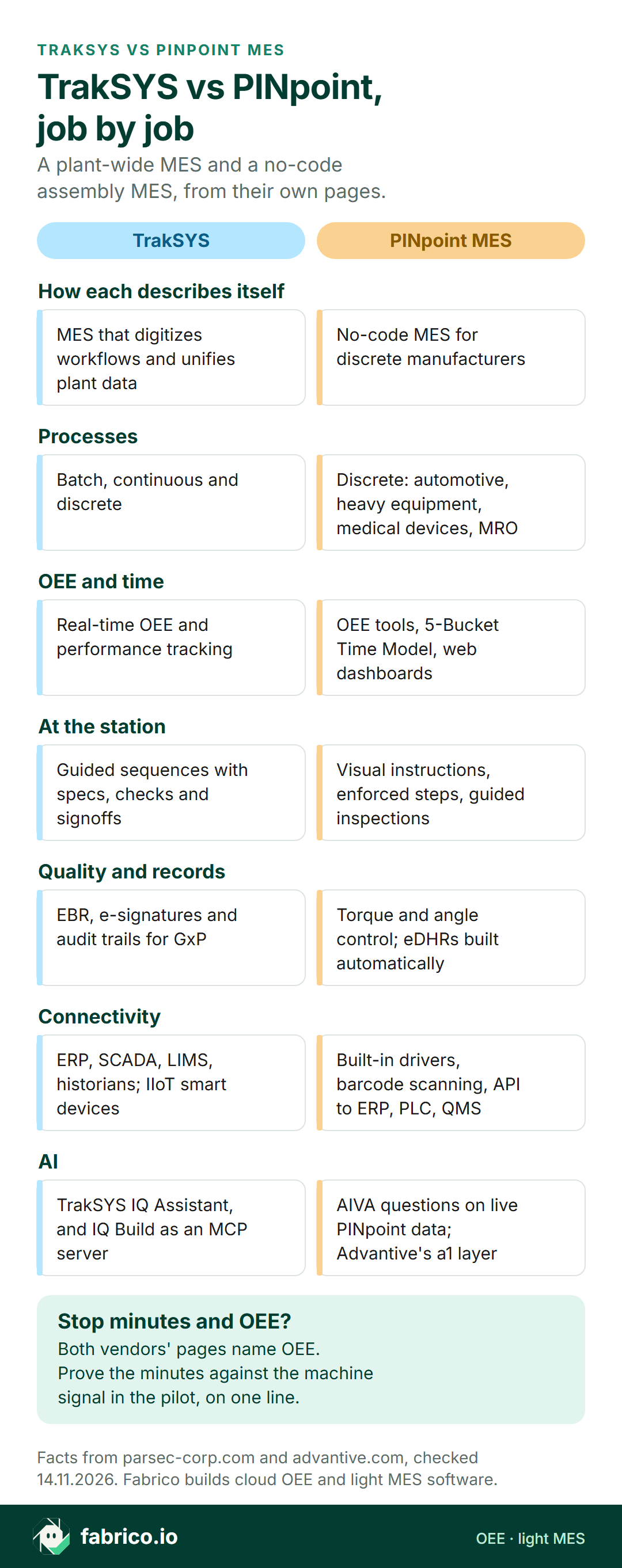
Text version of this infographic
- How each describes itself. TrakSYS: MES that digitizes workflows and unifies plant data. PINpoint: no-code MES for discrete manufacturers.
- Processes. TrakSYS: batch, continuous and discrete. PINpoint: discrete, from automotive and heavy equipment to medical devices and MRO.
- OEE and time. TrakSYS: real-time OEE and performance tracking. PINpoint: OEE tools, 5-Bucket Time Model, web dashboards.
- At the station. TrakSYS: guided sequences with specs, checks and signoffs. PINpoint: visual instructions, enforced steps, guided inspections.
- Quality and records. TrakSYS: EBR, e-signatures and audit trails for GxP. PINpoint: torque and angle control; eDHRs built automatically.
- Connectivity. TrakSYS: ERP, SCADA, LIMS, historians; IIoT smart devices. PINpoint: built-in drivers, barcode scanning, API to ERP, PLC, QMS.
- AI. TrakSYS: TrakSYS IQ Assistant, and IQ Build as an MCP server. PINpoint: AIVA questions on live PINpoint data; Advantive's a1 layer.
- Stop minutes and OEE? Both vendors' pages name OEE. Prove the minutes against the machine signal in the pilot, on one line.
Who changes a live route after go-live
An MES is configured once and changed for years. The second number matters more than the first. TrakSYS lists four delivery routes on its home page: Parsec-led, system integrator-led, customer DevOps-led ("Empower your internal teams to own MES delivery using TrakSYS as a digital foundation") and a hybrid. It also offers to "Connect to ERP, SCADA, LIMS, historians, and more with low-code tools." On the TrakSYS IQ page, IQ Build is "An MCP server that connects your AI assistant to TrakSYS", and "IQ Build proposes a plan and waits for a person to approve it."
PINpoint puts the change in the engineer's hands: "Drag-and-Drop Configuration: Test and implement process changes on the fly, without coding or delays", plus "Point-and-click setup with built-in drivers, barcode scanning, and API connectivity to ERP, PLC, and QMS systems." It asks for "existing Windows-based equipment and standard server space" and describes a "Modular, cloud-ready architecture".
The pilot test: on day ten, ask for one live step to change, say an added check after the gear pack, with your own engineer at the keyboard. Time it from request to release, and note who had to approve it. A route that only the vendor can change is a recurring cost the price page does not show.
Timing a manual station: 5-Bucket model or performance tracking
Both vendors name OEE. Advantive invites plants to "Collect granular data through the 5-Bucket Time Model to uncover hidden inefficiencies" and to "improve OEE". Parsec's performance page says TrakSYS can "Measure and improve OEE and plant productivity with real-time performance tracking" and "Capture production counts, scrap rates, and equipment status".
The formula is not where plants go wrong. The clock is. On an automated press the controller says when it runs. On a manual bench, the clock may start when the operator scans a housing and stop when the last bolt reports OK. If the operator waits 40 seconds for a kit, one system may log a slow cycle (performance) and another a short stop (availability). Both are defensible, but the before-and-after figures only compare if the rule is fixed first.
Ask both vendors to show, on your station, which event starts and stops the clock, where the threshold for a short stop sits, and whether the plant can change it later. Then ask where a planned model changeover lands: planned downtime or lost availability. Sector detail for this kind of line is in OEE for automotive manufacturing.
An out-of-range torque at the station
Fastening is PINpoint's headline. Its page promises to "Control torque and angle on any fastening tool model to ensure reliable joint integrity", to "Enforce standardized workflows and prevent skipped steps with digital work instructions", and to "Integrate IoT devices and smart tools to validate tasks and monitor torque, flow, and cycle times". Defects are tracked "at their root cause with heatmap reporting".
TrakSYS approaches the station through sequences. Its discrete manufacturing page offers to "Digitally guide operators through defined sequences with specs and checks", "Enforce quality checks and digital signoffs" and "Track individual units from component to final assembly."
Give both the same joint spec and the same tool model in the pilot, then force a reading out of range. Watch three things: whether the station holds until the bolt is redone, what the operator sees, and whether the event is attached to that unit's serial number. On a line where a loose bolt is found only at end-of-line test, that one behaviour is worth more than any dashboard.
Lot-shaped or unit-shaped records: Part 11 and the QMSR
Both systems sit at the same level of the plant. ISA's ISA-95 page says the standard "establishes an architecture based on the Purdue model that enterprises can apply regardless of the technology used," and it files MES under Level 3 of that model (accessed 14.11.2026). What differs is the shape of the record each builds there.
TrakSYS names "Electronic batch records, e-signatures, and audit trails built for GxP and 21 CFR Part 11," and lot genealogy for food and beverage: a record shaped like a lot. Under 21 CFR 11.10, controls for such systems include "(d) Limiting system access to authorized individuals" and "(g) Use of authority checks to ensure that only authorized individuals can use the system, electronically sign a record" (Cornell LII, accessed 14.11.2026). The plant, not the vendor, validates its own use.
PINpoint names "FDA 21 CFR Part 820, ISO 13485" and promises to "Capture operators, tools, parts, inspections, and signatures to build eDHRs automatically": a record shaped like a unit. FDA's QMSR page says the Quality Management System Regulation took effect on 2 February 2026, amending Part 820 and incorporating ISO 13485 by reference (accessed 14.11.2026); 21 CFR 820.10 now tells makers to "Document a quality management system that complies with the applicable requirements of ISO 13485" (accessed 14.11.2026). Device makers should ask both vendors to walk one device history record through the amended rule. More on that sector: OEE for medical device manufacturing; the levels themselves: the ISA-95 guide.
A transaxle line's stops at the tools, priced
Sample data only: the plant, line and figures are invented for this page, and no product screen appears. A plant assembles transaxles for ride-on mowers: housing prep, gear pack, fastening with two nut runners, oil fill and end-of-line test. A 9 hour shift with 35 minutes of breaks leaves 505 planned minutes. The ideal cycle is 75 seconds, 0.8 units a minute, so 404 transaxles are possible.
| Sample shift | Minutes or units |
|---|---|
| Nut runner fault and recalibration | 23 min |
| Changeover to a second variant | 21 min |
| Housings late from machining | 18 min |
| Rework bay full, line blocked | 10 min |
| Kit missing at gear pack | 7 min |
| Stops, total | 79 min |
| Transaxles built | 312 |
| Sent to rework at end-of-line test | 8 (5 for torque, 3 other) |
The baseline. Planned time 505 minutes, stops 79, so the line ran 426 minutes and availability is 426 / 505 = 84.4%. At 0.8 units a minute, 426 minutes allow 340.8 transaxles; 312 were built, so performance is 312 / 340.8 = 91.5%. End-of-line test sent 8 to rework, leaving 304 good first time, so quality is 304 / 312 = 97.4%. OEE: 84.4% x 91.5% x 97.4% = 75.2%, or 304 good of 404 possible.
What the pilot sets out to prove. Two targets come straight from the stop list. Recalibration steps and a fault reason at the nut runners take that stop from 23 to 9 minutes; guided changeover steps take the variant switch from 21 to 13. Those 22 minutes at 0.8 units a minute and 91.5% performance build about 16.1 more transaxles; at the non-torque rework rate of 3 in 312, about 16.0 pass first time. Holding the station on an out-of-range reading is assumed to stop 4 of the 5 torque escapes. That is about 20.0 more good units, 324 in all, and an OEE of about 80.2%, up 4.9 points. The pilot reports what actually happened against these targets.
A margin from a published range. Take a sample selling price of EUR 260 per transaxle and value lost output at 25%, EUR 65 a unit. That rate lies between the 15.86% pre-tax operating margin and the 37.47% gross margin that NYU Stern's January 2026 industry margin table reports for 105 US Machinery firms (accessed 15.11.2026). The gain is 19.96 x 65 = about EUR 1,297 a shift. At ten shifts a week over 46 weeks, 460 shifts, that is about EUR 596,800 a year, roughly EUR 49,700 a month. For scale, the 79 stopped minutes cost about 56 good units, or about EUR 3,665, on this shift alone.
OEE beside the MES, or before it
Some plants want the stop-reason layer first and the MES later, or OEE on lines the MES will not reach for a year. That is where Fabrico fits: cloud OEE software with a light MES, set out in its MES and OEE solution overview; route enforcement, torque control and batch or device records stay with TrakSYS or PINpoint. Fabrico reads run, stop and count from the machine's PLC; see the OPC UA and OEE guide. For the transaxle line, the hand-off is the stop list: nut runner faults and changeovers ranked by euros per shift, which tells the MES project which station to configure first.
At a hand-assembly bench, where no signal can be wired, finished units are counted by the camera add-on; suggesting stop reasons from that camera remains on the Roadmap. Where a camera covers the line, the video for the minute of a stop can be opened from the shift timeline; it is streamed on request and not stored. More on the camera add-on for OEE. Fabrico lists no ready connector to TrakSYS or PINpoint, so test that data exchange in the pilot before anyone relies on it. To see a sample shift's stops priced in euros, book a demo.
Five steps before the first demo
- Write the first problem in one line, such as "torque escapes reach end-of-line test", and send it to both vendors.
- Log one line for five shifts with stops over two minutes and their reasons, from the controller where possible.
- Price the stops: good units per running minute times a unit margin you can defend against published figures for machinery makers.
- List must-have modules (traceability, audit trail, scheduling) and map them to Parsec's plan tiers; ask Advantive for the same list priced.
- Name the owner of route changes after go-live and book the day-ten change test with both vendors.
Questions for Parsec and Advantive
- What starts and stops the clock on our manual station, and where is the short-stop threshold?
- When a torque reading is out of range, does the station hold, and is the event tied to the unit's serial?
- Who on our team can change a live route, with which approvals, and how long did it take at a reference plant?
- Which plan tier or quote line covers traceability, audit trail and the ERP interface we need?
- How does your device or batch record line up with the amended Part 820 or with Part 11, and what validation evidence comes with it?
- What does the ERP interface send on day one, and who maintains it after an ERP upgrade?
Wider reading: TrakSYS review for manufacturing, PINpoint MES alternatives and light MES vs full MES.
TrakSYS and PINpoint MES: questions plants ask
Does TrakSYS publish its price?
Yes, as starting points. On 15.11.2026 Parsec's plans page listed Essentials from $1,999, Growth from $4,999, Premier from $10,999 and Ultimate from $15,999 a month on annual subscription terms, with the final figure set by sites, modules, users and services. Advantive's pricing page offers a customised quote for PINpoint and shows no figure.
Do TrakSYS and PINpoint both measure OEE?
Both vendors' pages name OEE. Parsec's performance page describes real-time performance tracking with counts, scrap and equipment status. Advantive's PINpoint page names OEE alongside a 5-Bucket Time Model. Ask each how run and stop are detected on a manual station before comparing figures.
Which one suits medical device assembly?
Both can be tested. PINpoint's page names Part 820 and ISO 13485 and builds eDHRs automatically; TrakSYS names audit trails and e-signatures for GxP and Part 11. FDA's QMSR amended Part 820 from 2 February 2026, so ask both to walk a device record through the revised rule.
Is PINpoint an Advantive product?
Advantive's product page presents PINpoint as part of Advantive's shop floor management software. Ask Advantive directly about support, roadmap and contract terms for your region.
Can Fabrico run beside TrakSYS or PINpoint?
Yes, as the OEE and stop-reason layer, on lines the MES already covers or not yet. The station's controller or an added sensor supplies the run and count signal, operators pick the reason, and a REST API, webhooks and spreadsheet exports hand the figures on. Fabrico lists no ready connector to TrakSYS or PINpoint, so trial the exchange on one line.
Want a sample shift's stop minutes priced in euros, with OEE by line beside them? Book a demo.
Related articles






Real Fabrico tiles, sample data.