


 Login
 Blog
Computer Vision for Glove Manufacturing: Find Where Your Box Count Goes Wrong

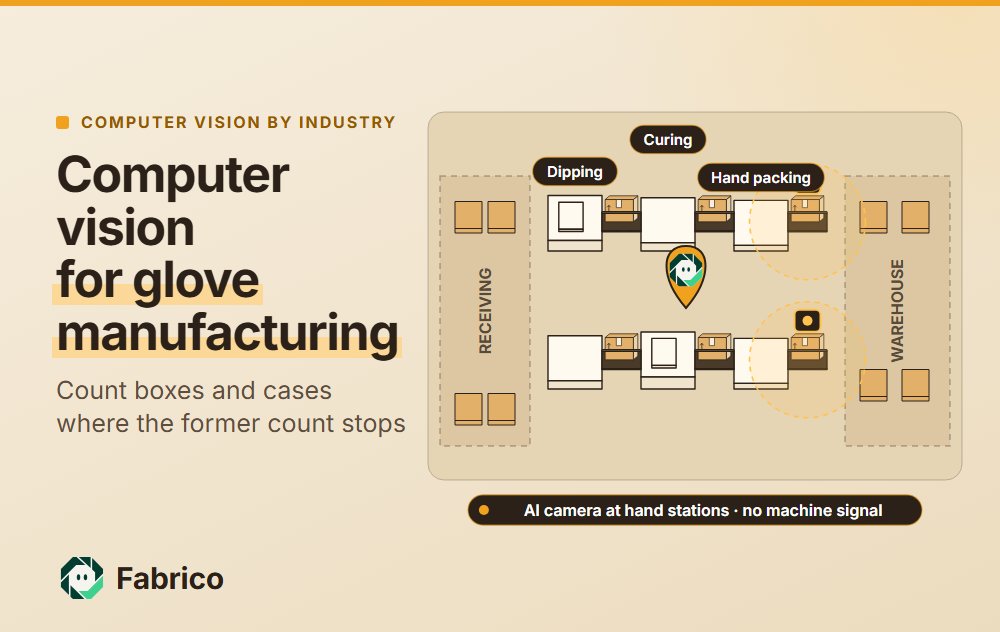
In short: computer vision for glove manufacturing counts dispenser boxes, cases and work glove bundles at hand packing tables, where a glove plant's output number goes wrong.
- Finding pinholes, tears and stains is inspection, which Fabrico does not do; counting what leaves a packing table is the camera add-on's job.
- Formers on the chain, gloves at the stacker, boxes on the tally sheet and cases on the label log each miscount for their own reasons.
- The camera add-on counts boxes, cases and bundles leaving a table, never single gloves at chain speed; gloves per box stay with the scale.
- Rework and regraded gloves that still ship cost crew time, not margin; only boxes never packed while orders wait cost margin.
A glove plant has plenty of counts: formers from the line PLC, gloves from a stacker, boxes on a tally sheet, cases on labels, lots in the QC lab. They describe one shift in different units, and each drifts for its own reason. This page audits them, for dipped gloves (nitrile, latex, vinyl) on former chains and for coated work gloves. Tyres and moulded rubber have their own page, computer vision for tire and rubber manufacturing.
The glove miscount table: where the output number goes wrong
Each row is a place where the shift report parts company with the gloves that reach a case. Read it beside a week of your own lot records and tally sheets.
| Where the count drifts | What happens to the number | The fix | Count kept by |
|---|---|---|---|
| Formers counted as gloves | Empty formers and unstripped gloves still pass the chain sensor | Pieces from the stacker; chain count for the rate | Line PLC, stacker |
| Pieces, pairs and boxes mixed | Line pieces get added to packing hall boxes | One unit per station, converted once | Item master |
| AQL sample gloves | Lab samples never reach a box | A planned deduction per lot | QC lab |
| Lot waiting for release | The wait reads as slow packing | Its own loss code | Shift lead |
| Rejects re-sorted or regraded | A re-sorted lot returns as new output | Count once, outside first pass good | QC lab, rework bench |
| Offline chlorination | A lot leaves, returns and is booked again | Book the batch as a move | Lot record in the ERP |
| Checkweigher push-offs | A repacked box is tallied twice | Repack out of camera view | Checkweigher, camera add-on |
| Boxes left at handover | Both crews tally the same boxes | Count at the table exit | Camera add-on |
| Work glove pairs and dozens | Bundles tallied as pieces, or under the wrong rating | Count bundles per rated item | Camera add-on |
The sections below follow the gloves from the line to the pallet, then audit one shift in money.
Explainer presented by Iris, Fabrico's AI-generated presenter: how an add-on camera counts output where a machine has no signal. Book a demo.
Plays from YouTube. Google may set cookies when you press play. Privacy policy.
Pieces, pairs and boxes: one unit for each station
A dipping line thinks in pieces. In a 2023 Universiti Malaysia Pahang case study of a natural rubber glove line, in the Journal of Modern Manufacturing Systems and Technology, the actual output was 3,000 pieces an hour for each of eight layers, 24,000 pieces an hour in total. A 12 hour shift made 288,000 pieces, and the authors count boxes of 100, so one shift fills 2,880 boxes, or 4 a minute if packing keeps pace.
Pairs appear too. EN 455-3, the European standard for the biological safety of single-use medical gloves, sets its low endotoxin limit per pair of gloves, and coated work gloves are sold in pairs, often bundled by the dozen. Cases carry boxes, often 10 to a case.
The miscount starts when these units meet on one report. The fix: each station reports its own unit (pieces at the line, boxes at the tables, cases at the case table, bundles at pairing), and the item master converts once, per size, because a box of large gloves and a box of small ones are different items.
Formers and stripper: what the line already counts
In an Engineering Journal study of a rubber glove former oven, wet gloves are "conveyed by chain into the oven with the producing speed". The UMP case study lists its line from acid and alkaline tanks, brushes and rinse through coagulant, latex, leaching, beading, the main ovens and a cornstarch tank, to a robotic station and an auto stacking machine. At the tanks, "the number of formers is four at a time."
The PLC counts formers passing a point: the right source for the rate, the wrong one for good pieces. An empty hook, a glove that failed to strip and a torn glove at the stacker all pass the chain sensor. The gap between formers counted and gloves stacked is yield; yield vs first pass yield explains which figure belongs in OEE quality.
Speed hides a second miscount. The case study names "the inappropriate conveyor speed" as a major defect cause: crews push the chain to hit the target and the dip gets too short. A former count rewards that push while rejects grow, so read chain speed and rejects on one timeline.
Stripping and stacking: take the count the line already has
Hartalega, a Malaysian nitrile glove maker, says its automated stripping system can remove more than 45,000 gloves per hour, about 750 a minute. No camera add-on needs to chase single gloves at that speed. Where a stacker counts gloves, take that count through the line PLC; where it has none, a sensor at the outfeed can, as in photo eye output counting.
Size changes are planned changeovers. The case study lists among the line setups the material tank, "where former installation depends on the glove size". Give that time its own code, apart from chain breakdowns. For software across rubber lines, see OEE tools for rubber manufacturing compared.
Inspection rejects, AQL samples and the lot hold
Defects are found by inspection, not by a counting camera. In a 2026 PLOS ONE study of glove defect detection, "Each production line consists of two parallel lanes for glove manufacturing, with three cameras assigned to each lane." The UMP case study sorts glove defects into four groups: "major visual, freedom of hole, critical non-acceptable, and non-functional". An inspection station's reject count can feed OEE quality; Fabrico does no inspection.
Lot sampling is the next miscount. For medical gloves in Europe, SATRA, a UK test and research body, explains that EN 455-1 sampling follows ISO 2859-1, so 200 gloves are tested; examination gloves must reach AQL 1.5 and surgical gloves 0.65. In the US, 21 CFR 800.20 describes how FDA checks gloves with a water leak test using 1,000 ml of water, with 1.5 AQL as the minimum for surgeons' gloves and 2.5 AQL for examination gloves, and ASTM D6319, the US nitrile examination glove specification, covers freedom from holes, powder, tensile strength and elongation. Sample gloves leave the lot for the lab: book them as a planned deduction per lot, or the line and the hall never agree.
The hold is a time loss. Where a lot waits for its lab result, a packing hall with no released lot is waiting; give that its own loss code, or slow results read as slow packers. Downtime by SKU then shows which sizes wait longest, and lot vs serial tracking covers lot tracing, which stays in the ERP.
Re-sorted gloves are the hardest row. Where a plant re-inspects a failed lot and ships part of it, those gloves are rework: count them once, outside first pass good. OEE quality and tracking scrap and rework inside OEE show how. Plants that also make devices can read computer vision for medical device manufacturing.
Chlorination and second passes: where lots get booked double
Powder-free gloves are chlorinated or polymer coated, either on the line before stripping or offline in tumblers after it. For medical gloves sold in the US, powder-free is not optional: FDA's final rule banning powdered surgeon's and patient examination gloves took effect on 18 January 2017; powder used in the manufacturing process stays outside the ban. The UMP case study line, with its cornstarch tank, makes powdered gloves, which that rule keeps out of US medical use.
Offline treatment creates a loop. A lot leaves for the tumblers, comes back and is booked in again; if the receipt counts as output, the plant makes the same gloves twice. Book the batch as a move, and count output once, when boxes leave the table. A lot washed again because it failed is rework; rework vs repair explains why that matters for quality.
Coated work gloves: pairs, dozens and rated variants
A coated work glove starts as a knitted liner (knitting has its own page: computer vision for textile manufacturing). Operators pull liners onto hand formers on a chain, the palm dips in nitrile, latex or PU, and the coating cures before stripping. A former the loader missed comes round empty, so the chain count runs ahead of the gloves.
Work gloves sell on rated protection. In the EU, a work glove is personal protective equipment under Regulation (EU) 2016/425, and its CE marking is the evidence that it complies. EN 388, the European standard for mechanical risks, grades a glove in four or five performance levels for abrasion, cut, tear and puncture: SATRA's example is a glove at "performance level 4 for abrasion but level 1 for tearing". Each liner and coating is its own rated item, and a bundle tallied under the wrong rating ships the wrong label.
After stripping, gloves are paired, bundled and bagged by hand. A camera add-on over the pairing tables counts bundles per rated item as they leave. More on hand work is in tracking OEE on manual and hybrid lines.
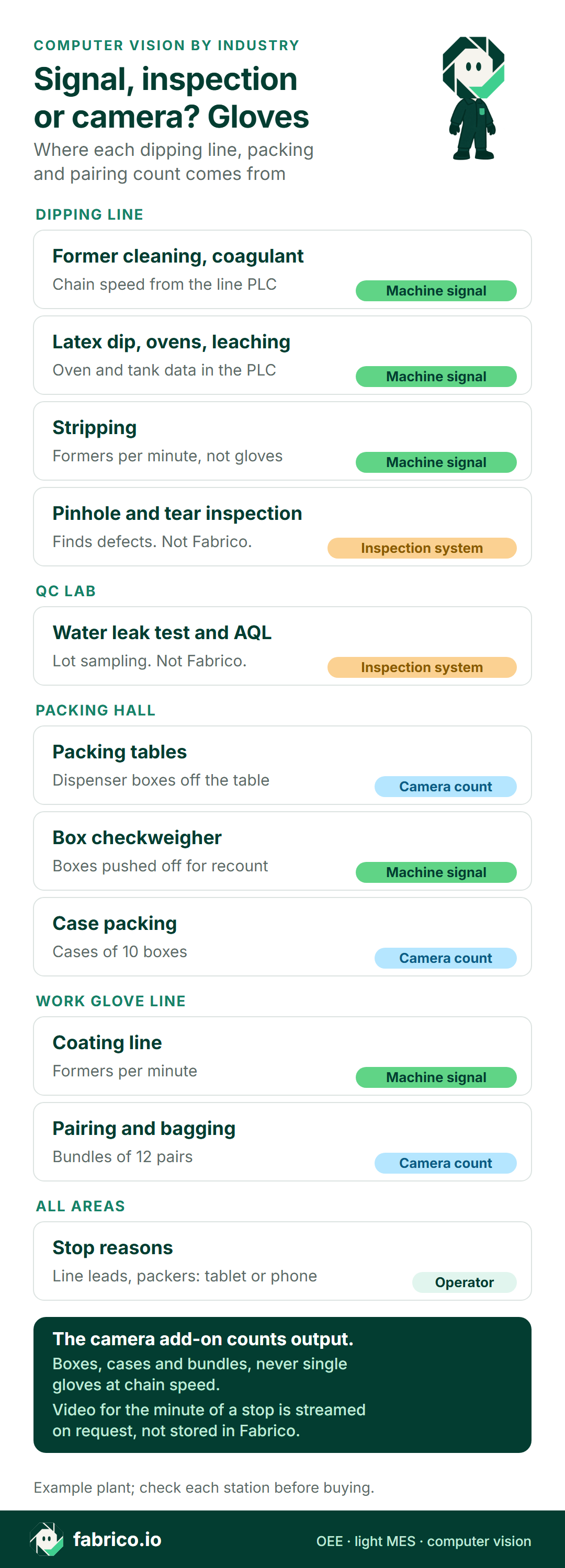
Text version of this infographic
- Dipping line: former cleaning and coagulant: machine signal, chain speed from the line PLC
- Dipping line: latex dip, ovens and leaching: machine signal, oven and tank data in the PLC
- Dipping line: stripping: machine signal, formers per minute, not gloves
- Dipping line: pinhole and tear inspection: inspection system, not Fabrico
- QC lab: water leak test and AQL sampling: inspection system, not Fabrico
- Packing hall: packing tables: camera count, dispenser boxes off the table
- Packing hall: box checkweigher: machine signal, boxes pushed off for recount
- Packing hall: case packing: camera count, cases of 10 boxes
- Work glove line: coating line: machine signal, formers per minute
- Work glove line: pairing and bagging: camera count, bundles of 12 pairs
- All areas: stop reasons: operator, line leads and packers on a tablet or phone
- The camera add-on counts output: boxes, cases and bundles, never single gloves at chain speed
- Video for the minute of a stop is streamed on request, not stored in Fabrico
What a camera can count at a packing table, and what trips it
Packers fill dispenser boxes, often 100 gloves to a box, and many count by weight on a scale. A checkweigher may push off boxes outside the weight band. Automatic boxing machines report their own counts; a camera adds little there.
Research on hand stations is useful and limited. In a 2020 Journal of Imaging study of counting pieces placed by hand on a small table between two operators, 94% of pieces were counted within one second of being set down and 2% were not counted. The misses came from one case: "when one operator places a piece while the other is picking up another piece, the algorithm (incorrectly) does not count". On a conveyor, the authors add, "counting through a MV system might be trivial". The study used one camera, one white table, dark steel parts and a light ring at one Italian firm. It did not test glove boxes; Fabrico states no accuracy figure.
Three rules follow for a glove packing hall:
- Count at the exit. Mount the camera add-on over the spot where closed boxes are set down, or over the case conveyor, apart from the pick-up zone.
- Keep the light steady. Glossy printed boxes under mixed daylight are harder than dark parts on a white table.
- Keep rework out of view. Repack pushed-off boxes at a bench the camera does not see, so each is counted on first pass only.
Where a camera add-on covers a station, the video for the minute of a stop can be opened from the shift timeline, streamed on request and not stored in Fabrico. More on bench counts: manual packing station OEE with a camera.
Packers and privacy. Before installing, settle with the packing crew, and the works council if there is one, what the box count is used for. Point the camera at the table exit, not at a seat, and report boxes per table per shift, not per packer.
Audit one day shift: tally sheet against camera count
Example inputs, no real plant. The packing hall sits behind one line making 24,000 pieces an hour, the case study rate, so its ideal rate is 4 boxes of 100 a minute. Six packing tables feed one case table. The day shift runs 06:00 to 18:00 less 60 minutes of breaks: 660 planned minutes. A camera add-on counts boxes set down at each table exit and cases leaving the case table; the checkweigher keeps its push-off count; the shift lead adds stop reasons.
| Audit step | Boxes | At 4 boxes a minute |
|---|---|---|
| Boxes on the packers' tally sheets | 2,420 | 605 min, OEE 91.7% |
| Less: repacked boxes tallied a second time | minus 100 | |
| Less: night shift boxes tallied again at handover | minus 60 | |
| Boxes the camera add-on counted at the table exits | 2,260 | Performance input |
| Less: boxes pushed off by the checkweigher and repacked | minus 100 | Rework, ships later |
| First pass good boxes | 2,160 | 540 min, OEE 81.8% |
Two miscount rows explain the 160 extra tallied boxes: 100 pushed-off boxes tallied again when repacked, and 60 boxes the night crew set down before 06:00, which the camera add-on had counted on the night shift. The tally reads 91.7% OEE, the audit 81.8%. When sources disagree, what to do when the camera and the operator log disagree shows how to settle it.
Availability. From 07:10 to 07:45 the size M lot waited for its AQL result, 35 minutes. From 14:20 to 14:35 the case cartons ran out, 15 minutes. The hall ran 610 of 660 minutes: 92.4%.
Performance. At 4 boxes a minute, 610 minutes could fill 2,440 boxes; the camera add-on counted 2,260: 92.6%. The 180 missing boxes are 45 slow minutes. From 10:00 to 12:00 the checkweigher was down and packers checked weights on table scales, packing 3 boxes a minute: 120 boxes, or 30 of the 45 minutes. The shift lead added the reason to those two hours on the shift timeline.
Quality. After the restart, the checkweigher pushed off 100 boxes. They were recounted and resealed at the rework bench and they ship, but as rework, not first pass good. Good output was 2,160 boxes, 216 cases, or 216,000 gloves: 95.6% of 2,260.
OEE. 92.4% x 92.6% x 95.6% = 81.8%. Check: 2,160 good boxes at 4 a minute is 540 minutes, and 540 of 660 is 81.8%. In minutes, 540 good, 25 repacked, 45 slow and 50 stopped add up to 660.
Money. Glove margins are plant-specific and can vanish: in April 2024 the Malaysian Rubber Glove Manufacturers Association (Margma) put global demand at 307.2 billion pieces in 2023, and its president said average selling prices had fallen below production costs for Malaysian exporters. For scale, the case study priced a box of 100 at RM 15.90.
- Boxes never packed. The 95 stopped and slow minutes are 380 boxes. Only while orders for these sizes wait do they cost margin: at an example margin of RM 0.80 a box, 5% of the case study's RM 15.90 price and inside NYU Stern's January 2026 margin band for US rubber and tyre makers (pre-tax operating 2.24%, gross 17.99%), which each plant replaces with its own, RM 304, of which the AQL hold is 140 boxes, RM 112.
- Boxes repacked. The 100 pushed-off boxes still ship, so they cost crew time: at an example one minute a box, 100 packer minutes, and at the case study plant's labour cost of RM 12 an hour, RM 20.
Fabrico prices each loss the same way, from the plant's own SKU price or margin. The fixes are cheap: repack out of camera view, count at the table exit, check carton stock before each shift, and code lab waits.
Book a demo to see packing tables, case packing and pairing tables counted on one shift timeline beside the dipping line's PLC data.
What to demand from a glove counting supplier
Hold each OEE and camera vendor's answers against a week of tally sheets and lot records.
| Ask the vendor | A good answer |
|---|---|
| How do formers per minute become pieces per hour? | Formers per row and layers set once, so the chain count gives the ideal rate. |
| Where does the stacker count go? | Beside the chain count, so the gap per lot shows as yield. |
| How are AQL sample gloves handled? | A planned deduction per lot, not rejects. |
| How is a lot waiting for release booked? | Its own loss code, apart from slow packing. |
| How do regraded gloves count? | Once, outside first pass good. |
| What happens to a repacked box? | Counted once on first pass; the repack is rework. |
| How do pieces, pairs, boxes and cases convert? | Each station keeps its unit; the item master converts once. |
| Where does video go, and who can see it? | A written data flow the plant and staff representatives can review. |
Start with one packing hall and run the audit table for a week before and after the camera add-on goes up.
Where Fabrico fits in a glove plant's count
Fabrico is cloud OEE software that also covers light MES work. In a glove plant, three jobs work today:
- On the dipping and coating lines it takes run state, chain speed and the former count from the line PLC, and the stacker count where there is one, so stripper jams, broken formers and slow running in a cold oven show up as stop or speed loss, each with a reason.
- In the packing hall and at pairing tables the camera add-on counts dispenser boxes, cases and bundles of pairs. When the hall stops, the shift lead can open the video for the minute of that stop from the shift timeline; it is streamed on request and not stored in Fabrico.
- Per glove size, box type and rated item you set the ideal rate, so packing performance reads in boxes a minute while the dipping line reads in pieces.
Line leads and packers add the stop reasons on a tablet or phone. Fabrico reports OEE and losses per line, packing hall and shift, prices each loss in money, and sends figures to the ERP or QC system by REST API, webhooks, or Excel and CSV files. The OEE and MES solution overview shows the screens those counts feed.
Roadmap: a camera add-on that spots a packing table standing empty on its own and offers a probable reason; it is not available today.
Not Fabrico's job: defect inspection over the lanes, the water leak test and AQL sampling, gloves per box on the scale or counting machine, oven and tank control, and lot traceability. Those stay in the inspection systems, the QC lab and the ERP.
The camera add-on has its product page at Fabrico computer vision for OEE, and vision systems for OEE walks through how box and case counts turn into an OEE figure.
Glove count questions from plant managers
Why does the former count differ from the boxes packed?
The PLC counts formers passing a point on the chain. Empty formers, gloves that fail to strip, torn gloves, inspection rejects and AQL samples all drop out before a box is filled. The gap is yield; see yield vs first pass yield.
Do AQL sample gloves count as a quality loss?
Book them as a planned deduction per lot. They are taken on purpose for the lab, and counting them as rejects makes a good lot look worse.
Can a camera count gloves at chain speed?
There is no need. The chain or stacker count from the line PLC already gives that rate. A camera add-on earns its place downstream, counting boxes, cases and bundles where people do the work.
Where should a glove plant put its first camera?
Over the table exits in the packing hall of the busiest line, where often only a tally sheet records the boxes; see manual packing station OEE with a camera.
Want to see where your tally sheet and your boxes part ways? Book a demo to see dispenser boxes, cases and bundles counted on one shift timeline beside the dipping line's former count.
Related articles













Real Fabrico tiles, sample data.