


 Login
 Blog
Computer Vision for Wine and Spirits Bottling: Fair OEE for Every SKU and Gift Set

In short: Computer vision for wine and spirits bottling should count the hand stations, where each SKU changes the work and no PLC counts output.
Inspection cameras check fill level, closures and labels; a counting camera only counts finished bottles, boxes and cases for OEE.
- One ideal rate per line misleads: a magnum run, a screwcap run and a gift box run each need their own rate.
- The filler, capper, labeller and case packer already count through their PLCs; the gift table and the wax bench do not.
- In the worked example, one line rate shows 58.6% OEE; rates per SKU show 68.8% and point at a 55-minute changeover.
- Fabrico's camera add-on counts closed gift boxes and dipped bottles. Fabrico does no inspection.
On a winery or distillery line the machines rarely change. The SKU does, sometimes four times a day: another wine, bottle, closure, market label or gift box. Each change lands on a different station, and often hardest on a table of people with no counter at all.
Variant by station: what changes between bottling runs
Each row is one thing that can change between two runs; each column is a station. Read across to see who absorbs a change, and down to see which station carries the most.
| Variant | Depalletizer | Filler | Corker or capper | Labeller | Case packer | Hand-packed gift sets |
|---|---|---|---|---|---|---|
| Wine, blend or spirit | Same | Drain, purge, new filter | Same | New front and back labels | New case print | New insert if gift run |
| Bottle format | New layer pattern, tier sheets | Height, star wheels, guides | Head height | Label position, guides | Case size, dividers | New box or tin |
| Closure | Same | Same | Cork, screwcap or bar-top head | Capsule or none | Same | Same |
| Label set and market | Same | Same | Same | New reels, market strip | Case marking | Leaflet language |
| Tax stamp, where a market needs one | Same | Same | Same | Stamp at the labeller or by hand | Stamp count per case | Stamp before boxing |
| Gift set | Same | Same | Wax dip or tag after capping | Same | Bypassed for the gift share | Fold, fill, close by hand |
Two columns stand out. The filler takes the liquid changes, and its PLC already logs them as stop time. The last column takes nearly every packaging variant and has no PLC: people fold boxes, set in a bottle and close the lid at their own pace. A row that reads "Same" across the line but changes the last column quietly sets the day's output.
Closures add their own column of work. A review in Foods notes that the wine closure market is dominated by cork, synthetic and screw caps, and many halls run two of the three, so a closure change means a different head on the corker or capper and often a different capsule or none at all. Spirits add the bar-top stopper, and the bottling technical centre Cetie now publishes a data sheet for bar-top stopper neck finishes in 27, 29 and 34 mm, so even one closure type can mean three neck diameters to change between.
Explainer presented by Iris, Fabrico's AI-generated presenter: how an add-on camera counts output where a machine has no signal. Book a demo.
Plays from YouTube. Google may set cookies when you press play. Privacy policy.
Why one ideal rate per bottling line misleads
Many bottling lines carry one rate on the wall: the filler's nameplate, say so many bottles an hour. OEE performance divides what the line made by what that rate allows. When the SKU changes, the fastest possible rate changes with it, but the number on the wall stays.
- A slower SKU looks like lost speed. A magnum or a wooden gift case cannot run at the rate of a 75 cl screwcap bottle, so the crew looks slow on a run where it did all it could.
- A faster SKU hides real losses. Set the rate for the slowest run and a plain run can show more than 100% performance, which means the rate is wrong, not that the crew beat physics.
- The bottleneck moves with the SKU. On a plain run the filler or labeller paces the line; on a gift run the table does.
The fix is an ideal rate per SKU, set at the station that paces that SKU. For a plain wine it is the filler or the labeller; for a gift set it is the hand table. The method is laid out in OEE per SKU with different rated speeds.
Rates per SKU also show where a winery really loses time. In one peer-reviewed case study at a winery in Pernambuco, Brazil, the two filling machines ran at an OEE of 69.19% and 69.38%, against 83.47% on the press. That is one plant, not a benchmark, but it points the same way as the matrix: the losses gather where the bottle and the run change, not in the cellar.
Bottle format and closure: changes the machines already count
A format change is the heaviest variant on the machine side: it touches every column of the matrix up to the case packer. All of these machines run on a PLC, so the stop shows up as stop time without any camera. What the PLC does not show is why; the crew books that, with a format change booked apart from a label change.
Export markets add formats. In the US, a final rule of 29 December 2020 from the TTB added seven standards of fill for wine and distilled spirits: three new wine sizes and four spirits sizes, among them 700 mL. That is a US rule, but it changes what a European bottler runs: with 700 mL on the list, a 70 cl spirit made for Europe can ship to the US in the same bottle. Every format the plant drops removes a changeover; every format it adds needs its own ideal rate.
Machine losses are covered on depalletizer OEE and filler OEE on a bottling line; here the PLC count beats a camera. The broad case, with PET, cans and the blow moulder, sits on computer vision for beverage and bottling lines, and returnable glass and kegs on computer vision for breweries.
Label sets, markets and tax stamps at the labeller
Much of the trade moves in the finished bottle: the OIV reports that bottled wine under 2 litres made up 50.8% of world wine trade by volume in 2024. Each bottle that crosses a border carries its market's label set: back label language, importer, strength and sometimes a market strip. On the labeller that is a short reel change, but a frequent one. Book it as its own stop reason, or an export week looks like one long format change. The labeller's own losses are on labeller OEE.
Tax stamps are the variant that comes and goes with the law. In the UK, an HMRC brief set out that the Alcohol Duty Stamp Scheme would end on 1 May 2025; until then the scheme required the stamping of larger retail containers of high strength spirits, wine and other fermented products. A UK run that needed a stamp step on 30 April did not need one on 2 May. Where a market still asks for a stamp applied by hand, that step belongs in the matrix with its own ideal rate.
A camera add-on count is not a stamp record. The excise records stay where the plant holds them today, and Fabrico makes no excise or compliance claim. Label checks are a separate system too: label and code vision versus an OEE camera explains the split.
Gift sets and hand packing: where a camera add-on counts
Gift sets are the variant that lands on people. Before the holidays a spirits line may send a large share of a run into gift boxes, tins or wooden cases. The case packer cannot do it, so the gift share leaves at the accumulation table for a table where people fold, fill and close. Premium wines add a wax seal or a numbered neck tag. None of these steps has a PLC; the run sheet is the only record.
- Wax dip bench: each bottle goes neck down into the pot, turns, drips and is set on a tray to cool. A camera add-on above the cooling tray counts bottles set down.
- Gift box table: a camera add-on over the table exit counts closed boxes or cases, not hands moving over the table.
- Neck tags: usually no own count is needed; the gift table count downstream shows the same flow.
The case packer still counts the plain share through its PLC, as covered on case packer OEE. Adding the two exits gives the run's real output, and the split shows which exit held the line back.
Seasonal crews and the works council. A camera over a gift table sees hands and often faces. Agree its purpose with the crew, and in many European countries with the works council, before mounting it. Aim at the table exit or the cooling tray, publish counts per station, never per person, and tell each seasonal packer on day one. The checklist is in cameras on the line without surveillance.
One hall's flow: where the gift share leaves the main line
The matrix says which station absorbs a change; the flow says where the product goes next. In the example hall below, the main line splits after the labeller: plain cases go to the packer, gift sets to the hand stations. The accumulation table between them is the queue to watch. When it fills, the gift exit paces the line; when it runs empty, the filler or labeller does.
Count the units the way each exit ships them: bottles at the filler, closed boxes at the gift table, cases at the packer. A mobile bottling truck is the same flow with one more variant: every client is a new wine, glass and closure in one day. The truck's monobloc rarely offers a PLC count the winery can reach, so a camera add-on at the truck exit gives cases per client run.
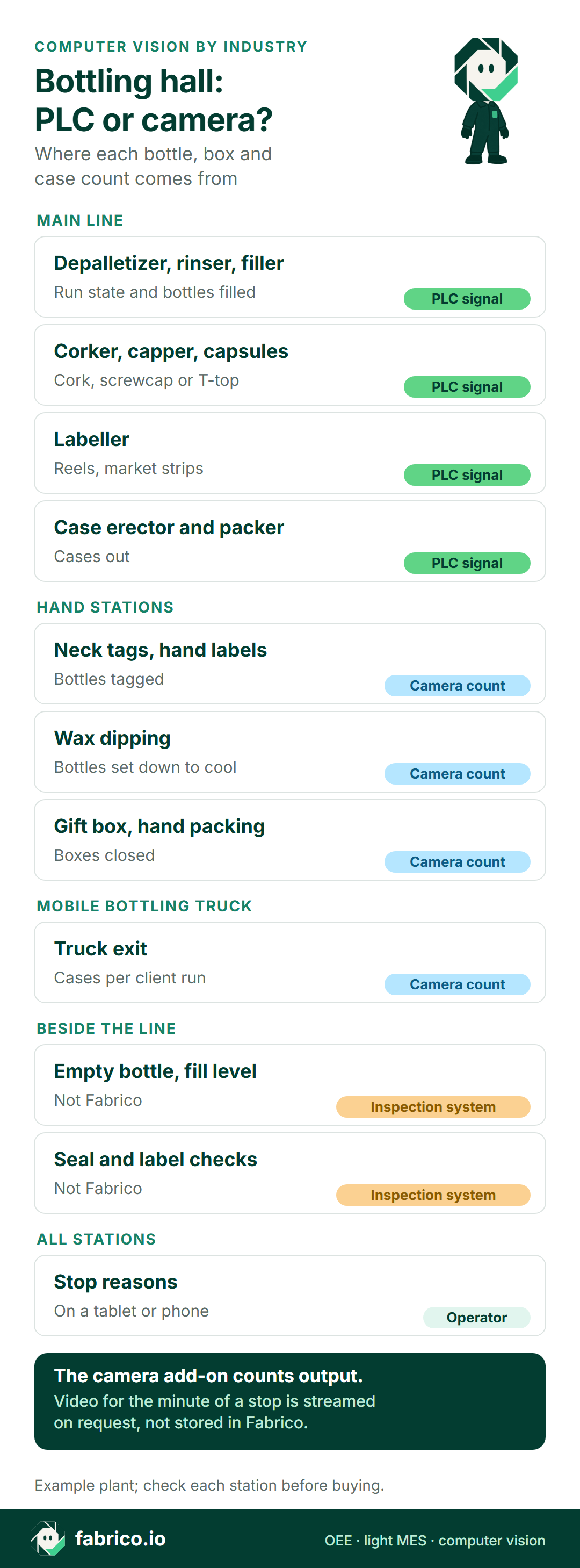
Text version of this infographic
- Main line: depalletizer, rinser, filler, corker or capper, capsule spinner, labeller: PLC signal
- Main line: case erector and packer: PLC signal, cases out
- Hand stations: neck tags and hand labels: camera count, bottles tagged
- Hand stations: wax dipping: camera count, bottles set down to cool
- Hand stations: gift box and hand packing: camera count, boxes closed
- Mobile bottling truck: camera count at the truck exit, cases per client run
- Inspection: empty bottle, fill level, seal and label: inspection system, not Fabrico
- All stations: stop reasons from the operator on a tablet or phone
- Camera add-on: counts output; video for the minute of a stop is streamed on request, not stored in Fabrico
Book a demo to see filler, labeller and gift box table counts side by side on one shift timeline.
Worked example: two gift SKUs at one table in one shift
Example numbers, no real plant. A craft distillery packs gift sets at one table with two people. The shift runs from 07:00 to 15:30 with a 30-minute break, so the table is planned for 480 minutes. A camera add-on counts closed boxes at the table exit, and the team lead books stop reasons on a tablet. Two SKUs run that day:
- SKU A: a 70 cl gin with a T-top stopper, in a folding gift box with a tasting glass. Ideal rate 6 boxes a minute.
- SKU B: a limited release 70 cl gin with a wax seal and a numbered neck tag, in a wooden case. Ideal rate 4 cases a minute.
Availability. The table stood 55 minutes for the changeover from A to B (new inserts, wooden cases, tags) and 25 minutes waiting for a pallet of wooden cases from the dry goods store. Run time was 400 of 480 minutes: 83.3%. SKU A ran 220 minutes and SKU B 180.
Performance. The camera add-on counted 1,140 boxes of A and 600 cases of B. At their own rates they earn 190 minutes (1,140 / 6) and 150 minutes (600 / 4), so 340 of 400 run minutes: 85.0%. Each SKU lost 30 minutes to slow packing.
Quality. 36 boxes of A came back for a torn box, and 16 cases of B for a new wax drip or a torn case. Good output is 1,104 of A (184 minutes) and 584 of B (146 minutes), so 330 of 340 earned minutes: 97.1%. That is 10 minutes of rework.
OEE. 83.3% x 85.0% x 97.1% = 68.8%. The quick check: 330 good minutes of 480 planned is 68.8%. The bars add up: 330 + 10 + 60 + 55 + 25 = 480 minutes.
Now the same counts at one rate:
| Ideal rate used | Performance | OEE | What the manager would conclude |
|---|---|---|---|
| 6 a minute for both SKUs | 1,740 of 2,400 = 72.5% | 58.6% | The crew is slow; train the packers |
| 4 a minute for both SKUs | 1,740 of 1,600 = 108.8% | 87.9% | Nothing to fix, and a figure over 100% that nobody trusts |
| Own rate per SKU (6 and 4) | 340 of 400 min = 85.0% | 68.8% | Chase the 55-minute changeover and the 25-minute case wait first |
At 6 a minute the 1,688 good units are worth 281.3 minutes, 58.6% of 480; the 48.7 missing minutes all sit on the wooden case run, which can never reach 6. At 4 a minute they are worth 422 minutes, 87.9%.
In money. Price lost minutes only while orders wait, at each SKU's own margin. There is no public margin for a gift-boxed craft gin. For scale, the Scotch Whisky Association reports Scotch exports of GBP 5.4bn in 2024, the equivalent of 1.4bn 70cl bottles, about GBP 3.86 of export value per bottle across bulk and bottled. A gift set sells for far more, so the margins here are example inputs the plant replaces with its own: EUR 5 per box of A, EUR 9 per case of B. For a margin band, NYU Stern's January 2026 margin data (accessed 16.11.2026) lists 14 US alcoholic beverage firms at a gross margin of 46.96% and a pre-tax operating margin of 22.76%; at those margins, EUR 5 fits a gift box selling for about EUR 11 to EUR 22, and EUR 9 a case selling for about EUR 19 to EUR 40.
- SKU A: 30 slow minutes x 6 = 180 boxes x EUR 5 = EUR 900.
- SKU B: 55 changeover + 25 case wait + 30 slow = 110 minutes x 4 = 440 cases x EUR 9 = EUR 3,960.
- Total: EUR 4,860 of margin on one day while orders wait. The case wait alone is 100 cases, EUR 900; the changeover is 220 cases, EUR 1,980.
The 52 reworked units are not lost margin: they ship after a new drip or a new box. A third person at the wax bench spends about 40 minutes on them, about EUR 23 at the 2024 EU average hourly labour cost in industry of EUR 33.9 reported by Eurostat. In Fabrico the margin is set per SKU from the plant's own figures, so a folding box and a wooden case carry different loss values.
The loss to chase first is not the packers. The case wait was a late dry goods call, and the changeover ran long because the wooden case needed a different insert and the tags were not counted out in advance. The count showed both within the hour.
Checks for a camera vendor when the SKU changes every run
Know the limits before the questions. A 2026 systematic review of industrial object counting in Sensors warns that "some stations have backlight and low-light shooting conditions" and that tracking-based counting "is prone to ID switching and trajectory fragmentation in dense occlusion scenarios". The review covers industrial counting in general, not bottling halls, and gives no figure for a gift table. Here the same limits look like dark glass and shrink film that reflect, and hands covering the box as it closes. No Fabrico accuracy figure is published, so ask every vendor to prove the count on the plant's own runs.
| Question | What a good answer shows |
|---|---|
| Does the count hold on antique green, amber and flint glass? | A count shown on each glass colour under the hall's own light, including backlit windows. |
| What happens when the bottle changes between runs? | The count still works from a 75 cl bottle to a magnum or a shaped decanter, without a new setup per run. |
| What exactly is counted at the gift table? | A closed box or case leaving the table, not a hand moving over it. |
| Can the ideal rate change per SKU? | One rate per bottle, closure and pack, so a wooden case run and a folding box run are judged at their own rates. |
| How does the count know the SKU has changed? | A clear way to switch the running SKU, and a record of when it switched. |
| Can label, format and gift set changes have their own stop reasons? | Separate codes, so a market label change does not hide inside a full format change. |
| How does rework come back without a double count? | A re-dipped or re-boxed unit leaves the good count once and is not counted twice when it returns. |
| Where does the video go? | A written data flow the bottling crew and the works council can read. |
Start with the hand station whose rate changes most between SKUs, and check its light during a plain and a gift run.
Where Fabrico fits on a multi-SKU bottling line
In a winery or distillery bottling hall, Fabrico runs as cloud OEE with light MES functions and does three jobs today:
- On the main line it takes run state and counts from the filler, capper, labeller and case packer PLCs, so tank changes, closure head changes and reel changes show up as stop time.
- At the gift exit the camera add-on counts dipped bottles and closed boxes or cases. Where the camera add-on covers a station, the video for the minute of a stop, such as the gift table going quiet at 10:40, can be opened from the shift timeline, streamed on request and not stored in Fabrico.
- Per SKU you set an ideal rate and a margin for each bottle, closure and pack, so a magnum, a miniature and a wooden gift case are judged fairly and their losses are priced from the plant's own figures.
The crew adds the stop reason on a tablet or phone, so a label change, a format change and a gift set change get their own codes. Fabrico shows OEE and losses by station and shift, with losses in money, on the web, iOS and Android. Figures leave by REST API, webhooks, or Excel and CSV export.
Roadmap, not live today: a camera add-on that notices a stopped gift table by itself and suggests the likely reason.
Outside Fabrico: empty bottle, fill level, closure and label inspection; the cellar, blend and cask records; and excise and stamp records. The cellar side is covered on winery production software and distillery production software.
For the OEE method on the whole line, read OEE for wine bottling lines and OEE for spirits bottling lines. OEE with computer vision explains how camera add-on counts become an OEE figure, OEE software is the wider buying guide, and the product page is Fabrico computer vision for OEE. Put Fabrico through the eight checks above as well.
Bottling managers' questions on variant runs
Which station should get the first camera on a multi-SKU bottling line?
The hand station whose rate changes most between SKUs and that nobody counts: usually the gift box table, sometimes the wax dip bench. The filler, capper, labeller and case packer already report through their PLCs.
Why does one ideal rate per line give the wrong OEE?
Because each SKU has its own fastest possible rate. A rate set for the fastest run makes slow SKUs look like lost speed, and a rate set for the slowest run can push performance over 100%.
Can the counting camera check fill level, corks or labels?
No. Fill level, closure and label checks belong to the inspection systems on the line, and empty bottle inspection sits before the filler. Fabrico does no inspection. Their reject counts can still feed the quality part of OEE.
Should a label change and a format change share one stop reason?
No. A label change on the same glass is a reel and a check; a format change touches the depalletizer, filler, closure head, labeller and case packer. Separate reasons show which one eats the day.
Does a camera count replace the run sheet or tax stamp records?
No. The run sheet, lot records and any stamp or excise records stay where the plant keeps them today. The count is an extra figure for the plant's own checks, and Fabrico makes no excise or compliance claim.
Want to see a multi-SKU bottling day read this way? Book a demo to see your bottling line and gift table counted on one shift timeline, with an ideal rate per SKU.
Related articles








Real Fabrico tiles, sample data.