


 Login
 Blog
Computer Vision for Agricultural and Construction Machinery: Count per Model, Not per Line

In short: in a tractor or excavator plant, a camera add-on counts output from weld bays, cab lines and kitting; OEE needs one ideal time per model.
This is output counting, not inspection: weld quality, paint film and end-of-line function tests keep their own systems, and Fabrico does no inspection.
- Sub-assembly absorbs most options: cabs, axles and hose kits change per model long before the final line does.
- One takt for the line makes a heavy-mix shift look slow and a light-mix shift look fast.
- Set the ideal time per model from its slot, and date it when the takt changes.
- Fabrico's camera add-on counts output; the video for the minute of a stop is streamed on request and not stored in Fabrico.
A tractor, combine, wheel loader or excavator plant rarely builds one product. CEMA, the European agricultural machinery association, counts about 1,300 manufacturers making more than 450 types of machine. Most build in low volumes with many options per model, often on one final line.
That mix breaks the usual OEE setup. Below: which station absorbs each variant, where a camera add-on fills the count gap, and one shift priced per model.
Variant by station: where each tractor and excavator option lands
Each row is something that changes from one machine to the next; each column is a station type. Read down a column to see which station absorbs the mix, and across a row to see how far one option travels.
| Variant driver | Weld bays | Paint | Sub-assembly | Final line | End-of-line test |
|---|---|---|---|---|---|
| Power class or size | Bigger frame or boom | Fewer parts per carrier | Larger axle and transmission | Longer slot at drivetrain | Longer run-up |
| Front linkage, front PTO | Extra bracket weldment | Extra parts on hooks | Own hose and valve kit | Own station (S5) | Linkage and PTO check |
| Cab trim | No change | No change | Cab line: wiring, glazing, HVAC, seat | Same marriage slot | Electronics set-up, water test |
| Boom, arm, counterweight | Longest weldments | Long parts, long oven pass | Hose sets per length | Heavier lifts | Hydraulic cycle test |
| Dealer or fleet colour | No change | Colour change | No change | Decals per order | No change |
| Market package | No change | No change | Engine and after-treatment pack | Lights, plates, documents | Market test steps |
Three patterns show up on most lines. Sub-assembly absorbs more of the mix than the final line, because options turn into parts there. The weld bays absorb size: a long-reach boom is a longer weldment, not a different count. Market packages land late, at the last line stations and the test stand.
Fendt's tractor plant in Marktoberdorf shows the first pattern. Christoph Roser's plant visit write-up reports that around 25% of all employees on the shop floor work in a pre-assembly station, with front and rear axles built in sequence for the main line, plus customizing cells where a tractor spends between twenty minutes and two hours, depending on its work content. That spread cannot hide inside one ideal time. A yamazumi chart per model shows which stations a heavy model overloads and which it leaves idle.
Explainer presented by Iris, Fabrico's AI-generated presenter: how an add-on camera counts output where a machine has no signal. Book a demo.
Plays from YouTube. Google may set cookies when you press play. Privacy policy.
Why one takt per line misreads a tractor plant
On a paced line, the count is one machine completing a station per slot. The question is how long that slot should be. A 2021 International Journal of Production Research paper on variable takt times, written with the tractor maker Fendt as industry partner, puts the habit plainly: "In practice, most companies rely on a fixed takt time, even when the work content between models varies considerably." The authors model variable takt times with configuration-specific task times instead.
Fendt runs that idea on the floor: AGVs keep a set distance to the next tractor by model, which gives each tractor a takt between 90% and 130% of the average, at an average takt of slightly over five minutes with eleven models on one line. The drivers of the spread are engine power, length, width and weight.
Deere's Mannheim plant keeps the slot fixed and changes the parts: on its single 6 Series line, each tractor stays 3.2 minutes at a workstation and a computer decides which parts that model gets. Either way, OEE has to follow the model. With one ideal time for the line, a heavy-mix shift reads as slow with nobody running slower, and a light-mix shift hides its short holds inside spare slot time.
The fix is an ideal time per model or option set, taken from the slot the line gives that model. If the line is designed to run faster than takt, use that designed cycle as the ideal instead. The two terms are separated in takt time vs cycle time, how the ideal drives performance is in ideal cycle time for OEE, and the same logic for many products at different speeds is in OEE per SKU.
Volume moves the takt too. CECE reported that the European construction equipment market fell 19% in 2024. When demand drops, plants often lengthen the takt. Change the ideal times with it, dated, or a slower planned rate reads as a slow line.
Sub-assembly: start counting where options become parts
A premium cab carries more wiring, glazing, HVAC and seat content than a standard one. Front linkage and front PTO need their own hose and valve kit. A bigger power class gets a bigger axle and transmission. All of it is built off the main line, at benches and short lines that feed it in sequence.
So the final line often stops for a sub-assembly problem: the cab for the next top model is not ready, or the linkage kit is short a fitting. The main line's PLC records the stop, but not why the cab line fell behind, because the cab line has no counter.
Count the sub-assembly exits by variant: cabs per trim, kits per option set, axles per size. A late cab then shows as a gap at the cab line before it becomes a stop at the marriage station. Moving content into pre-assembly is a design choice, covered in line balancing vs line design; counting mixed bench and machine work is in measuring OEE on manual and hybrid assembly lines.
Weld bays and paint: why arc hours miscount booms
Frames, booms, dipper arms and buckets are still welded by hand on positioners, and a long-reach boom is simply more weld. The power source can log arc-on time, but arc-on is not a finished weldment: TWI's typical duty cycles for workshop arc welding put semi-automatic MIG/MAG at about 45% arc time, in a range of 15 to 60%. The rest goes on fit-up, tacking, turning the positioner and waiting for the crane.
Count weldments lifted out of the bay and give each part number its own standard time. A bay that welds two long booms may be working harder than one that welds five short ones; one standard per bay ranks them the wrong way round. Weld quality stays with the inspector and NDT, as set out in welding inspection; scheduling the fabrication hall is in MES for metal fabrication.
Paint absorbs size and colour: big parts mean fewer per carrier, fleet colours mean colour changes. The paint line PLC counts carriers through the oven; a camera add-on at unload counts parts off the hooks, so a half-loaded carrier shows as lost capacity. Film thickness stays with the gauge.
Market variants: engines, approvals and the end-of-line test
One model can leave the line in several market versions. According to the 2017 DTN tour of Mannheim, the U.S., Canada and Australia receive 34% of its tractors, and about 32% go to the EU. Market versions differ in what the rules ask for, not only in what the customer ordered.
Engines are the clearest case. The European Commission's page on non-road mobile machinery says the EU's NRMM Regulation "defines emission limits for NRMM engines for different power ranges and applications". A machine for a market with other rules can carry a different engine and after-treatment package, which lands at sub-assembly and the test stand.
Safety rules are moving too. The European Commission's machinery page states that machinery placed on the EU market before 20 January 2027 must comply with Directive 2006/42/EC, and makers may already declare conformity with Regulation (EU) 2023/1230; see EU Machinery Regulation 2023/1230. If the switch adds an end-of-line check for EU machines only, put it into the EU version's ideal time, or it shows up as short holds nobody can explain.
The test stand absorbs the rest: run-up, hydraulic and PTO function, brakes, lights, a cab water test and electronics set-up, with more steps for more options. That is a separate system; Fabrico takes only the result count from it. A machine that fails goes to the repair bay, as Roser saw at Fendt, where some issues are fixed at the end of the line in repair stations rather than stopping the line. The line keeps moving, so the repair bay needs its own count.
Which stations already report, and where a camera add-on fills the gap
Lasers, press brakes and weld robots report through their controllers, an indexing final line knows when it moved, and test stands log results. The gaps are the manual exits that feed or follow the line:
- Weld bay exits: weldments lifted out, against each part number's standard time.
- Cab line exit: cabs sent on; the trim comes from the build sequence, not the camera.
- Kit and hose benches: one count per kit cart, never loose fittings.
- Repair bay and PDI: machines out, so a repaired machine counts once.
- Stations without an index: machines on AGVs or pushed by hand, counted as they leave.
Count large, single items at an exit, not small parts in a bin. A CVPR 2019 study of densely packed scenes found that "precise object detection in such scenes remains a challenging frontier even for state-of-the-art object detectors"; its scenes were shelves of near-identical products packed in rows. A bin of hydraulic fittings looks like that shelf; a cab on a hoist does not. The study says nothing about cranes, hands or weld glare, so test those yourself: a fitter standing in the view, or arc light from the next bay, can hide a crossing or fake one. Mount the camera over the exit, clear of the arc and the crane path, and check it against a hand tally first. How the count becomes OEE is in how OEE with computer vision works.
Welders and fitters first. People will ask who watches the camera. Put in writing that the figure is weldments, cabs or machines per station and shift, take it to the works council if there is one, point the lens at the exit, not the positioner, and report by station, never by name. More in putting cameras on a line without surveillance.
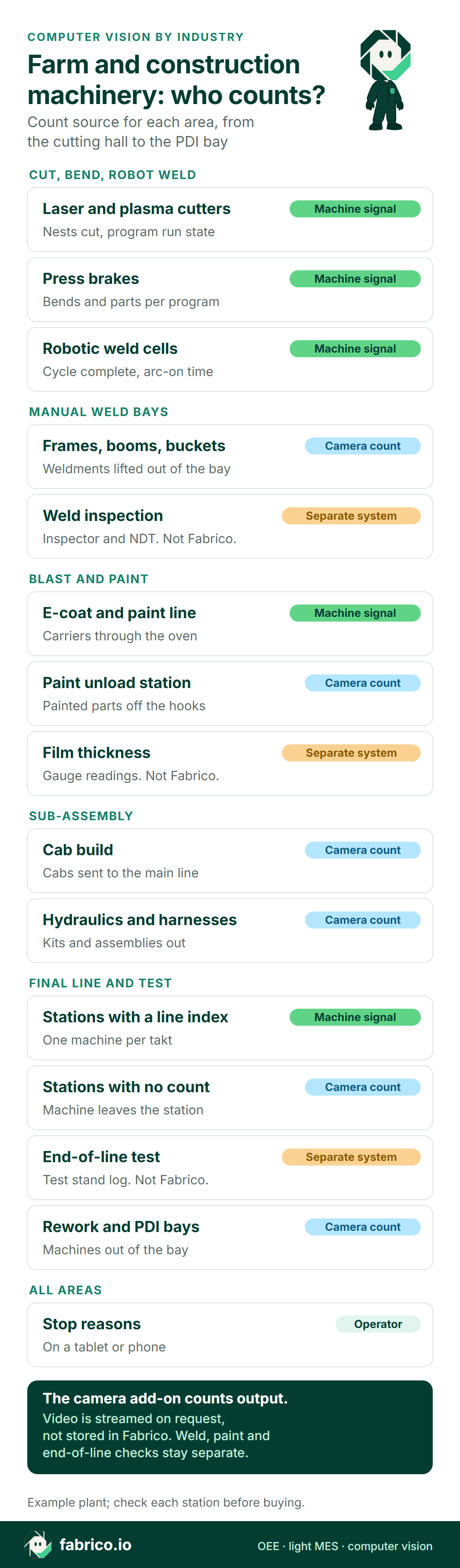
The card below lists common stations and where each count comes from. Walk each cell with the production lead before asking for a quote.
Text version of this infographic
- Cut, bend, robot weld: laser and plasma cutters: machine signal, nests cut and program run state
- Cut, bend, robot weld: press brakes: machine signal, bends and parts per program
- Cut, bend, robot weld: robotic weld cells: machine signal, cycle complete and arc-on time
- Manual weld bays: frames, booms, buckets: camera count, weldments lifted out of the bay
- Manual weld bays: weld inspection: separate system, inspector and NDT, not Fabrico
- Blast and paint: e-coat and paint line: machine signal, carriers through the oven
- Blast and paint: paint unload station: camera count, painted parts off the hooks
- Blast and paint: film thickness: separate system, gauge readings, not Fabrico
- Sub-assembly: cab build: camera count, cabs sent to the main line
- Sub-assembly: hydraulics and harnesses: camera count, kits and assemblies out
- Final line and test: stations with a line index: machine signal, one machine per takt
- Final line and test: stations with no count: camera count, machine leaves the station
- Final line and test: end-of-line test: separate system, test stand log, not Fabrico
- Final line and test: rework and PDI bays: camera count, machines out of the bay
- All areas: operators enter stop reasons on a tablet or phone
- Bottom panel: the camera add-on counts output; video is streamed on request, not stored in Fabrico; weld, paint and end-of-line checks stay separate
- Footer: Example plant; check each station before buying.
Book a demo to see weld bays, cab lines and the repair bay counted per model on one shift timeline.
One heavy-mix shift on a tractor final line, priced per model
Example numbers, no real plant. The line works 06:00 to 14:30 with a 30-minute break: 480 planned minutes. Each model's ideal time is the slot the line gives it. The line PLC counts machines leaving S7, with the model from the build sequence; a camera add-on counts cabs and hose kits; team leads enter stop reasons.
| Model | What it is | Ideal time | Built | Good | Example contribution |
|---|---|---|---|---|---|
| S | Six-cylinder, standard cab | 24 min | 1 | 0 | EUR 18,000 |
| M | S plus front linkage, front PTO, suspended cab | 30 min | 4 | 4 | EUR 22,500 |
| H | Top power class, premium cab | 36 min | 6 | 5 | EUR 27,000 |
Availability. The line stood 45 minutes for a premium cab that the cab line delivered late, and 25 minutes for a front linkage hose kit that was short. Run time was 410 of 480 minutes: 85.4%.
Performance. 11 machines left S7: 1 S, 4 M and 6 H. Their ideal times add up to 24 + 120 + 216 = 360 minutes from 410 minutes of running: 87.8%. The 50 missing minutes were short holds of a minute or two at the wheels and fluids station, each too short for anyone to book.
Quality. One S and one H failed the hydraulic function test and went to the repair bay. They leave the good count: 24 + 36 = 60 ideal minutes out, so 9 good machines earn 300 of 360 minutes: 83.3%.
OEE. 85.4% x 87.8% x 83.3% = 62.5%. The quick check: 300 good ideal minutes of 480 planned minutes is 62.5%.
In money. For scale, the University of Illinois farmdoc 2025 machinery cost estimates put the list price of a 310 HP tractor at USD 623,657, up 7.5% from 2023. The contributions in the table are example inputs set far below that band, since dealer margin, materials and freight come off first; the plant replaces them with its own. They work out at EUR 750 per ideal minute. Stops and short holds cost 120 minutes, or EUR 90,000 of contribution on one shift; the late cab alone is EUR 33,750. That holds only while orders wait: a line building to stock loses crew time, not margin. Fabrico prices each loss from the plant's own SKU price or margin.
The two repaired tractors still ship, so price them at crew time, not as EUR 45,000 of lost contribution: two fitters for two hours each is 8 crew hours, EUR 440 at an example EUR 55 an hour. See rework vs repair, and availability loss vs performance loss for why the late cab is availability and the short holds performance.
The biggest single stop is not on the final line at all. The camera add-on count at the cab line showed the premium cab leaving 40 minutes behind its slot, so the fix belongs at cab build, not at the marriage station.
Four ideal-time settings side by side: what a single takt hides
Run the same shift through one ideal time for the whole line. Same 11 machines, same 410 running minutes, same two test failures; only the ideal changes.
| Ideal time setting | Earned min | Performance | Good min | Quality | OEE | What the plant sees |
|---|---|---|---|---|---|---|
| Per model: 24, 30, 36 | 360 | 87.8% | 300 | 83.3% | 62.5% | 50 min of short holds, as logged |
| One takt, 30 (average) | 330 | 80.5% | 270 | 81.8% | 56.3% | 30 min of slow running that did not happen |
| One takt, 36 (heaviest) | 396 | 96.6% | 324 | 81.8% | 67.5% | Short holds shrink from 50 to 14 min |
| One takt, 24 (lightest) | 264 | 64.4% | 216 | 81.8% | 45.0% | A line that looks broken |
With one 30-minute ideal, the line loses 30 minutes of performance it never lost: the extra content of six top models, less what the one small model saved. Team leads would hunt for slow running that did not happen. Set the ideal to the heaviest model and 50 minutes of short holds shrink to 14 on paper. Only the per-model row matches the floor.
On a shift of mostly small models, the same 30-minute ideal can push performance past 100% while short holds pile up unseen. When the OEE board and the build plan disagree, check the mix before the people.
Where Fabrico fits on a mixed-model tractor or excavator line
Fabrico is a cloud OEE platform with light MES functions. Mapped onto a plant that builds many models on one line, the product covers this:
- Ideal time per model: the ideal cycle time is set to the slot of each model, so line stops, short holds and test failures are what the losses show.
- Machines with a signal: run state and counts come from the laser, press brake and weld robot controllers and the line PLC; a robot fault becomes stop time that someone gives a reason.
- Manual exits: the camera add-on counts weldments lifted out, cabs and kits sent on, and machines leaving the repair bay. Where a camera add-on covers the station, the video for the minute of a stop can be opened from the shift timeline, streamed on request and not stored in Fabrico.
- Reasons and money: welders, fitters and team leads pick why work stopped, on a tablet or phone. Fabrico shows OEE per station and per shift and puts a money value on each loss, in a browser or the iOS and Android apps.
Figures reach the ERP through the REST API, webhooks, or an Excel or CSV export.
Roadmap, not available today: the camera add-on spotting on its own that a station has stopped, and offering the probable reason for the team lead to accept or change.
Outside Fabrico: weld inspection and NDT, paint film and adhesion checks, end-of-line function tests, robot seam tracking, and the machine's serial and build record, which stays in the ERP and the quality system.
Details of the add-on are on the Fabrico computer vision page, and choosing OEE software is the broader buyer's guide.
Questions for a camera or OEE vendor on mixed-model counting
Ask every vendor on the shortlist the same things and hold the answers up against your build sequence and test records.
| Ask | A good answer |
|---|---|
| How is an ideal time set per model or option set? | Per product, dated, so a takt change does not rewrite last month. |
| Where does the model of each machine come from? | The build sequence or order, not a guess by the camera. |
| What does the camera count at a cab line exit? | One cab leaving, matched to the sequence for its trim. |
| How are repaired machines counted? | Out of first-pass good, counted once when they leave the repair bay. |
| What does the camera count in a weld bay, and can it survive there? | A weldment lifted out, not arc light; a housing against spatter, clear of the crane. |
| How do counts per model reach the ERP? | A documented API or export, with an example file. |
Start with the station that absorbs the most mix and has no count, usually the cab line or a weld bay. Which model runs next is a planning question, covered in production sequencing and dispatching rules; the count only has to follow it.
Model-mix questions from tractor and excavator plants
Should a mixed-model tractor line use one ideal cycle time?
No. Give each model or option set its own ideal time, taken from the slot the line gives it. One number makes a heavy-mix shift look slow and a light-mix shift look fast.
Can the camera tell which model it counted?
Do not rely on it for that. The model comes from the build sequence the line runs to; the camera add-on counts the cab, kit or machine leaving the station.
Does a tractor fixed in the repair bay count as good?
Not first time. It leaves the good count and is counted once, when it leaves the repair bay. Price the repair at crew time, because the machine still ships.
Is this about cameras on tractors in the field?
No. Crop, weed and autonomy cameras run on the machine in the field. This page is about the factory that builds it.
Do lost minutes on a tractor line always cost margin?
Only while orders wait. When the line builds to stock, a lost minute costs crew time and overtime instead; see make-to-order vs make-to-stock scheduling.
How should a plant plan capacity with many models on one line?
In model hours, not machines: load each model's slot, add them up by shift and compare with the time the line has. Mixed-product capacity planning walks through it.
Want to see weld bays, the cab line and the repair bay counted against each model's slot on one timeline? Book a demo.
Related articles





Latest from our blog




Real Fabrico tiles, sample data.