


 Login
 Blog

Computer Vision for Electronics Manufacturing: Honest OEE on High-Mix Boards

In short: computer vision in electronics manufacturing counts boards at the hand stations after SMT, so OEE can judge each variant against its own ideal time.
- Inspection is a separate job: SPI, AOI, X-ray and test find defects; the counting camera only counts finished boards and units.
- One ideal time per line lies: a board with 22 hand-inserted parts is not slow because it takes longer than one with 14.
- Each change lands on one station: SMT absorbs setups, hand insertion absorbs parts count, coating absorbs masking, box build absorbs the customer's housing.
- In the example shift, per-variant ideal times give 71.7% OEE; one line rate of 75 seconds reports 63.3% and blames the wrong board.
- Fabrico's camera add-on counts boards and units; the video for the minute of a stop is streamed on request and not stored in Fabrico.
A high-mix EMS hall can run five board programs in one shift, and the SMT line logs each of them. After it, one board family splits: one variant carries 14 through-hole parts and the next 22, one is coated and one is not, one ships in a customer's own housing. Each change lands on a different station, mostly hand work that nothing counts. That is the gap a counting camera closes, and the reason one ideal cycle time per line gives the wrong OEE.
The variant-by-station matrix for an EMS hall
Read across a row to see which station absorbs a change. Setup means the change costs a changeover, Cycle means it changes the time per board, Both means both, and an empty cell means no effect. The last row says where each station's count comes from.
| What changes per board, variant or order | SMT line | THT hand insertion | Wave or selective solder | Touch-up | Coat and mask | Test | Box build and pack |
|---|---|---|---|---|---|---|---|
| Placement program, feeders, stencil | Both | ||||||
| Moisture-sensitive parts on the bill | Setup | ||||||
| Number of through-hole parts | Cycle | Cycle | |||||
| Wave pallet or selective program | Setup | Both | |||||
| Leaded or lead-free alloy | Setup | Setup | |||||
| Coating yes or no, mask pattern | Both | ||||||
| Test program and fixture | Both | ||||||
| Housing, cable set, label, carton | Both | ||||||
| Where the count comes from | Machine signal | Camera add-on | Machine signal | Camera add-on | Coater, or a camera at de-masking | Tester log | Camera add-on |
Setups cluster on the SMT line and in test, where machines already report. Cycle changes cluster at the hand stations, where nothing counts. A variant that adds through-hole parts changes the time at insertion and at touch-up together, so one board can look slow at two benches for one reason. Fill one in per product family with the line leads.
Explainer presented by Iris, Fabrico's AI-generated presenter: how an add-on camera counts output where a machine has no signal. Book a demo.
Plays from YouTube. Google may set cookies when you press play. Privacy policy.
Why one ideal cycle time per line lies on high-mix boards
OEE performance compares what a station made with what it could have made at its ideal cycle time. On a line that builds one board, one ideal time is enough. EMS work is rarely like that. In a paper presented at IPC APEX, researchers from Valor and the University of Turku noted that high-mix low-volume environments "have become common in printed circuit board (PCB) assembly".
With a mix, one number per line fails predictably. Set it from the fastest board and every slower variant reads as slow running. Set it from the slowest and the fast boards hide real losses. Either way performance follows the order book, not the line.
The fix is a rule, not a tool. Ideal cycle time belongs to the variant at the station that sets its pace, and a shift's ideal minutes are the sum of boards times their own ideal time. That needs two things most hand stations lack: a count, and the variant attached to it. See theoretical vs actual cycle time for the planned rate against the real one. An EMS quote prices each job from its own times too, which is why OEE in electronics: quote vs actual compares job by job.
SMT setups: the line already reports, the changeover is the variant cost
Loader, screen printer, SPI, pick and place, reflow, AOI and unloader report their own state. IPC-2591, the Connected Factory Exchange (CFX) standard, "establishes the requirements for the omnidirectional exchange of information between manufacturing processes" and the host systems around them. For the board handover between machines, the Hermes Standard (IPC-HERMES-9852) is an open protocol based on TCP/IP and XML, which IPC recognises as the next generation of the old SMEMA handover. Older lines report through the line PLC. A camera adds little here.
What a new variant changes on SMT is mostly setup: a program, feeder trolleys, a stencil, a first article to verify. Give each its own stop code, so a day of short runs reads as setup and not as a slow line. Reducing SMT changeover time covers offline kitting, and first off approval after changeover the wait inside a changeover.
One change happens before the line starts: moisture-sensitive parts. JEDEC's J-STD-020 classifies non-hermetic surface mount parts so that they "can be properly packaged, stored, and handled to avoid damage during assembly solder reflow attachment and/or repair operations". A variant that carries such a part may wait for a bake or a dry cabinet before its program runs. Book that wait as its own stop reason on SMT, or it shows up as no boards at the hand stations and the THT line takes the blame for a kitting decision.
Through-hole content and the solder step: where the variant sets the pace
After SMT the variant shows its weight. Connectors, transformers, relays and large capacitors go through the board, inserted by hand onto a wave pallet, often at two stations side by side. A power board with 14 through-hole parts and its sister with 22 share the benches but not the pace. The slower insertion station sets the ideal time: say 75 seconds for the 14-part board and 105 seconds for the 22-part board. Those 30 seconds are content, not loss.
The solder step absorbs the variant as setup. A board with a new connector layout may need its own wave pallet and profile, and a selective solder cell runs one program per board; both machines report. The alloy is a setup too. Products for the EU market fall under the RoHS Directive, which restricts ten substances in electrical and electronic equipment, lead among them, so a plant that also builds leaded boards for products outside its scope books an alloy swap, at the solder cell and at touch-up, as a changeover. Where setup ends and changeover begins is in changeover vs setup time.
The insertion stations have no signal at all. A camera add-on above the last one counts pallets sent to the wave. With the variant taken from the work order running at the station, those pallets turn into ideal minutes at the right rate. OEE with computer vision shows how such a count becomes availability, performance and quality.
Touch-up, coating and test: where variant trouble queues
Touch-up
After the wave, an operator clears bridges and solders what the wave missed. The work per board depends on the variant: more joints, more chances to bridge. On a bad wave day this bench is the real bottleneck of the THT line. A camera add-on over the bench exit counts boards set down as done, the count the worked example below uses.
Conformal coat
Some variants are coated, and each coated one has its own list of what must stay clean: connectors, test points, trimmers. The coater runs a program, but masking and de-masking are hand work with a per-variant pattern. If the coater waits for boards, count at the de-masking exit.
Depaneling and test
Breaking out V-scored panels by hand leaves no record, so a camera there counts boards. ICT, flying probe and FCT log pass and fail per serial number; a fixture swap is a setup. Yield by line is in first pass yield on SMT lines.
Box build and pack-out: the customer's variant shows up last
In box build the order, not the board, is the variant. The same controller board goes into three housings for three customers, with different cable sets and labels. A screwdriver controller counts tightenings, but the bench as a whole counts nothing, and the time per unit changes with the housing. A camera add-on over the bench exit counts finished units, and one over the pack-out table counts closed boxes.
If pack-out counts cartons and box build counts units, set the conversion per order. Work orders and routes, which give each count its variant, are in MES for electronics and EMS manufacturing.
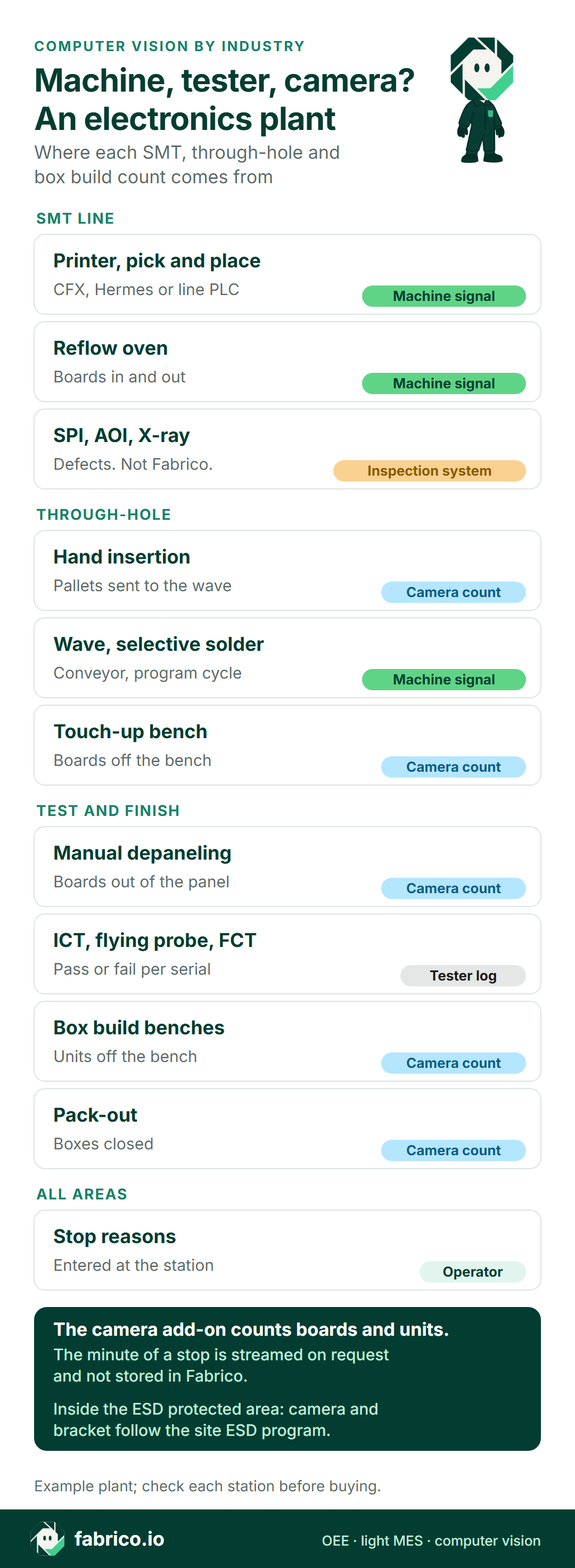
Text version of this infographic
- SMT line: screen printer and pick and place: machine signal, through IPC-CFX, Hermes or the line PLC
- SMT line: reflow oven: machine signal, boards in and out
- SMT line: SPI, AOI and X-ray: inspection system, finds defects, not Fabrico
- Through-hole: hand insertion: camera count, pallets sent to the wave
- Through-hole: wave and selective solder: machine signal, conveyor and program cycle
- Through-hole: touch-up bench: camera count, boards off the bench
- Test and finish: manual depaneling: camera count, boards broken out of the panel
- Test and finish: ICT, flying probe and FCT: tester log, pass and fail per serial number
- Test and finish: box build benches: camera count, units off the bench
- Test and finish: pack-out: camera count, boxes closed
- All areas: operators enter stop reasons at the station
- Camera add-on: counts boards and units; the minute of a stop is streamed on request and not stored in Fabrico
- Inside the ESD protected area: camera and bracket follow the site ESD program
This plant's flow, and where a camera counts reliably
The worked example uses the through-hole side of an example hall: two insertion stations in parallel feed one wave, one touch-up bench takes everything the wave sends, and only variant B is coated after test. The queue that matters forms in front of touch-up.
Where the camera points decides whether the count holds up. A study from Hamburg University of Technology, published in Sensors, set aside watching the product to judge assembly progress, because that "is not always applicable if the product is multi-variant with small lot sizes and, as a result, the data availability is poor or if the assembly situation is chaotic and affected by occlusions". The study tracked tools and hand actions, not board counts, outside electronics, so read it as a warning about conditions, not an accuracy figure.
In electronics that means counting a single, clear event: a pallet leaving insertion, a board set down at the touch-up exit, a box closed at pack-out. Do not ask a camera to follow insertion work under hands and tools. Keep finished boards apart from work in progress, so a stack two deep is not read as one board, and watch for glare off fresh solder. When a variant arrives with a new board shape or colour, check the camera count against a hand count before it feeds OEE. No accuracy figure carries over from one bench to another.
Worked example: two power board variants on one late shift
Example numbers, no real plant. The THT line runs a late shift from 14:00 to 22:00 with a 30-minute break: 450 planned minutes. Variant A, a power board with 14 through-hole parts, runs until 18:00. Variant B, its sister with 22 parts and a larger connector, runs from 18:25. Ideal times are 75 seconds for A and 105 seconds for B. The camera add-on counts boards at the touch-up exit, the ICT log gives the fails, and the line lead enters stop reasons.
Availability. The changeover from A to B took 25 minutes: new pallets, a new wave profile and a parts kit swap. During B the line stood 30 minutes with no boards, because the SMT line upstream lost time on a feeder error in B's program. Run time was 450 minus 55, or 395 minutes: 87.8%. A ran 210 of those minutes and B 185.
Performance. The touch-up exit counted 158 A boards and 80 B boards. In ideal time that is 158 x 1.25 = 197.5 minutes plus 80 x 1.75 = 140 minutes, 337.5 minutes in all. Against 395 minutes of run time, performance is 85.4%. Per variant, A ran 197.5 ideal minutes in 210 (94.0%) and B 140 in 185 (75.7%). Slow running cost 12.5 minutes on A and 45 on B.
Quality. ICT failed 10 boards on solder joints, 5 of each variant, and they went to rework. Good boards were 153 A and 75 B, worth 191.25 + 131.25 = 322.5 ideal minutes, so quality is 322.5 of 337.5 minutes, 95.6%. A plain board count would say 228 of 238, 95.8%, but a failed B board costs more line time than a failed A board.
OEE. 87.8% x 85.4% x 95.6% = 71.7%. The quick check: 322.5 good minutes of 450 planned is 71.7%.
The same shift with one ideal time for the line
Now run the same counts through the line's old single rate of 75 seconds, set when it built only A.
| Ideal time used | A performance | B performance | Line performance | OEE | What the line lead sees |
|---|---|---|---|---|---|
| Per variant: A 75 s, B 105 s | 94.0% | 75.7% | 85.4% | 71.7% | B lost 45 minutes at the touch-up bench; look at the wave for B. |
| One line rate: 75 s for both | 94.0% | 54.1% | 75.3% | 63.3% | B looks broken, and 40 of its lost minutes are its eight extra parts. |
Same counts, different ideal time, 8.4 points less OEE. The 40 minutes between the two line performance figures are exactly B's eight extra parts: 80 boards x 30 seconds. The per-variant figure points at the 45 slow minutes on B, where the cause was.
The line lead opened the video for the minute of a short stop at the touch-up bench at 20:40 and saw B boards stacking up beside it. Short stops like this one sit in the slow running figure, not in availability. The wave was bridging on B's larger connector, so touch-up slowed on B and ICT still caught 5 B boards; the 5 A fails were scattered joints. The fix belongs at B's wave pallet or profile, not at the bench.
In money. No public per-board margin exists for EMS work, which is quoted per customer and job, so these are example inputs: a contribution margin of EUR 6 for an A board and EUR 8.40 for a B board, both EUR 4.80 per ideal minute. While customer orders are waiting, the 55 stop minutes and 57.5 slow minutes, 112.5 in all, cost EUR 540 a shift. The changeover alone is EUR 120 of that: the price of the mix itself. The 10 reworked boards are not lost sales, so price them at crew time: 8 minutes each at an example EUR 42 an hour is EUR 56, which one rework technician absorbs inside the shift. The bridging on B, 45 slow minutes plus 5 reworked B boards, is EUR 216 + EUR 28 = EUR 244 a shift, or EUR 1,220 a week if B runs on five late shifts. Fabrico prices losses the same way, from the plant's own SKU price or margin.
Book a demo to see two board variants counted at their own ideal times on one shift timeline.
Vendor questions when the mix changes every shift
Put the same questions to each shortlisted vendor; one ideal time per line shows up in the first two answers.
| Question | What a good answer shows |
|---|---|
| Where is the ideal cycle time set: per line, per product, or per variant and station? | Per variant, at the station that sets its pace, with a history when someone changes it. |
| How does a count get its variant? | From the work order or product running at the station, not guessed from the picture. |
| Do you count panels or boards? | Boards per panel from the program, with X-out positions booked as known scrap. |
| How are feeder setups, stencil changes, bake waits and alloy swaps booked? | Their own stop codes, with offline kitting kept apart from line time. |
| What happens when a new variant with a new board shape arrives? | A check against a hand count before the count feeds OEE, with a named person who signs it off. |
| How do AOI, ICT and FCT fails reach quality? | From the tester's own fail count, weighted by the variant's ideal time, with reworked boards never shown as first-pass good. |
Start with one THT line or box build cell where the mix is widest, and see how to evaluate OEE software.
ESD benches, customer designs and the works council
A lens over a touch-up bench sees hands and faces. Explain the purpose to the operators first, and where a works council exists, put the plan to it before anything is mounted. Do not lean on signed consent forms: the EDPB video guidelines say that in most cases employers should not rely on consent, given the imbalance of power, so settle the legal basis with the data protection officer. Report per bench and shift, never by name. Cameras on the production line without surveilling people has the full list.
Electronics adds two gates. The first is static. Hand stations sit inside the ESD protected area, and IEC 61340-5-1 "provides the requirements for an ESD control program", so the camera, its bracket and its cable become items the ESD coordinator has to approve. The second is the customer: an EMS plant builds other companies' designs, and some contracts limit who may film them. Check the contract first, and aim the lens so the board layout is not the subject.
The Fabrico camera add-on counts boards and units, not people. Where it covers a station, the video for the minute of a stop is streamed on request and not stored in Fabrico. Whoever you shortlist, get the video path on paper.
Where Fabrico fits in a high-mix EMS plant
Fabrico is a cloud OEE platform with light MES functions. In an electronics plant it does three things today:
- On the SMT line it takes run state and panel counts from the line through PLC connectivity or IoT sensors, so feeder errors, stencil changes and starved conveyors show up as stop time with a reason.
- At hand insertion, touch-up, depaneling, box build and pack-out the camera add-on counts pallets, boards and units leaving the station. If the touch-up bench stops at 21:10, the line lead opens the video for the minute of that stop from the shift timeline, streamed on request and not stored in Fabrico.
- Per program and variant you set the ideal cycle time from the constraint machine or the slowest hand station, and boards per panel, so performance reads in boards and not in panels.
Stop reasons come from operators, line leads and test technicians, picked on a tablet or phone at the station. OEE and its losses are shown per line and shift, priced in money, in a browser or the iOS and Android apps. Line results go to the ERP or the MES of record through a REST API or webhooks, or leave as Excel and CSV exports.
Roadmap, not available today: the camera add-on noticing by itself that a touch-up bench or a box build station has gone idle, and proposing the likely reason.
Outside Fabrico: SPI, AOI, X-ray, ICT and FCT, the placement machine's own vision, reflow profiling, and the traceability record of reels, lots and serial numbers.
More on Fabrico computer vision for OEE, OEE in electronics manufacturing, IPC-CFX and Hermes on an SMT line, and stops after changeover in the first hour of a new variant.
Model-mix questions EMS plants ask
Where should an EMS plant with a wide mix put its first camera?
At the hand station that absorbs the most cycle change and has no count: usually the touch-up bench after the wave, or the box build exit. The SMT line already reports through its machines.
Can an OEE camera replace AOI or X-ray inspection?
No. SPI checks paste, AOI checks placed and soldered parts, X-ray sees joints under BGAs, and ICT and FCT prove the circuit. Fabrico does no inspection. Confirmed fails from those systems still feed the OEE quality figure through their counts.
Should ideal cycle time be set per line or per variant?
Per variant, at the station that sets that variant's pace. One rate per line makes heavy variants look slow and hides losses on light ones. In the example on this page it moved OEE from 71.7% to 63.3% with the same counts.
Should OEE count panels or boards?
Count what the customer pays for, usually boards, and convert panels with the boards per panel from the program. Book X-out positions as known scrap, so a panel with two bad positions does not read as eight good boards.
Want to see two board variants counted at their own pace on one shift timeline? Book a demo.
Related articles










Real Fabrico tiles, sample data.