


 Login
 Blog

Computer Vision for Garage Door Manufacturing: Fair OEE When Every Door Differs

In short: computer vision for garage door manufacturing counts door sets and kits at hand stations; ideal times per door family keep OEE fair.
- Inspection systems judge skins, foam, glazing and springs; the camera add-on only counts what leaves a station, and Fabrico does no inspection.
- Width, height, colour, windows, a wicket door, the spring pair, an operator and the market each land on a different station.
- One ideal time per door set makes a builder's day of single doors look fast and a dealer's day of doubles look slow.
- Give each door family its own ideal time per station, and count a door set only when all its packages are counted.
Two garage doors on the same order can share nothing but the profile. One is a single door, smooth white, four sections, manual. The next is a double door in woodgrain with a window row, five sections, a heavier spring pair and an operator box. The window bench, the spring bench and the packing cell feel all of it, which is why a door plant's OEE moves with the order book, not only with the crew.
In scope: sectional, roller and up-and-over garage doors, and industrial sectional doors. Windows, entrance and patio doors sit in computer vision for window and door manufacturing, and building boards and precast in computer vision for building materials. Smart openers with built-in cameras are a consumer product and are left out.
Garage door variants by station: which bench absorbs each option
Each row is one choice on the order; each column is a station. A "no change" cell is where one ideal time is safe.
| Variant | Panel line | Saw and finishing | Spring bench | Kit bench | Packing cell |
|---|---|---|---|---|---|
| Colour and finish (smooth, stucco, woodgrain) | Coil swap, embossing roll | No change | No change | No change | No change |
| Width (single or double) | Longer cut | More struts | Heavier pair | More hinges | Longer stack and wrap |
| Height (four or five sections) | One more section | One more section to punch | Heavier pair, more turns | Hinge set by section count | Taller stack |
| Window row | No change | Window bench | Glass adds weight | No change | Glazing protected |
| Wicket door | No change | Wicket bench, across sections | Heavier pair | Closer and lock | Extra check |
| Wind rating | No change | Extra struts | Heavier pair | Heavier hardware | No change |
| Operator or manual | No change | No change | No change | No change | Operator box added |
| Market (US or EU) | No change | No change | No change | No change | Label set per market |
Two rows rest on the rules. Width drives struts because the US standard ANSI/DASMA 102 says door sections "shall be designed to support their own weight when in the horizontal position and not deflect more than 1/120th of the door width": sag outgrows that limit as doors widen. The operator row exists because the same standard defines the door system as sections and components, and adds: "This may include an operator, if listed as part of the door system."
Roller and up-and-over doors add rows of their own: curtain width sets the time at the threading and boxing bench, canopy size at the welding and cladding bench.
Explainer presented by Iris, Fabrico's AI-generated presenter: how an add-on camera counts output where a machine has no signal. Book a demo.
Plays from YouTube. Google may set cookies when you press play. Privacy policy.
Why one ideal time per door set gives the wrong answer
A planning sheet that says "6 minutes a door set" is an average of last season's mix, and it misleads the way nameplate capacity does. Take an example packing cell: 5 minutes for a single door set, 7 for a double, 1 more with an operator box. On a mix that averages 6 minutes, the flat figure is right; on any other day the error lands on the crew. The table holds running time at 372 minutes, so only the mix changes. Example inputs, no real plant.
| Shift | Single / double / single with operator / double with operator | Sets counted | Flat 6 minutes | Family times |
|---|---|---|---|---|
| A: mixed day | 25 / 13 / 12 / 6 | 56 | 336 of 372 = 90.3% | 336 of 372 = 90.3% |
| B: replacement dealer day | 10 / 20 / 6 / 14 | 50 | 300 of 372 = 80.6% | 338 of 372 = 90.9% |
| C: house builder day | 52 / 0 / 12 / 0 | 64 | 384 of 372 = 103.2% | 332 of 372 = 89.2% |
Shift B: 10 x 5 + 20 x 7 + 6 x 6 + 14 x 8 = 50 + 140 + 36 + 112 = 338 minutes. Shift C: 52 x 5 + 12 x 6 = 260 + 72 = 332 minutes. With the flat figure, B is worth 50 x 6 = 300 minutes and C is worth 64 x 6 = 384.
So the flat figure puts the dealer-day crew 22.6 points behind the builder-day crew, while the family times put them 1.7 points apart, the other way round.
Panel line: colour and height cost time, not counts
Insulated sections come off a continuous line. Two pre-painted steel coils feed the outer and inner skins, embossing rolls press stucco or woodgrain into the outer skin, and roll formers shape the joint between sections. A high-pressure mixing head lays polyurethane between the skins, a double-belt conveyor holds the panel while the foam cures, and a flying saw cuts sections to length on the move.
The line PLC counts metres and sections, so connect its run state and counter; no camera is needed here. What the mix changes on this line is time, not the count:
- Colour and finish: a new skin colour or embossing pattern means a coil swap on one or both decoilers. Book each as a changeover, split by colour pair.
- Foam start-up: after a stop, the first metres of foam can be scrap, so a short stop for a colour change costs more than its minutes.
- Section profile and height: they set the speed the saw and stacker can hold, so give each product group its own ideal rate in metres per minute.
Running colours in blocks loses fewer minutes to coil swaps than following the order list. For line speed and scrap in depth, see OEE for roll forming.
Sections cut to order: width, struts, windows and wicket doors
Every section is cut to the length of its door, so the saw works to the order list, not to stock, much as make-to-order plants do. Sections are punched for hinges and brackets, in line on many panel lines or at a press after the stacker, and fitted with end caps. A punching press counts its strokes, so read that signal. The benches that follow do not count.
Struts on wide doors
Struts are riveted or screwed on by hand, and a double-width door, or one rated for high wind, carries more of them. In the US, ANSI/DASMA 102 leaves wind load to "the authority having jurisdiction", so the strut count can depend on where the door is going. A camera add-on at the bench exit counts sections leaving, and a wide-door ideal time keeps extra struts from reading as slow work.
Window rows
A press or a CNC router cuts window openings in the chosen section, then a fitter clips or screws window frames and glazing in by hand. Only sections with windows visit this bench, so its count is sections out, with an ideal time per section set by width.
Wicket doors on industrial sectionals
A wicket door is a pedestrian door built into the door leaf. In the EU, Intertek's summary of EN 13241 lists "pass doors incorporated in the door leaf" as "also covered by this European Standard". Building one is long manual work: cut the opening across several sections, frame it in aluminium profile, hang the leaf, fit closer and lock. Give each wicket type its own ideal time, and the long cycle stays out of the slow-work column.
Springs: start from the door's weight
Torsion springs come off CNC spring winders, which count each spring, so read that signal. Spring design is engineering work: in the US, ANSI/DASMA 102 says "Torsion springs shall not be used to balance sectional doors employing an index ratio of less than 6 to 1", and that stays on the spring calculation sheet.
The range is wide. DASMA's spring colour code data sheet, TDS 171 lists 49 torsion spring wire diameters, from .1200 to .6250 inch, each colour coded, and extension springs in 26 door weights from 50 to 300 pounds. Its note for extension springs reads: "Two extension springs are required for the corresponding door weight." Every weight band is a different spring, and extension springs come in pairs.
That makes the spring bench the station where a mix change bites first. After the winder, springs are paired left and right wound, cones are fitted, and they are boxed with the shaft and cable drums. A winder on heavy double-door wire must change wire before it can feed single doors: a changeover, not a fault. The pairing bench has no counter, so a camera add-on counts spring boxes closed.
Kits, operator boxes and labels for each market
Hinges, track rollers, bottom brackets, top fixtures and cables go into one hardware kit per door. Hinges come numbered by their position between sections, so a five-section door takes a different kit from a four-section one, and a wide or heavy door takes more of everything. Track is roll formed and counted per program, then bundled by door size by hand.
The operator box and the label set depend on where the door is sold:
- US: rules for residential operators say "A residential garage door operator shall be provided with labels for field installation", so a US operator box carries its warning labels.
- EU: per Intertek's summary, garage doors "should meet the requirements as described in the standard EN 13241, which is a harmonized standard under the Construction Products Regulation (EU) 305/2011", and these doors "can be manually or power operated."
A camera add-on counts operator boxes closed; whether each box holds the right labels for its market is the packer's check. A door with an operator box takes one more package and one more check, so it earns more minutes.
Door families: count once, when every package is in
A door family is a group of doors that takes the same time at one station. Example figures; a plant replaces each with its own timed runs.
| Station | Unit counted | Example ideal times | Count source |
|---|---|---|---|
| Panel line | Metres and sections | Rate per section profile and height | Line PLC |
| Window bench | Sections with windows | 6 min single width, 9 min double width | Camera add-on |
| Wicket bench | Wicket doors | 45 min per standard wicket type | Camera add-on |
| Spring bench | Spring boxes | 3 min single door, 4 min double door | Camera add-on |
| Kit bench | Hardware kits | 4 min four sections, 5 min five sections | Camera add-on |
| Packing cell | Door sets | 5 min single, 7 min double, 1 min more with an operator box | Camera add-on |
ANSI/DASMA 102 describes the door system manufacturer as the one that "Supplies as a package all sections and components necessary to produce an operational door". So count each package at the station that closes it, and put all of them on one shift timeline against the day's door list.
If 40 doors are planned and the counts read 40 section stacks, 38 track bundles and 34 spring boxes, the spring bench is holding dispatch, whatever the panel line OEE says. A door set counts as good output when all its packages are counted, so the six missing spring boxes show as six doors short, not as a good day. Why the queue of waiting packages grows with variability is in the Kingman formula; the general method for hand-built output is in measuring OEE on manual and hybrid assembly lines.
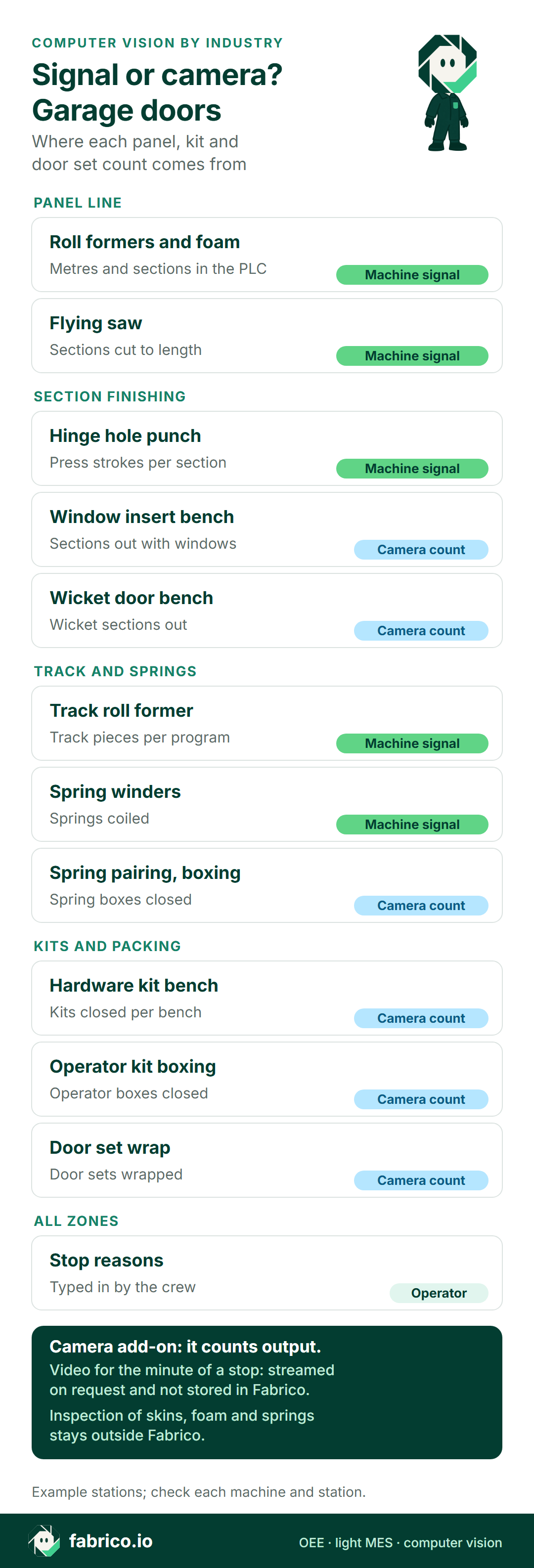
Text version of this infographic
- Panel line: Roll formers and foam: machine signal, Metres and sections in the PLC
- Panel line: Flying saw: machine signal, Sections cut to length
- Section finishing: Hinge hole punch: machine signal, Press strokes per section
- Section finishing: Window insert bench: camera count, Sections out with windows
- Section finishing: Wicket door bench: camera count, Wicket sections out
- Track and springs: Track roll former: machine signal, Track pieces per program
- Track and springs: Spring winders: machine signal, Springs coiled
- Track and springs: Spring pairing, boxing: camera count, Spring boxes closed
- Kits and packing: Hardware kit bench: camera count, Kits closed per bench
- Kits and packing: Operator kit boxing: camera count, Operator boxes closed
- Kits and packing: Door set wrap: camera count, Door sets wrapped
- All zones: Stop reasons: operator, Typed in by the crew
- Camera add-on: it counts output.
- Video for the minute of a stop: streamed on request and not stored in Fabrico.
- Inspection of skins, foam and springs stays outside Fabrico.
One early shift in the packing cell, priced by door family
Example inputs, no real plant. In a residential sectional door plant, two kitters and two packers close each hardware kit, add the spring box, track bundle and any operator box, and wrap the door set. The morning shift, 06:00 to 14:00 less a half-hour break, plans 450 minutes at the family times above. One camera add-on watches wrapped sets leave the cell; the team lead types stop reasons into a tablet.
Availability. The spring winders had run a block of heavy double-door wire, and the change back ran long: the cell stood 54 minutes without single-door spring boxes. A tool change on the track radius bender left it 24 minutes without track bundles. 78 minutes down leaves 372 running minutes; 372 / 450 = 82.7%.
Performance. 56 wrapped door sets passed the camera add-on: 25 single, 13 double, 12 single with an operator box and 6 double with one. At family times they are worth 125 + 91 + 72 + 48 = 336 minutes, and 336 / 372 = 90.3%. The team lead booked the 36 slow minutes to kitting: the hinge bins for five-section doors ran empty, and kitters walked to stores.
Quality. The dispatch check reopened 2 sets: a double door whose hardware kit had no lifting cable, worth 7 minutes, and a single door whose spring box held two springs wound the same way, worth 5. Good output: 54 sets worth 324 minutes, and 324 / 336 = 96.4%.
OEE. Multiplied out, 0.827 x 0.903 x 0.964 gives 72.0%. Check: 324 good minutes of 450 planned is 72.0%. The bars add up: 324 + 54 + 24 + 36 + 12 = 450.
The shift in euros
No public per-door margin from a source that passes this page's rules was found, so both money inputs are examples for the plant to replace: EUR 140 contribution margin per residential door set at this mix, and EUR 40 an hour for a fully loaded worker. For 2025, Eurostat's hourly labour cost data put industry in the euro area at EUR 40.3 per hour, the highest of its sectors. This mix averages 6.0 minutes a set (336 minutes over 56 sets), so the 114 wait and slow minutes are 19 door sets never made.
| Loss this shift | Minutes | Door sets | Margin, example |
|---|---|---|---|
| Single-door spring boxes short, wire change | 54 | 9 | EUR 1,260 |
| Slow kitting, five-section hinge bins empty | 36 | 6 | EUR 840 |
| Track bundles short, bender tool change | 24 | 4 | EUR 560 |
| Reopened, fixed at dispatch | 12 | 0 | Crew time |
| Total | 126 | 19 | EUR 2,660 |
When orders are waiting and no overtime is booked to catch up, those 19 sets are EUR 2,660 of margin gone; five such shifts make EUR 13,300 a week. The crew of four was also paid for the 126 minutes: 4 x EUR 40 x 2.1 hours, another EUR 336. In Fabrico, losses are priced from the margin or price set per product, so each family carries its own figure.
Every loss on this shift traces back to the mix. The first fix is the spring winders' wire sequence, not the packers: run single-door and double-door wire in blocks that match the packing order, the kind of pacing line balancing works through. The two waits, EUR 1,820 together, go to the spring and track teams; a two-bin refill for five-section hinge sets deals with the bins.
This quarter: list each door set's packages and their stations, time last month's door families where they change the work, and match wire and colour blocks to the packing sequence. Book a demo to see door sets counted by family on one shift timeline.
What a camera can count at a door bench, and where it struggles
The camera add-on counts a closed kit, a spring box or a wrapped door set crossing a line at the station exit. It does not read wire sizes or open kits: the family comes from the door list, the count from the camera.
In a KTH Royal Institute of Technology and AstraZeneca study of camera tracking on a pharmaceutical test line, published in IEEE Access in 2025, the best detection score was 98.7%, but "Camera 1 exhibited less than 1% accuracy on Edge 2 due to occlusion and the inability to maintain a clear view of Edge 2." The authors add: "Moreover, environmental factors such as variable lighting conditions, reflections from metallic surfaces, and the presence of dust or fumes can degrade image quality."
That study tracked items on conveyors, not hand benches, and gives no figure for door plants. Its lessons carry over: painted skins and galvanised track reflect hall lights, packers lean over stacks, and a wrapper's arm crosses the view. Mount the camera where the wrapped set leaves, clear of forklifts and the wrapper, light the zone evenly, and run a hand count beside it for one shift per station.
This page gives no accuracy figure for Fabrico's add-on; ask every supplier for a hand-count comparison at your bench. From camera count to OEE figure: OEE with computer vision.
Garage door mix questions
Where should a garage door plant put its first camera?
At the exit of the door-set packing cell, where every package of a door meets. The second goes to the spring pairing bench, where a mix change shows first.
Will an OEE camera find dents, foam voids or a wrong spring?
No. Skin defects, foam voids, section length and spring torque are checked by inspection systems, cut tests, gauges and spring rigs. Fabrico does no inspection. A set reopened because of those checks is booked against quality, so OEE still reflects it.
Where Fabrico fits in a door plant with many variants
Fabrico is cloud OEE software with light MES features. On a garage door site it does three things now:
- Panel line, presses, track and springs: machine signals from the line PLC, the punching press, the track roll formers and the spring winders give run state and counts, so a coil swap or a wire change appears as down time with a reason from the crew.
- Benches and packing: the camera add-on counts sections out of window and wicket benches, spring boxes, hardware and operator kits, and wrapped door sets. Where a camera add-on covers the station, the video for the minute of a stop can be opened from the shift timeline, streamed on request and not stored in Fabrico.
- Ideal times: each door family and section profile gets its own ideal rate or time, so a counted door set earns its minutes.
Reasons come from the people at the station, on a phone or tablet. Each loss carries a euro value in station and shift reports on the web, iOS and Android. Exports: REST API, webhooks, Excel or CSV.
Roadmap: a camera add-on that marks a kit bench running past its ideal time and suggests a probable cause, which the team lead accepts or corrects; not available today.
Outside Fabrico: panel and foam inspection, spring calculations and spring tests, operator safety tests, wind load and EN 13241 paperwork, and each door's build record.
Four questions for any supplier
| Question | A sound answer |
|---|---|
| Can one station hold several ideal times? | Yes, one per door family, taken from the door list. |
| How are coil swaps and wire changes booked? | As changeovers with their own reasons, apart from faults. |
| What happens to a set reopened at dispatch? | It leaves the good count once, with a reason. |
| What leaves the plant, and to whom? | A data flow on paper, and reports per station and shift, never per worker. |
Kitters and packers will be in the picture, so talk to them, and to a works council where there is one, before any bracket goes up. Fabrico's camera add-on counts sections, kits and door sets, never people. The camera feature is described at computer vision for OEE, and routings and job tracking for metal work in MES for metal fabrication.
Want every door family counted on one shift timeline? Book a demo and see a garage door plant's benches and packing cell side by side.
Related articles












Real Fabrico tiles, sample data.