Login
 Blog
OEE for Roll Forming Lines: Coil Changes, Line Speed and Scrap

Key takeaways
- Measure a roll forming line in metres: the ideal is the rated line speed for each profile, in metres per minute.
- Coil changes and profile changeovers are Availability losses; running below rated speed is a Performance loss.
- Cut-off and punching faults land in all three factors, depending on whether they stop the line, slow it or make bad parts.
- Start-up metres after a coil change or a changeover, plus coil heads and tails, are Quality losses.
- Price each loss per metre, so changeovers, coil changes, slow running and scrap rank on one list.
The roll former on line 2 runs at its set speed for most of each coil. Then the coil ends, the new one takes a while to thread, the first metres come out with flare and twist, and the flying cut-off misses its length twice before lunch. The run screen says the line ran most of the shift. The metres say something else, and that difference is what OEE on a roll forming line should explain.
This guide is for plant managers, production managers and engineers who run roll forming lines for profiles, panels, purlins or tubes. It covers the ideal rate in metres per minute, coil changes, profile changeovers and roll tooling, cut-off and punching faults, start-up scrap and what each data source can see.
Where the time goes on a roll forming line
A typical line runs from the uncoiler and coil car through a straightener, the entry guide and a pre-punch press or in-line punching, into the forming stands, then a flying cut-off or a stop-to-cut shear, the run-out table and a stacker or bundler. When any of them stops, the strip stops.
| Station | Typical stops and losses | OEE factor |
|---|---|---|
| Uncoiler and coil car | Coil end, coil change, threading the new head, coil fault | Availability |
| Straightener and entry | Strip wander, camber, entry guide set wrong | Performance, Quality |
| Punching | Missed punch, hole position out, slug pulling, broken punch | Availability, Quality |
| Forming stands | Roll setting drift, strip jam, lubrication fault | Availability, Quality |
| Cut-off | Length error, burr, die wear, cut-off sync fault | Availability, Quality |
| Run-out and stacker | Stacker full, bundle not removed, profiles piling up | Availability, Performance |
| Profile changeover | Roll change or stand adjustment, cut-off and punch dies, first part check | Availability |

Line speed as the ideal rate
A roll former makes a continuous product, so measure it in metres. The ideal rate is the rated line speed for the profile, in metres per minute, set for its gauge, material and punch pattern. Performance is the metres produced divided by run time times the ideal speed.
Set the ideal per profile from the design rating or the best stable speed held over long runs. Do not set it to the speed operators usually run. If a hard material or a marginal tooling setup makes the crew run slower, that is speed loss, and it should show. Our article on diagnosing rate loss with data covers how to find it.
Stop-to-cut lines need care. The strip stops for each cut, so short parts lose more time per metre than long ones. Set the ideal per profile and length band, including the designed time for each cut, or Performance punishes the short jobs. Count metres from the line encoder and pieces from the cut counter; where lengths vary, metres are the fairer count.
Coil changes
A coil change means running out the tail, cutting off the tail end, loading the new coil with the coil car, threading the head through the straightener and entry guide, jogging it into the first stands and cutting off the head. With the line stopped, it is an Availability loss with its own reason code.
Coil changes can repeat several times a shift, so they add up. A double-head uncoiler or a coil car that preps the next coil while the line runs turns part of the change into external work. Heavier coils mean fewer changes, if the uncoiler and the crane allow them.
Decide once whether a standard coil change counts as planned. If it does, set a standard time and book the minutes over it as unplanned. Either way, keep coil changes out of the general stop bucket, or they disappear into it.
Profile changeover and roll tooling
A profile change is the long stop. On a line with fixed tooling, the rolls come off the shafts stand by stand, or whole rafts or cassettes are swapped by crane. On a size-adjustable line, stands move to the new width. Either way, roll gaps are set, the entry guide is reset, the cut-off and punch dies are changed, the program is loaded, the strip is threaded and the first parts are measured and adjusted.
Most of the time goes into what could be done before the line stops: rafts pre-set off the line, dies and guides staged, settings recorded from the last run of the profile. Our guide to changeover time covers how to measure and split it. Track changeover time by profile pair, because some changes are far longer than others.
Cut-off and punching faults
Cut-off and punching faults land in different factors. A broken punch or a cut-off fault that stops the line is Availability. A strip jam the operator clears in a minute is a short stop and lands in Performance if it falls under your stop threshold. A part cut to the wrong length, a missed hole or a heavy burr is a Quality loss.
Length errors are worth their own reason code. They can come from the measuring wheel slipping or wearing, and they make bad parts at full speed, which nobody notices until the parts are measured. Give each fault a code on the station where it starts. Our article on downtime reason code design explains how to keep the list short enough for operators to use.
Start-up scrap and coil ends
After a profile changeover, the first metres come out with flare at the ends, twist, bow or the wrong section until the rolls are set. After each coil change, the head and tail are cut off. Both run at line speed, so count them as produced and not good: Quality loss, measured in metres.
Scrap from steady running is different: a strip defect, a roll mark, a length error. Code the two apart, because start-up scrap is fixed with better setup and coil end scrap with better threading, while steady-state scrap points at material or tooling.
A worked shift on one line
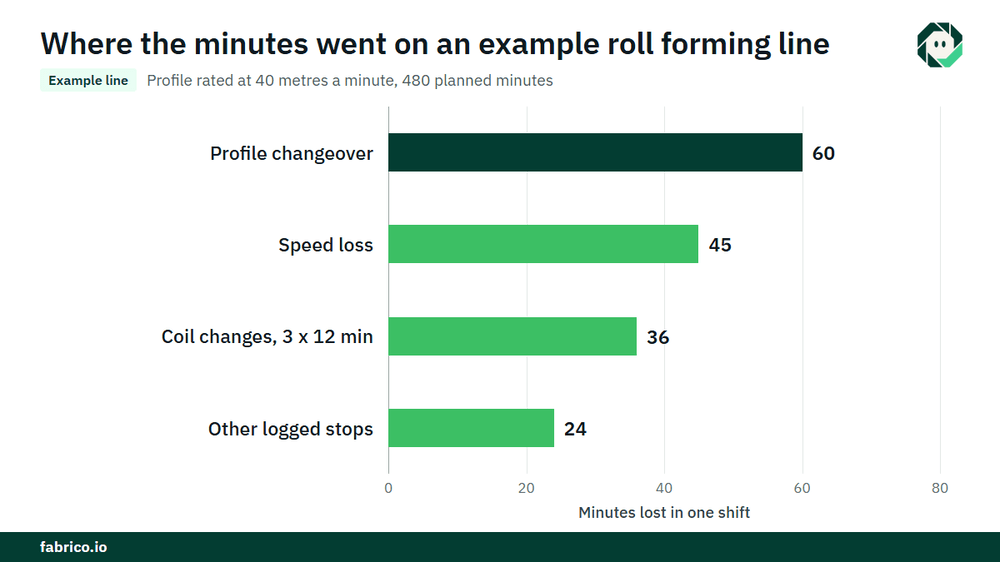
Sample line (illustrative numbers, not a customer): the profile is rated at 40 metres a minute. Planned production time is 480 minutes.
- The profile changeover took 60 minutes, three coil changes 12 minutes each (36 minutes), and other logged stops 24 minutes. Run time is 480 minus 120 = 360 minutes. Availability is 360 / 480 = 75.0%.
- At 40 metres a minute, 360 minutes could make 14,400 metres. The line made 12,600. Performance is 12,600 / 14,400 = 87.5%, which is 315 ideal minutes out of 360.
- Scrap was 40 metres of start-up after the changeover, 72 metres of coil heads and tails, and 28 pieces of 5 metres cut to the wrong length: 252 metres. Good output is 12,348 metres. Quality is 12,348 / 12,600 = 98.0%.
- OEE is 0.750 x 0.875 x 0.980 = 64.3%. Check: 12,348 metres / 40 = 308.7 minutes, and 308.7 / 480 = 64.3%.
- At a contribution of $1.50 a metre, €1.50 in a euro plant, the changeover cost 2,400 metres, $3,600 (€3,600). The 45 minutes of speed loss cost 1,800 metres, $2,700 (€2,700). The coil changes cost 1,440 metres, $2,160 (€2,160). The scrap cost 252 x $1.50 = $378 (€378), plus the steel.
The ranking is the useful part: changeover first, slow running second, coil changes third, scrap last. These figures become cash only if the extra metres sell or save overtime, so agree that rule with your controller.
What each data source sees
| Source | What it tells you | What it misses |
|---|---|---|
| Line PLC and encoder | Line speed, metres, run or stop | Why it stopped, whether the metres were good |
| Cut-off and punch signals | Pieces cut, punch strokes, faults | Length errors the encoder did not catch |
| Operator input | Stop reasons, scrap metres and reasons | Short jams nobody halts to enter |
| Camera at the uncoiler or cut-off | A clip as evidence of a threading problem, a strip jam, profiles piling up | What happens inside the forming stands |
Where the PLC only says stopped, a camera at the uncoiler or the cut-off shows whether the crew was threading a coil, clearing a jam or waiting on a full stacker. The software suggests the likely reason and the operator confirms it in one tap. Common mistakes: the ideal set to the usual running speed, pieces counted when lengths vary, coil changes buried in planned time, and start-up metres never counted.
Where Fabrico fits
Fabrico is a computer vision enabled Manufacturing Performance Platform. On a roll forming line it starts with OEE and light MES: automatic downtime logging from the line signal, OEE live by line and shift, and losses priced in money, so coil changes, changeovers, slow running and scrap sit on one list.
- The operator confirms the reason for a stop in one tap.
- A camera clip as evidence for a stop, where a camera watches the uncoiler or the cut-off.
- Losses ranked by money, so the costliest profile or stop type comes first.
- One view across plants if you run lines in more than one.
- When a stop is a breakdown, a work order to the right technician with its cost.
You start on one line, with a baseline and a decision date agreed in advance. Each plant gets a quote after a review of its lines. Read how the platform tracks OEE in the solution overview.
Frequently asked questions
How do you calculate OEE for a roll forming line?
Availability is run time over planned production time. Performance is metres produced over run time times the rated speed for the profile. Quality is good metres over metres produced. OEE is the three multiplied.
What should the ideal speed be on a roll former?
The rated line speed for that profile, gauge and punch pattern, or the best stable speed held over long runs. Not the speed the line usually runs, or speed loss disappears. Our guide to OEE Performance explains why.
Is a coil change planned or unplanned downtime?
That is your plant's rule. Many plants keep coil changes as an Availability loss with their own code; others plan a standard coil change and book the minutes over it as unplanned. Keep the rule fixed.
Should OEE use metres or pieces on a roll forming line?
Metres, when part lengths vary. Pieces work on a line that runs one length, but metres let you compare jobs and price the loss per metre.
How do you count start-up scrap on a roll forming line?
Count the metres cut off after a changeover or a coil change as produced and not good, with their own reason code, separate from steady-state scrap.
See your roll forming losses in a demo
Bring one line, its profiles and your current shift report. We will show where the metres go and what they cost.
Latest from our blog