


 Login
 Blog
Computer Vision for Luminaire Manufacturing: A Pilot Plan for One Assembly Cell

In short: computer vision for luminaire manufacturing starts with one pilot cell, where a camera add-on counts finished fittings and is checked against the plant's own records.
- Pilot one final assembly cell and one high-volume fitting, such as a 1200 mm linear luminaire, before any other station.
- Compare the camera with three records the plant already has: job cards, the burn-in rack log and the driver end of line test.
- Proof is a matched count, reasons on the stops and one loss the plant can price; the plant sets its own pace.
- Where a camera add-on covers the cell, the video for the minute of a stop is streamed on request and not stored in Fabrico.
A counting camera records output; it does not inspect solder joints, test insulation or measure light, which stay with AOI, the safety tester and the lab.
A reflow oven knows how many panels of LED boards went through it. The bench where two assemblers screw those boards into a 1200 mm profile, hook in the gear tray and push on the end caps knows only what someone writes on the job card at the end of the shift. This plan tests, on the plant's own floor, whether a camera add-on closes that gap.
What a luminaire pilot measures, and what stays on the test rigs
Vision systems on a luminaire line check things: solder joints on LED boards, LED placement, the print on a rating label. A counting camera has a narrower job. It records how many fittings left a station, and when, so OEE gets an output figure at the stations that never had one. Checking parts and proving designs both stay outside a counting pilot.
| Job in a luminaire plant | Done by | Part of the pilot? |
|---|---|---|
| Inspect solder joints on LED boards | AOI on the SMT line | No |
| Driver end of line test | Driver line tester, unit by unit | No; its log is a record to compare against |
| Hi-pot and earth continuity test | Safety tester | No; its reject total feeds quality |
| Measure lumen output and colour | Integrating sphere, the lab | No, sample tests |
| Count luminaires closed at the pilot cell | A tally on the job card | Yes, the main count |
| Count luminaires into and out of burn-in | Rack log sheets | Yes, the second count |
| Show the minute of a cell stop | Nobody; the job card has no time | Video streamed on request |
Fittings that fail the safety tester or the glow test feed the quality factor through that tester's reject total, while the camera add-on supplies the good count. Fabrico does no inspection of its own.
Why start at a hand cell? A Chalmers study of OEE records from 884 machines in 23 companies put average OEE at 65%; close to half of the recorded losses had no usable category, and 90% of the stop time that did get one came from supporting work by operators, not from the automatic process. A cell waiting for drivers, or for profiles still at the powder coater, is that kind of loss, and a job card tally records none of it.
Explainer presented by Iris, Fabrico's AI-generated presenter: how an add-on camera counts output where a machine has no signal. Book a demo.
Plays from YouTube. Google may set cookies when you press play. Privacy policy.
Pilot step 1: pick one cell, one fitting and one owner
Choose the final assembly cell that builds the highest-volume fitting, say a 1200 mm linear luminaire with an opal diffuser, and hold the pilot to that one item at first. Every length, lumen package and emergency variant needs its own ideal cycle time before its count means anything, so add variants only once the main item matches. Choosing the pilot line covers the trade-offs in more depth.
Name one owner: the cell's team leader or the production engineer for the luminaire family. That person signs the baseline, keeps the tally sheets and decides when the pilot ends. Leave panels, switchboards and switchgear out of a luminaire pilot even if they share the hall; they are another plant type, covered on computer vision for electrical equipment manufacturing.
Pilot step 2: list the records the plant already keeps
The trade is spread across smaller firms: LightingEurope says its members account for over 1,000 European companies, a majority of them small or medium-sized, that manufacture luminaires, lamps and related components. The make-or-buy split differs from plant to plant, and so do the records. LED boards may come from a contract assembler, drivers from a control gear maker, housings from an extruder or a caster. Before mounting anything, write down which counts exist and who owns them. Three of them are what the camera will be compared against.
- Job cards. The cell's tally of luminaires closed, written by hand at the end of the shift or at each order. It has a total and no times.
- The burn-in rack log. Rack sheets or the rack controller's file: which luminaires went onto which rack, and pass or fail. Burn-in practice varies. Some plants run a short glow test on each fitting and age a sample, while others age whole orders on racks.
- The driver end of line test. In-house drivers pass a tester that logs each unit. The driver is a product with its own safety standard: IEC 61347-2-13:2024 specifies safety requirements for electronic controlgear for LED light sources for use on DC supplies up to 1 500 V or on AC supplies up to 1 000 V, separate from the luminaire standard. So the driver count stays the driver line's record, and a bought-in driver is booked at goods in, by lot.
Upstream machines keep their own counts and stay out of the pilot. An SMT line counts panels; a 1500 mm fitting can take three boards, so boards per panel and per luminaire go on the item (see OEE in electronics manufacturing and MES for electronics manufacturing). Saws count cuts, die casting cells count shots from multi-cavity dies (OEE for high pressure die casting), press brakes count strokes, moulding presses count cycles (computer vision for plastics injection molding) and the powder coat line counts hangers.
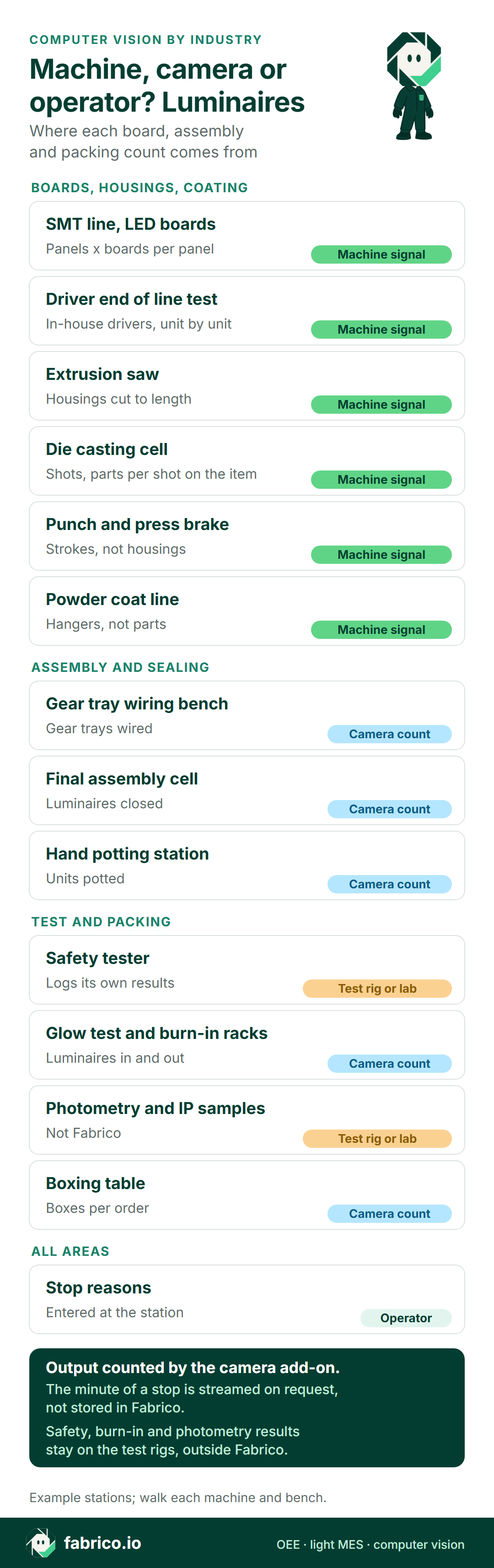
Text version of this infographic
- Boards, housings, coating: SMT line, LED boards: machine signal, panels x boards per panel
- Boards, housings, coating: driver end of line test: machine signal, in-house drivers, unit by unit
- Boards, housings, coating: extrusion saw: machine signal, housings cut to length
- Boards, housings, coating: die casting cell: machine signal, shots, parts per shot on the item
- Boards, housings, coating: punch and press brake: machine signal, strokes, not housings
- Boards, housings, coating: powder coat line: machine signal, hangers, not parts
- Assembly and sealing: gear tray wiring bench: camera count, gear trays wired
- Assembly and sealing: final assembly cell: camera count, luminaires closed
- Assembly and sealing: hand potting station: camera count, units potted
- Test and packing: safety tester: test rig or lab, logs its own results
- Test and packing: glow test and burn-in racks: camera count, luminaires in and out
- Test and packing: photometry and IP samples: test rig or lab, not Fabrico
- Test and packing: boxing table: camera count, boxes per order
- All areas: stop reasons: operator, entered at the station
- Footer: output counted by the camera add-on
- Footer: the minute of a stop is streamed on request, not stored in Fabrico
- Footer: safety, burn-in and photometry results stay on the test rigs, outside Fabrico
- Footer: example stations; walk each machine and bench
Book a demo to see a pilot cell, its burn-in rack and the boxing table counted next to the SMT line and the powder coat line, station by station.
Pilot step 3: brief the assemblers and the works council
A camera over a cell also sees the people at it. The EDPB video device guidelines note that collective agreements, works agreements among them, may lay down specific rules on employee data, and that consent is, in most cases, not a basis an employer should rely on. Tell the assemblers and packers what is counted and why, and brief the works council if the plant has one. Reports go by cell and shift, not by name. Agree which named roles may open the video for the minute of a stop. Where pay is per piece, settle first whether the camera add-on count has any part in it. Production line cameras without surveillance has the fuller checklist.
Pilot step 4: mount the camera at the out trolley and the rack doors
Two positions cover the pilot. Camera 1 sits over the out conveyor or the test trolley of the pilot cell, where each finished luminaire is set down once. Camera 2 watches the burn-in rack doors and counts luminaires loaded and unloaded. Nothing on the bench itself counts luminaires: a controlled screwdriver logs tightenings, but one fitting takes several screws, and a crimp tool or a push-fit end cap logs nothing.
Luminaires are a hard scene for a camera. A peer-reviewed 2020 study of camera counting at a manual assembly line, in the Journal of Imaging, counted "black-painted steel lighting devices" and found that "the motion phases are the main source of error for counting algorithms": the moments a hand picks up or places a piece. The authors also fitted a light ring "to reduce the multiple light variations inside the assembly department". Here that means hands over the out trolley, shiny aluminium profiles, and lit fittings on the burn-in rack behind the camera. The study tested one line at one firm, so the pilot measures this plant's own error at steps 5 and 6. The camera placement and lighting guide covers mounting height, angle and glare from bright opal diffusers.
Set the counting rules before the first count:
- One luminaire, counted once. A 1500 mm fitting with three boards and one driver is one unit, and so is a twin-driver high bay.
- Gear trays count where they are wired. If a separate bench wires gear trays for the cell, count trays there and luminaires at the cell, and never add the two.
- Potted units count at dispense. One Electrolube polyurethane encapsulation resin lists a usable life of 10 minutes at 20°C and a cure time of 48 hours at 23°C, or 3 hours at 60°C. So an outdoor luminaire is counted where it is potted, and the cure rack is a buffer: units counted in and out of it show the work in progress, and the time they sit there is not stop time at the potting station.
Pilot step 5: tally by hand beside the camera
Keep the job card exactly as it is. Do not tidy it up before the pilot, or nobody can tell what the camera changed. Next to it, one person keeps a hand tally sheet for the pilot shifts: luminaires set on the trolley, luminaires loaded onto and taken off the burn-in rack, and the clock time and reason for stops at the cell.
Agree a short list of stop reasons with the assemblers: driver or gear tray wait, profile wait, order change, rework, other. They enter the same reasons on a tablet at the cell, so sheet and timeline read side by side. Tally total closed and good first time on separate lines; good count versus total count explains why the two must never be merged.
Pilot step 6: match the camera to job cards, the rack log and the driver test
After each pilot shift the owner sets four numbers side by side; these come from the sample shift in the worked example.
| Check (example numbers) | Camera add-on | Plant record | What the gap means |
|---|---|---|---|
| Luminaires closed at the cell | 126 | Hand tally 126; job card 130 | The job card counted 4 reworked fittings a second time |
| Luminaires loaded onto the burn-in rack | 118 | Rack log 118 | No gap; 8 fittings still at the tester or trolley |
| Drivers against luminaires | 126 luminaires, one driver each | Driver test log: 132 passed for both orders | 6 drivers still in the cell's kit, not a loss |
| Stop minutes with a reason | 45 of 45, assemblers' reasons | Job card: no times | A record the plant lacked |
A gap the hand tally explains is a finding, not a fault: a job card that books a reworked fitting twice, or rack sheets filled in at the end of the shift. A gap nobody can explain is a camera problem. Go back to step 4, move the camera or the counting zone, and restart the tally. A fitting that fails the safety test and comes back fixed is counted once, as rework; rework and the good count and first pass yield cover the rule.
When the main item matches, add variants one at a time. IEC 60598-1:2024 specifies general safety requirements for luminaires incorporating electric light sources for supply voltages up to 1 000 V, and its tenth edition adds a new Annex W for luminaires using batteries. Battery luminaires now have their own annex; on the floor, give an emergency variant its own item as well, with its own ideal pace, since the emergency module and battery add minutes at the gear tray. OEE per SKU explains why one pace for the whole cell would let the mix move the number.
Worked example: one early shift at the pilot cell, priced
Sample numbers, no real plant. Two assemblers build 1200 mm linear luminaires with opal diffusers in the pilot cell, from 06:00 until 14:00; after a 30-minute break, 450 planned minutes are left. The ideal pace is 3 minutes a luminaire, or 20 an hour: gear tray wired and hooked in, two boards fitted, diffuser and end caps on. Camera 1 counts luminaires set on the test trolley, and the assemblers enter stop reasons on a tablet at the cell.
Availability. The cell stood 24 minutes waiting for drivers: the driver line sent two pallets and one was still in stores. Another 21 minutes went on the changeover to the next order, with microprismatic optics, a different gear tray and new labels. That gives 405 of 450 minutes running: availability 90.0%.
Performance. At 3 minutes a luminaire, 405 minutes allow 135 luminaires. The camera add-on counted 126 on the test trolley: 93.3%, a cycle time deficit of 9 luminaires.
Quality. At the safety tester and the glow test, 4 luminaires failed: two with an earth screw left loose, two with a lead pinched under the gear tray. A rework bench out of camera view fixed them, so they count as rework: 122 of 126 were good first time, 96.8%.
OEE. 90.0% x 93.3% x 96.8% = 81.3%. The quick check: 122 good luminaires x 3 minutes = 366 of 450 planned minutes, or 81.3%.
The 27 slow minutes are 9 luminaires. In the first 60 minutes on the new order the cell closed 14 luminaires instead of 20 while the assemblers got used to the new optic and gear tray: 6 luminaires, or 18 of the 27 minutes. The other 9 minutes are spread across the shift; OEE on manual and hybrid assembly lines sets a cell like this beside machine OEE.
The lost minutes in euros
Altogether 84 of the 450 planned minutes went: 45 standing, 27 slow and 12 on rework. At 3 minutes a luminaire, the cell made 28 fewer than it could have. No public margin figure for a linear luminaire was found, so the margin below is an example input; the plant should swap both inputs for its own numbers.
- Contribution margin (example input): EUR 18 per 1200 mm linear luminaire. 28 x EUR 18 = EUR 504 per shift, or EUR 115,920 across 230 single shifts a year for one cell.
- Labour (sourced rate): making the shortfall up on overtime takes 84 minutes from each of two assemblers, 168 minutes in all. Eurostat gives average hourly labour costs in EU industry in 2024 as EUR 33.9, so those 2.8 hours come to about EUR 95, overtime premium not included.
Taken by cause, the 24-minute driver wait alone is 8 luminaires, or EUR 144 at the example margin. It belongs to stores and kitting, not to assembly, and it is the cheapest loss to remove: kit drivers per order before the order starts. Fabrico prices every loss from the margin or price the plant enters per item, so each luminaire type needs its figure only once.
Pilot step 7: four tests, then widen, change or stop
The owner writes these four tests down before step 4, so the result cannot be argued afterwards:
- The count matches. Camera 1 and the hand tally agree within a limit set in advance, for example 1 luminaire in 200, and every larger gap has a written cause.
- The rack queue is visible. Camera 2 matches the burn-in rack log in and out, and the count on the rack shows whether burn-in or assembly is holding the order.
- Stops carry reasons. Stops at the cell longer than an agreed threshold, say 5 minutes, carry a reason the assemblers entered.
- One priced loss gets acted on. In the sample shift that is the driver wait: 8 luminaires, EUR 144 at the example margin, removed by kitting.
Then decide on events, not on the calendar:
- Widen when all four tests hold across at least three orders, one changeover to every variant in scope and every shift in scope; the boxing table comes next.
- Change when an unexplained gap survives one camera move: fix the view or zone, then restart at step 5.
- Stop when the job cards already match the hand tally and stops are already timed; a camera adds little there.
The plant sets its own pace for every step. No step has a duration, and none of it is a Fabrico delivery or rollout time. For the general version of the plan, see the camera OEE pilot plan.
Questions for a camera or OEE supplier before the pilot
Ask these before step 4, and check each reply against the hand tally once the pilot runs.
| Ask | A sound reply |
|---|---|
| At the pilot cell, what exactly is counted? | Finished luminaires set on the out conveyor or test trolley, not boards, drivers or screws. |
| How is a luminaire that fails the safety test counted? | Once, as rework; the first-time good figure is untouched. |
| Can each length, optic and emergency variant have its own pace? | Yes: one item per variant, each with its own ideal pace. |
| Who may view footage from a cell, and through what? | Named roles only, opening the stop on the shift timeline; the works council sees the data flow before any camera is fitted. |
Where Fabrico fits in the luminaire pilot
Fabrico is cloud OEE software with light MES functions. In a luminaire pilot it splits the floor like this:
- SMT line, saws, die casting, presses, moulding and powder coat: cycles, cuts, shots, strokes and hangers are read from the machine control or a sensor; feeder changes, die changes and colour changes land on the timeline as stop time awaiting a reason.
- Pilot cell, burn-in rack and later the boxing table: the camera add-on counts luminaires closed, luminaires into and out of burn-in and boxes per order. Where a camera add-on covers the station, the video for the minute of a stop can be opened from the shift timeline, streamed on request and not stored in Fabrico.
The assembler or machine operator enters stop reasons on a phone or tablet by the station. OEE and losses, priced in money, are reported per station and shift in the browser and the iOS and Android apps, and data goes out via REST API, webhooks and Excel or CSV export.
Roadmap: idle cell detection, where the camera add-on spots a cell standing still and suggests a probable cause for the assembler to confirm or change.
Outside Fabrico: AOI and solder inspection, driver test, safety tester and burn-in results, photometry, IP and thermal tests, and the certification files behind them.
The OEE and MES overview shows the whole product, Fabrico computer vision for OEE describes the add-on, and manufacturing vision systems for OEE shows how camera add-on counts become availability, performance and quality.
Luminaire pilot questions
Where does the first camera go in a luminaire plant?
Over the out trolley of the final assembly cell that builds the highest-volume fitting, with a second position at the burn-in rack doors. Luminaires leave both with no controller recording them, while the SMT line, the extrusion saw and the powder coat line keep their own counts.
Can an OEE camera check solder joints, LED placement or light output?
No. Solder joints and LED placement are checked by AOI on the SMT line, and light output in an integrating sphere or on a goniophotometer; Fabrico does neither. The rejects those checks find still reach OEE quality through the count of the station that found them.
When is a luminaire pilot finished?
When the proof the owner wrote down beforehand holds: matched counts, reasons on the stops and one priced loss acted on. The plant sets its own pace; no step has a duration.
Want to see a pilot cell, its burn-in rack and boxed luminaires counted side by side, shift by shift? Book a demo.





Latest from our blog



Real Fabrico tiles, sample data.