


 Login
 Blog
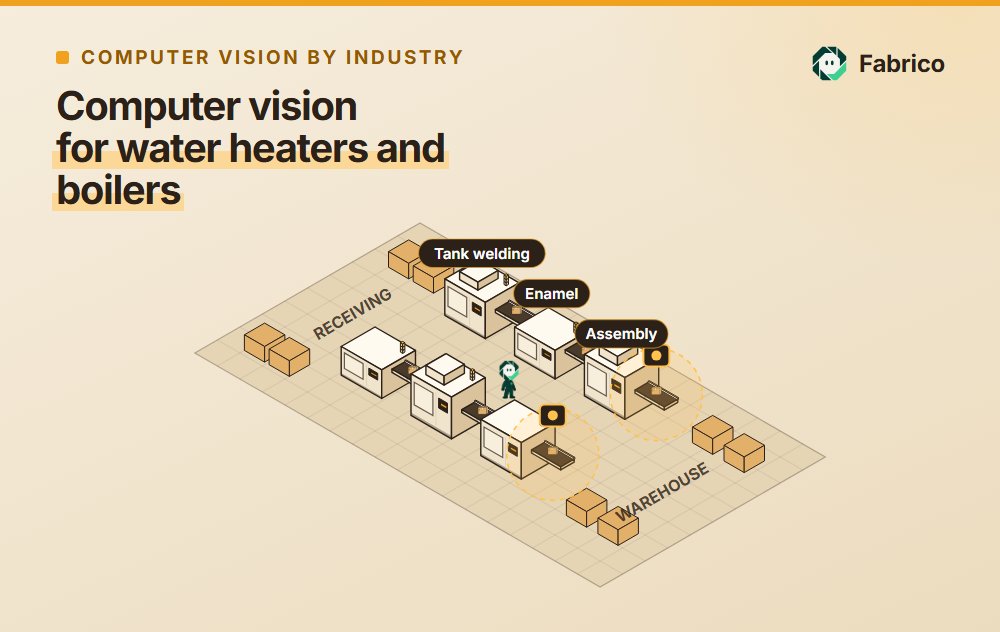
Computer Vision for Water Heater Manufacturing: Stop Counting Repaired Boilers as Good

In short: computer vision in water heater manufacturing counts output at hand stations. Clear count rules keep repaired, retested and scrapped units out of good output.
Weld, lining, leak and combustion checks stay with inspection systems and test rigs; a counting camera only counts units leaving a station.
- Seven places where a tank and boiler plant's output figure goes wrong, and the counting rule that settles each.
- A boiler repaired after the fire test ships, but it never joins first-pass good output.
- The camera add-on covers group benches and hand packing; the repair bay only where the rig's retest log cannot be read.
A tank and boiler plant knows how many units its rigs passed. It rarely knows how many passed first time, how many were one boiler on its second run, or how many foamed tanks were scrapped after the foam jig counted them. This page audits those miscounts on an example site building storage water heaters and wall-hung boilers.
The miscount table: where a tank and boiler plant's output number goes wrong
ISO 22400-2 presents each manufacturing KPI by its formula and the elements behind it. Read OEE that way and each row below is one element booked in the wrong place.
| Where the number goes wrong | What the plant sees | Counting rule | Who counts it |
|---|---|---|---|
| 1. Repaired boiler counted as good | A unit that failed the fire test reaches packing and joins good output | A quality loss at first test; the retest stays out of first-pass good | End-of-line test rig, pass or reject count |
| 2. Retest counted as new output | One boiler runs the rig twice and is counted twice | One count per serial number; the second run is a retest | The rig's log by serial number |
| 3. Leaking foamed tank counted at the foam jig | A foam shot reads as a good tank, then the tank is scrapped | Foam shots for the jig only; good tanks counted after the test; scrap booked once | Foam jig for shots, test rig for good tanks |
| 4. Rewelded bare tank counted as first pass | A tank repaired after the air leak test reads as good first time | Rework at the bare-tank leak test, then a retest | Bare-tank leak test rig |
| 5. Bench groups added to boilers | Groups, tested units and packed boilers summed as one output | Each station counts its own unit; plant output is read once, at packing | Bench camera add-on for groups; packing for units |
| 6. One unit for every size | An 80 litre tank and a 300 litre cylinder share one ideal | An ideal per litre size and output rating | Each station, with ideals the plant sets |
| 7. Furnace gap booked as slow running | Fewer tanks fired after a diameter change, and nobody owns the gap | Book the gap as changeover time at the furnace | Enamel furnace conveyor PLC |
Five of the seven owners already have a machine or a rig that counts, so the fix there is a counting rule, not hardware.
Run the audit on one week of paperwork
- Collect one week of numbers. Tally sheets, rig logs, scrap notes, packing counts.
- Match them by unit. Per row, does plant output hold that unit once, twice or never?
- Ask the test end one question. Can the rig's retest log by serial number be exported? If it can, the repair bay needs no camera.
- Name an owner. Write the owning station next to each count, and brief the assemblers and the works council before any camera goes up.
Explainer presented by Iris, Fabrico's AI-generated presenter: how an add-on camera counts output where a machine has no signal. Book a demo.
Plays from YouTube. Google may set cookies when you press play. Privacy policy.
Repaired boilers counted as good: the first-pass rule at the end-of-line test
In this example plant, finished boilers pass water and gas circuit leak tests, a fire test that reads the flue gas and an electrical safety test; water heaters get a leak test and, for gas units, a fire test. A failed unit leaves the flow: a weeping fitting is resealed, a gas valve or sensor swapped, a harness plug reseated, and the unit goes back through the same test. When it passes, packing sees one more boiler, and if good output is read at packing, the failure has vanished.
OEE good count is first-pass good. A boiler that fails the fire test is a quality loss at the test station when it fails, and it stays out of the first-pass good count after its retest. Repair bay time goes under its own loss code. The boiler still ships, so units shipped and first-pass good are two numbers, and a plant needs both. Does rework count as good in OEE sets out the same rule for a food plant, and first pass yield keeps the repair visible.
The rig owns this count because it already decides. Fabrico can take the rig's pass or reject count, not its leak, combustion or electrical safety readings, and inspects nothing itself. The tester types the reason for a reject on a tablet next to the rig.
One serial, one count: a retest is not a double count
A rig counts tests, not boilers. A boiler that fails, is repaired and passes leaves two records, so if the rig total is read as output, a bad hour at the repair bay raises output.
Count by serial number instead. The first run of a serial decides first-pass good or reject; any later run is a retest. Serial tracking follows every single unit, and that stops a retest reading as a new boiler.
Where the rig's retest log by serial number can be read, it already counts units sent back, and the repair bay needs no camera. Where it cannot, a camera add-on above the bay exit counts them. Either way the repair technician adds the reason for each repair, and the rig still decides whether the unit passes.
A Chalmers study of raw OEE data from 23 companies and 884 machines found that almost half of the recorded losses could not be classified, because the categories were missing or poorly described. So write codes for rig waits, units held for retest and repairs waiting for a part before counting starts.
A foamed tank that leaks is scrap, not rework
Order decides which quality loss a leak is. Domed heads are drawn from coil-fed blanks on presses that count strokes. Shells are rolled and closed with a longitudinal seam, a flue tube goes through the centre of a gas unit, and circumferential seam welders join heads to shell, each counting its cycles (OEE for robotic welding cells covers their stops).
The bare tank then gets an air leak test before it is lined. A tank that fails there can still be repaired at the weld and retested. That is rework: a quality loss at the bare-tank leak test, with the tank kept out of first-pass good.
After lining and foam, the same leak is scrap. A foamed glass-lined tank that leaks through its shell cannot be welded again. The foam jig counted a shot for it, so if shots are read as good tanks, the scrap shows up nowhere. Scrap and rework are two quality losses with very different costs, and here the station that finds the leak decides which one it is.
The fix: the foam jig counts shots for its own run time and pace, good tanks are counted after the end-of-line test, and the scrapped tank is booked once, at the test where it failed. That keeps the OEE quality loss on the station that found it.
Where the count is taken: bench groups, tested units and packed boilers
At benches beside the boiler line, one assembler fits the pump, diverter valve, plate heat exchanger, pressure sensor and safety valve onto a manifold, or builds a control harness. The line PLC counts chassis, the rigs count tests and packing counts units out. Each counts a different unit: summed, they double count; compared, they hide the buffer of groups on the rack. Keep each station on its own unit, read plant output once, at packing, and keep good count and total count apart at every station.
Small tanks and boilers go through an automatic carton and strapping line that counts its own cycles; where an older line has no counter, a photo eye can count its output. Cylinders of 300 litres and up are packed by hand on a pallet: base tray, corner posts, sleeve, straps, label. Nobody counts there, so a camera add-on at the pallet outfeed counts packed cylinders.
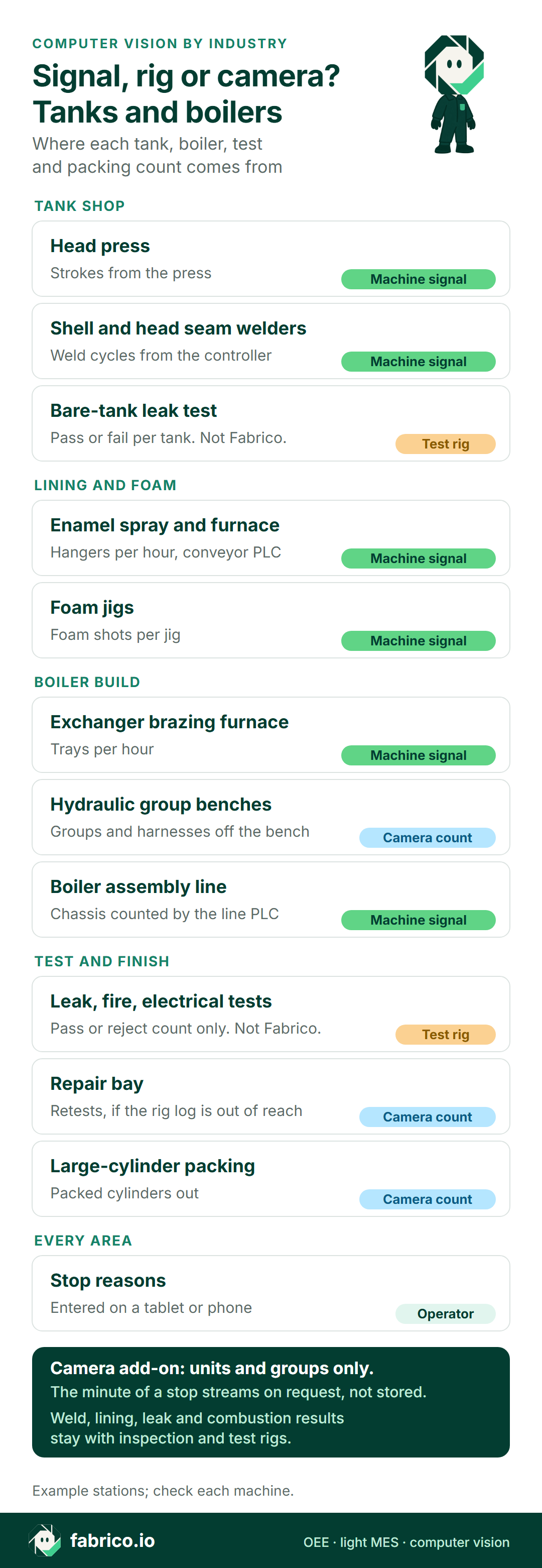
Text version of this infographic
- Tank shop: head press: machine signal, strokes from the press
- Tank shop: shell and head seam welders: machine signal, weld cycles from the controller
- Tank shop: bare-tank leak test: test rig, pass or fail per tank, not Fabrico
- Lining and foam: enamel spray and furnace conveyor: machine signal, hangers per hour
- Lining and foam: foam jigs: machine signal, foam shots per jig
- Boiler build: exchanger brazing furnace: machine signal, trays per hour
- Boiler build: hydraulic group benches: camera count, groups and harnesses off the bench
- Boiler build: boiler assembly line: machine signal, chassis counted by the line PLC
- Test and finish: leak, fire and electrical safety tests: test rig; only its pass or reject count reaches Fabrico
- Test and finish: repair bay: camera count where the rig's retest log cannot be read
- Test and finish: large-cylinder packing: camera count, packed cylinders out
- Every area: stop reasons, entered by the operator on a tablet or phone
- Camera add-on: units and groups only; video for the minute of a stop is streamed on request, not stored in Fabrico
- Weld, lining, leak and combustion results stay with inspection and test rigs
Book a demo to see tank shop machines, boiler benches and test rigs counted on one shift timeline.
Model sizes and market variants: one ideal per model, not per line
The size of a unit changes what one count means. US federal rules in 10 CFR 430.2 define a gas-fired storage water heater as one with a nameplate input of 75,000 Btu/h or less, and an electric storage water heater as one rated at 12 kW or less. Above that line, 10 CFR 431.102 counts gas-fired storage water heaters rated above 75,000 Btu/h as commercial equipment: the class of the big cylinders packed by hand, yet both read as one unit.
The products are filed apart too: the old US industry manual lists household water heaters under SIC 3639, household appliances, and low-pressure steam or hot water heating boilers under SIC 3433, heating equipment except electric and warm air furnaces. On the floor, a tank shop is a sheet metal and welding plant, while a wall-hung boiler is built on an assembly line, its primary heat exchangers welded from stainless coil, brazed in a furnace or bought in as castings.
Gas and electric variants add their own burner or element and test, and in Germany, the heating industry association BDH reported about 627,000 heating systems sold in 2025, 12% fewer than in 2024, against about 800,000 a year over the decade before (in German). Smaller orders mean more model changes per shift, so one rate per line misreads more hours.
The fix is an ideal cycle time per litre size and output rating at each station. A kit change at a bench, with its first-off approval after the changeover, is a stop of its own, not a slow assembler.
The enamel furnace and the foam jigs: gaps after a diameter change
Inside, the tank is shot blasted, sprayed with enamel slip, dried and fired on hooks through a continuous furnace. The furnace conveyor runs at one speed, so its real loss is the gap after a diameter change, when nothing is fired until the next size is blasted, sprayed and dried. Book that gap as changeover time at the furnace, read from the conveyor PLC, not as slow running.
Then come the anode, the element or burner and the jacket, and foam is injected between tank and jacket in a jig that counts shots, with cure time inside its cycle.
What a camera can and cannot count on a coating conveyor
Citlak and Pillay (Automation, 2024, peer-reviewed) put a video camera next to an enamel paint coating conveyor in a household appliance plant to classify hanging sheet metal parts. They note that "At any given instant, the parts may not be in the exact coordinates within the desired area of interest and the classes of objects vary based on changing production requirements." They report that "The highest achieved average precision obtained from the model was 98.27% with an overall accuracy of 98.24% using the proposed framework."
Read that narrowly: one paint line, not a vitreous enamel furnace, one camera position, trained part classes, and detection rather than a shift count checked against a hand tally. A bench adds hands in view, groups set down two deep and glare off steel. So the camera add-on goes only where no PLC counts, and its count is checked by hand first. This page states no accuracy figure for any Fabrico camera add-on.
Where a camera add-on counts on a two-product site
In this example layout, the hand stations are the only places without a count.
At the hydraulic group benches, the camera add-on over the outfeed counts finished groups set on the rack, so an hour spent waiting for valves shows as that hour; OEE on manual and hybrid assembly lines follows the same idea. A FIFO lane or a supermarket line-side sets how long a bench waits for valves. Before pricing anything, check the camera count against a hand tally for a few shifts.
Benches, privacy and the works council. A lens above a bench catches hands and faces. Tell the assemblers what the count is for, settle it with any works council, aim at the outfeed rack, and report per station and shift, without names. The Fabrico camera add-on counts units and groups and follows no person. Running line cameras without surveillance lists the steps.
Worked example: one early shift at a hydraulic group bench
Example numbers, no real plant. One of three benches feeding a combi boiler line builds hydraulic groups for 24 kW and 30 kW models, one assembler, one group at a time. The early shift runs 06:00 to 14:00; a 30-minute break leaves 450 planned minutes. The fastest pace held on the 24 kW group is 5 minutes, so the ideal is 90 groups. The camera add-on counts groups set on the rack; the assembler books set-aside groups and the shift lead enters stop reasons.
Availability. Diverter valves did not arrive from the line-side supermarket for 35 minutes. The switch from the 24 kW to the 30 kW kit, with its first-off check, cost 20 minutes. The bench ran for 395 of 450 minutes: 87.8%.
Performance. At the ideal pace, 395 running minutes allow 79 groups. It handled 70: 67 sent to the line and 3 set aside. 70 of 79 is 88.6%.
Quality. The 3 set aside had a cross-threaded sensor port and were stripped at the same bench later. 67 of 70 is 95.7%. When those 3 come back onto the rack, they are rework, not new first-pass groups, by the same rule as a repaired boiler.
OEE. 87.8% x 88.6% x 95.7% = 74.4%. The quick check: 67 good groups of the 90 that 450 minutes allow at 5 minutes each is 74.4%.
The bars add up: 335 good, 15 set aside, 35 valve wait, 20 model change and 45 slow building make 450. The 45 slow minutes are not a slow assembler: after 11:00 the bench built the 30 kW group, with a larger plate heat exchanger and more clips, and it had no ideal of its own. That is miscount 6. Give the 30 kW group its own ideal, and those minutes land on the missing standard. The valve wait belongs to material supply, so that fix sits in the warehouse.
What the shift cost in money
Here the three benches set the pace of the boiler line, so a group not built is a boiler not built that shift. No public margin per boiler was found, so the margin is an example input, EUR 120 contribution margin per boiler; the plant replaces it with its own figure per model.
| Loss | Minutes | Groups lost | At EUR 120 (example) |
|---|---|---|---|
| Slow building, 30 kW group | 45 | 9 | EUR 1,080 |
| Valve wait | 35 | 7 | EUR 840 |
| Model change and first-off | 20 | 4 | EUR 480 |
| Set aside, cross-threaded port | 15 | 3 | EUR 360 |
| Total | 115 | 23 | EUR 2,760 |
The check: 90 ideal groups minus 67 good is 23, and 23 x EUR 120 is EUR 2,760 for one bench on one shift. An hour with the bench stopped costs 12 groups, or EUR 1,440. The biggest line, the missing 30 kW ideal, costs nothing to fix but a timed run. Fabrico values each loss from the price or margin the plant enters per product, so in practice this table uses the plant's own figures.
Checks for OEE and camera vendors in a tank and boiler plant
Each check comes from a table row.
| Ask | A good answer |
|---|---|
| How does a unit that fails the fire test count? | A quality loss at first test, repair time as its own loss, and the retest kept out of first-pass good. |
| How is a retest told apart from a new unit? | By serial number from the rig's log, booked as a retest. |
| What does the system take from a test rig? | The pass or reject count, not the leak, combustion or electrical readings. |
| Where is a scrapped foamed tank booked? | Once, at the test where it failed; foam shots never read as good tanks. |
| Can the ideal differ by litre size and output rating? | An ideal per model and station that the plant sets itself. |
| Who sees the video, and on which devices? | A written data flow that IT and the works council can sign off. |
Where Fabrico fits in a water heater and boiler plant
Fabrico runs in the cloud as OEE software plus light MES functions. In a plant that builds tanks and boilers it covers two areas today:
- In the tank shop and on the boiler line it reads run state and counts off presses, seam welders, the furnace conveyor, foam jigs and the line PLC, and takes the pass or reject count from the test rigs. Die changes, empty hooks and starved stations show up as stop time.
- At hydraulic group benches, large-cylinder packing and, where the rig's retest log cannot be read, the repair bay the camera add-on counts units and groups leaving. If the packing station stood still at 04:10, the video for the minute of a stop can be opened from the shift timeline, streamed on request and not stored in Fabrico.
Welders, assemblers and testers enter stop reasons on a tablet or phone. Fabrico prices each loss in money and shows OEE per station and shift on the web, iOS and Android; the ERP gets the data through the REST API, webhooks or a CSV file.
Roadmap item, not available today: a camera add-on that would flag a repair bay gone quiet and propose a likely cause.
Outside Fabrico: weld inspection, the lining coverage test, leak, pressure and fire testing, electrical safety testing, rating plates and serial number traceability remain in their own systems and the ERP.
The product page is Fabrico computer vision for OEE. Coils and heat pumps sit in computer vision for HVAC equipment, white goods in computer vision for household appliances. The OEE software for HVAC manufacturing comparison sits closest to this industry, and the OEE software guide covers the wider field.
Questions tank and boiler plants ask
Does a repaired boiler count as good output in OEE?
No. It is a quality loss at the test station when it fails, and it stays out of the first-pass good count after its retest. Time in the repair bay goes under its own loss code, and the retest is booked as a retest, not as new output. The boiler still ships.
Where should a water heater plant put its first camera?
At a hydraulic group bench on the boiler side, or large-cylinder packing; the repair bay only where the test rig's retest log cannot be read. Presses, seam welders, the furnace conveyor and the boiler line already report through their own controls.
Is a leaking foamed tank rework or scrap?
Scrap. Once a glass-lined tank is foamed into its jacket, a leak through the shell cannot be welded again. Book it once, as scrap at the test where it failed, and never read the foam jig's shot count as good tanks.
Can an OEE camera check welds, enamel or combustion?
No. Seam welds go to weld inspection, the glass lining to its coverage test, pressure to the leak rig and combustion to the fire test station. Fabrico inspects nothing. A rig's reject count can still feed the OEE quality figure via the test station's reject signal.
Want first-pass good, retests and scrap counted where they happen? Book a demo to see hydraulic group benches, cylinder packing and the end-of-line test counted on one shift timeline.
Related articles








Real Fabrico tiles, sample data.