


 Login
 Blog

Computer Vision for Air Compressor Manufacturing: A Step-by-Step Pilot Plan

In short: computer vision for air compressor manufacturing counts airends, packages and crates at hand-built stations; pilot it first at one package bay.
Counting a unit as it leaves a station is not inspecting it: flow, power, leak and noise results stay with the run-in bench.
- Step 1 puts one camera add-on over the bay exit; the order sign-offs and the run-in bench log are the two checks.
- The airend bench count comes third, so a bay wait can be traced one step upstream.
- Proof is written down before mounting: counts that reconcile, stop minutes with reasons, and one shift carried to euros.
- Stop rules are fixed as well: no crew agreement, a count that will not reconcile, or a bay that is not where minutes go.
- Where Fabrico's camera add-on covers a station, the video for the minute of a stop is streamed on request and not stored in Fabrico.
A rotor grinder knows how many rotors it ground this shift. The fitters at a package bay know how many units they finished, but nothing on the bay records when each one left. A first camera pilot should close that gap and nothing else.
What follows is a plan, step by step, with example numbers. It is not a record of any plant. It covers screw, piston and portable air compressors built in series. Hermetic and semi-hermetic refrigeration compressors are out of scope; fitting them into chillers, rooftop units and heat pumps is covered in computer vision for HVAC manufacturing. Compressors in service are outside this page too.
Why a compressor plant starts its pilot at the package bay
A pilot needs a station where output is real, nobody records it, and a second record exists to check the camera against. In a screw compressor plant that is the package assembly bay. Its output is the plant's output, the order sign-off gives a paper count, and the run-in bench logs the same units by serial.
Upstream, the feeders already count, so they are poor pilot sites. Each rotor is profile ground, or finish milled, and measured before the pair is matched, and the measuring room judges it, because screw compressor performance is highly affected by leakage, which is a direct function of the clearance gaps between the rotors and between the rotors and the housing. Grinder states are covered in CNC machine monitoring; housing cells in MES for metal fabrication. With more than one candidate bay, how to pick the line for an OEE pilot gives the general test.
Explainer presented by Iris, Fabrico's AI-generated presenter: how an add-on camera counts output where a machine has no signal. Book a demo.
Plays from YouTube. Google may set cookies when you press play. Privacy policy.
The pilot plan at a glance, step by step
One bay, three count points added in order. Each step has one job, one record to check against and one thing that must be true before the next step starts.
| Step | Work | Compared against | Done when |
|---|---|---|---|
| 0 | Agree the purpose; write count rules; pull the bench log | Nothing yet | Signed purpose, seven rules, a baseline |
| 1 | One camera over the bay exit; a hand tally | Hand tally and order sign-offs | Daily counts match, or each gap has a cause |
| 2 | Reconcile the bay count with bench runs | Run-in bench log | Packages out equal first runs plus the change in the line-up |
| 3 | Cameras over the airend bench and line-up | Airend clipboard, a floor walk | One bay wait traced upstream |
| 4 | Build minutes per model; loss codes | The assembly lead's standards | Reasons on the agreed share of stop minutes |
| 5 | Shifts as OEE; price one | Finance's margins per model | One shift in euros, and a decision |
The step numbers set the order, not a timetable. The plant sets its own pace: a step is done when its check passes.
Book a demo to see airend bench, bays and run-in benches on one shift timeline.
Step 0: works council, count rules and a baseline
Nothing is mounted in step 0. A camera above a bay sees the crew as well as the frame, so first agree the purpose with the fitters and any works council, in writing, including who may open footage. Point the lens at the outfeed, not at faces, and report by bay and shift, not by name; the camera add-on counts airends, packages and crates, not people. The steps are in works council approval for OEE monitoring and GDPR and production line cameras.
The second job is the count rules. An airend becomes a package, a package becomes a tested unit, and a tested unit becomes a crate. Each hand-over is a chance to count one compressor twice or lose a shift's work, and a camera will repeat a bad rule faithfully. Write these seven down first.
| What goes wrong | Rule for the pilot |
|---|---|
| Airends added to packages as output | Airends and packages on separate counters, never summed |
| Package counted at the bay and again after run-in | One output point at the bay exit; the run-in pass gives good units |
| A unit rerun after repair counted as new | The rerun is rework on the original unit |
| Units in the run-in line-up booked as bay stops | The line-up is a station of its own |
| A 7.5 kW and a 90 kW unit counted alike | Build minutes per model |
| Piston pumps counted as finished compressors | Pumps and finished units on separate counters |
| Crates closed next morning credited to that shift | Count at the bay exit with its time stamp |
The third job is a baseline. Pull four weeks of the run-in bench log and the bay's shift notes; OEE baseline measurement covers the method. Then put the proof and stop rules from the end of this plan into a one-page agreement, as in the terms to agree before an OEE pilot.
Step 1: one camera over the bay exit
A crew of two or three builds each package on its base frame under a hoist: motor, airend, cooler, separator vessel, valves, filters, controller and sound-insulated panels. The count point is where the finished package rolls out: the outfeed, or a floor marking in front of it.
Mount one fixed camera above that marking, clear of the hook path, with the whole unit in view as it crosses. Until the counts agree, the team lead ticks each package on the route card as it leaves. Each shift then has three numbers: the camera count, the tally and the order sign-offs. They should agree, or each gap should have a cause someone can name.
How far can a camera be trusted at a station? In a peer-reviewed field study in Sensors (2023), Panahi and co-authors ran a vision method on 420 hours of video from a US factory that builds housing modules station by station, and report "96% accuracy in identifying the occupancy of the workstations and an F-1 Score of 89% in identifying the state of each station on the production line." The paper names what broke the method: "the failed cases were commonly related to the performance of the model and the occlusions caused due to the oblique view of the CCTV video camera and installation of new components such as walls and bath pods." It warns that workers can be present at an occupied workstation but not working, and that its scope is limited to assembly lines without buffers.
Three cautions: a housing module factory is not a compressor plant, the study measured occupancy rather than finished units, and none of its figures is a Fabrico accuracy figure. What carries over is the risk list. The hoist, the lifting beam or a fitter can block the view, and an open dock door changes the light. So the lens looks down at the floor marking, the count is a unit leaving, and the line-up, a buffer, gets its own camera in step 3. A test method is in how accurate a camera part count is for OEE, and mounting height and light in camera placement and lighting on a production line.
Step 2: catch double counts against the run-in bench log
Each package runs on a bench before it ships: load cycles, a leak check, and on screw units flow and power. The bench computer logs each run and its verdict; that log is the pilot's second witness.
CAGI, the US Compressed Air and Gas Institute, explains that ISO 1217 is the recognised performance standard for displacement compressors but too complex for performance testing in volume production, so CAGI and Pneurop wrote simplified test codes that are now appendices to ISO 1217. In the US, under 10 CFR 431.345, lubricated rotary air compressors manufactured from January 10, 2025, from 10 hp or 35 cfm up to 200 hp or 1,250 cfm, must meet a minimum package isentropic efficiency, yet DOE does not require performance or certification testing for all units distributed in commerce. For the pilot, the bench run is the plant's own gate, so its pass and fail log is the record of good output to reconcile against.
Reconcile per week, not per hour. Take the bay count, the bench's first runs and reruns, and the line-up on Monday morning and Friday night. The test is one line: packages out of the bay equal first bench runs plus the change in the line-up.
An example week, with invented numbers: the camera counts 24 packages out of the bay and the sign-offs say 24. The bench log shows 26 runs, of which 3 are reruns, so 23 first runs. One more package stands in the line-up on Friday than on Monday. 23 plus 1 is 24, and the count reconciles. Read as 26 compressors, the 26 runs would have added two units that never existed. A repaired unit's rerun is rework on a unit already counted, as argued in whether rework counts as good in OEE.
Step 3: add the airend bench and the run-in line-up
Next, add the two stations that explain bay waits. The airend, one of the costliest parts of a package, is built on a bench of its own: bearings onto the shafts, the matched pair into the housing, end clearance set with shims, then the fitter turns the rotors by hand to feel for contact.
The City paper on rotor interference gives the reason those readings matter: the tolerances of the rotor and bearing housings and of the bearings themselves have to be included in the design to get the best overall performance. On the floor that means reshims and airends sent back after the hand-turn check, none of it timed. A camera add-on above the bench exit counts finished airends, so a bay wait can be traced one step upstream; check it against the clipboard until the two agree.
The second camera goes over the parking spots in front of the run-in benches. With three packages parked for a free bench, the bays look slow while the limit is bench capacity. A camera add-on counts packages in and out of the line-up; floor walks check it.
Then read the three counts together. A line-up that grows while the bay keeps its pace says the benches hold output back. An empty line-up with an idle bench points at the bay or the airend bench. A gap in the airend count that lines up with a bay wait names the cause. The vocabulary is in starvation and blocking and bottleneck versus constraint.
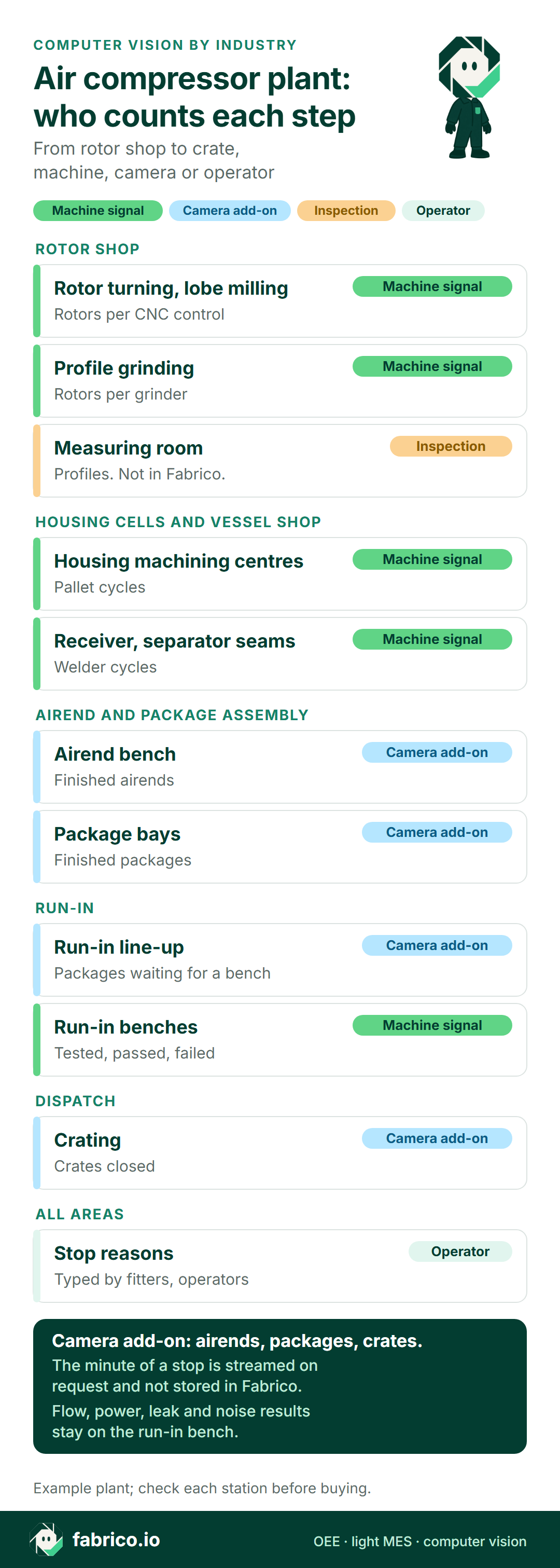
Text version of this infographic
- Legend: machine signal, camera add-on, inspection, operator
- Rotor shop, rotor turning and lobe milling: machine signal, rotors per CNC control
- Rotor shop, profile grinding: machine signal, rotors per grinder
- Rotor shop, measuring room: inspection, profiles, not in Fabrico
- Housing cells and vessel shop, housing machining centres: machine signal, pallet cycles
- Housing cells and vessel shop, receiver and separator seams: machine signal, welder cycles
- Airend and package assembly, airend bench: camera add-on, finished airends
- Airend and package assembly, package bays: camera add-on, finished packages
- Run-in, run-in line-up: camera add-on, packages waiting for a bench
- Run-in, run-in benches: machine signal, tested, passed, failed
- Dispatch, crating: camera add-on, crates closed
- All areas, stop reasons: operator, typed by fitters and operators
- Footer: camera add-on counts airends, packages and crates; the minute of a stop is streamed on request and not stored in Fabrico; flow, power, leak and noise results stay on the run-in bench
- Example plant; check each station before buying
Step 4: build minutes per model variant and loss codes
A 7.5 kW unit and a 90 kW VSD unit with dryer can share a bay, but not a takt. With the assembly lead, set build minutes per model: fixed speed, VSD, with or without dryer. A package then earns its build minutes as it leaves the bay, and performance is earned minutes over running time.
Stops need reasons, and the people at the bay supply them. Put a short list on a tablet at the bay: waiting for airend, waiting for cooler or separator vessel, model change, hoist or torque tool fault, waiting for a free bench, repair after run-in. Chalmers researchers who studied OEE records from 884 machines in 23 companies found nearly half the losses unclassifiable for want of clear categories, and traced 90% of the classified stop time to operator support work. At a hand-built bay there is no automatic process at all, so every reason has to come from the crew. Downtime reason code design shows how to keep the list short.
Agree with the crew what share of stop minutes should carry a reason before step 5, and ask finance for a margin per model. Both are needed in step 5.
Step 5: one shift in OEE and in euros
By step 5 the bay has counts, build minutes and reasons, so a shift can be written as OEE. The figures below are example inputs for an imagined bay, not results from any plant. Three fitters build a 22 kW fixed-speed package with a build standard of 45 bay minutes and a 37 kW VSD package with an integrated dryer at 75. Planned time is 450 minutes: an early shift from 06:00 to 14:00, minus half an hour of break.
Availability. Three stops cost the bay 110 minutes. The crew waited 65 for a 37 kW airend, spent 25 swapping the frame fixture and lifting beam from the 22 kW to the 37 kW model (a model change, timed as in changeover time), and lost 20 when the hoist's limit switch failed. Running time was 340 of 450 minutes, 75.6%.
Performance. Two 22 kW packages earned 90 build minutes and three 37 kW VSD packages earned 225: 315 earned minutes in 340 minutes of running, or 92.6%. The gap is 25 minutes of slow build, a speed loss rather than a stop; the difference is in reduced speed loss versus minor stops.
Quality. One 22 kW package failed run-in with an oil leak at a cooler hose fitting, so its 45 build minutes drop out of the good figure: 270 of 315, or 85.7%.
OEE. 75.6% x 92.6% x 85.7% = 60.0%, and 270 good minutes over 450 planned gives the same 60.0%. The formula is laid out in how to calculate OEE.
In this example, the airend wait is not the grinder's doing. Its control shows the 37 kW rotor pair finished before the shift began, but the airend bench count shows no airend leaving between 06:20 and 07:25, while that bench rebuilds a 22 kW airend that failed the hand-turn check. Counted at the bay alone, those 65 minutes would land on the bay crew.
What the shift cost
Is there a public price for the money? Only loosely. The US Department of Energy's 2020 rule gives an average installed cost of USD 21,698, in 2015 dollars, for a baseline fixed-speed, lubricated, air-cooled rotary compressor, which includes markups, tax and installation. No public source found for this page gives a maker's margin per unit. So the margins here are example inputs, set well below that installed cost: a contribution margin of EUR 1,350 per 22 kW package and EUR 2,250 per 37 kW VSD package, which both work out at EUR 30 per bay minute.
Lost bay minutes from stops and slow build are priced at that rate. The failed unit ships after repair, so its repair is priced at crew time: 40 minutes of one fitter on the next shift at an assumed EUR 48 per hour. A plant enters its own margin per model and crew rate, and Fabrico prices losses from those.
| Loss | Minutes | Example value |
|---|---|---|
| Airend wait | 65 | EUR 1,950 |
| Slow build | 25 | EUR 750 |
| Model change | 25 | EUR 750 |
| Hoist fault | 20 | EUR 600 |
| Repair after run-in, crew time | 40 fitter | EUR 32 |
| Total | 135 bay + 40 fitter | EUR 4,082 |
The 135 bay minutes are 450 planned, less 270 good, less the failed unit's 45, and 135 x EUR 30 = EUR 4,050; the repair adds 40/60 x EUR 48 = EUR 32. The bay rate holds only while the bay is the constraint. The airend wait alone makes EUR 1,950, so the first fix is at the airend bench, not in the bay.
What counts as proof, and when to stop the pilot
Proof is decided in step 0 and checked in step 5. The thresholds are examples; the plant writes its own.
| Test | Passed when |
|---|---|
| The count reconciles | In two weekly reconciliations in a row, bay count and bench reconciliation differ by no more than one package, with a named cause |
| Stops carry reasons | The agreed share of stop minutes, for example four fifths, carries a crew reason |
| A wait is traced upstream | At least one bay wait is matched to a gap in the airend count or to a full line-up |
| One shift is priced | Finance accepts the margins and the euro figure for one shift |
Stop rules matter as much, because a pilot that cannot fail proves nothing.
- No signed purpose from the crew and any works council: do not mount.
- The bay count still will not reconcile after step 2 and one re-aim of the camera: stop, and check the view and the count rule.
- The minutes are lost at the benches, not the bay: move the effort to bench capacity.
- Reasons stay below the agreed share in step 5: fix the entry routine before buying anything.
- All four tests pass: the pilot is over. Decide; do not let it drift on as a free trial.
If the answer is yes, the next bays, crating and the piston line follow the same rules; see scaling computer vision from one line to the plant. For the budget talk, the business case for line cameras lists the questions finance will ask.
What Fabrico covers in a pilot like this
Fabrico is cloud OEE software with light MES functions. Across a compressor plant it covers three kinds of station today:
- Rotor grinders, housing cells and seam welders: states and counts from the controls, with dressing and wheel changes under their own codes.
- Airend bench, package bays, run-in line-up and crating: the camera add-on counts airends, packages and crates. Where a camera add-on covers a station, the video for the minute of a stop can be opened from the shift timeline, streamed on request and not stored in Fabrico.
- Run-in benches: pass and fail results read from the bench computer, against build minutes per model.
Fitters and operators add the stop reason on a tablet or phone, and lost minutes show in euros per station and shift from the plant's own margins. Apps run in a browser, on iOS and on Android; data leaves through a REST API, webhooks, Excel or CSV.
Roadmap: the camera add-on spotting a bay that has gone quiet or a lengthening line-up at the benches, and proposing a stop reason that the fitter confirms or changes.
Not in Fabrico: rotor profile measurement, clearance readings, bench flow, power and noise values, test certificates, receiver records and serial numbers. Fabrico inspects nothing; what those systems reject comes in as a count.
See camera-based OEE software, manufacturing vision systems for OEE, MES and OEE software for manufacturing and the general computer vision OEE pilot checklist.
Questions about a compressor plant pilot
Can the OEE camera measure free air delivery, leaks or noise?
No. Flow, power, pressure, leak and noise values are measured by the run-in bench and its instruments, rotor profiles by the measuring room. A unit those systems fail arrives in OEE as a reject count.
What happens to the count when a package fails run-in and runs again?
Still one compressor. Its first run marks it as a reject for the shift's quality figure; the fitter's repair time goes under a repair code; when it passes on the second run it ships as the same serial, never as an extra package.
Want to see the airend bench, package bays and run-in benches on one shift timeline? Book a demo.
Related articles





Latest from our blog







Real Fabrico tiles, sample data.