


 Login
 Blog
Shift Patterns in Manufacturing: 8 and 12-Hour Rotas, Coverage Maths and Cost

In short: A shift pattern is the rota that decides which crew works which hours, so a plant can run longer than one person's working day. Manufacturers use 8-hour patterns (two or three shifts, five days) and 12-hour patterns with four crews for 24/7 work, such as 2-2-3, 4 on 4 off and DuPont. The pattern sets how many hours a line can run, how tired people get, and what labour costs.
- Coverage maths: 168 hours a week split across 4 crews is 42 hours each, whichever 24/7 pattern you pick.
- 12-hour, 4-crew rotas carry at least 4 hours of US overtime per worker per week on average, because the 40-hour test is weekly.
- Before adding a crew or a Saturday, price one OEE point in overtime avoided. On the example line below it is worth about $27,400 a year.
Guide, updated 14 November 2026. Sources are listed at the end.
What is a shift pattern in manufacturing?
A shift pattern, also called a rota or shift schedule, is the fixed sequence of working days, shift times and days off that each crew follows. It answers three questions: how many hours a day and a week the plant runs, how many crews it takes to cover them, and in what order each crew moves between mornings, afternoons, nights and rest.
EU law gives a precise definition. Article 2 of the Working Time Directive 2003/88/EC defines shift work as organising work so that workers succeed each other at the same work stations according to a certain pattern, which may rotate, and may be continuous or discontinuous. In plain terms: the machine stays, the people change.
Shift work is a normal part of factory life, and nights are more common in factories than in the workforce as a whole. In the BLS American Time Use Survey, Table 7 (2024 to 2025 averages), 15.3% of US manufacturing wage and salary workers worked a non-daytime schedule. 5.9% worked nights and 2.4% rotating shifts, against 3.4% and 1.9% for all workers.
How shift patterns work: the coverage maths
Every pattern starts from the hours the plant wants to cover. A week has 168 hours. Divide the hours you want to run by the hours one crew should work, and you get the number of crews.
- One shift, five days: 5 x 8 = 40 plant hours a week, one crew.
- Two shifts, five days: 80 hours, two crews, each working 40.
- Three shifts, five days (24/5): 120 hours, three crews, each working 40.
- 24/7, four crews: 168 hours. 168 / 4 = 42 hours per worker per week on average, whatever the order of shifts.
- 24/7, five crews: 168 / 5 = 33.6 hours each, used where a shorter week is the goal or the contract.
Two things follow. First, a 24/7 pattern does not decide how many hours people work; the crew count does. A four-crew plant averages 42 hours per person with 8-hour shifts or 12-hour shifts. Second, the pattern only changes how those hours are arranged: how long each shift is, how many shifts come in a row, how fast crews rotate and how many weekends they get off. Those are the things that drive fatigue and cost.
The built-in overtime of 12-hour, four-crew rotas
In the US, the Fair Labor Standards Act tests overtime week by week. US Department of Labor Fact Sheet #23 says hours over 40 in a workweek earn at least time and a half, that a workweek is a fixed and regularly recurring period of 168 hours, and that averaging hours over two or more weeks is not permitted.
Now apply that to any 12-hour, four-crew rota. 42 hours a week is 3.5 shifts of 12 hours. A worker cannot work half a shift, so weeks alternate at best between 3 shifts (36 hours) and 4 shifts (48 hours). The 48-hour weeks carry 8 hours of overtime, so the floor is 4 hours of overtime per worker per week on average. Where the employer fixes the start of the workweek can make it worse, never better. On a 2-2-3 rota, a badly placed workweek splits the 7 shifts of each fortnight into 5 and 2 (60 and 24 hours), which raises the overtime from 8 to 20 hours per fortnight.
That premium is part of the rota's price, not an accident of a busy month. It is the first line to put in any cost comparison between 8-hour and 12-hour patterns in a US plant.
The common shift patterns, explained
Names vary between countries and companies, and most plants run a local variant. These are the patterns people search for, with the structure that defines each one.
Two-shift and three-shift, five days
Mornings and afternoons (and nights for three shifts), Monday to Friday, with crews often swapping shift each week. Weekends are free for maintenance, cleaning and catch-up. The weak point is the weekly rotation: HSE advises against rotating every one to two weeks (see the rules below).
Continental shift pattern
A four-crew, 24/7 pattern with 8-hour shifts and fast forward rotation: short blocks of two or three mornings, then afternoons, then nights, then days off, repeating over a cycle of several weeks. Its strength is that no one works long shifts or long runs of nights. Its weak point is that crews change shift time often, and some cycles have long runs of working days.
2-2-3 shift pattern (Panama)
A four-crew, 24/7 pattern with 12-hour shifts. Over 14 days each crew works 2 days, has 2 off, works 3, has 2 off, works 2 and has 3 off: 7 shifts, 84 hours, every other weekend off. Crews either stay on days or nights, or swap between them every few weeks, depending on the variant. No block is longer than three shifts.
4 on 4 off shift pattern
Four 12-hour shifts, then four days off, on an 8-day cycle: 48 hours per 8 days, which averages 42 a week. The days off move through the week, so weekends off come round irregularly. Over an 8-week span, half the workweeks hold four shifts and half hold three.
DuPont shift pattern
A four-crew, 12-hour pattern on a 28-day cycle, often written as 4 nights, 3 off, 3 days, 1 off, 3 nights, 3 off, 4 days, then 7 off. That is 14 shifts, 168 hours in four weeks, 42 a week. Its attraction is the seven-day break; its cost is two blocks of four 12-hour shifts.
Weekend crews and partial patterns
Some plants run 24/5 with three crews and add a weekend crew working two or three long shifts on Saturday and Sunday. Others run Saturday overtime when demand is high. These keep the weekday rota intact but add cost and, in the overtime case, fatigue on the people who already work the week.
Shift patterns compared
| Pattern | Plant hours a week | Crews | Average hours per worker | Shift length | Longest block | US overtime built in |
|---|---|---|---|---|---|---|
| Two shifts, 5 days | 80 | 2 | 40 | 8 h | 5 days | None |
| Three shifts, 5 days (24/5) | 120 | 3 | 40 | 8 h | 5 days, incl. 5 nights | None |
| 24/5 plus Saturday overtime | 144 | 3 | 48 | 8 h | 6 days | 8 h per worker per week |
| Continental (4 crews) | 168 | 4 | 42 | 8 h | 2 to 3 per shift type | Depends on the cycle |
| 2-2-3 (Panama) | 168 | 4 | 42 | 12 h | 3 shifts | At least 4 h per week on average |
| 4 on 4 off | 168 | 4 | 42 | 12 h | 4 shifts | At least 4 h per week on average |
| DuPont | 168 | 4 | 42 | 12 h | 4 shifts | At least 4 h per week on average |
Averages and overtime are arithmetic from the coverage maths above and the weekly overtime rule in Fact Sheet #23. Local laws and agreements change the overtime column outside the US.
The rules a shift pattern must meet
A rota is a safety decision as much as a scheduling one. Two sets of rules matter in most plants: working time law and fatigue guidance.
Working time law in the EU
The Working Time Directive sets the floor that national law builds on:
- 11 consecutive hours of daily rest in every 24 hours (Article 3).
- A weekly rest of 24 hours plus those 11 hours in every seven days (Article 5).
- Average weekly working time, including overtime, of no more than 48 hours (Article 6), averaged over a reference period of up to four months (Article 16).
- Normal hours of night workers of no more than 8 hours on average in any 24-hour period, and a hard 8-hour limit where the work involves special hazards or heavy physical or mental strain (Article 8).
Article 17 allows derogations, including for industries where work cannot be interrupted on technical grounds, and for shift changes where daily or weekly rest cannot be taken between shifts. That is why 12-hour nights are legal in many continuous plants. They are still a choice that needs a risk assessment, and national rules and agreements often go further.
Fatigue guidance from HSE
The UK Health and Safety Executive publishes good practice guidelines for shift work design. The ones that decide between patterns:
- Rotate shifts every 2 to 3 days or every 3 to 4 weeks, otherwise use forward rotation (morning, afternoon, night).
- Limit shifts to 12 hours including overtime, or to 8 hours for night shifts and work that is demanding, monotonous, dangerous or safety critical.
- Limit consecutive work days to 5 to 7, and restrict long shifts, night shifts and early starts to 2 to 3 in a row.
- Allow two nights of full sleep when switching between day and night shifts, and build regular free weekends into the rota.
HSE's own inspection topic on managing fatigue risks adds the overtime rule that matters most for 12-hour rotas: if 12-hour shifts are worked, no overtime is worked on top. It is a little looser on nights, at 4 in a row at most where possible, with at least 2 days off after them. It also advises at least 12 hours between shifts, avoiding weeks over 50 hours, and planning weekends off at least every 3 weeks.
What the research says about risk
The reason for these limits is measured risk. A summary report commissioned by IOSH, the chartered body for safety and health professionals, sums up the injury evidence: night shifts carry about a 25 to 30% higher risk of injury than day shifts, 12-hour shifts about 25 to 30% more than 8-hour shifts, and risk rises evenly over the first four shifts in a row, faster on nights than on days.
Those figures come from the review by Folkard and Tucker in Occupational Medicine (2003). Its abstract states that safety declines over successive night shifts, with more hours on duty and with longer gaps between rest breaks. It adds a point plants often miss: the factors interact, so a long night shift with frequent breaks may prove safer than a shorter one with few.
For a production manager, that turns into two practical rules. Keep runs of nights short. And if you choose 12-hour shifts, plan the breaks and the hardest tasks with the same care as the rota itself.
Worked example: one more shift, or more from the shifts you have?
Example data. Every figure is an assumption for a mid-size packing line, except the wage, which is from BLS as marked.
- The line runs 24/5 on three 8-hour shifts: 120 planned hours a week. Example data.
- Its ideal rate is 1,000 packs an hour and its OEE is 60%, so it makes 120 x 1,000 x 0.60 = 72,000 good packs a week. Example data.
- Each shift needs 6 operators: 18 people in three crews. Example data.
- Demand rises 20%, to 86,400 packs a week, for at least a year. Example data.
- Pay is $30.43 an hour, the October 2026 (preliminary) average hourly earnings of US manufacturing production and nonsupervisory employees in BLS Employment Situation Table B-8. Overtime is 1.5 x $30.43 = $45.645 an hour. Wages only; benefits are left out. The plant works 50 weeks a year. Example data.
Option A: Saturday overtime
Add three 8-hour shifts on Saturday: 144 planned hours. Output is 144 x 1,000 x 0.60 = 86,400 packs, exactly the new demand. The cost is 3 shifts x 8 hours x 6 operators = 144 overtime hours a week, x $45.645 = $6,572.88 a week, or $328,644 a year. Every operator now works six days and 48 hours. That fits the EU 48-hour average, but only with no other overtime, and it cuts into the regular free weekends that HSE asks for.
Option B: move to a four-crew 2-2-3 rota
Run 24/7: 168 planned hours and 100,800 packs a week at the same OEE, 40% more than today. It needs a fourth crew of 6, so 24 operators. Labour is 168 x 6 = 1,008 paid hours a week, and the built-in overtime is 24 x 4 = 96 hours at half-rate premium on top. Cost: (1,008 + 48) x $30.43 = $32,134.08 a week, against $21,909.60 today (720 hours). The increase is $10,224.48 a week, or $511,224 a year, plus hiring and training six people. Per extra pack it is cheaper than Saturdays ($0.36 against $0.46), but only if you can sell all 28,800 extra packs. If demand stops at +20%, you pay $0.71 for each pack you need.
Option C: raise OEE inside the 120 hours
At 120 hours and 1,000 packs an hour, one OEE point is 1,200 packs a week. The 14,400-pack gap is 12 points. Saturday overtime makes those packs at $6,572.88 / 14,400 = $0.456 each, so each OEE point recovered is worth $547.74 a week, or $27,387 a year, in overtime you no longer need. Recovering 6 points, from 60% to 66%, halves the Saturday need and is worth $164,322 a year. Recovering all 12 points removes it.
The right answer is often a mix: win the points you can find in changeovers, short stops and slow running, and use the rota only for the rest. The trap is choosing a rota first, because a new pattern is a long commitment to people's lives, and once hours are bought, the losses inside them stop looking urgent. For more on this trade-off, see overtime vs OEE. To check whether extra shifts are covering lost time, use the overtime and weekend shifts capacity diagnostic, and to compare crews fairly, the OEE shift comparison method.
Book a demo and see OEE and losses per line and shift.
How the shift pattern shows up in OEE
The rota changes the OEE inputs in ways that are easy to misread.
- Planned production time changes with the pattern. Moving from 120 to 168 hours makes OEE comparisons before and after unfair unless you compare good output per planned hour on the same basis, or track TEEP, which uses all calendar time.
- Shift handovers are losses you can see. Every change of crew is a chance for a slow start. Three handovers a day on 8-hour shifts become two on 12-hour shifts. Measure the first 30 minutes after each change and compare.
- Nights and the end of long shifts differ. The research above shows risk rising on nights and late in long shifts. Split OEE and scrap by hour of shift and by shift type before you blame a crew.
- Weekend time stops being free. On 24/5, planned maintenance and cleaning happen at the weekend. On 24/7, they must be planned into production time, and availability will show it.
For reference points by sector, see OEE benchmarks by industry.
Common mistakes
- Choosing a rota for its days off. Long breaks are popular, but HSE notes that people may prefer badly designed patterns for social reasons, such as long breaks that come with 14-hour shifts. Score the pattern against the guidance first, then consult.
- Forgetting the weekly overtime test. In the US, a 42-hour average is not 42 hours each week. Model the overtime of the actual rota and the actual workweek start.
- Adding overtime to 12-hour shifts. HSE's inspection guidance says no overtime on top of 12-hour shifts. Holdovers to cover absence quietly break that rule.
- Rotating weekly. HSE advises rotating every 2 to 3 days or every 3 to 4 weeks, not every 1 to 2 weeks, and rotating forward.
- Buying hours before measuring losses. A new crew is the dearest way to find capacity if the line loses a third of its planned time to stops and slow running.
- Comparing crews without splitting the data. A night crew on a 12-hour rota and a day crew on 8 hours do not face the same risk or the same jobs. Compare like with like: same product, same hour of shift.
For plant, production and maintenance managers
This week
- Write down your current pattern as numbers: plant hours a week, crews, average hours per worker, longest run of nights, and how often crews rotate.
- Score it against the HSE guidelines: nights in a row, rotation speed, 8 hours for demanding night work, weekends off.
- Pull last month's overtime hours by crew and the reason for each block: demand, absence or breakdown recovery.
- Split last month's OEE by shift and by the first and last two hours of each shift. Note the biggest gap.
This quarter
- Price one OEE point in overtime avoided on your bottleneck line, as in Option C. Put that number in front of anyone proposing a new crew.
- Run one focused project on the largest loss on that line and track the change in good output per planned hour.
- If you still need hours, model two or three patterns with real overtime rules, absence cover and handovers, then consult the crews.
- Plan planned maintenance and cleaning windows before the new pattern starts, not after.
- Review fatigue indicators such as incidents, near misses and scrap by hour of shift three months after any change.
Shift-level data is the hard part on most sites. OEE software records run time, stops and counts per machine and shift automatically, and a light MES ties those hours to orders, crews and products, so the loss on each shift is visible before anyone buys more shifts.
How Fabrico fits
Fabrico is a cloud OEE and light MES platform. It shows OEE and losses by machine, line and shift, from the PLC or a Fabrico IoT device, with the reasons operators add on a tablet or phone. That gives you the OEE by shift and by hour of shift that the steps above need.
On manual stations, AI cameras (an add-on) count output.
Book a demo and see downtime per line and shift.
What people ask next
What is a 2-2-3 shift pattern?
A four-crew, 24/7 rota with 12-hour shifts. Over 14 days each crew works 2 days, has 2 off, works 3, has 2 off, works 2 and has 3 off: 7 shifts and 84 hours, an average of 42 hours a week, with every other weekend off. It is also called the Panama pattern.
What is the 4 on 4 off shift pattern?
Four 12-hour shifts followed by four days off, on an 8-day cycle. That is 48 hours every 8 days, or 42 hours a week on average. Days off move through the week, so free weekends come round irregularly, and the four shifts in a row go beyond HSE's advice of 2 to 3 long or night shifts in a row.
What is a continental shift pattern?
A four-crew, 24/7 pattern on 8-hour shifts that rotates forward quickly: short blocks of mornings, afternoons and nights, then days off, over a cycle of several weeks. It averages 42 hours a week per worker and keeps runs of nights short, in line with HSE's guidance on fast, forward rotation.
How many crews do you need for 24/7 production?
At least four. A week has 168 hours, so four crews average 42 hours each and five crews average 33.6. Three crews can cover 24/5 at 40 hours each. Add cover for holidays, sickness and training on top of the crew count.
Are 12-hour shifts worse than 8-hour shifts?
On injury risk, the research summarised by IOSH puts 12-hour shifts about 25 to 30% above 8-hour shifts, and night shifts about 25 to 30% above day shifts. HSE advises 8 hours for night shifts and demanding work, and no overtime on top of 12-hour shifts. Breaks and task planning reduce the gap.
Do 12-hour shift patterns cause overtime?
In the US, yes. The FLSA tests overtime per 168-hour workweek and does not allow averaging. A four-crew 12-hour rota averages 3.5 shifts a week, so weeks alternate at best between 36 and 48 hours, which means at least 4 overtime hours per worker per week on average.
Sources
All sources accessed on 14 November 2026. Dates are the publication dates shown on each page.
- US Department of Labor, Wage and Hour Division, Fact Sheet #23: Overtime Pay Requirements of the FLSA, revised October 2019
- US Bureau of Labor Statistics, American Time Use Survey, Table 7: workers by shift usually worked, 2024-2025 averages, page modified 10 November 2026
- US Bureau of Labor Statistics, Employment Situation, Table B-8: average hourly earnings of production and nonsupervisory employees (October 2026 figures; this URL always shows the latest release), page modified 6 November 2026
- Directive 2003/88/EC concerning certain aspects of the organisation of working time, Official Journal L 299 (copy on legislation.gov.uk), 18 November 2003
- Health and Safety Executive, Human factors: good practice guidelines for shift work design, undated, accessed 14 November 2026
- Health and Safety Executive, Specific topic 2: Managing fatigue risks (inspection guidance), undated, accessed 14 November 2026
- IOSH, The effects of shift work on health: summary report, undated, accessed 14 November 2026
- Folkard S, Tucker P. Shift work, safety and productivity. Occupational Medicine 2003; 53(2): 95-101 (PubMed abstract), March 2003
Related articles



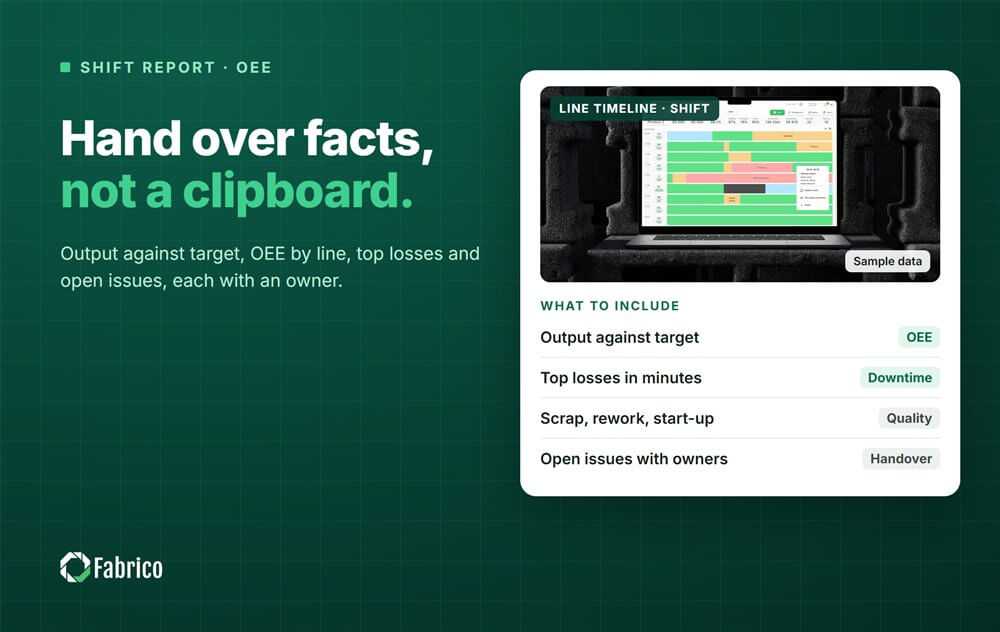










Real Fabrico tiles, sample data.