


 Login
 Blog
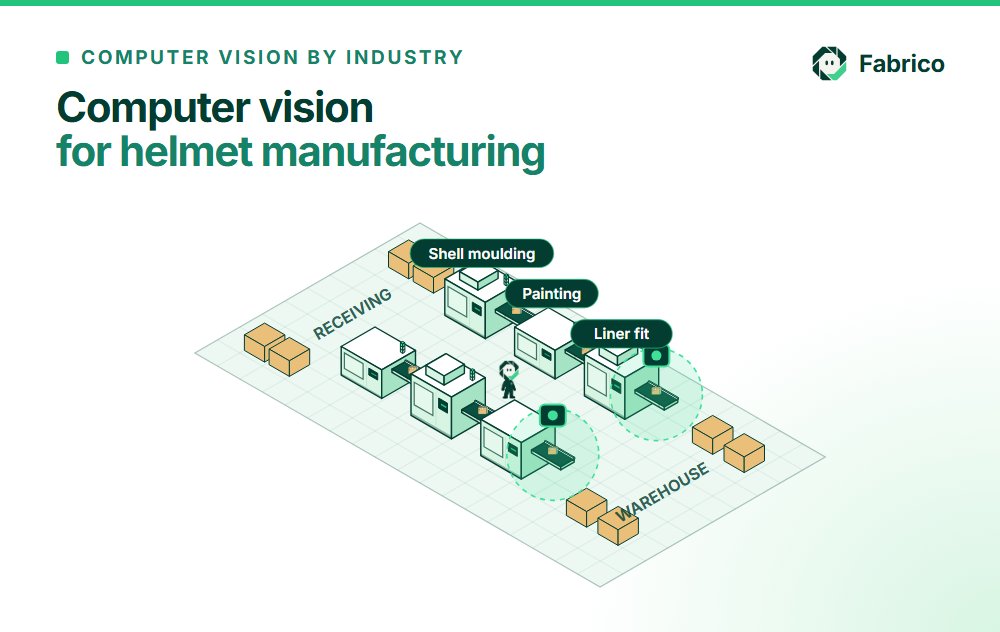
Computer Vision for Helmet Manufacturing: A Pilot Plan That Proves the Bench Count

In short: computer vision in a helmet plant counts finished helmets off the fitting benches, which keep no count. A plant-run pilot proves it.
Inspection cameras judge shells, paint and impact; a counting camera only counts helmets, and the test lab keeps every lot sample.
- Mount one camera add-on over the finished rack of one bench group, never over the fitters' hands.
- Compare its count with bench tally sheets, the boxing log and lot records, model by model.
- Proof: the camera count closes against boxed helmets, lot samples and rework, inside a tolerance written down first.
- Stop when it closes, or when glare, stacked helmets or hands still break the count after one re-mount.
A helmet is two moulded parts and a bench full of small ones. In a Częstochowa University of Technology study of EPS helmet liners, the authors give liner thickness in motorcycle helmets as "between 30 to 40 mm" at a density "from 40 to 50 kg/m3", with shells of 1 to 2.5 mm in composite or 4 to 5 mm in thermoplastic. The presses count their own shots; the fitting benches keep a tally sheet at best, so that is where a camera pilot has something to prove. Moulding cells have their own page, computer vision for injection molding.
Cameras that check whether workers wear hard hats are a safety compliance product. Fabrico does not do PPE detection; this plan is about making helmets.
Before the pilot: what a counting camera does in a helmet plant
| Job in a helmet plant | Who keeps it | In this pilot? |
|---|---|---|
| Find sink marks, short shots, paint runs | Inspectors or inspection cameras | No |
| Impact, penetration, retention tests | Test lab, samples per lot | No; samples get their own code |
| Count shell and liner shots | Press or moulder counter | No; read as they are |
| Count helmets leaving the fitting benches | A bench tally sheet today | Yes: the camera add-on |
| Count boxed helmets | The packing list | Only after the pilot proves out |
Test labs work on finished helmets. Snell's test lab drops helmets on an instrumented metal headform onto steel anvils, after conditioning them ambient, wet, hot and cold. That proof stays with the lab for a reason: the WHO says correct motorcycle helmet use can reduce the risk of death in a crash by more than 6 times. No counting pilot should delay a lot sample or skip a test to make a number look better. Fabrico inspects nothing; a reject count logged by inspection or the paint line can still feed OEE quality.
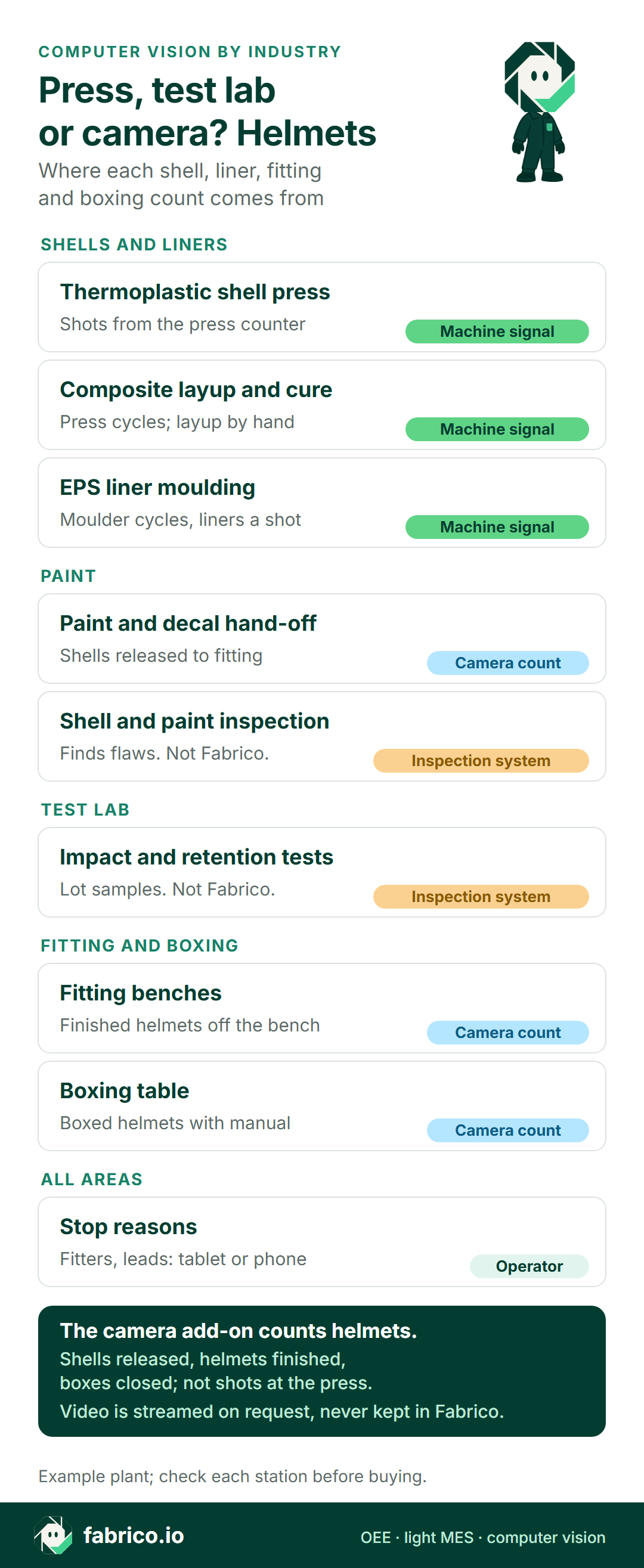
Text version of this infographic
- Shells and liners: thermoplastic shell press: machine signal, shots from the press counter
- Shells and liners: composite layup and cure: machine signal, press cycles; layup by hand
- Shells and liners: EPS liner moulding: machine signal, moulder cycles, liners a shot
- Paint: paint and decal hand-off: camera count, shells released to fitting
- Paint: shell and paint inspection: inspection system, finds flaws, not Fabrico
- Test lab: impact and retention tests: inspection system, lot samples, not Fabrico
- Fitting and boxing: fitting benches: camera count, finished helmets off the bench
- Fitting and boxing: boxing table: camera count, boxed helmets with manual
- All areas: stop reasons: operator, fitters and leads on a tablet or phone
- Footer: the camera add-on counts shells released, helmets finished and boxes closed, not shots at the press
- Footer: video is streamed on request, never kept in Fabrico
The plan runs in six phases, each with a check that closes it. The plant sets its own pace: a phase ends when its check is met, not on a date.
Explainer presented by Iris, Fabrico's AI-generated presenter: how an add-on camera counts output where a machine has no signal. Book a demo.
Plays from YouTube. Google may set cookies when you press play. Privacy policy.
Phase 1: one bench group, one model family, its shell sizes
Pick the full face model family with the highest volume and its bench group. Shell sizes decide how hard that is: each shell size needs its own mould, so S, M and L shells reach the benches as three streams, and a size L shell waits for a size L liner. Choose a family whose shells and liners come from presses that report cycles, so a bench wait can be traced to a press, the moulder or paint. The press side is covered in OEE for injection moulding: cycle drift, changeovers and scrap.
Keep other helmet types out of the first pilot. In-mould bicycle helmets fuse a thin polycarbonate shell to the EPS in one machine, and industrial helmets only get a harness clipped in; both deserve pilots of their own. Composite shells are cured in a heated press that keeps a cycle count, so their delays show at the press, not the bench.
Then time three fitters on each model and take the fastest steady rate the crew has held. Each model gets its own ideal bench time, and a size gets its own only where fitting really takes longer. The check that closes this phase: one page naming benches, rack, boxing table, models and ideal times.
Phase 2: agree the camera with fitters and the works council
A camera over a bench can see a fitter's hands and face, so the agreement comes before the bracket. Put four points on paper: the camera add-on looks at the finished rack, not the bench top; it counts helmets, never fitters; results are per bench group, never per person; and the video for the minute of a stop is streamed on request and not stored in Fabrico. Ask the fitters where the rack should stand; they know where hands reach back.
What the Fabrico camera add-on counts is shells, helmets and boxes, never fitters, and its video is not kept in Fabrico. Give any works council the purpose note and the camera frame together; privacy masking on line cameras shows how to keep the bench top out of the picture. The check that closes this phase is a signed purpose note. If the fitters or the council say no, the pilot stops here.
Phase 3: a hand count from tally sheets and lot records
The baseline comes before the camera. For a run of shifts the plant picks, lay four records side by side, model by model: bench tally sheets, the paint shop's shell releases, the boxing log and the lot records. Note every disagreement and its cause; paper OEE logs drift in known ways.
The label on the helmet makes this easier than it sounds. For bicycle helmets sold in the US, 16 CFR 1203.6 requires each helmet to be marked with durable labeling, starting with the model designation, and the certification label under 16 CFR 1203.34 must identify the production lot and the uncoded month and year of manufacture. Other markets have their own label rules. Where the label carries model and lot, a shift lead can recount the rack by reading labels: that is the hand count the camera will face. It also means label stock at the bench changes with model, lot and month, each a short changeover with its own code.
Before any camera number, write the tolerance it must meet: 2 helmets per 100 on each model in this example; the plant sets its own. Writing it first keeps the pilot honest (why hand-keyed numbers lie). This phase closes with a baseline table and a written tolerance.
Phase 4: mount over the finished rack, away from glossy paint glare
Mount one camera add-on above the rack where helmets go after the last label, looking down, with the bench top outside the frame. A helmet on the rack is finished; one in a fitter's hands is not.
Published work shows where this goes wrong. In a peer-reviewed study in the Journal of Imaging, Pierleoni and colleagues at Università Politecnica delle Marche counted pieces an operator placed on a table at the assembly line of a high-mix, low-volume manufacturer. They write: "Regardless of the kind of technique we choose to detect objects, the motion phases are the main source of error for counting algorithms." Their first blob counter, without a motion check, reached 85.2% specificity, because placing and picking up pieces caused false counts; with the check added, its specificity rose to 96.6% and its accuracy from 92.7% to 96.6% in the paper's Table 2. They also fitted a light ring around the lens, because artificial light mixed with daylight that changed with the weather.
The limits: one table, one camera, products unlike helmets and recorded video. No Fabrico accuracy figure is given on this page. What carries over is what to design out:
- Hands in view: a fitter reaching back to fix a strap is a motion phase, so place the rack where nobody reaches back.
- Glare: clear coated shells shine; check the frame under hall lights and daylight.
- Helmets two deep: one row per shelf, or one hides the other.
- Changing shapes: visor up or down, bag on or off.
The check that closes this phase: a frame where every helmet on the rack is visible and no fitter's hands are.
Phase 5: codes for EPS liner waits, paint returns and lot samples
Without codes, the gap between camera and boxing log has no names. A helmet plant needs these beside the usual stops:
- Waiting for shells, by size. Paint has not released size L, so the benches stand. Booked at fitting, apart from slow fitting, so a short paint shop is not read as slow fitters.
- Waiting for EPS liners, by size. In the Częstochowa study, pre-expanded beads were "dried and then seasoned" before final sintering in a mould placed in an autoclave, for a batch of ski helmet liners. In a plant, if no seasoned bead of the right density is ready, the moulder stands, and the code says "no bead", not breakdown. Denser liners turned harder and more brittle in that study, so density stays with the lab.
- Parts short. Visor pivot kits, cheek pads in the right size, straps.
- Paint return. A shell scratched at the bench goes back to paint for touch-up. It is out of first pass good and counted once, when it comes back through the hand-off. See does rework count as good in OEE and first pass yield by machine and shift.
- Model or label change. New model, new lot or new month on the label stock.
Lot samples need care of their own. For bicycle helmets in the US, 16 CFR 1203.33 says helmets shall be divided into production lots and that "sample bicycle helmets from each production lot shall be tested", and the test schedule in 16 CFR 1203.13 works on a set of eight helmet samples. For a rating in the UK, the government's SHARP scheme puts each motorcycle helmet model through 30 linear and 2 oblique impact tests on at least 7 helmet samples in a range of sizes. Those helmets are fitted and never boxed, so they get their own code, and quality does not look worse than it is.
A failed lot comes back later. Under 16 CFR 1203.33(b)(4), a lot whose testing shows a helmet may not comply cannot be certified until no noncomplying helmets are likely to remain, and identified ones "must be destroyed or altered by repair, redesign, or use of a different material or component". That repair returns to the benches later; book it under a lot rework code so it neither hides in slow fitting nor rewrites closed shifts. Quality holds and OEE covers the hold and release side. The check that closes this phase: a code list the shift leads have used on real stops.
Phase 6: compare, close the gap and put money on it
Now the camera runs. For each shift and model, set three numbers side by side: the camera count at the rack, the bench tally, and helmets boxed plus lot samples plus helmets on the rework shelf. The camera passes when it matches that sum within the written tolerance on every model. The tally need not match; where it drifts is part of the result.
Lot records count a lot, not each helmet, so they confirm totals, not single units (lot vs serial tracking). Once counts close, the same data gives OEE and a money value per loss.
Book a demo to see shell presses, fitting benches and the boxing table counted on one shift timeline.
What counts as proof: an example comparison shift
Example numbers, no real plant. A motorcycle helmet plant runs six fitting benches and one boxing table on its early shift, 06:00 to 14:30, less a 30 minute team meeting at the start and a 30 minute break at 10:00: 450 planned minutes. Each fitter takes 12 minutes per full face helmet at the fastest steady rate this crew has held, so six benches can finish 0.5 helmets a minute. The camera add-on counts helmets arriving on the finished rack, and the shift lead adds the stop reasons on a tablet.
| Record | Helmets | What it shows |
|---|---|---|
| Camera add-on at the finished rack | 180 | Helmets off the benches |
| Boxing log | 166 | Boxed with manual |
| Lot record: samples to the lab | 8 | Fitted, not boxed (example set) |
| Rework shelf, logged by the shift lead | 6 | 4 shells to paint, 2 straps to refit |
| Boxed + samples + rework | 180 | Closes with the camera |
| Bench tally sheets | 184 | 2 ticked at the start, 2 ticked twice |
The camera add-on count closes exactly and the tally is 4 high, so the camera add-on passes the example tolerance. One shift proves little; the plant repeats it on every model.
Availability. From 07:10 to 07:40 the benches had no size L shells: the paint shop had not yet released them, 30 minutes. At 11:15 the visor pivot kits ran out until stores brought a new box, 20 minutes. The benches ran 400 of their 450 minutes: 88.9%.
Performance. At 0.5 helmets a minute, 400 minutes could finish 200 helmets. The camera add-on counted 180: 90.0%. The 20 missing helmets are 40 minutes of slow fitting.
Quality. Four helmets had a shell scratched during fitting and went back to the paint shop for touch-up; two had a twisted chin strap and go back to their bench for a refit. The shift lead logged the six on the tablet, and none of them counts as first pass good, which leaves 174 good helmets, 96.7% of 180, and 12 minutes in the rework bar. The 8 lot samples are good helmets and stay in the 174.
OEE. 88.9% x 90.0% x 96.7% = 77.3%. Cross-check: 174 good helmets divided by 0.5 a minute equals 348 ideal minutes, and 348 / 450 = 77.3%. The bars close too: 348 + 12 + 40 + 50 = 450 minutes.
Hour by hour, the camera add-on count put the slow fitting in one window. Between 12:00 and 13:20 the six benches finished 24 helmets against an ideal 40, so 16 helmets, or 32 of the 40 slow minutes, went there. This plant books halts under two minutes as speed loss, not stop time, and the window was full of them. For one such short stop at 12:40, the shift lead opened the video for that minute from the shift timeline, streamed on request by the camera add-on over the finished rack and not stored in Fabrico. It showed two fitters sorting cheek pads by size from a mixed bin beside the rack. The fix is cheek pads kitted by shell size before the shift starts. For the method behind bench OEE, see tracking OEE on manual and hybrid assembly lines.
What the shift cost in money
At the ideal rate, 450 planned minutes could have produced 225 helmets. The benches delivered 174 first pass good, so the shift lost the capacity of 51 helmets. No public margin figure for helmet models was found, so this example uses a contribution margin of EUR 45 a helmet as an example input; each plant replaces it with the margin of its own models. Fabrico puts a money value on each loss the same way, from the plant's own SKU price or margin.
| Loss | Minutes | Helmets | At EUR 45 |
|---|---|---|---|
| Waiting for size L shells | 30 | 15 | EUR 675 |
| Visor kits short | 20 | 10 | EUR 450 |
| Cheek pad sorting | 32 | 16 | EUR 720 |
| Other slow fitting | 8 | 4 | EUR 180 |
| Rework at bench and paint | 12 | 6 | EUR 270 |
| Total | 102 | 51 | EUR 2,295 |
Lost margin is real money only when the plant can sell the extra helmets, and demand moves: ACEM counted 1,002,848 new motorcycle registrations in France, Germany, Italy, Spain and the UK in 2025, about 12.9% fewer than in 2024. When orders do not wait, value the lost time at bench cost instead. With an example rate of EUR 30 an hour per fitter, the 102 lost area minutes across six fitters are 10.2 fitter hours, or EUR 306. Either way, the ranking holds: the pad bin and the late size L shells cost more than the visor kit shortage.
When to stop, widen to paint and boxing, or rethink
- Stop and widen. The count closed within tolerance on every model in the family. The next camera add-on goes over the boxing table, then the paint hand-off rack, which shows whether a fitting wait was paint running short.
- Stop and re-mount. The gap traces to glare, helmets two deep or hands in the rack. Move or re-light the camera once and repeat Phase 6.
- Stop and rethink. It still does not close after the re-mount. Count at the boxing table instead, or leave that bench group on its tally.
- Back to the codes. The counts close but the losses stay unexplained: that is a Phase 5 problem, not a camera problem.
- Stop at once if the fitters or the works council withdraw their agreement.
Widening repeats Phases 3 to 6 for each new camera. The generic pilot checklist in computer vision OEE pilot fits beside this helmet plan.
Where Fabrico fits in the pilot, and what stays with other systems
Fabrico runs OEE in the cloud and handles light MES jobs alongside it (the OEE and MES overview). What it does in a helmet plant today:
- Shell presses, composite presses, EPS moulders: run state and cycles arrive from the press controller or a counter, so a mould change or a moulder short of seasoned bead appears as stop time with its reason.
- Paint hand-off, fitting benches, boxing table: the camera add-on counts shells released, helmets finished and boxes closed. For a bench stop, the add-on streams video of that stop's minute on request, opened from the shift timeline; Fabrico does not store it.
Fitters and shift leads type stop reasons on a phone or tablet. Fabrico shows OEE and losses by press, bench area and shift, puts a money value on each loss, and runs on web, iOS and Android. Figures reach the ERP through the REST API and webhooks, or as Excel and CSV files. Presses work as in MES for plastics injection moulding; the computer vision feature page covers the camera add-on, and vision systems for OEE follow a count to OEE.
Roadmap: a camera add-on that spots an idle fitting bench without being told and proposes a likely reason, which is not available yet.
Left to other systems: shell and paint inspection, impact, penetration and retention testing, EPS density checks, press and moulder control, and lot traceability belong to inspection, the test lab and the ERP.
Questions to ask a vendor before the pilot starts
| Ask the vendor | A good answer |
|---|---|
| At the finished rack, what exactly is counted? | Helmets arriving on the rack, not hands or loose parts. |
| How are lot samples and lot rework booked? | Their own codes, so the rack to box gap is explained. |
| What breaks the count? | A straight list (glare, stacking, hands) and how the mount avoids each. |
| Where does bench video travel, and who opens it? | A data flow on paper that fitters and their representatives can read. |
Helmet pilot questions answered
Where should a helmet plant put its first camera?
Over the finished rack of the bench group that fits the highest volume model family. The boxing table and the paint hand-off follow once the pilot count closes. Shell presses and EPS moulders already report through their own counters.
When is a helmet camera pilot finished?
When the camera count matches boxed helmets plus lot samples plus rework, within the tolerance the plant wrote down first, on every model in the pilot. There is no fixed length; the plant decides how many shifts it needs to trust the result.
Want to see bench counts next to press counts? Book a demo to see helmet fitting benches and the boxing table counted on one shift timeline.
Related articles









Real Fabrico tiles, sample data.